Leaderboard
-
Tónskáld
Members5Points653Posts -
Papageno
Members3Points270Posts -
PeterthePapercomPoser
Admin3Points2,961Posts -
pianist_1981
Old Members3Points49Posts

.thumb.png.8b5b433a341551e913a34392660bc95b.png)

Popular Content
Showing content with the highest reputation on 11/07/2020 in Posts
-
2 pointsThank you Tonskald and PaperComposer for taking the time to share your thoughts. When I posted this, I thought there would be a good chance of it receiving no real attention, as it is not written in a style that is especially popular on this site. Aside from a couple of people I know here, I didn't expect anyone would listen much beyond the first couple of minutes, let alone listening to the complete work multiple times. I appreciate that. Since you both took a movement-by-movement approach to the work, it's probably easiest for me to address your remarks in a similar manner: 1st: The main theme is indeed subtle by design and introduced without fanfare. Though a completely linear progression of energy would never work in a piece like this, the sense of gradual building of energy you should ideally experience over the course of the complete work would be lost if I'd opened with an overly energetic first movement. Are either of you familiar with Hindustani classical music? the gradual build-up of energy over an extended work is something I find fascinating about their approach. Tonskald, I was pleased to note that my thematic development was not lost on you. I'm not surprised - this is something you find interesting in your own work, so you look for it. As far as I'm concerned, development makes or breaks music in this style, and there is a great deal to find in this piece for those willing to search for it. But I've learned that most peoples' listening priorities lie elsewhere. PaperComposer, you too obviously have well-developed critical listening skills (and you clearly don't need the score in front of you). The line between development and recapitulation is intentionally blurred in this movement. I'm inclined to leave the listener to place it where they will; most of it has to do with what part of the opening theme you consider to be the most critical part of it. I know what part is most important to me (in fact, it's one of the integral motives that can be traced through the work as a whole), but there's certainly more than one way to approach it. The point you make about liking this movement more with repeated listens is something that resonates with me. Most of the works that I now count among my favourites are ones that did not have a great deal of immediate appeal when I first encountered them. Conversely, I find that many pieces that did have an immediate appeal didn't have a lasting appeal. It's like a sugary snack - it tastes great when you bite into it but leaves you feeling unsatiated 20 minutes later. The only comment you made that left me puzzled was the suggestion that the clarinet is consistently used in the expression of the themes of this movement. I actually had to listen to it again to see if it was something I had missed. I guess I don't hear that myself. 2nd: Very different opinions on this one, I see. In a way, I agree with both of you. At the time I wrote it, this was my least favourite movement. But strange as it may be for a composer to say that his own work has grown on him, that is effectively what has happened here. In the end, I decided not to replace it, but I gave that notion very serious consideration at the time I was working on it. I think a person's reaction to this sort of music will often be guided by what they associate with it. My appreciation for the opening theme is driven by its inspiration (which, I can assure you, is not a sappy Twilight-inspired love story, haha)! But then, it was never the first theme that bothered me. I like that sort of simple approach to harmony, and you'll often find it in my slow movements. I vastly prefer it to the decidedly chromatic approach that most accomplished composers now take to their lyrical passages. What I didn't like so much was the B material. That's the stuff that grew on me over time and was spared the axe in the end. 3rd: You guys make me feel like a politician. Apparently, the ending is too abrupt, but it's also not abrupt enough. There's no pleasing you people! 😄 On a more serious note, I can understand your objection to the tempo, PaperComposer. The beat is 180 to the quarter here which I find is far too fast for a minuet. But the piece has the elegance and character of a minuet, and for someone expecting a fiery, Beethovenesque scherzo, this would be a let-down. So... I should probably explain the reasoning here. It may help - or maybe not. Personally, I don't think a fiery scherzo would work in a piece where the overarching goal is a buildup of energy. I can't push the tempo of the finale much more, and as Tonskald noted, there's already a similarity to be found in the character of these two movements. To achieve the effect, the performance of the third needs to be more restrained and elegant - more energetic than the preceding movements, but leaving something on the table for the fourth. For what it's worth, I do think the tempo could be safely pushed into the 190s without sacrificing that effect. Whatever the tempo ended up being would be a conductor's decision. Peoples' tastes regarding tempo can vary dramatically, and I don't leave metronome markings on my scores. I find it interesting to note that your opinions have flipped - this seems to be PaperComposer's least favourite movement ("still a somewhat enjoyable piece..." LOL - ow... my pride!), but Tonskald notes it's his favourite. Since you're listening to it here, you can surmise that I like this movement. If I didn't, I'd have replaced it. I have a hard time ranking it by comparison to the others, but I think it would be in the top 2 for me. Chalk it up to different tastes, I suppose. 4th: Looks like there was no difference of opinion here. I'm glad you both found the ending satisfying. Did I jump scare you at 6:33? Now I'll turn my attention to the other interesting general topics you brought up: PaperComposer, I understand your observation about the overall character of the work. It has an undeniably positive character, and in this sense it is rather unusual in my output. I lean more towards positive emotions in my works, but seldom is it so pervasive. What can I say? I was in a good mood when I wrote this, and we could all use more of that in the midst of the pandemic. I would note, though, that I personally find just as much weightiness and significance in positive emotions as I do in negative emotions. We don't seem to share that. 'Trifle' certainly isn't a word that I'd have thought would be associated with this work. Regarding Brahms, I would certainly consider him an influence, as I enjoy his approach to music more than that of most other composers. I don't see a connection in the 2nd movement, to be honest. Brahms's approach to melody is typically more melancholy, and his approach to form in symphonic slow movements is also very different from what I've used here. But I'm sure you can find him in the treatment of form and motivic development in the 1st or 4th movements. I've never made a conscious attempt to imitate any composer's style. But as I mentioned in my initial post, I write what I like to hear, and so if I like a composer's music you'll probably find something similar to it in my own writing. Tonskald, I very much appreciate what you write at the end of your reply. Two things - firstly, subjective comments are every bit as valuable as objective comments in my view. And secondly, I feel your comment about pastiche is spot on. I first encountered this site as a university student in the early 2000s. It's not as active as it once was, but over the years, I've had the 'privilege' of witnessing more than a few engagements between composers with a passion for earlier styles and those who are, to put it kindly, somewhat intolerant of music that doesn't incorporate the harmonic and formal principles of what university professors and textbook editors have decided comprise modern art music style. I've seldom participated in these discussions myself, but one thing that always amuses me as an outside observer is that most of the detractors are oblivious to the fact that they are also composers of pastiche - typically impressionism, neoclassicism, or film score. The notion that we should strive to avoid the musical conventions of the past ultimately led to what I believe to be the most destructive and idiotic movement in the history of Western music. Though short-lived, the damage it wrought can still be seen decades later. Many composers and academics still cling to the belief that music is somehow worth less if written in a style that does not make use of the full gamut of modern resources. I'll never understand that way of thinking. As I see it, music is simply effective or it isn't. The time period in which it is written is irrelevant. The degree to which it breaks new ground is also irrelevant, except as it pertains to effectiveness.2 points
-
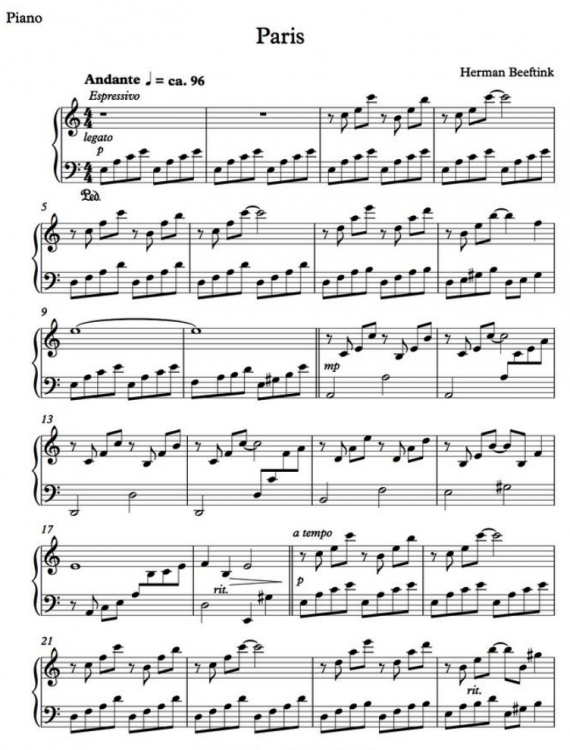
2 pointsThat is nothing to be sorry for! By "score," I meant the sheet music. You know, this thing: Very good, then. If you want advice, I'm sure there are many on this forum who can give it. Best wishes!
 2 points
 -
1 pointThis is a piece much longer than my usual minuets and my knowledge of form is limited and perhaps that is limiting me taking on more ambitious projects but I submit it for review so I can learn and improve.1 point
-
Hello everyone, Here is my first piano trio, which I composed several years ago. This was really a challenge for me, with a lot of thoughts and a lot of work. Recently, I made a revision of the score, which I am posting here, (but there are probably still additional things to correct). The piece consists of three movements, following a classical style, with major influences from Beethoven, Mozart, and particularly, Schubert. I hope that you will enjoy this piece, and I am very interested to obtain your critical comments. Best regards1 point
-
1 pointHello, all! Here's my most recent composition. This is a more sonorous piano piece, less "dissonant" perhaps, though it's still based on the symmetrical scales of the prelude I posted recently. The title means "silver nocturne," and is intended to be liquid and smooth and placid, like rippling moonlight on a quiet lake. It will likely become incorporated as a "slow" movement into a larger work. The work features motivic, rather than thematic, development; you will notice the same motif weave in and out of the sections. Please let me know what you think of this. I'd love feedback of any kind! (This is a live recording so I do apologize for some of the choppiness in advance.) Happy listening!1 point
-
1 pointHi all, It's been a while since I posted anything at YC. I had hoped by now that I'd have something live to share, but the pandemic has greatly curtailed performing activities here. I'm generally reluctant to post digital versions of my compositions and am willing to wait a long time for a live recording. But this piece has now been sitting in my drawer for eight years, and with no realistic prospect of having it performed any time soon, I don't think there's a point in holding off any longer. I prefer German 19th-century music styles, generally leaning to the conservative side of the War or the Romantics. I also believe we are at our best when we write the sort of music we want to hear ourselves, and so that is what you can expect of this work. It's in four movements, following the typical sonata form plan. The provided audio includes repeats of the expositions for the first and final movements. I have mixed feelings about this convention and often don't repeat my expositions, but when I listen to the movements without the repeated exposition, I personally find the pacing is negatively affected. That said, if you hate repeated expositions, start movement 1 at 3:20 and movement 4 at 1:55. Forms: mvt 1; Sonata-Allegro mvt 2: Rondo (ABABA) mvt 3: Scherzo and Trio mtv 4: Sonata-Allegro As most of you know, I am not comfortable sharing my scores online. I apologize to those who would like to see it. Hope you enjoy!1 point
-
1 point
-
Usually 3/8 is used for pieces that are fast enough to be conducted/thought of in 1. If your piece is slow enough where every beat is conducted than 3/4 seems more fitting imo. Since as you say, you sped up the piece, it's up to you which you go with. If you opt for the slower version use 3/4, if the faster version 3/8. I like the music - it sounds almost baroque in it's approach and use of sequencing to create development. Sounds like you could use a secondary theme in the relative major or in a closely related key. Nice job!1 point
-
@PaperComposer i am very happy you like it - and even see the potential to further develope this material. The idea of continue with this piece makes me a bit nervous tho , since i have a great struggle to find an adequat form / cadence / ABC part to stay in a "consequent / logical" or at least comprehensible flow. In this piece i find the mood (as beautiful it might be at times) is dead and i need something new refreshing. Most of the time i then simply make a strong cut, but maybe i also can develope and in fact its far from dead 🤔 do you know a method for getting back in touch with a "finished" piece in a spontanous, open mind? 🙂 i am very curious what might rise from this , since i declared it finished and i now kinda out of my comfort zone thanks again for your interest and kind words! have a nice day1 point
-
1 pointThank you for reviewing, you never seem to miss any mistake! Lol. Your reviews are really helping me to improve! I corrected the mistakes you pointed out and polished it. It was meant as a surprise so on this occasion I didn't ask for permission but you are right, some may be flattered, others may be offended so ill take care in future. Thank you. Papercomposer1 point
-
Really? Well - it's your piece so if it sounds finished to you then keep it as is but to me it sounds like it could keep going. I like what you have so far - it just sounds unfinished to me. Sometimes when we learn music theory and study too hard we lose the originality of our youth which is something I perceive in your music - it's very individual so congrats on that! Thanks for sharing and I hope you work more on this!1 point
-
1 pointHi everyone, New here... I'm inviting you to listen to my new piece "empty thoughts" youtube link:1 point
-
1 pointWelcome, YakoB! This is a very evocative piece, contemplative and nostalgic. I agree with @DarrenEngland; a score would be helpful. What kind of feedback are you looking for, by the way?1 point
-
1 pointWelcome to the forum! What a beautiful piece! Its perfect, so dreamy and the visuals really suit the music. I have no criticism except that others may want to look at the score. Its worth the effort because you'll get a more detailed feedback. What a wonderful piece to begin with!1 point
-
1 point1st movement: This gets going without any semblance of an introduction it seems. The main theme sounds very underwhelming and subtle. You also seem to consistently use clarinet for the expression of the themes of this movement. I really wish I had a score to follow along with. You create a very joyful atmosphere here and your development section is nice and chromatic. I like the darkness you bring in at around 6:40 which I think is also the beginning of the development section. The rising and falling chromatic lines bring a sense of peril and tension. It's hard for me to pin down but I believe the recapitulation starts somewhere around 9:20. I must say I've grown to like this movement through multiple listenings. The conclusion is not drawn out nor bombastic which is a fitting end to quite an elegant piece! 2nd movement: I like your use of the minor iv in a major mode - always a nice modal mixture. You say you're "on the conservative side of the War of the Romantics". Does that mean you admit Brahms as an influence? This movement in particular feels Brahms-y. Maybe it's just the explicitly romanticized main theme. Your use of harmonized thirds and juxtaposition of duple and triple rhythms also seems to channel Brahms. You have some beautiful suspensions in this as well. An interesting and emotional listen! 3rd movement: I usually love scherzi but this just does not seem intense nor driving enough for my taste. The tempo is barely fast enough to be a scherzo and as mentioned above, sounds almost more akin to a minuet. Also, a scherzo should have more elements of surprise such as sudden dynamic changes and juxtaposition of soft and loud. Overall it sounds too tame in my opinion. Not that it wasn't still a somewhat enjoyable piece. Also as mentioned above, you take some great opportunities to use canonic imitation in various different registers which is always neat. I also agree that the ending is a bit sudden in this. 4th movement: This celebratory movement reminds me of Beethoven's 7th Symphony 3rd movement which also has that triple compound meter feel at a similar tempo. Quite a well developed and drawn out finale in this which definitely makes it sound finished! Great job! Overall, I feel like you've accomplished quite a feat by composing this symphony. Not to downplay your achievement but your emphasis on major keys and happy themes makes your symphony sound a bit like a trifle. Especially from the romantics it is usually expected that they handle somewhat heavier and more substantial themes in their works. Like I said it's great as it is though - your developments are great because they do tend to explore more darker places. Thanks for sharing and I look forward to hearing more!1 point
-
1 pointThe first movement is stately and unhurried, almost like a late Mozart symphony—if he had used trombones. Your use of counterpoint is quite astute, I must say. Of course, the digitalized MIDI instruments significantly muddy things here, so I'm sure many of the nuances are "lost in translation." Nevertheless, what I heard flowed wonderfully well and your thematic development is unparalleled! The more classical side of Romanticism is not my cup of tea, so to speak, but I did find this enjoyable. I particularly liked the climactic moments at around the 10:00 mark. The second movement sounded out of place to me, almost like the filmscore to a modern romance movie. The harmonic progressions were a bit too cliché, especially during the first 2 minutes—at least for my tastes. The next section, beginning at around 2:00, contrasted perhaps too much with the first section. I also found some dissonances there that seemed unnecessarily muddy, but maybe in a live rendition they would be clearer. The minor section at 5:30 is a welcome changeup to the flood of major chords from the previous sections. The climax at 7:30 is tastefully done, with its quiet resolution to the main theme. You round things out nicely with a woodwind-led recapitulation, finishing things off with gentle statements from the winds. Well done! The third movement is probably my favorite, thanks to all the superbly-written counterpoint! The engaging 3/4 meter reminded me so much of a Mozart minuet, frequently found in his third symphonic movements. Again, but for the low brass, the harmony is so airtight it might have been composed by the great Austrian himself! Wonderful climax at ca. 5:30. A critique of this movement is the seemingly stagnant pace—quick though it is, it never seems to change up. However, the melodic progressions are quite lovely and make the lack of tempo change forgiveable. Oh, one more critique: the ending seems too contrived. I feel it should have been more abrupt, rather than a drawn-out chord. The fourth movement, with its bouncy 6/8 meter, is perhaps a little too reminiscent of the previous movement. Oh, I like the rhythmic changeup at 2:20! This movement flows so well, I hardly realize how much time has passed. The buildup at around 5:00, followed by an explosion of the main theme, is quite nice. The subsequent section with its trills and droning bass chords is equally nice. The finale is expertly executed, quite devoid of the everlasting Beethovenesque chords that seem to keep on going; instead, you close things out quickly and efficiently, but still in a very tasteful manner. Dynamically, I feel this movement explores the extremes better than the other movements, and it's probably the most "mature" movement of the symphony. Overall, I'd say you're a composer that most certainly knows his (or her) craft. This symphony was written by someone with profound musical prowess, and your ability to emulate the masters is extremely impressive. I'm glad you're writing what you like to hear, and not churning out this modern stuff that wants to pass for music. Certainly what you've written is pastiche, but it's good pastiche, and something I daresay concertgoers wouldn't feel cheated out of their money to sit through during a night at the symphony. I apologize that all of my comments above are stylistic rather than technical, and are therefore not worth much objectively. (But maybe that can be viewed as a huge compliment; I can almost always find technical issues!) Thank you for sharing this delightful symphony. I earnestly hope you're able to have it performed in the near future! Best, Jörfi1 point