All Activity
- Past hour
-
Several months ago, I posted a piece which was at the time an exercise in sonata allegro form, which I decided to make the third movement of a sonata in d minor. I've had this theme in my head for a while, so I decided it would be the perfect time to use it. I went down a big rabbit hole of nonfunctional modal harmony, which was quite fun but really challenging to work out (though I wrote the secondary theme in five minutes during a chemistry lecture). sonata in d minor movement 1 audio.mp3 sonata in d minor movement 1 score.pdf
- Today
-
-
-
-
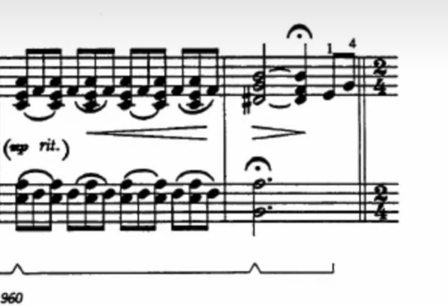
So we have progress!! Fantasie Negre - ORCHESTRATION FINAL.pdf -- score starts at 0:25 in the video In the above screenshot from the score video, in that last measure, there is a V7 (6-5 sus.)...on the copy I was using, there is an error (G is held), and I kind of liked that sound for the orchestration, so I'm going to keep it as is. In my original orchestration, I liked some of the sounds/fullness I was getting at around 0:32, 0:48-1:02, 2:17-2:23, which I tried to maintain, but I also did a look at my score and saw where I had really clean drop-offs between players/parts, so that is my main concern. That and keeping the fullness going between parts, and that sustained pedal sound. I'm at 0:48 in the video so far in my edits. Let me know how I did! Thanks again for all the feedback!
-
Hello! This piece was one of my favourites to compose, sadly the software that i use to render the lyrics (Cantamus) didnt work nicely for the words: Cricket, Leap'd, Jump'd, Alive, Pass'd and Tra la la. So sorry for that! I hope one day they can update the software and its able to render it correctly! (If you guys have suggestions for free realistic vocal synthesizers i would be pleased to check them!) The story is about a woman and her beloved singer cricket, who sadly has passed. Alternative title (Detto lo) "lament for the death of a singer cricket." Lyrics: I once had a cricket green and strong and he went: tra la la la He leap'd and jump'd and sang, He did not use the common slang tra la la la Then one dark day he pass'd my cricket went away No more music no more dance, goodbye my cricket. tra la la la. I once had a friend that sang for me and he went: tra la la la But now he's not alive, And i still sing in the wildlife tra la la la No money in this world can buy my cricket back No gold coins nor golden rings can buy my cricket tra la la la. Poem written by: MYSELF! mixdown-_1_.mp3
- Yesterday
-
The next piece from my Preludes and Fugues project is the Prelude in D major: Since I can only use a particular key once, I first had to think carefully about what kind of prelude I wanted to compose when using the festive key of D major. Who doesn’t think of Handel’s “Hallelujah,” Beethoven’s “Ode to Joy,” or the “Gloria” from Bach’s Mass in B minor when considering what composers have done with this special key? To avoid imitating „trumpets and timpani“ on the piano, I came up with the idea to use a main theme which is very close to the theme of the „Gloria“ – or, more precisely, is literally derived from it. However, to make the prelude unique, I decided to face the challenge of setting it in the odd meter of 11/16. I really like such odd time signatures and try to use not only all keys but also every possible and impossible meters throughout my project. Because of this decision, the mood of the piece is not only festive but also humorous, so I needed a more serious form to round it out: sonata form. Exposition, first theme (mm. 1 – 8a). The „Gloria“-like first theme (highlighted in blue) is accompanied by runs of staccato 32th notes, which recur throughout the entire piece. It is introduced in the home key of D-major, but also appears shortened in C-sharp minor (mm. 5, tenor) and inverted in E major (mm. 6, soprano), thus giving the exposition a kind of a three part invention. Exposition, second theme (mm. 8B – 12a). The second theme (highlighted in plum-color) is characterized by staccato leaps and grace notes, which are contrasted by arpeggios serving as calming elements. The accompaniment, consisting of shortened 32nd notes, remains throughout, thereby emphasizing the humorous, bouncy character. Exposition, codetta (mm. 12b – 12). The thematic material of the codetta (the „third“ theme, highlighted in green) is more chordal and syncopated, leading the exposition to its end in the dominant key of A major. Development (mm. 17 – 28). In the development section, all three themes appear in various segments, starting in the dominant key of A major, but also modulating to the parallel F-sharp minor/major. Recapitulation (mm. 29 – 44a). The recapitulation is structurally and in length identical to the exposition, although having a different harmonic progression: The first theme starts in D-major, but appears shortened in B minor (mm. 33, tenor) and inverted in D major (mm. 34, soprano), thereby initially stabilizing the home key, while the third theme, with an appearance in C minor finally leads to the coda. Coda (mm. 44b - 48). In the coda, the second theme appears for the last time, accompanied by material from the third theme, leading to the ultimate entry of the first theme, here in G major, resulting in a deceptive cadence that resolves in B minor. After a rest, the piece ends abruptly with a surprising C minor – G minor – A7 – D major progression. Praeludium-V-D-major.mp3 Praeludium-V-D-major-with-coversheet.pdf
-
Hallo @Thatguy v2.0, this prelude is a piece I very loved and I wish I had composed it! 😀 It opens with a subject that – at the first glance – seems to be Baroque-like but introduces strong chromaticism in its second half, so that in mm. 5, when the second voice enters, it reminds me of Bach’s B minor fugue from the WTC I (BWV 869b). But now, in mm. 9, comes the surprise. The mood changes to a more „romantic“ feeling with the arpeggios. And that unexpected change now reminds me at numerous preludes (or fugues) from Shostakovich’s op. 87. I didn’t make an in-depth analysis, but I can see how you have constantly took benefit from using the initial thematic material, which for me emphasizes the effectiveness of counterpuntal technique. Even if I did not recognize more complete entries of the initial subject, I have the feeling that motifs from it recur, even sometimes in augmentation. I enjoyed your effort on articulation, including the pedalling and the rubato, and also the key signature change to Bb minor (or is it Db major?). All in all, a piece very much to my taste. Full of counterpoint, but not in the “Neo-Baroque” style, rather with contemporary harmonies and dissonances and a slight touch of Romanticism! By the way, I’m very curious to know how you’re organizing your preludes (since this is No. 16). Is it a complete cycle based on 16 of the 24 keys? I’m really looking forward to hearing more of them—and have I perhaps already missed one?
-
I have used all these extended techniques in other works; but I'm not sure they'd be appropriate here? Is there anywhere in particular I might use them? I did consider using harp glissandi. Think they would work in this piece; but I'm not sure they'd be an improvement? More likely they would make the music worse rather than better.
-
This makes sense, I hadn't thought about it, but it makes sense considering the pieces spiritual inspiration. Great minds think alike - last night when I was working on it, that's exactly where I decided the piece would end. Thank you so much @MK_Piano!! I'll be working on it non-stop this weekend, so I will post updates as I work through the piece.
-
Hi! I'm Harry Wood. I'm new to this forum and all things music honestly. I'm 30 years old, discovered piano a year ago and fell in love. I have no musical background, I've never played an instrument prior to this and I'm still learning how to read sheet music. I'm going for my grade 1 in piano later this year I hope. Started writing my own music 3 months ago as a way to express myself and my emotions, I'm very into neo classical artists such as Ludovico. I am struggling to know what to actually do with the pieces I have written. I think it sounds okay but I struggle to find people to show to see what others think of it. Below you can find 2 audio clips of my latest piano compositions, neither are finished and I will continue to work on them but I would love some feedback and opinions no matter how harsh it may be. I have fallen in love with writing music and I want to get better and that will only happen through honest feedback so please feel free to express your opinions and I will take it all on board. Kind Regards Harry. Far From Everything Far From Everything.mp3 As I am As I am.mp3
-
HarryWood joined the community
-
In my opinion, when the main theme starts, it should be in the trumpet. That spiritual style longs for a trumpet lead and if I were to continue the arrangement, I’d start in the trumpet versus woodwinds. Sort of, in a sultry way. With picking a spot to end, why try to tackle the whole piece? You experienced how the first reading session went. It’ll probably be under tempo, so pick a spot where the phrase feels conclusive. In my opinion, about one-minute, thirty seven seconds in (1:37 from the beginning) of the video, Price does a deceptive cadence in the third measure of the system. Instead, make it a PAC and resolve the piece before it goes into the developmental section. This is one suggestion and you can find more spots like this later in the work as more alternatives. So, you have options to pick from.
- Last week
-
My original thought was to keep it in the flutes and oboes Again, super helpful!! Now unto my final dilemma - a cadence...I like the point I reached in my arrangement (time wise), but I need a "Price-esque" ending lol. My Orchestration professor suggested doing a simple V7-i, but that's too simple imo. And I think the piece is too active to abruptly end like that.
-
Dipping my toes back in music composition after a hiatus. Last year, I wrote this piece in honor of the Detroit Medical Orchestra. This orchestra comprises volunteer musicians from the medical profession in the metro Detroit area, including doctors, nurses, dentists, medical students, and more. Their mission is to bring healing through music, and they perform free concerts throughout the region to achieve this goal. I’ve been a part of this wonderful orchestra for many years, and I wrote this piece to celebrate its 15th anniversary. This piece is somewhat an unofficial sequel to the very first piece I posted here on this website, as it continues to explore Greek mythology. (https://www.youngcomposers.com/t34170/nocturne-for-orchestra-an-ode-to-nyx-goddess-of-night/#comment-1186668533) More information of the piece can be found in the short program notes in the PDF score. The Detroit Medical Orchestra had the opportunity to perform this at a local hospital. I'm linking the performance here, as well as providing the audio MIDI mockup. Any comments/feedback is highly appreciated :) Asclepius.mp3 An Ode to Ascelpius, God of Medicine and Healing - Full score.pdf
-
Yes, I do: Keep the melody intact. As pianists, we often find that composers embellish around the melody with active passages, sometimes played between both hands and sometimes only in one hand. However, with the orchestra you have a lot more diversity when it comes to sustaining a melodic line and dispersing the accompaniment. So, as one suggestion, pick and choose where to keep the melody intact. Next, inform yourself of the piece. Florence Price did not come up with the melody. The whole piece is centered around the spiritual "Sinner, Please Don't Let This Harvest Pass". The term Fantasie implies that it is her sense of improvisation. The whole piece can be translated at the "Negro Fantasy" or "Negro Improvisation." This is important as you'll have to pick your battles. You may not be able to write a passage exactly how it's notated on the piano part, but instead, simplify and keep the idea or gesture intact for the orchestra. I did this in my version at measure 6. I was prioritizing the beat and flow of the melody versus the fancy arpeggio. Lastly, keep the meter simple; change it when the piano version does. The orchestra is not a solo pianist and it's better to keep the meter/ time signature the same as overall score. This may add some concessions when you do. One example in my version is the first arpeggio. Instead of making it fit into the one bar as Price did, I noticed that the arpeggios were grouped in sevens. Thus, I decided to write it out and make it explicit. It added a few measures, but when someone simply hears it, they may not feel the difference. When you look at my score, everything feels clean, and makes sense rhythmically. It's a benefit of keeping the meter related to the original.
-
-
Investigation of Incident Incident Investigation - Victitious Version.mp3 Incident Investigation - THEME.mp3

-
About 3 years or so, on and off. Started with my own works; but in the last few months I began orchestrating lesser known pieces by famous composers.
-
It seems very well orchestrated. Not over orchestrated and much clearity. Nice work. May I ask. How long have you been orchestrating for? I am also practicing orchestration but recently took it more serious. My only critique would perhaps be to use more extended techniques maybe? Like harmonics, Divisi, Mutes, Double stops and triple stops etc, play more around with textures maybe. But it's not really necessary. it's really good as is.
-
Hi to all, This week I decided to revise and extend my orchestration of Ravel's piano menuet in C# minor. The original is very short, and I thought a longer orchestration would work better. Haven't put the slurs in yet, as it's still a work in progress. Hope you enjoy! (P.S. If anyone knows an orchestra who might like to perform this, do let me know! I have several other companion works that would go nicely with it.) Menuet in C sharp minor (Ravel orchestration) #18 (midi).mp3 Menuet in C sharp minor (Ravel orchestration) #18 (score) #5.pdf
-
Okay, it's time: I only did the introduction as this is not my project lol. The main thing you'll notice is how I prolonged pitches in the instruments compared to what the piano score looks like. This is how I was able to write a piano sustain pedal in this case. I am unsure if I would change anything, however, I spent only an hour on this and would probably mess around with it if I had more time. Attached is a Transposed score, Concert-pitch score and an MP3 audio. (Use the C-score to compare to the piano and transposed score for the parts) Orch-F.Price_FantasieNegre.mp3 Fantasie_Negre_Excerpt_C-score.pdf Fantasie_Negre_Excerpt_Transposed.pdf