
Fermata
Old Members
-
Joined
-
Very expressive and tasteful writing — stylistically convincing, with beautifully balanced imitative lines. Honestly one of the prettiest pieces I've come across on this forum. (By the way, I noticed a parallel fifth right before the tenore's very first re-entry between the bass and alto (A–E, G–D), and I think I heard another similar moment elsewhere. Were these choices intentional? The piece is so stylistically assured that they caught my ear — not because they sound harsh (they don't), but because they stand out a bit against the otherwise very refined, Renaissance-authentic counterpoint.) A very enjoyable work!
- 2 replies
-
- renaissance
- vocal
- counterpoint
- latin
-
Tagged with:
-
Thanks for your detailed thoughts! When I mentioned monotony, I was referring more to the process of working with a long, slow subject - after a while the contrapuntal development itself felt a bit repetitive to write. The fugue was an exercise I worked out on paper with pen, mainly as a kind of contrapuntal puzzle, which I've always enjoyed doing as a hobby. That said, you're absolutely right that the playback could be improved. I didn't add any articulation or dynamics, so the notation software makes everything sound much flatter than it would in a real performance. I'll try revising it along the lines you suggest to make it sound more natural. Thanks again for taking the time to comment!
-
This book was intended as a supplement to harmony studies; on its own I don't find it very useful. For self‑teaching it's unsuitable — it tries to cover too many topics in too little space. Could you post a few of the exercises you solved from the book? I'm curious to see how you approached them. By the way, have you studied harmony in a formal setting, for example at school?
-
The fugue subjects are from Marchant's collection 500 Fugue Subjects and Answers, which you can also find online. It was a very long time ago when I studied counterpoint; my teacher recommended Jeppesen’s Counterpoint, which I used. It deals with 16th‑century vocal polyphony, but the fundamental principles remain valid in later centuries as well. From a didactic point of view, I would definitely start with the vocal counterpoint idiom—either Renaissance practice or the tonal counterpoint foundations laid out by Fux. I would only move on to Baroque / Classical instrumental practice (such as the approach in Goetschius’s book) after you’ve mastered the basics of pure voice leading.
-
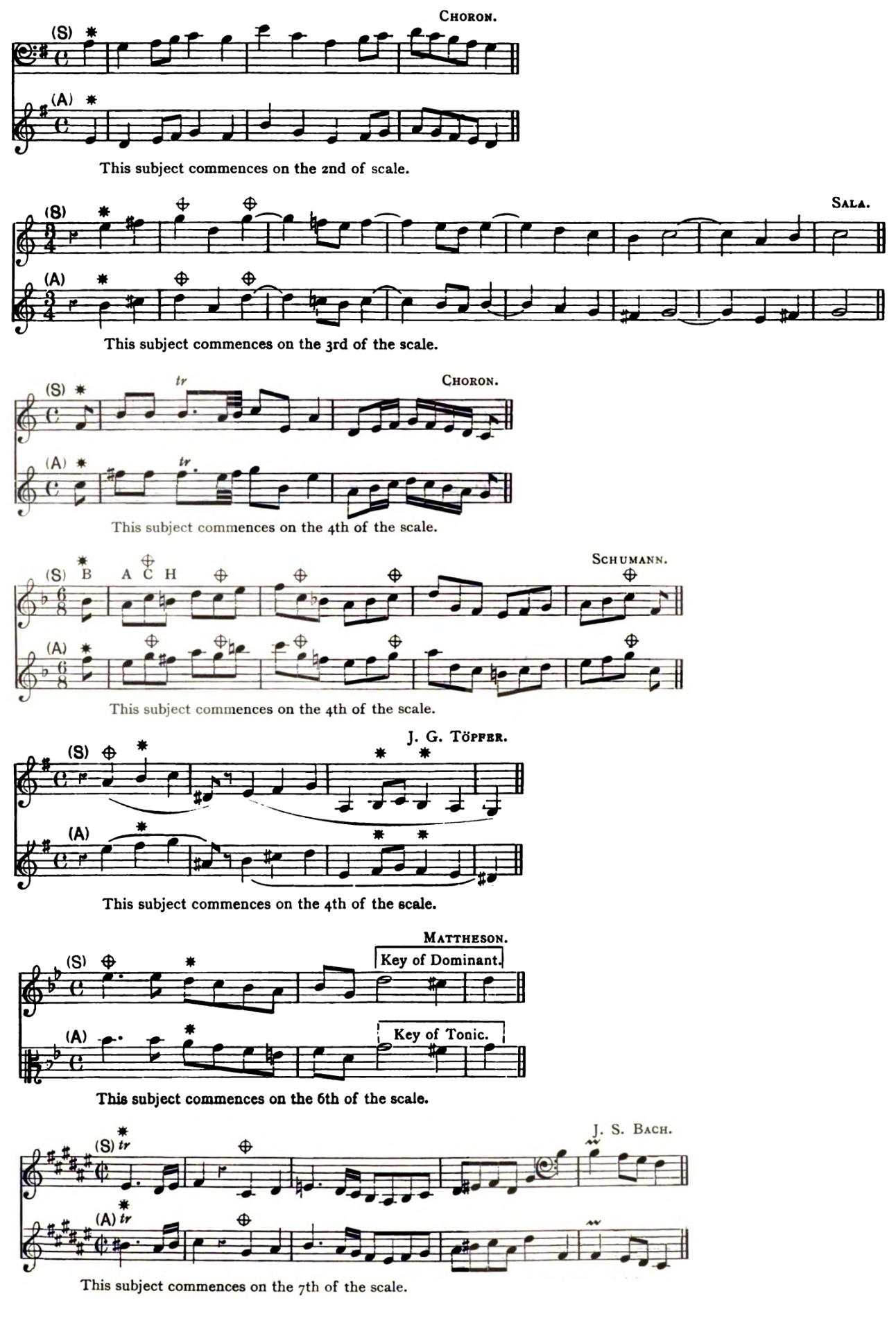
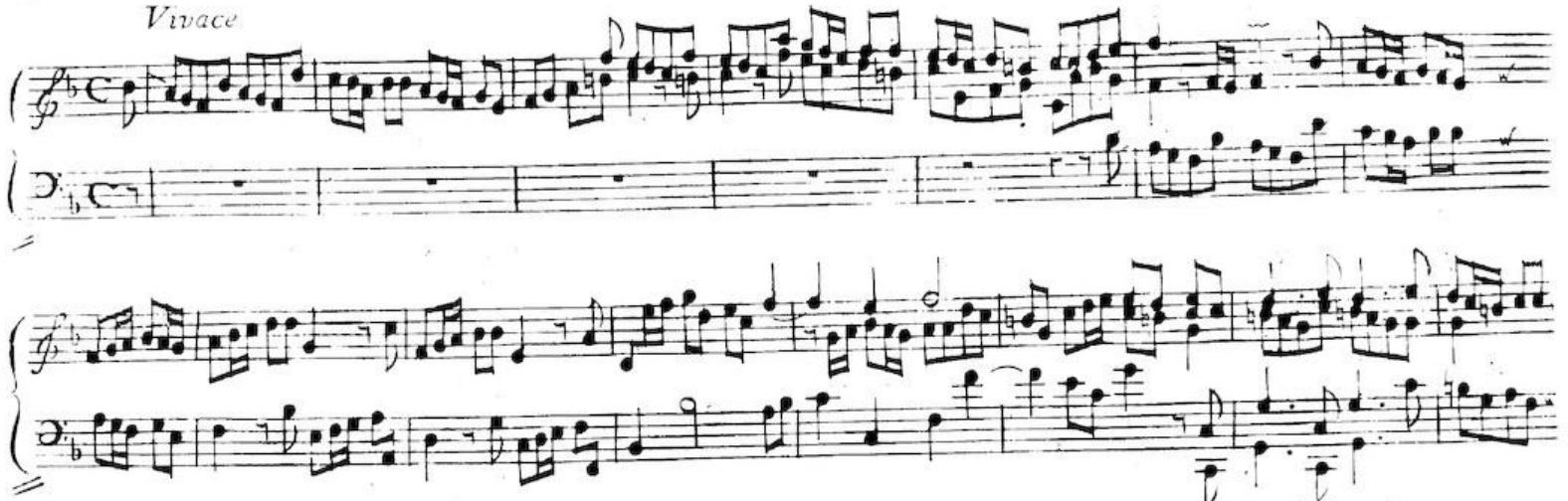
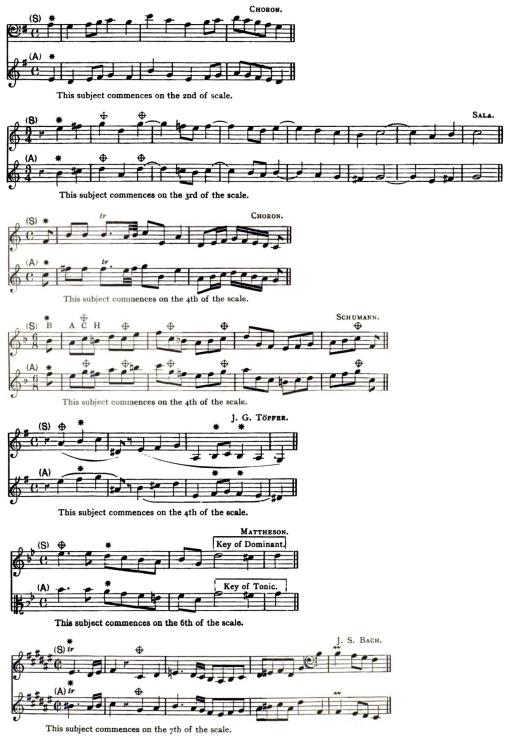
Well, it is a fugue subject that begins on the 4th degree of the scale. And in fact, fugue subjects can begin on any scale degree, not only the tonic or dominant (see examples below). I'm also pasting the original fugue exposition here to show how it was actually realized by its author. I'm sorry, but this is neither invertible nor correct counterpoint. 1) The C against the B-flat would work as an implied root-position dominant seventh harmony (or as a third inversion when the subject is transposed below the countermelody). The repeated F's could be interpreted as figuration over a tonic inner pedal point, but they undermine the effect of the implied dominant harmony. That marked F should really be E instead, even if it disrupts the figuration. 2) You leap down to D, resulting in an unprepared dissonance. That D could work only if the C above were treated as a suspension. That C in the subject implies either a dominant or a tonic harmony. 3) These intervals produce perfect parallel fifths.
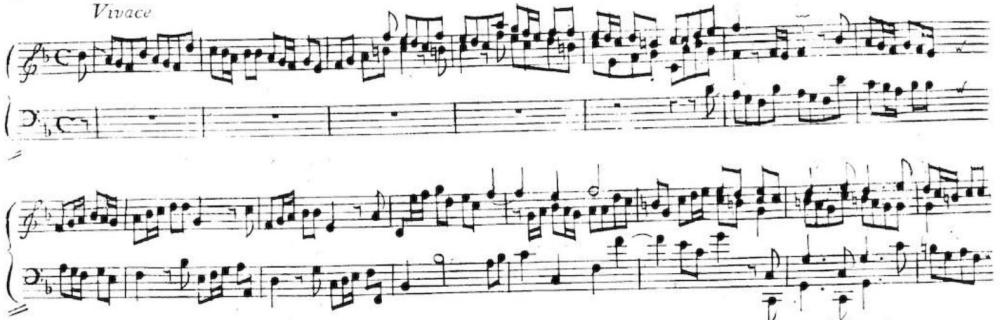
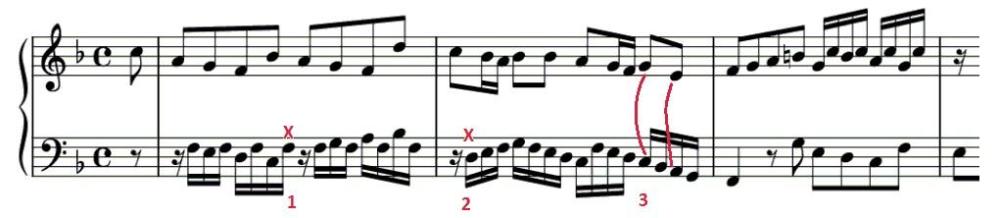
-
This doesn’t contradict what I wrote above at all (I already mentioned it’s not a technical mistake). The technical side of this is covered in pretty much any standard counterpoint textbook; Goetschius’s book should work fine for that as well. However, musically it feels weak because it’s only in two voices, so it really sticks out. In a fuller texture (with three or four, or even more voices) it wouldn’t be much of an issue.
-
Thanks for the comment! You’re absolutely right that thinning out the texture can help keep things fresh — that idea crossed my mind as well while writing. I treated it more like a fugue d’école rather than a stylistically Baroque fugue (the subject itself is a 20th‑century textbook theme), so I kept the four‑voice texture going longer than I normally would. I also thought about extending some of the three‑voice spots, but the subject is already pretty long and the tempo is on the slower side, so the whole thing was starting to feel a bit too stretched out. Still, your point is totally valid, and I appreciate you mentioning it. Glad you enjoyed the fugue!
-
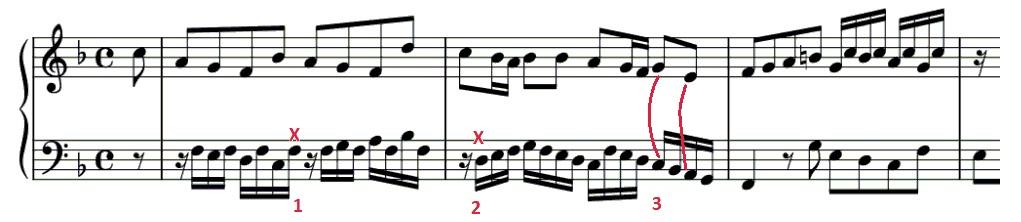
By the issue of 'passing quavers,' I meant the following. Take a look at the attached example. As you can see, the G quaver connects two consonant intervals, while it forms a seventh with the upper voice, which is a dissonant interval. Technically this is not incorrect, but musically it's very disadvantageous — since we're dealing with two‑voice counterpoint, the musical texture is very 'thin,' and this dissonant friction becomes quite audible. The same problem occurs with the other G as well. Regarding the A marked with the exclamation mark: the harmony is too 'empty' this way. If you put the subject into the bass and try to harmonize it on piano, it's obvious that an F-major (first-inversion) chord should be implied there. I think most of these issues (including the ones I mentioned earlier) can be corrected fairly easily.
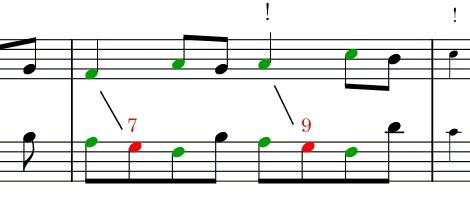
-
There are some problematic parallels, such as the G–A octaves in m. 6 (this corresponds to m. 7 in your score — the notation software misnumbered the measures because the initial upbeat should not be counted as a full measure), or the E–F♯ parallels in m. 9 [m. 10 in the score], and so on. Also, you can’t reuse the countermelody that you introduce just after the lower voice’s entry simply by transposing it, because it is not written in invertible counterpoint. For example, the fifth on the fourth beat of m. 4 [m. 5] becomes a fourth when the two voices are inverted. You can see the result of this in m. 7 [m. 8], where an A–D fourth appears. The interval of a fourth is always treated as a dissonance in traditional two‑part counterpoint. A passing fourth may sometimes be tolerated in the instrumental style, though. You may also want to revise some of the crotchets in the countermelody to avoid frequent dissonant clashes with the passing quavers of the theme (see the example below).
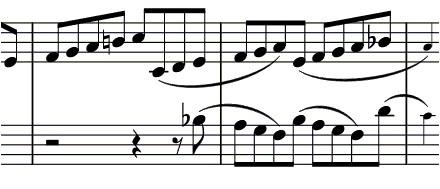
-
I don't think this theme was meant to be treated as the usual antecedent/consequent imitation at the octave, like in Bach’s two-part Inventions. The subject comes from a harpsichord suite by Sheeles (not by Händel); the ascending F–G–A–B is actually a codetta leading to the real answer a fifth above. As for your solution, it keeps hitting the octave far too often — you should avoid that, as it’s too harsh for two‑part counterpoint (and there are a few voice‑leading mistakes as well). The modulations to related keys could be prepared more effectively, for example by using simple sequences built from fragments of the theme. Introducing the inversion was a good idea; it adds a bit of variety.
-
A four-part fugue exercise composed on a given subject, with no particular instrumentation in mind. Developing the subject contrapuntally wasn’t difficult, but after a while it became rather monotonous. The labels A1, A2, B1, etc. indicate the various fragments on which the episodes are built. (The slurs are only meant to highlight motifs for my own reference.)
-
There's improvement, but some dissonances are still not well resolved. See below for a few ideas—though you may want to reduce movement in quavers to better align with the keyboard style. EDIT: added a 2nd version
-
It has parallel 8ves between mm. 4-5, 10-11 & in m. 13 between the bass and the uppermost voice. In m. 12 the last note of the middle voice should be an E crotchet because the G also appears as a passing dissonance in the bass. The tail of the subject in m. 5 should lead to the same countermelody introduced in mm. 2-3. In m. 7 you wrote a 6 4 chord on the 2nd beat; there should be a D in the middle voice according to the figures given.
-
I don't think this fugue was meant to be strictly in four voices. It's nigh impossible to realize measures 13–15 in four parts with the given figures without resorting to playing around with the arrangement of the voices in order to conceal bad parallels. (Had Händel written out 7 43 instead of 7 6, it'd be much more feasible.) I'd suggest you try to realize this exercise using only three voices.
-
Most of your realization is quite tasteful and pretty. In mm. 10-11, there are parallel octaves (G-F) between the bass and the alto; in m. 11, there's an unprepared 6 4 chord on the 2nd beat. In mm. 13-15, the harmonies do not correspond to the figuring, as there should be a 6 chord on every 2nd beat (you have 6 4 chords instead). Also, in mm. 14-15, on the 1st beat, you approach the 9th interval with the lower voice moving down a step. Are you sure about the G in the bass in measure 16? It sounds strange. Isn't that an A in the original exercise?