All Activity
- Past hour
-
 PROGRESS 4 feel like i was on a roll this past couple of weeks cus this is going to be the last progress update until i will eventually upload the whole entire thing as one piece !! short analysis: this section is basically the repeat of B. with a couple of changes: b.221-246 is now in a major mode and it is lighter. some figures are developed here as well (intro section 2' makes an appearance on b.376). this is a step forward toward piecing the main theme together. however, this quickly gets interrupted on b.380, returning to the original texture. it has the same melody but with stanza from the previous climax (b.329). along with that, one final important line is added: let me fly! this line marks a climax, which is teased in the subsequent bars (viola b.375, sax b.376). the climax also comes with an ascending leitmotif (b.395, sax, which is just the Look to the sky motif in an upward arpeggiated line) that signifies the sung line, let me fly! this then transitions into the return of intro section 2'. however, instead of restating b.55 on b.409, the piece finally states the full main theme, as it is similar to the original song. this leads to the penultimate climax (b.441) of the entire piece. one that will then transition into the final section. hope you all enjoy listening to this one !!!
 - Today
-

2-part invention in counterpoint
Frederic Gill replied to Frederic Gill's topic in Piano Music, Solo Keyboard
Hi Henry. (1) The book asked to start small invention exercises with one voice only... (2) about 4th#, look at my recent answer to Munchen. (3) Ok. it's a F:V7, but the D in upper voice make it ambiguous with a V9 or IV. Yes that's not very good. In the previous bar I have a F:I6-... so I would not go for a I64 as you suggest, unless the very motive prescribes it. (4) Yes, I forgot to put a '# 'on the previous C in lower voice for indicating my 'episodeless' modulation. Thanks for noticing me! (5) Can I ask to you as well what would you do with the 4th# in bar 3: a transient modulation (in every occurence of the motive, as I did) or an altered chord? Thanks for your feedback. -
2-part invention in counterpoint
Frederic Gill replied to Frederic Gill's topic in Piano Music, Solo Keyboard
Ok, but there is more: The piece is titled 'exercise 13b...' because we were asked in exercise 11b, 12b & 13b to add sections to complete a small invention from lesson 7a exercises. So, assuming that, what would YOU do with the last bar of the motive (in every imitation)? Would you modulate to the Dominant as I did, or use an altered chord? -

2-part invention in counterpoint
muchen_ replied to Frederic Gill's topic in Piano Music, Solo Keyboard
Well, we were missing the context here. I looked at the pages of the book you took the exercise from, and the exercise asks you to compose a countersubject to the theme in the bass, then repeat in the upper part, and no more. It's a simple exercise in composing a countersubject. If that was what had been advertised then my feedback would've been very very different because composing an entire invention is altogether a very different (and harder) beast compared to writing a countersubject (which does not even need to be invertible). So what is your goal here? You've done what the exercise asked of you in bars 4-6. There's a few errors in your countersubject but overall you have the right idea. But then you extended the exercise into a 32-bar piece, which you named an invention, and it doesn't work as an invention for all of the reasons I've listed. Do you want feedback on the specific countersubject(s) you've composed? Or do you want feedback on the whole piece? -

2-part invention in counterpoint
Henry Ng Tsz Kiu replied to Frederic Gill's topic in Piano Music, Solo Keyboard
Just wanna disturb the great discussion between you and @muchen_, but just one observation looking the opening bar in your piece: in Bach's inventions either with long subject both voices begin at the beginning, or with short subject usually the other voice join after a bar or so. The opening sounds more like a fugue to me. I think the 4# would work well if you modulate to C major for the answer, but you return to F major in the answer so it sounds a bit weird to me. I think he's talking about the {C, C} in b.6 and then the {Bb, D} follows, which causes some ambigous harmonic progression to me as well since a bare C can indeed imply a V, altho I think you are going for an implied I 6/4 here. for the D minor entrancr in b.8, you will prepare it better with C# before it. Henry -
2-part invention in counterpoint
Frederic Gill replied to Frederic Gill's topic in Piano Music, Solo Keyboard
I'm not sure you have read all the previous comments, because you are over-lecturing me. But I'll put the blame on the bad quality of my 'pastiche'. I have admitted earlier that my episodes were short or absent. And that I have neglected the general check up. Because of that, I will delete this post once we've closed the discussion. As for the motive itself, it has a degree 4# in bar 3, which I interpret as a short modulation into the dominant. Otherwise it would just be an altered chord (IV#). So I have assumed for the last bar of the motive a Tonic: I / dom: IV-I. Please, let me know what you think of my choice. Back to your comment: At bar 6(7) we have {Sop,Bass} = {A,F}-{G,G}-{A,A} = F:I / C:IV. But what do you mean by V-IV? Or did you follow the (wrong) numbering in the score? At bar 5(6),{Bb,G}-{-.E}. This is F:vii6, followed at next bar by F:I / C:IV. The last two crochets of bar 7(8) are {D,A}-{Bb,G} = d minor: (ambiguously) i or iv. And the next bar is d:V. The key of C is at 6(7), {C,E}-{G,E}, the tonic chord of the dom key in the end of the motive, as I've just explained. I'll not explain for the other bars (12, 16). About Bach's 2-part inventions, I mentioned (in a previous comment) that Bach's faster rhythm (3 or 4 notes to a beat) is a good asset for handling unessential tones (compared to my 2-notes to a beat). But this motive has a constant, fast rhythm and has only quavers (or semi-). It doesn't leave much room for maneuver of the counter motive and trying to avoid dissonances or ambiguous chords with the motive. And I didn't want to accelerate in the counter-motive. On the contrary, I used 'augmentation' (slower rhythm applied to segments of the motive) in the counter motive. Thank you for your time.- 20 replies
-
- 1
-

-
- invention
- counterpoint
- (and 1 more)
-
.thumb.png.8b5b433a341551e913a34392660bc95b.png)
i pushed it (a morality play)
PeterthePapercomPoser replied to jejrekmek's topic in Jazz, Band, Pop, Rock
I listened all the way through! Quite a ride! Would you share the lyrics with us? -
only listen to this if you'll listen to it all the way through
- 1 reply
-
- 1
-
-
2-part invention in counterpoint
muchen_ replied to Frederic Gill's topic in Piano Music, Solo Keyboard
Since this book is a fairly comprehensive text in harmony, you should keep what you've learnt from this book in mind - not only for these counterpoint pastiches you're writing, but for everything you write from now. The reason why I'm mentioning this is: 18th-century counterpoint (which is what the Goetschius book deals with) and all of the counterpoint-employing music that comes after, is completely interwoven with harmony. All of the harmonic devices/features you have learnt so far, you should find readily in these inventions. And so with this in mind, you can hopefully see the two major problems: There are no strong cadences (V-I in root position etc.) anywhere in the piece. This is the musical equivalent of writing a paragraph of text with no punctuation whatsoever. Some of what you write is either harmonically ambiguous, or does not follow common harmony rules. Examples: - In bar 6, what are the first two crotchets supposed to be? Is this V-IV? This is a forbidden progression. Is this I-IV? Then why is the root of I missing? Contrast this with the last two crochets of bar 7, which clearly spells out a C major chord and is well-written. - What are the last two crochets of bar 12 trying to spell out? Is this V? vii°? i? - What is bar 16? You start off with a G chord (fine), introduces the C# in the upper voice which strongly suggests a chord that is the dominant seventh in third inversion of D minor (also fine), but then this dominant seventh resolves to a B natural chord (?) Point 1 can be easily fixed. Regarding point 2: if you look at Bach's 15 Inventions, you will find that 14 of them have semiquaver prevailing rhythms, and the remainder uses broken chords extensively. This is completely deliberate in 2-part writing. Writing in semiquavers gives you more notes to work with, and one advantage of that is it allows you to trace out chords easily thereby making your harmony unambiguous. I would recommend a similar approach here. The other problem here is form. The main material in a 2-part invention is a section of invertible counterpoint, which is then repeated but often inverted (in the sense of two voices exchanging the material they play) and/or transposed, often called the theme. You have indeed written this. But you also need material between these sections, called episodes. These have multiple functions: they serve as modulatory material, they provide a break from the theme, they introduce devices not often found in the theme such as sequences, they allow motifs found in the theme to be presented in a new context (e.g. harmonised differently), they facilitate strong cadences mentioned above, and so on. You need to write these episodes in for your invention to adhere to the form.- 20 replies
-
- 1
-
-
- invention
- counterpoint
- (and 1 more)
- Yesterday
-
Why do you follow Random since 1970 Jan. 1st, but joined on 2005 August 26th?
-
Noticed a few hand clashes and enharmonic spelling errors today: so here's a revised draft. Also made a tiny change in Bar 8 (left hand). Hopefully better? It's still a bit of a beast, with awkward hand-crossings; but I wrote it for someone with great technical skills!
-
2-part invention in counterpoint
Frederic Gill replied to Frederic Gill's topic in Piano Music, Solo Keyboard
My point was that he said these intervals were 'good', not 'poor', or, as you said, 'clashy' (BAD in my limited SL English). Now I understand that you meant 'musically weak'. Also, all (diatonic) passing notes in 2-notes to a beat, like here, are unavoidably dissonances. So I didn't understand you. Besides, I have seen similar passing movements in some of his many 'BACH' examples, but in 3- or 4-notes to a beat. Then each dissonance is less prominent. So it is a matter of taste. I agree with you that it sticks out, also being the same tone G. I'm glad I finally understood that. Perhaps I simply can't combine the motive with this counterpoint of me4. -
2-part invention in counterpoint
Frederic Gill replied to Frederic Gill's topic in Piano Music, Solo Keyboard
Yes. (MUMC in short) 1909 & 1941, up to figuration. And also Theory & Practice of Tone Relations (1918) which less thorough than MUMC. I have noticed that PG has allowed over the decades more licences to his rules. -
2-part invention in counterpoint
muchen_ replied to Frederic Gill's topic in Piano Music, Solo Keyboard
I listened to your invention and digged around for the Goetschius book. I suppose my question would be: have you looked at the prerequisite book to this, namely The Material Used In Musical Composition? -

2-part invention in counterpoint
Fermata replied to Frederic Gill's topic in Piano Music, Solo Keyboard
This doesn’t contradict what I wrote above at all (I already mentioned it’s not a technical mistake). The technical side of this is covered in pretty much any standard counterpoint textbook; Goetschius’s book should work fine for that as well. However, musically it feels weak because it’s only in two voices, so it really sticks out. In a fuller texture (with three or four, or even more voices) it wouldn’t be much of an issue. -
Fugue in d minor
Fermata replied to Fermata's topic in Incomplete Works; Writer's Block and Suggestions
Thanks for the comment! You’re absolutely right that thinning out the texture can help keep things fresh — that idea crossed my mind as well while writing. I treated it more like a fugue d’école rather than a stylistically Baroque fugue (the subject itself is a 20th‑century textbook theme), so I kept the four‑voice texture going longer than I normally would. I also thought about extending some of the three‑voice spots, but the subject is already pretty long and the tempo is on the slower side, so the whole thing was starting to feel a bit too stretched out. Still, your point is totally valid, and I appreciate you mentioning it. Glad you enjoyed the fugue! -
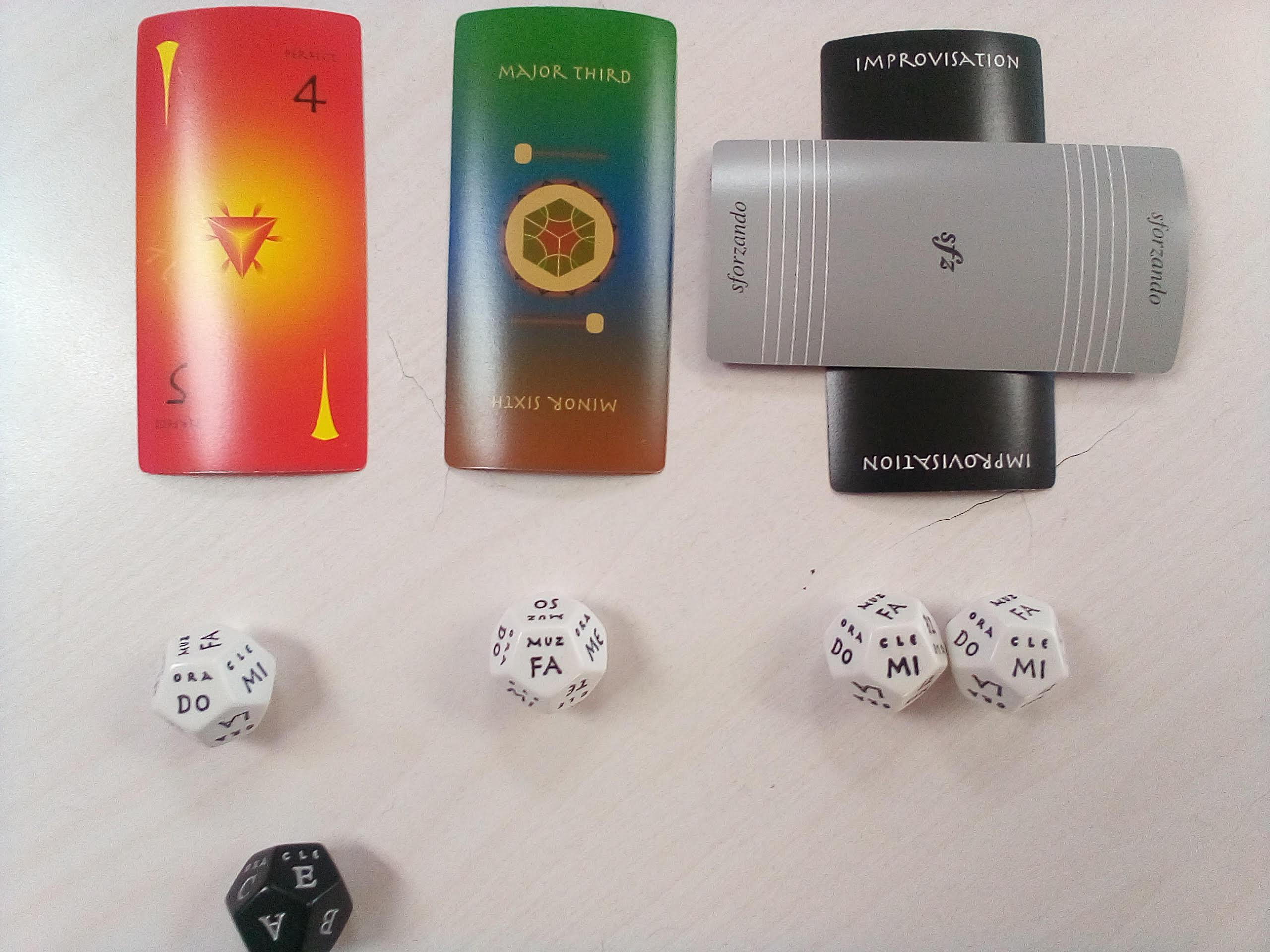
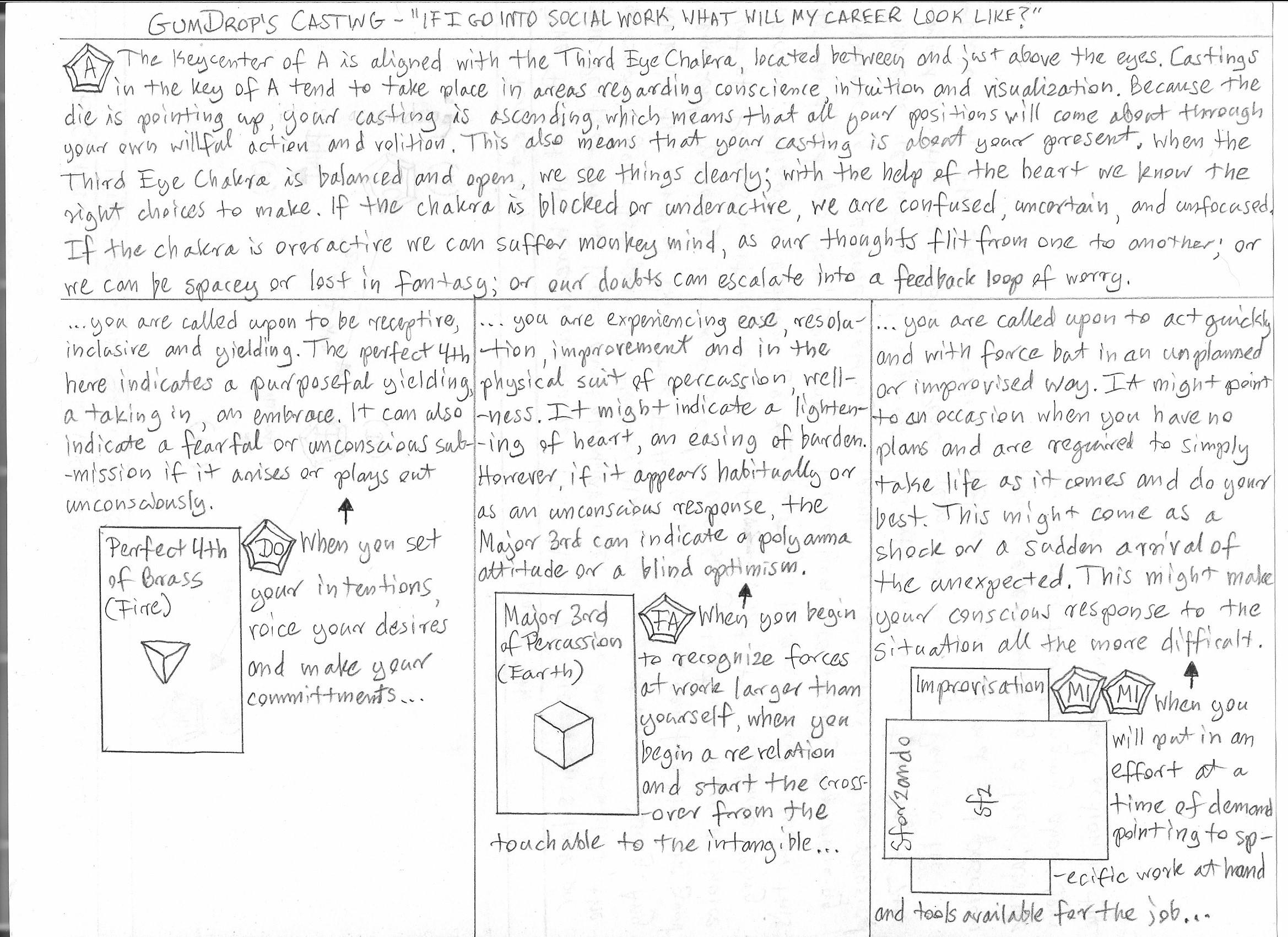
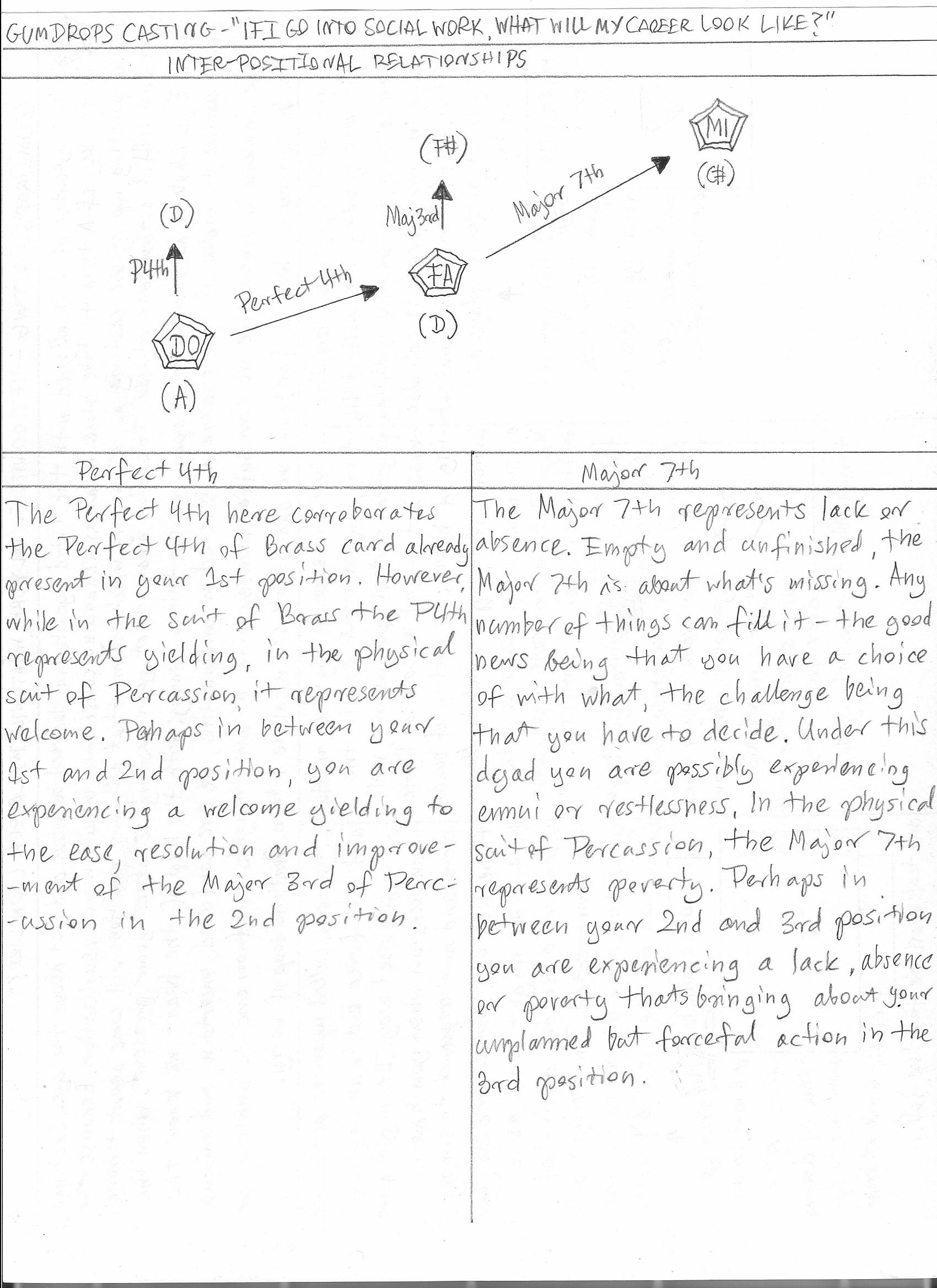
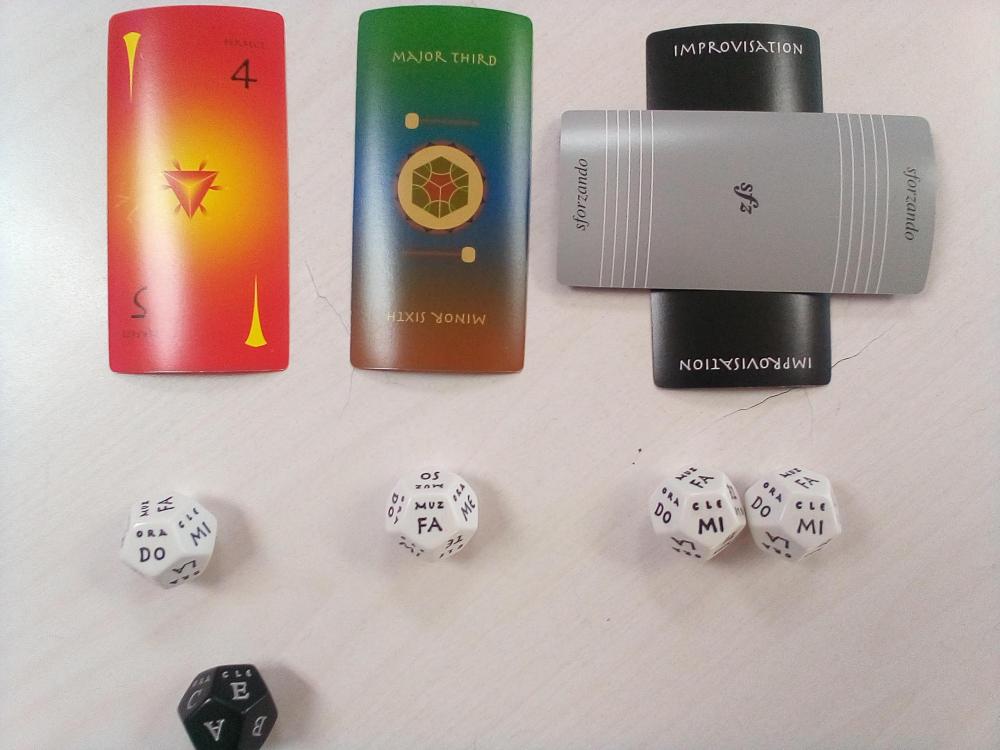
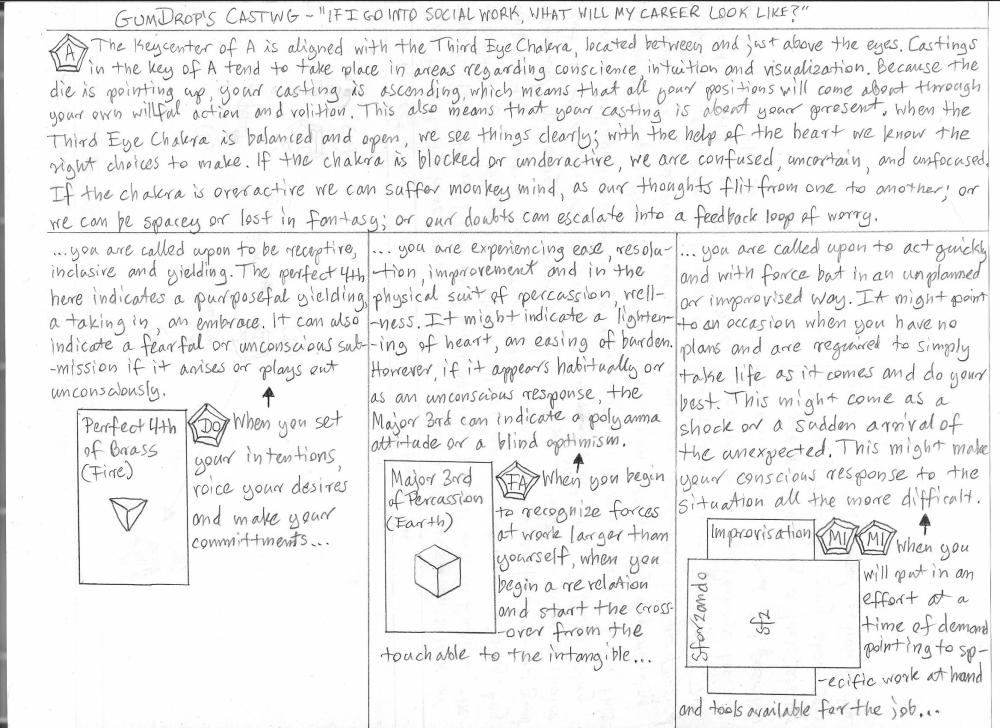
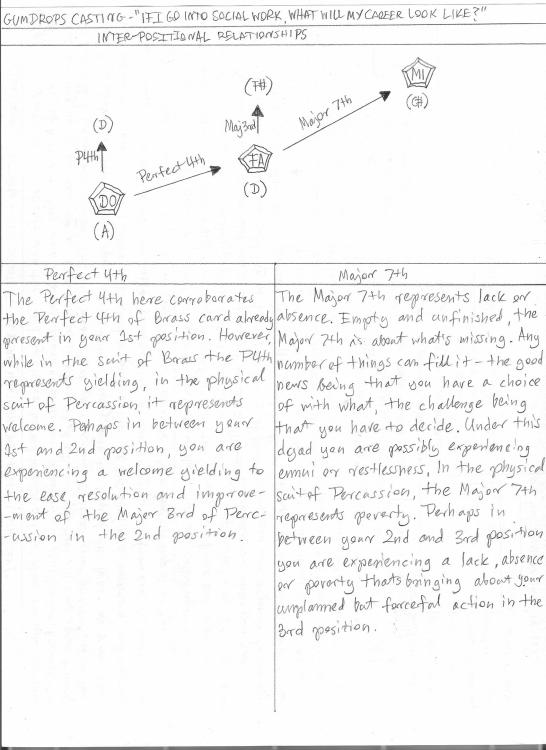
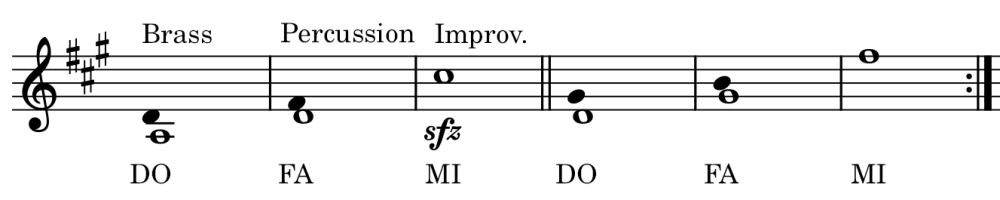
This time I come to you with my 13th casting, which I've done on Friday the 13th! GumDrop asked me "If I go into social work, what will my career look like?" (Muzoracle is a storytelling/fortune telling/divination tool similar to the Tarot card deck, but with cards with musical concepts and 12-sided Musician's dice and Solfege dice. Perhaps it may be thought of as a special musical Oracle card deck.) My interpretation of the cards and dice are displayed below. Since the casting was in the key of A (because the black musician's die landed on A), it pertained to the Third Eye Chakra which is associated with woodwinds. Because of this I picked English Horn. Because the first card drawn was a Perfect 4th of Brass, I also chose French Horn. Then, the card in the 2nd position was a Major 3rd of Percussion, so I chose Piano (also because GumDrop once played Piano). If you'd like to find out more about Muzoracle and how castings are interpreted go here: https://muzoracle.net/ This short musical representation of GumDrop's Casting is about ~2 minutes long. I created the following melodic/harmonic underdrawing guided by the cards and the dice. I used the first few solfege dice as a skeleton for the main melody. To obtain extra material, I transposed the whole pattern up a perfect 4th to D, since the perfect 4th is a very prominent feature of the casting. Since the piece is in A and associated with the Third Eye Chakra, I started the piece with the English Horn. The Percussion card comes 2nd so I included the Piano as accompaniment. Then I finally added the French Horn. I also prominently use parallel 4ths throughout the piece which gives it a certain Asiatic/Impressionistic flavor. If you've gotten this far thanks for reading! And I hope you enjoy listening to this short chamber work I wrote to represent GumDrop's casting. Comments, critiques, suggestions, and observations are of course, always welcome. Thanks for listening!
-

Fugue in d minor
ComposaBoi replied to Fermata's topic in Incomplete Works; Writer's Block and Suggestions
For future fugues, to break up the monotony, maybe you could have more sequences with less voices? For most of Bach's 4-voice fugues, like half the fugue is for less than 4 voices. So having lots of 3 or 2 voice sequences and switching which voice combinations are doing said sequences really helps with monotony. Thank you for the enjoyable fugue 🙂 -
2-part invention in counterpoint
Frederic Gill replied to Frederic Gill's topic in Piano Music, Solo Keyboard
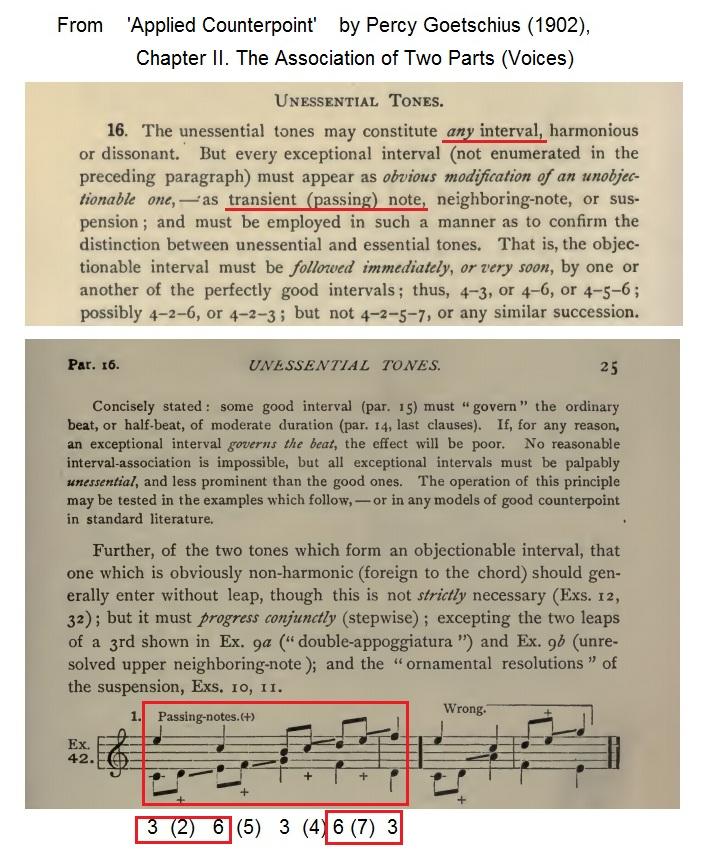
I'll show you a relevant sample (attached) of what I have learned with P. Goetschius. I assume that you'll dissagree with him. Unless I didn't catch something. Do you have a book(s)/author(s) on Music Theory that summarize your knowledge/approach?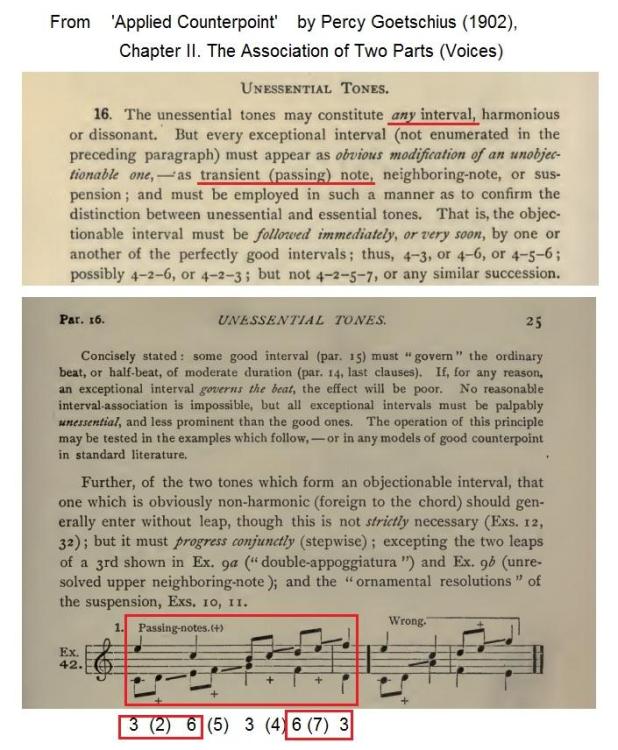
-
Hi to all my fellow musicians. Here's my latest piece for piano, that I spent the last two days writing. Haven't quite finished the phrasing and dynamics yet. I may possibly extend the work; but I'm not quite sure yet. Hopefully I haven't accidentally stolen ideas from other pieces I've heard? I know the initial chord progression of C#m to Am(maj7) came from a You Tube video; but can't remember which piece they were discussing. (Pretty sure it was from a film score; but can't remember which one.) Anyway, hope you like it. I wrote it for a concert in May. P.S. Can you guess which composer inspired me to write this? (N.B. Revised scores will be posted below.)
-
Hey, guys! I'm an amateur composer who recently attempted Celtic music for the first time. I thought it would be a fun idea to see if anyone would want to make their own version of it. 😄 I'm curious how you'd enhance the orchestration or add your flair. Feel free to experiment and share your versions! https://www.youtube.com/watch?v=CFX2w9EWaGs
-
- 1
-
-
 ScarletSelah joined the community
 - Last week
-
I’m trying to improve at improvising. I’d appreciate any feedback. Also im curious what kind of style of piano music this improvisation would fall into?
-
 piano1324 joined the community
 -
2-part invention in counterpoint
Fermata replied to Frederic Gill's topic in Piano Music, Solo Keyboard
By the issue of 'passing quavers,' I meant the following. Take a look at the attached example. As you can see, the G quaver connects two consonant intervals, while it forms a seventh with the upper voice, which is a dissonant interval. Technically this is not incorrect, but musically it's very disadvantageous — since we're dealing with two‑voice counterpoint, the musical texture is very 'thin,' and this dissonant friction becomes quite audible. The same problem occurs with the other G as well. Regarding the A marked with the exclamation mark: the harmony is too 'empty' this way. If you put the subject into the bass and try to harmonize it on piano, it's obvious that an F-major (first-inversion) chord should be implied there. I think most of these issues (including the ones I mentioned earlier) can be corrected fairly easily.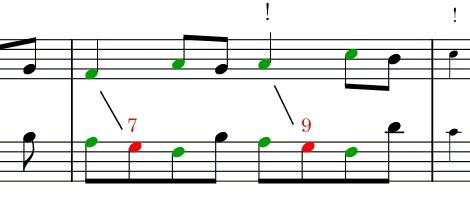
- 20 replies
-
- 1
-
-
- invention
- counterpoint
- (and 1 more)
-
2-part invention in counterpoint
Frederic Gill replied to Frederic Gill's topic in Piano Music, Solo Keyboard
Oh boy! parallel octaves! I didn't check these on fractions of a beat. BAD. {A,D} inverted to {D,A} on 3rd beat is bad indeed. 'Passing quavers': They are not essential by definition. Especially useless when they make an interval of a P4th! I guess I found it gave stamina and authority to the sequence in the motive. (NB, your picture above is not of mine). So I looked at the "frequent dissonant clashes with the passing quavers" in my exercise. I found one p4th (me24, to be corrected!), one p5th (me6, bad?), and 2 8ves (me9, 21, dissonant?). Is there more? Conclusion: I was so carried away and happy with my experience and creative process for that piece (developing the 'horizontal mirror' of the motive, what you call 'inversion' and that PC calls 'contrary motion'), that I didn't pay attention (deficit!) to all those defects and even neglected to check! That happens when I spend too much time on something, I just lose perspective. I'm definitely not a MATURE COMPOSER yet, lol. Also I knew the modulatory episodes were almost absent. I have to develop good episodes even when the tempo is fast and am afraid to lose momentum. Thanks for your feedback.- 20 replies
-
- 1
-
-
- invention
- counterpoint
- (and 1 more)
-
2-part invention in counterpoint
Fermata replied to Frederic Gill's topic in Piano Music, Solo Keyboard
There are some problematic parallels, such as the G–A octaves in m. 6 (this corresponds to m. 7 in your score — the notation software misnumbered the measures because the initial upbeat should not be counted as a full measure), or the E–F♯ parallels in m. 9 [m. 10 in the score], and so on. Also, you can’t reuse the countermelody that you introduce just after the lower voice’s entry simply by transposing it, because it is not written in invertible counterpoint. For example, the fifth on the fourth beat of m. 4 [m. 5] becomes a fourth when the two voices are inverted. You can see the result of this in m. 7 [m. 8], where an A–D fourth appears. The interval of a fourth is always treated as a dissonance in traditional two‑part counterpoint. A passing fourth may sometimes be tolerated in the instrumental style, though. You may also want to revise some of the crotchets in the countermelody to avoid frequent dissonant clashes with the passing quavers of the theme (see the example below).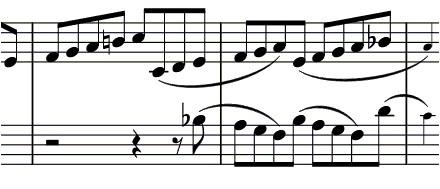
- 20 replies
-
- 1
-
-
- invention
- counterpoint
- (and 1 more)