Leaderboard
-
JWNewton
Members4Points17Posts -
Tónskáld
Members2Points653Posts -
PeterthePapercomPoser
Admin1Points2,954Posts -
Aiwendil
Members1Points184Posts
.thumb.png.8b5b433a341551e913a34392660bc95b.png)

Popular Content
Showing content with the highest reputation on 07/13/2022 in Posts
-
1 pointThe three movements of this piece are subtitled: I - Melting Glacier II - The Veldt III - Mountain Climb The instrumentation is for string orchestra with 2 Flutes, 2 Horns in F, Glockenspiel, Vibraphone, Marimba, and Tambourine. I used Musescore since I don't yet have any Vibraphone VST's. Let me know what you think. I tried to create some thematic associations between movements. Thanks for listening and for any critiques, suggestions or observations that you may have!1 point
-
Hello! I'm pretty new to the forum and just posted here for the first time yesterday (in the large ensemble section). I thought I might post another piece that I composed last year for the piano: Ballade in F-minor. With most of my pieces, I tend to improvise themes or notate melodies in my head and develop them at the piano. This piece took that method a step further; nearly all of the musical material and the sequence in which it appears came from a single improvisation (obviously, I heavily edited it during and after transcription to paper though). As such, Ballade has a very quasi improvisando feel throughout. This piece, because of how it was composed, was an opportunity for me to sharpen my editing skills. I suppose you all will be the judges of how well I did at that editing. Constructive feedback would be very much appreciated. There are a few different areas I'd enjoy feedback on, so choose your favorite (or favorites). What was your favorite part of the piece? What made it enjoyable? What did you dislike most about the piece? In a similar vein, which were your favorite and least favorite themes? Why? How did you feel about the different styles and moods present in each of the themes? How was the engraving? I'm sure that if you followed along with the score you noticed that it got very dense in several places. Were there any unclear markings (e.g., the floating ties at the Adagio tranquillo)? Are there any places where expanding to three staves would make the score more readable? Don’t be afraid to be specific here. Did anything in the piece feel out of place? How well did the consonance and dissonance throughout the piece balance? Did you feel that the Adagio tranquillo at the end was too big of a transition or a bad ending? Do you have any comments about my compositional technique (things like harmony, transitions, melodic writing, etc.)? How well did I execute the ballade form (use Chopin as a frame of reference)? What did this piece remind you of (could be a composer, piece, image, scene, or something else)? Any overall suggestions for improvement (in this piece and in general throughout my compositions and style)? I haven't tried to get this performed (yet), so for a recording, I just sightread the score this morning, worked on it for a bit, and then recorded it with my phone. The recording isn't super great, but it will definitely give you a better picture of the piece than Finale MIDI, even if it sounds like this. I'm also attaching the score below, so feel free to follow along. Thanks for listening to Ballade! I hope that you enjoy it. 10 November 2022: I've attached an edited score along with a recording. I'll leave the previous score (not the recording; it's not letting me have two mp3s), but be aware that "Ballade in F minor Score.pdf" is the edited score version. Also, my preemptive apologies for the poor performance of the coda. Ballade in F minor.mp3 Ballade in F minor.mp31 point
-
1 pointAnother old symphony that I've revised a little bit in the past week. This one looks to the "Strum und Drang" symphonies of Haydn for inspiration, and is mostly Classical in idiom, though it does some decidedly un-Classical things harmonically in a few places (e.g. there's one moment where we go all the way around the circle of fifths via a series of distant chords). I'm curious whether people find that those moments are jarring or if they seem to fit. I'm also aware that the horn part calls sometimes calls for a high degree of agility, but I decided not to extensively rewrite it, since I think it's still playable on the modern horn. Anyway, any comments, criticisms, or other feedback would be most appreciated. Thanks!1 point
-
1 pointSomething I started a while ago living in Colombia and recently decided to finish. More or less a theme with variations.1 point
-
1 pointthis has some crazy cool moments.. awesome. I think this is my favorite song of yours.1 point
-
1 pointMelting glacier: well I'm not sure if it's melting but it'd be difficult to me not to associate vibraphone with ice for some reason. It feels to me like a trip into a very cold place. The first 5-10 bars sound very epic (basically the first phrase of the piece) and I would consider adding some bass when you arrive to that section again. The veldt: still beautiful, but still cold, though it feels to me that the trip led me to a populated place inside that cold region. It was shorter than I expected but I liked it anyway and the transition II-III was nice, very nice indeed. Mountain climb: this is another story. I love its beginning, and I agree with JWNewton regarding the time signature. The passages that come after that make me feel like the climbing became more difficult because of some blizzard. In summary, another very nice piece you made. The title of the whole set of movements seems to fit perfectly with what you made me imagine while listening to them. Thank you, as always. Kind regards!1 point
-
That isn't true. You are an excellent composer. I definitely think it's more for this reason that I'm struggling a bit. Make no mistake: this piece is wonderful, and even I, someone completely inexperienced with the sort of harmony you employ here, can tell that. But I'm very limited in my ability to understand it, and so struggle to engage with it.1 point
-
I’m glad at least some of this was helpful! 😅 No, the fast passage has nothing to do with interpretation. There’s more interpretation in chords than fast notes, I think. But I really phrased that horribly. There’s plenty of opportunity for interpretation in this concerto, but I think there could be more. Pēteris Vasks’ Cello Concerto “PRESENCE” (2015) is one of my favorite contemporary works, and elements of your piece remind me of it (though they are very different). I don’t know if you’ve heard it before, but I think you might find some inspiration for this piece in listening to it. At least, it will clarify what I’m trying to say with the solo interpretiveness. I do enjoy the stops; don’t let me convince you otherwise. All I was saying is don’t overuse them (it seems that the vast majority lot of the solo material is chords, so I was just suggesting a proportion change). Yes, these were more of the guesswork comments. I defer to your judgment; you’re the expert, not me. Still, I stand by my advice to include some sort of harmonic resolution. Remember that all great music has balance that helps to take the listener on a journey, especially in a large work like this. And I, as a listener with probably more exposure (though still a negligible amount) to contemporary music than the audience for when this work is performed, found the journey hard to engage with. Just something to keep in mind. By all means—write what makes you happy, though. That’s more important. I think the string-heaviness might just have been MIDI’s fault. You know the score better than I do. I’m glad that you’re working on the climaxes! I didn’t notice that. Good on you for bringing the motifs together. I think a lot of things with this where just stylistic differences. It seems that our tastes with contemporary music vary slightly—so write what makes you and the soloist happy and what you think best for the piece—not what makes me happy. Again, just reiterating that I enjoyed listening to your concerto.1 point
-
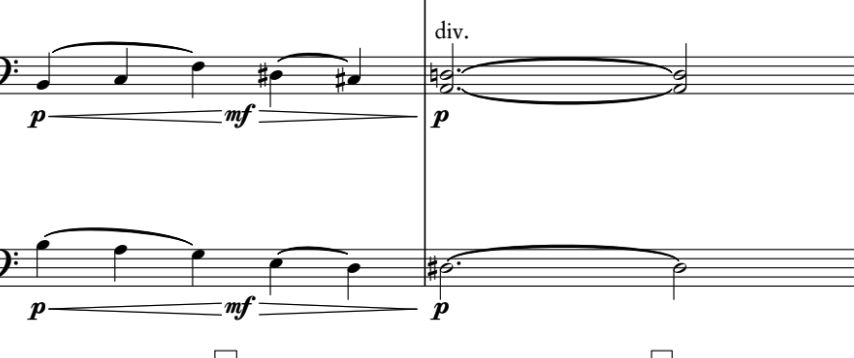
You've got a great eye/ear for this! I've actually met with the violinist in person since posting this and we made almost the exact changes to the stops you made mention of here. Some of the problematic passages you've mentioned were changed to "rolled" chords, some triple stops omitted altogether, others given the grace note you talked about. I will add the harmonics notations; thanks for that recommendation! I agree with you wholeheartedly about the narrowness of the technical difficulty here. The idea behind the stops was not to increase difficulty for difficulty's sake, but really because I love stops on the violin. And I guess I disagree with your point about there being a lack of interpretation there. Perhaps less interpretation than in a fast, difficult passage. In any case, your point about the addition of a fast passage is noted. This piece is being composed rather open-endedly, and as I add more thematic material, I will likely come back to revise the earlier movements — including a fast passage or two in the 2nd movement, should the muse within demand it. 🙂 This comment has me confused. Are you saying I neglected to put them in? I've gone back through the score a few times now and can't find where I missed them... (Also, we will have to agree to disagree about the lack of a tonal center.) I hope what I'm about to say doesn't come off as condescending, lol. I truly don't mean it that way. The idea that this isn't melodic or melody-driven really gives me pause. There are 3 themes here (4 really, but one hasn't been developed yet) that have the necessary characteristics of a melody: they are constructed from a scale and they have a recognizeable pattern. Theme 1: Theme 2: Theme 3: The rest of the music in these movements is derived from these 3 melodies. Now, if you mean lyrical melodies, I would agree that these themes are not Tchaikovsky, lol. To me, though, they sound expressive, and the way the violin leaps around from tritone to tritone gives me chills. But I will take what you've said into consideration and see what expressive opportunities present themselves. 😉 Here, again, we will have to agree to disagree. I think consonance/dissonance enters into the realm of personal taste. For instance, I think this piece borders on being too consonant, dangerously approaching tertian harmony in a few places. I am familiar with The Rite of Spring and admire Stravinsky's handling of the material — but Stravinsky is not me, lol. (Wouldn't that be nice, though?) I absolutely own that these harmonies are not for everybody. I also have to own that I can't write music that makes everyone happy... so I have to write what makes me happy. And in a work couched in nothing but quartal harmonies, it goes against everything my intuition has to offer to introduce tertian harmonies — and that's not even considering the fact that I think quartal harmonies sound wonderfully fresh on their own. (The entire concept of consonance and dissonance is embedded in the strategy of using quartal harmony, by the way. As these first two movements are meant to be darker in color, they are going to consist of more dissonant fourth intervals.) Ah, yes, great points. (I don't know about this being a string-heavy work, though. If anything, I think the woodwinds have the biggest part, and the violins/violas aren't even introduced until m. 23.) There is a climax at m. 89 and again at the end of the score (m. 174), also some moments of "increased dynamics" at m. 24 and 142. I agree, though, that the climactic moments could be better and am currently working to expand the material at m. 89. You may have noticed that the two themes are brought together at the end of the piece, thrusting it into the next movement (yet to be written, of course). I'm not sure what you mean by this. To my ear, this piece has lots of color and character, but I don't really have enough information to answer that question. Yes, and thank you for your detailed feedback! I'm sorry that I wasn't able to address a lot of the issues you brought up, but I'll keep them in mind as I trudge through whatever lies ahead for this piece. Thanks for taking the time to listen and comment! Best, Jörfi
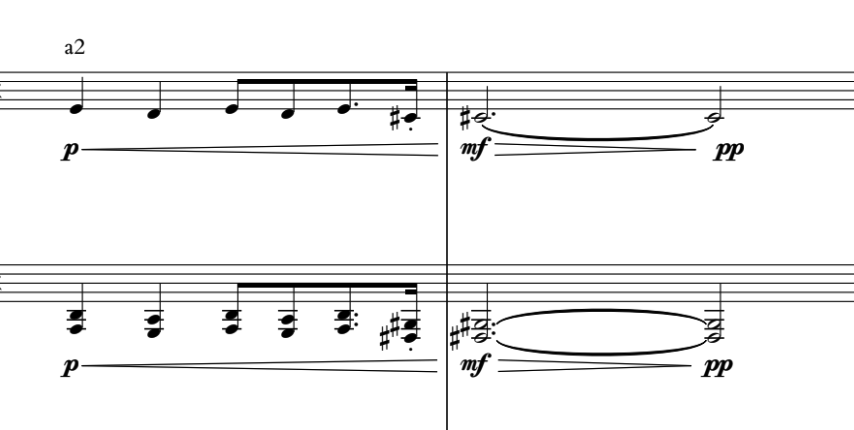
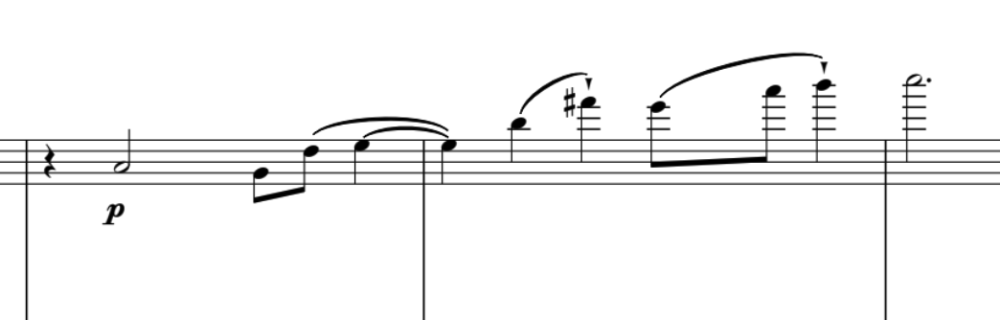 1 point
 -
I’m impressed! This is really well written. I have a few comments; take them with many grains of salt as most are stylistic and I’m not well-versed in the style of this piece—so they’re mostly blind and possibly irrelevant. Firstly, make sure you have a little note somewhere that says that the score is in concert pitch. I'm certainly not complaining though; it was far easier to follow the score not having to read a whole bunch of transpositions at once. Long ride for the solo part here. Be aware that some of the double/triple/quadruple stops and leaps you've inserted will probably be very difficult to execute at performance tempo. I'm sure your dedicatee is very talented, but make sure they're able to pull these off while maintaining the integrity of your markings (and of course good intonation and sound quality). I'm not really worried about impossibility, though, since I know you play the viola. One spot that caught my eye at the get-go: m. 19-23. Those leaps are really up there, and probably nigh impossible to execute while playing pianissimo. And then in 22-23, even though that passage is easier than 19-20, it's still going to be really hard to play quietly. Same for 64-66. That crescendo will probably end up quite a lot louder than mezzo-piano. The triple stops at 53-54 and 57 will also be very difficult just in terms of fingering and intonation. It also looks like the first two triple stops in m.70 are impossible. The first one will either require Db on the G string, A on the D string, open A, and B on the E string, or else a leap from the D string to E mid-double stop. The latter of these probably isn't feasible. I'd add a second A to the score to make it clear (if that's what you're going for, that is). The second triple stop requires both an Ab and Db simultaneously. Since these are on the G string, that isn't possible unless you notate the Ab as a grace note to indicate that it isn't part of the chord and should be played before the Db and Bb. But be aware that the triple (double?) stop won't sound as smoothly this way. But that's better than being impossible, right? As for m. 88, the G and C# double stop is impossible, no way around it. I might stop focusing (or focus less) on the solo violin with my comments for the rest of the piece, so I'd advise you to do a really good proofreading session for the violin part and check for feasibility. I probably missed other impossible double stops since I wasn't particularly looking for them, so make sure you screen the whole thing. On the high notes, it might be a good idea to put in harmonics (natural, not artificial) where you can. I know you've done this in several places to achieve a certain color. But putting them in more places (especially faster notes) will improve the intonation, won't change the tone color (too much, at least), and will make some of the high sections much easier. I'm writing that looking at m.109, where all of the notes could be harmonics and the part would become much easier and probably sound quite a lot better. Another thing; most of the difficulty in the piece is the double stops and the leaps, and a great difficulty they are. If I were your dedicatee, I would appreciate varied items of difficulty (for example, a fast passage could work well in the character of this piece). Also (this I'll talk about more later), expressiveness is my favorite challenge as a violist. Technical difficulty is all well and good, but there's not as much interpretation in that. Make sure you have plenty of chances for the soloist to express themselves as a musician--really, that's the most important part of any concerto--and not just show off their quadruple stop and shifting skillz. I enjoy the chords, though. Don’t mistake that for me saying I don’t. As for the style, I think you've done really well. I can't say that I know a lot (anything, really) about this style and won't pretend to, but here's one thing I do know: going back to one of my comments on the solo violin earlier, there need to be so many chances for the soloist to be expressive. That looks different for everyone. After reading your response, it’s apparent you’ve put a lot of thought into constructing the thematic material of the concerto. You’re fortunate to have a dedicatee for this concerto, which means (and maybe you’ve talked about this while meeting with them?) that you have the opportunity to insert passages exclusively suited to their creative voice. You said that the violinist isn't a huge fan of your compositional style. Adding more “traditionally” melodic segments to the soloist part could be a great way to make him/her enjoy the part much more and balance the style you’ve written in with their playing style. Additionally, that could even work really well as a way of contrasting the ensemble and soloist and providing opportunities for musical dialogue. Just food for thought. You also might consider adding just a few places where the harmony is more traditional (I’m saying that as someone inexperienced with this style, so again, grains of salt). I mentioned to you that post-romantic music is so enjoyable for me because the modern compositional techniques coupled with traditional elements make for more expressive, more impactful (to me) music. I'm not telling you to X out all of the long dissonant passages, but I would have enjoyed places of harmonic resolution (in terms of modern to traditional, not necessarily a cadence) Even if you just have these a little bit, everyone will be happier: the soloist, the orchestra, the audience (that's an important one), and even you, I'd wager, because the musical style will possess greater balance, making everything in the piece more meaningful. Think of whyThe Rite of Spring might be regarded as one of the greatest musical masterpieces of the 20th century even by general audiences—it’s very dissonant, very polytonal, right? For me, Stravinsky's masterstroke was to provide relief from all of the hard-on-the-ear material. He did this within movements, but also provided long sections of surprisingly consonant harmony. My favorite movement of the Rite is 'The Round-Dances of Spring’ because of the relief it brings—that makes both the traditional and contemporary aspects of the piece more impactful. I’m sure that his contemporary writing was also brilliant and there’s something to that too, but I’m no expert on that. Quinn said that the ending is too bombastic for the translucent texture, and he's right. I actually really like the end though. If you’d like to keep the end as it exists in this score, I just have some brainstorm-y ideas. I would vary the texture quite a lot more. Give more textural time to the woodwinds and brass. Based on just the sound of the MIDI recording, the concerto is very string-heavy (I’m not saying that after intensive score review); that isn't a bad thing (and a live performance would probably yield a very different texture), BUT even MIDI playback can make distinctions between different textures! I don’t even now how applicable that is to your piece, but it’s always good advice so I’ll leave it. Also, I missed out on a climax, which would make a louder ending smoother. Another thing: where are the color and character changes? Perhaps it's just because I'm not used to this style (or maybe just MIDI), but I couldn't really hear any. Anyway, I think that constitutes most of my feedback. This is really good, and I'm excited to see how it turns out! Jacob1 point
-
Thank you! I am also a not very good violist, though I do own a violin and did my best to work out the fingerings/bowings of some of the more difficult passages. You know, I hadn't considered that the ending would be uncharacteristically bombastic — it was written early on in the life of this work, and I'd decided on creating a 'foreshadowing' of the ending about midway through the piece (the tutti passage at around 2'30" of the moderato section) to prepare the listener for it. However, now that I listen to the closing bars and take the transluscence of the piece into consideration, I agree that it's too much. Thanks for the heads-up! I noticed that, too. I've not used Noteperformer before so its mechanics are new to me; it seems it plays things with relativity, as you noticed. I'm going to work on a better rendering. Hopefully that will address these issues of balance and dynamics. Thank you! No, I would likely only be changing the solo violin passages per the advice of the violinist. I'm afraid my composing style isn't quite his preference, so I feel I should at least let him play a part he finds enjoyable. Yes, thank you! Me, too!1 point