
ComposerByNight
Old Members
-
Joined
-
Last visited
-
I usually do a little bit of both writing using Finale, and on staff paper with a pencil. Sometimes I find that writing with pencil makes me think about my ideas a bit more carefully. I like to have my first ideas for a piece written on paper, and maybe a rough outline for my piece, and after that I will start entering it into Finale, adding details and creating revised drafts. Sometimes there is even a step before this where I'll have a short idea recorded on my phone, either sung or played on the piano. Then I'll write it down and go through what I said above.
-
Hi ansthenia, I agree with SYS65: listen to orchestral music and read the scores at the same time. If you hear a sound you are interested in, stop and figure out how the composer made it. You can find TONS of free PDF scores in the public domain at imslp.com. I think Brahms' 4th symphony would be another one to check out. And you're on the right track - big orchestral chords often contain lots and lots of doubling. When I write orchestral music I will often write a piano score version first (kind of like your 4-part harmony excercises). Make notes for yourself along the way for different instrumentation. Then score it for the full orchestra afterward. That's one way to go about it, and I know many composers who do this.
-
Hi Eric, Thanks for sharing your music. I'm glad you're having fun composing! I recommend a book called "Composing Music" by William Russo. http://www.amazon.ca/Composing-Music-A-New-Approach/dp/0226732169 In the book he goes through lots of different aspects of composition, from writing melodies, to form, to variation, to harmony and more. It looks like you're getting a good grasp on harmony yourself! I have a challenge for you in the chamber piece. Give your melodies rhythms that stand out against the accompaniment. For example, the oboe melody in the last section. Melodies that begin or make changes on an off beat can be very effective. All the best, David
-
Hi renjer, Nice work! And writing a fugue is a good challenge. You're right, it is difficult to keep bass and alto within an octave. When writing four-part choral harmony, the rule is generally to keep the voices within an octave of each other, except for the bass, which can be more than an octave away from the tenor line. You're writing keyboard music anyway, but it's not a requirement for you here. Don't be afraid to have nice wide spacing. :)
-
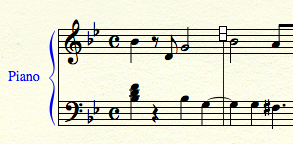
To avoid your octaves, you could delay the G in the bass while maintaining the same harmony. You could even add a passing note (A) between Bb and G. Just an idea!