
Churchcantor
Members
-
Joined
-
Last visited
-
THIRD MOVEMENT!!! Just kidding; this doesn't make the cut! I wrote a little joke piece this morning. Maybe to keep myself from writing the third movement! Space Nerd Free Sheet Music by Outis for Piano/Keyboard | Noteflight
-
Hard to believe I was 28, half my life ago; 57 now. 😶🌫️
-
I think I wrote it, drawing the music staves onto blank paper, in some doctor's office in the '90s. ba Free Sheet Music by Robert C. Fox for Violin and Piano/Keyboard | Noteflight
-
Dance Segment For Guitar Free Sheet Music by Robert C. Fox for Acoustic Guitar (Tab) | Noteflight
-
Bipolar...I commiserate! 🫠
-
Listening and editing...that first movement could be called sonata in f# minor!😆
-
Excellent! Could have been played after dinner at court with Joseph II. I would get in trouble, throwing some whole tone chord in or 20th-21st Century surprise of some sort! This has a great purity but also sense of humor about it. I haven't listened to the middle movements YET, but I'm sure they measure up. Reading your comment just above about the oboe getting off on the wrong stop and having to get back to key...I do that all the time. It reminds me of when I'm playing bass to my brother's guitar, covering classic rock, and we go into a jam...and train wreck, or near train wreck, but we chromatically wrench it back into key...there's a part in the piano sonata I'm working on that does this sort of thing, many parts, actually, but one in particular. Your last movement Presto does this well and sounds like something Wolfie might have done; perhaps in a fantasia or musical joke?😉 Oh yes, I realized why it had to be in Bb!
-
So, two movements done, and I'm at least thinking of the third. Maybe a Brahmsian A Minor melody with a quirky harmonization, rondo-sonata with a big fugue for a development? That sounds right up my alley!😀 Melody...🤔 Hazards of editing: in the second movement, I meant to repeat the whole A section, which is aba within itself, but forgot the ba!☹️Had to paste it in...nine minute movement with repeats, I think... I had the thought in the shower, that I can't have the last movement ending triumphantly in A Major, since the first movement did that. Too much harmonic symmetry! Will have to be a tragically austere A Minor final cadence.
-
Good round, though!
-
Seems about right.
-
Yep!
-
UncleRed99: Also, I noticed at M. 67, I have no idea what's goin on there with the ensemble, but it's definitely out of key between all the parts. lol Made me cringe a bit, if I'm honest. As far as I can tell, M. 67 is just an F# Minor chord, with a couple dissonant tones floating around it. Actually, there WAS a missing accidental in the clarinet in m.67, fixed and compared to ms. That was just an entry mistake on my part when I plugged it into NF. Also, here is a comment I made in Noteflight about this piece in general: This is the scariest piece I have ever written. Not only does it deal with the Medieval legend of elves abducting people, (and remember; medieval has "die" in the middle: it fits the Middle Ages perfectly!) the music itself is scary. Dissonant, strident, Death Klezmer clarinet, whole tone chords. There are YouTube videos pointing out the most Death Metal moments in classical music. This isn't really Death Metal, but what is it? Well, I have only written in this style once: Mahler at his creepiest, and it was intentional. 1999.
-
Obviously, this would be a huge orchestration project, and I'll finish my piano sonata first of course!
-
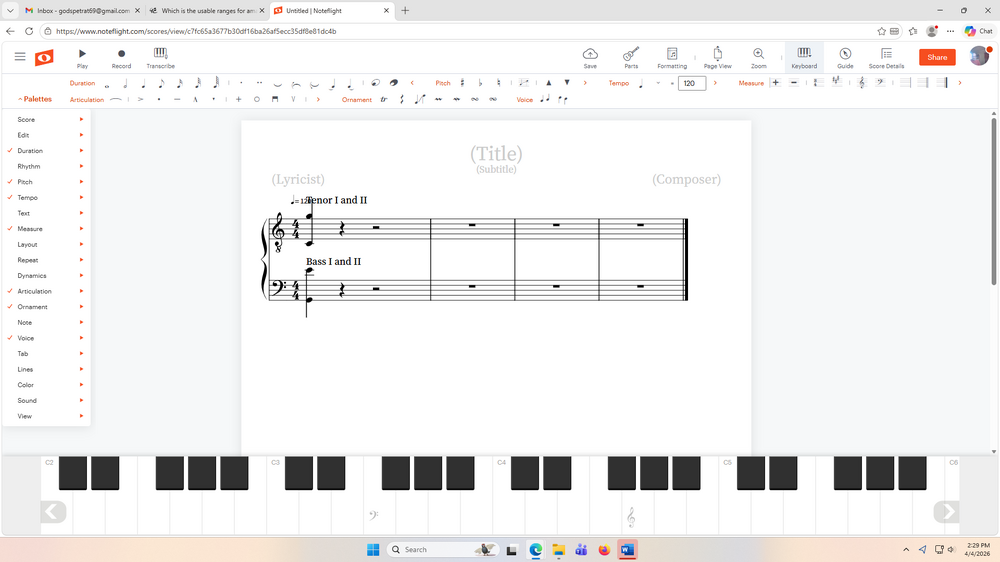
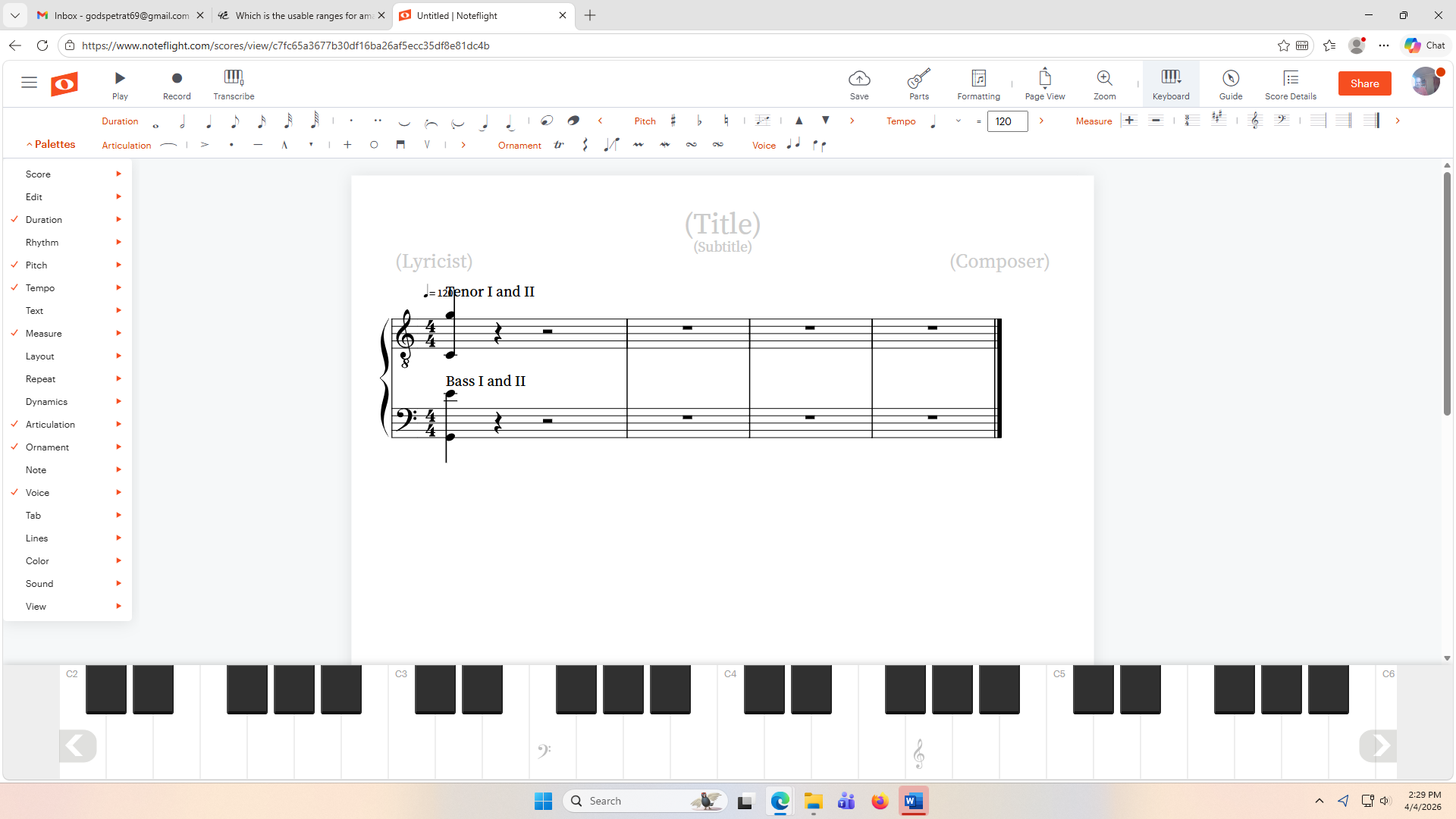
Amateur tenors can't keep pounding out that high G; prepare it and don't overuse it. Basses as opposed to baritones might not like a whole lot of that E, so usually don't go higher than a D. Something I post like Part Songs or sacred music will take tenors (and sopranos) to A, basses as low as f below g, as high as the high e or even f occasionally, but that would be if I was thinking soloists, and I don't intend that stuff for amateurs.
-
Interesting; this is what some site gives for Barbershop Quartet, but these are soloists! From highest to lowest, the voice parts in barbershop are tenor, lead (melody), baritone, and bass. The following graphics indicate the common vocal ranges by gender of the four parts used in barbershop arrangements: Male: http://www.barbershop.org/wp-content/uploads/2018/06/malerange.jpg Note the subscript 8 under the treble clef to indicate that it sounds an octave lower than written. This is traditional TTBB notation. For four average male singers, I would just keep it, keeping in mind that with really good singers (pro or talented amateur) one can stretch the ranges a bit.