Search the Community
Showing results for tags 'dodecaphonic'.
Found 4 results
-
Based on two dodecaphonic dodecaphonic series, the first of which was inspired on the same procedure employed by the main dodecaphonic series in Anton Webern's Op. 28 String Quartet (quite a remarkable tone row which can be subdivided both into three identical tetrachords and the same four trichords corresponding to each of the four transformations (original, inverted retrograde, inverted, and retrograde respectively)), this perpetually descending double canon combines both tone rows at different pitches and entry points, perfectly calculated to limit the amount of clashing dissonances (such as major 7ths or minor 2nds). The main difference between the first tone row and the one which inspired it is the fact it can be divided into four identical trichords, like in the case of Webern's own, but the fact that the jumping interval is a perfect fourth instead of a minor third as in the original means it cannot be divided into three identical tetrachords, nor can it be arranged so that one of them forms Bach's signature motif, which Webern specifically places at the beginning of his own series, perhaps as a reference, homage or even a tribute to Master Sebastian. Even though the successive iterations (each one full step downwards from the previous one, covering the octave in a whole-tone scale pattern) could theoretically continue ad infinitum, for example, if using techniques such as Shepard tone, they are supposed to stop once a full octave downwards from the original entry has been covered when played with real instruments, with a tonal-sounding cadence added at the end to give a greater sense of resolution. Enjoy! YouTube video link:
-
Joy Comes in 'Mourning' is a piece for three string players that serves as a reflection on the experiences of a music student in the collegiate environment. The piece, alluding to a phrase found in the Hebrew Psalms, reflects on the inner turmoil and eventual overcoming of pain, process of recovery, and result of joy in the end. Structured in Rondo-allegro form, the piece guides listeners through the composer's introspective journey. It begins with a dodecaphonic canon that pictures the composers internal reflection acting as the first two themes motivic material. It then transitions to a frenetic section of pizzicati, and concludes with a broad statement of hopeful anticipation looking into the future.
-
-
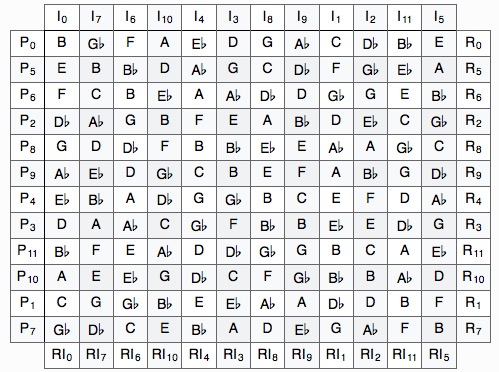
This piece is in the Rondó Form. There is a main subject (tema principal) and three subordinate themes. So the structure is ABACADA, the A part has always been modified. I have used the "classical" atonal system described by Schönberg and "friends". The dodecaphonic matrix is this: Several series are combined to achieve the variation and to create tension and rest (they are not randomly combined, as many people think about atonality). The series are notated in the score. Rondó.pdf Rondó.mp3