All Activity
- Past hour
-
Noticed a few hand clashes and enharmonic spelling errors today: so here's a revised draft. Also made a tiny change in Bar 8 (left hand). Hopefully better? It's still a bit of a beast, with awkward hand-crossings; but I wrote it for someone with great technical skills!
- Today
-

2-part invention in counterpoint
Frederic Gill replied to Frederic Gill's topic in Piano Music, Solo Keyboard
My point was that he said these intervals were 'good', not 'poor', or, as you said, 'clashy' (BAD in my limited SL English). Now I understand that you meant 'musically weak'. Also, all (diatonic) passing notes in 2-notes to a beat, like here, are unavoidably dissonances. So I didn't understand you. Besides, I have seen similar passing movements in some of his many 'BACH' examples, but in 3- or 4-notes to a beat. Then each dissonance is less prominent. So it is a matter of taste. I agree with you that it sticks out, also being the same tone G. I'm glad I finally understood that. Perhaps I simply can't combine the motive with this counterpoint of me4. -
2-part invention in counterpoint
Frederic Gill replied to Frederic Gill's topic in Piano Music, Solo Keyboard
Yes. (MUMC in short) 1909 & 1941, up to figuration. And also Theory & Practice of Tone Relations (1918) which less thorough than MUMC. I have noticed that PG has allowed over the decades more licences to his rules. -

2-part invention in counterpoint
muchen_ replied to Frederic Gill's topic in Piano Music, Solo Keyboard
I listened to your invention and digged around for the Goetschius book. I suppose my question would be: have you looked at the prerequisite book to this, namely The Material Used In Musical Composition? -

2-part invention in counterpoint
Fermata replied to Frederic Gill's topic in Piano Music, Solo Keyboard
This doesn’t contradict what I wrote above at all (I already mentioned it’s not a technical mistake). The technical side of this is covered in pretty much any standard counterpoint textbook; Goetschius’s book should work fine for that as well. However, musically it feels weak because it’s only in two voices, so it really sticks out. In a fuller texture (with three or four, or even more voices) it wouldn’t be much of an issue. -
Fugue in d minor
Fermata replied to Fermata's topic in Incomplete Works; Writer's Block and Suggestions
Thanks for the comment! You’re absolutely right that thinning out the texture can help keep things fresh — that idea crossed my mind as well while writing. I treated it more like a fugue d’école rather than a stylistically Baroque fugue (the subject itself is a 20th‑century textbook theme), so I kept the four‑voice texture going longer than I normally would. I also thought about extending some of the three‑voice spots, but the subject is already pretty long and the tempo is on the slower side, so the whole thing was starting to feel a bit too stretched out. Still, your point is totally valid, and I appreciate you mentioning it. Glad you enjoyed the fugue! -
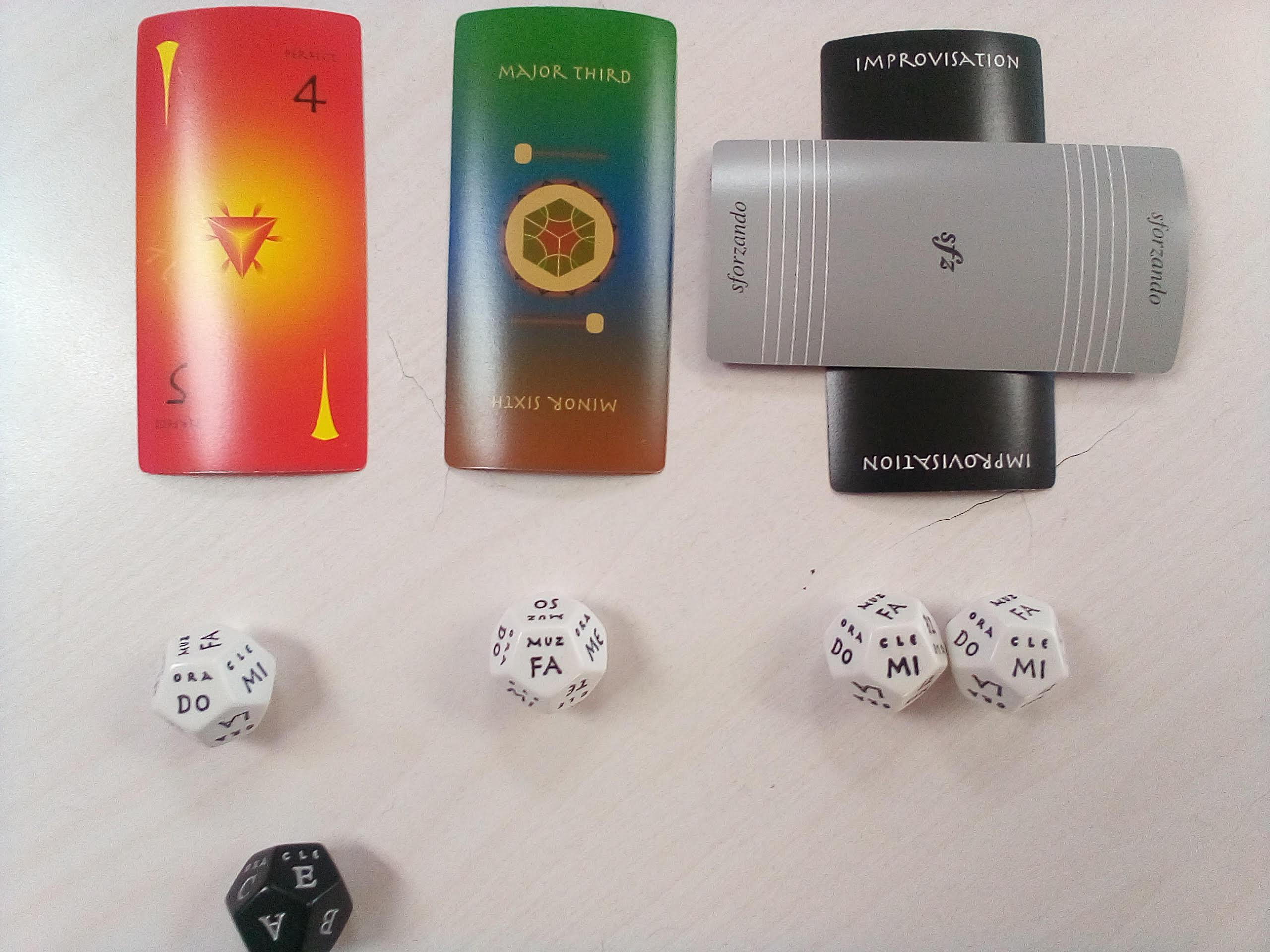
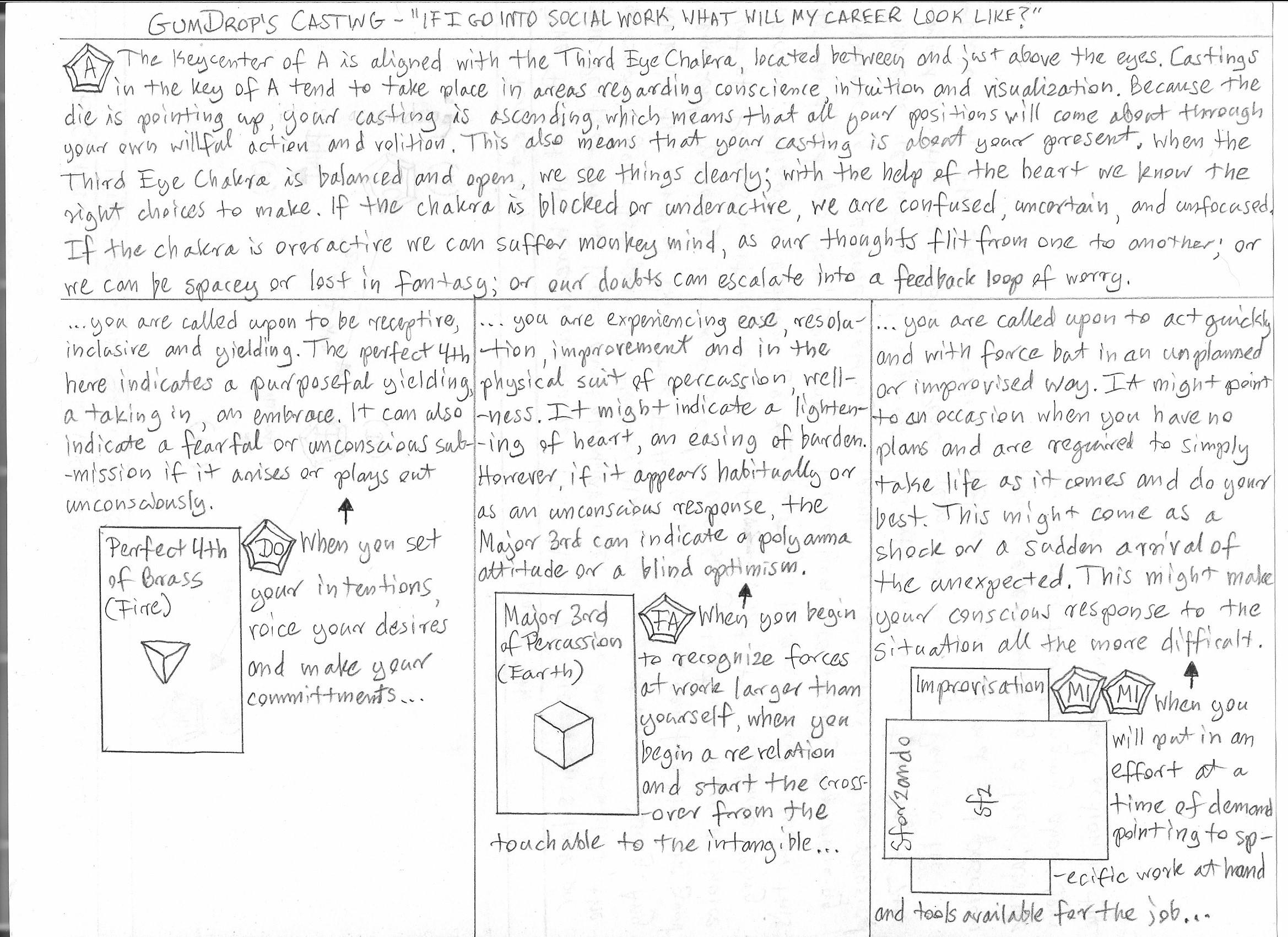
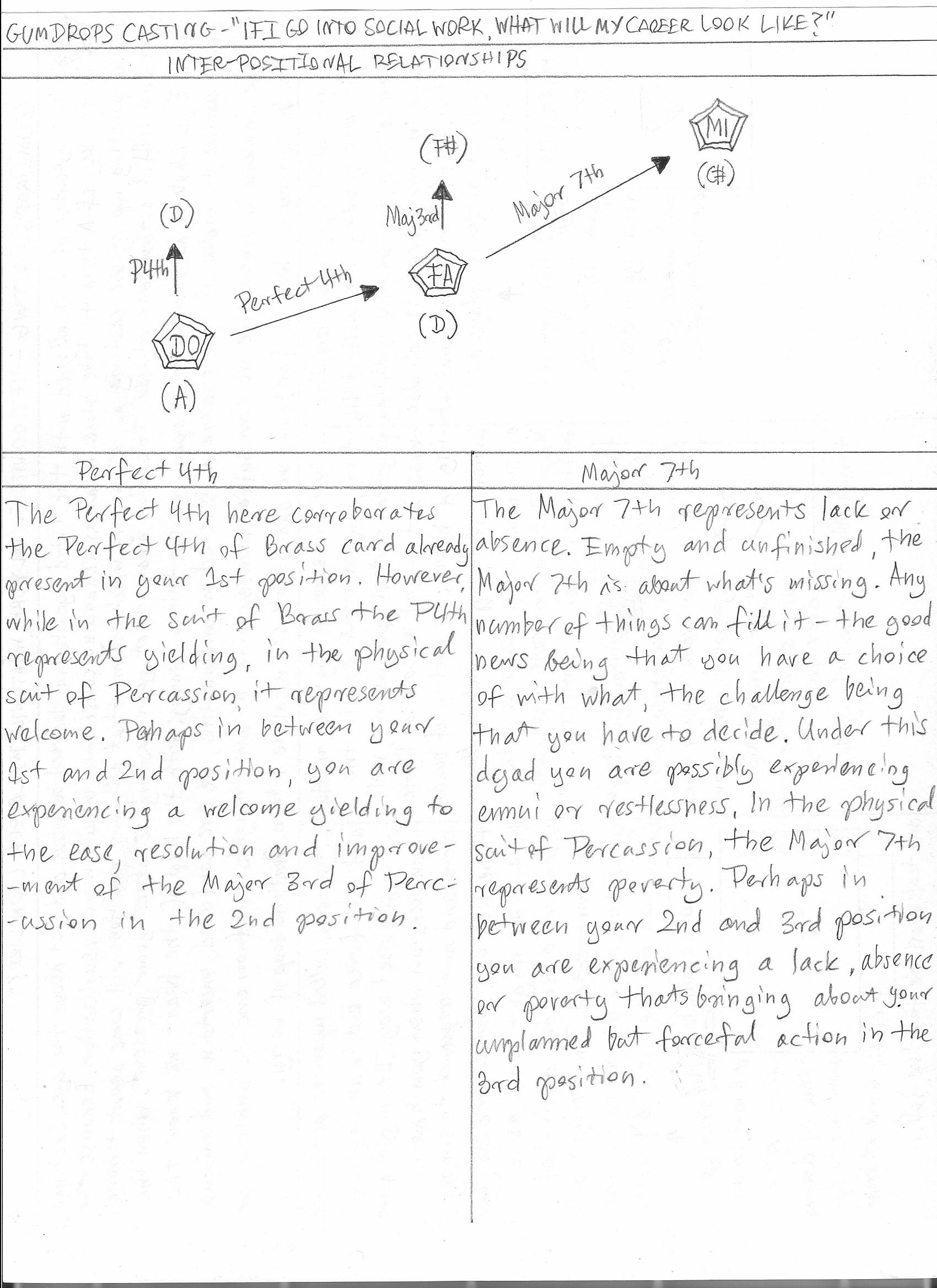
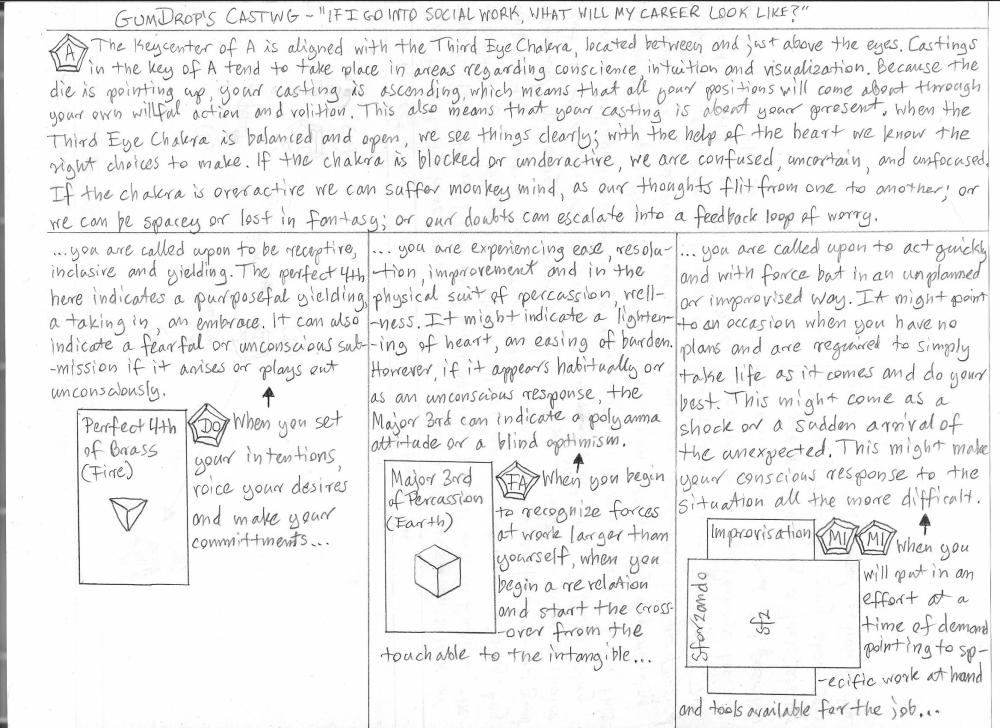
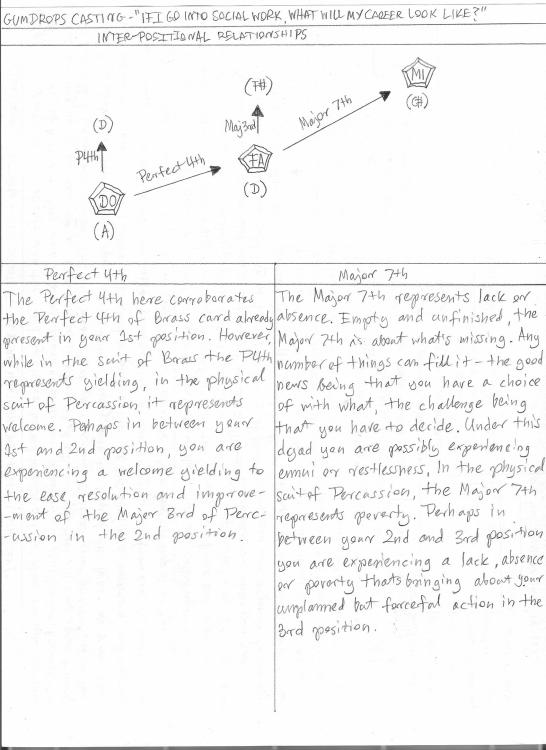
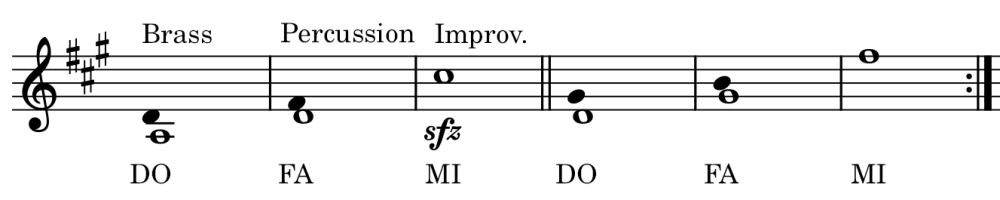
.thumb.png.8b5b433a341551e913a34392660bc95b.png) This time I come to you with my 13th casting, which I've done on Friday the 13th! GumDrop asked me "If I go into social work, what will my career look like?" (Muzoracle is a storytelling/fortune telling/divination tool similar to the Tarot card deck, but with cards with musical concepts and 12-sided Musician's dice and Solfege dice. Perhaps it may be thought of as a special musical Oracle card deck.) My interpretation of the cards and dice are displayed below. Since the casting was in the key of A (because the black musician's die landed on A), it pertained to the Third Eye Chakra which is associated with woodwinds. Because of this I picked English Horn. Because the first card drawn was a Perfect 4th of Brass, I also chose French Horn. Then, the card in the 2nd position was a Major 3rd of Percussion, so I chose Piano (also because GumDrop once played Piano). If you'd like to find out more about Muzoracle and how castings are interpreted go here: https://muzoracle.net/ This short musical representation of GumDrop's Casting is about ~2 minutes long. I created the following melodic/harmonic underdrawing guided by the cards and the dice. I used the first few solfege dice as a skeleton for the main melody. To obtain extra material, I transposed the whole pattern up a perfect 4th to D, since the perfect 4th is a very prominent feature of the casting. Since the piece is in A and associated with the Third Eye Chakra, I started the piece with the English Horn. The Percussion card comes 2nd so I included the Piano as accompaniment. Then I finally added the French Horn. I also prominently use parallel 4ths throughout the piece which gives it a certain Asiatic/Impressionistic flavor. If you've gotten this far thanks for reading! And I hope you enjoy listening to this short chamber work I wrote to represent GumDrop's casting. Comments, critiques, suggestions, and observations are of course, always welcome. Thanks for listening!
This time I come to you with my 13th casting, which I've done on Friday the 13th! GumDrop asked me "If I go into social work, what will my career look like?" (Muzoracle is a storytelling/fortune telling/divination tool similar to the Tarot card deck, but with cards with musical concepts and 12-sided Musician's dice and Solfege dice. Perhaps it may be thought of as a special musical Oracle card deck.) My interpretation of the cards and dice are displayed below. Since the casting was in the key of A (because the black musician's die landed on A), it pertained to the Third Eye Chakra which is associated with woodwinds. Because of this I picked English Horn. Because the first card drawn was a Perfect 4th of Brass, I also chose French Horn. Then, the card in the 2nd position was a Major 3rd of Percussion, so I chose Piano (also because GumDrop once played Piano). If you'd like to find out more about Muzoracle and how castings are interpreted go here: https://muzoracle.net/ This short musical representation of GumDrop's Casting is about ~2 minutes long. I created the following melodic/harmonic underdrawing guided by the cards and the dice. I used the first few solfege dice as a skeleton for the main melody. To obtain extra material, I transposed the whole pattern up a perfect 4th to D, since the perfect 4th is a very prominent feature of the casting. Since the piece is in A and associated with the Third Eye Chakra, I started the piece with the English Horn. The Percussion card comes 2nd so I included the Piano as accompaniment. Then I finally added the French Horn. I also prominently use parallel 4ths throughout the piece which gives it a certain Asiatic/Impressionistic flavor. If you've gotten this far thanks for reading! And I hope you enjoy listening to this short chamber work I wrote to represent GumDrop's casting. Comments, critiques, suggestions, and observations are of course, always welcome. Thanks for listening!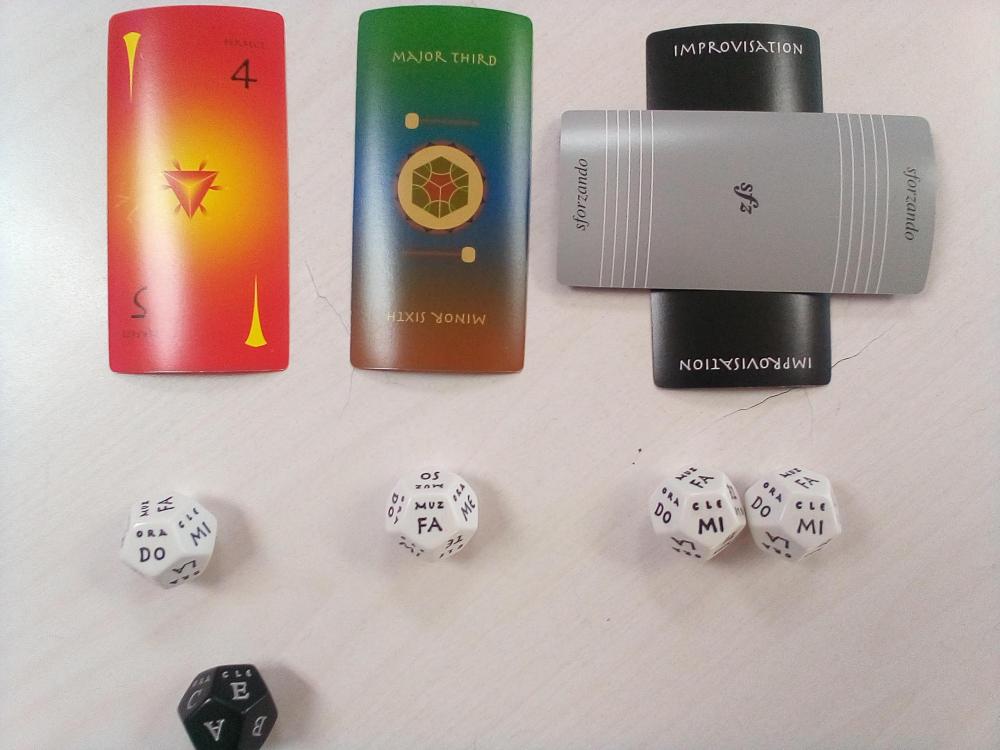
-

Fugue in d minor
ComposaBoi replied to Fermata's topic in Incomplete Works; Writer's Block and Suggestions
For future fugues, to break up the monotony, maybe you could have more sequences with less voices? For most of Bach's 4-voice fugues, like half the fugue is for less than 4 voices. So having lots of 3 or 2 voice sequences and switching which voice combinations are doing said sequences really helps with monotony. Thank you for the enjoyable fugue 🙂 -
2-part invention in counterpoint
Frederic Gill replied to Frederic Gill's topic in Piano Music, Solo Keyboard
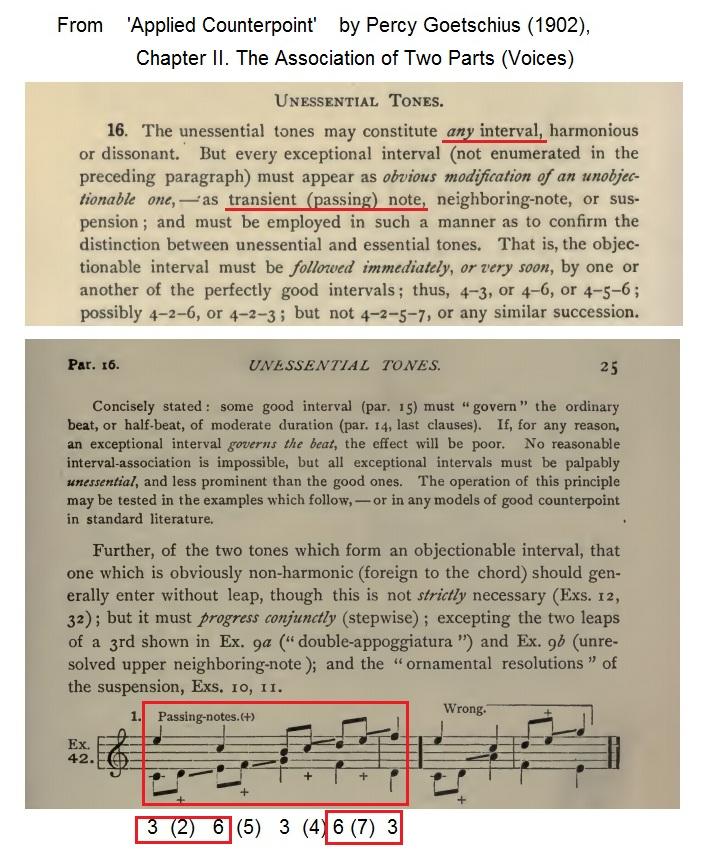
I'll show you a relevant sample (attached) of what I have learned with P. Goetschius. I assume that you'll dissagree with him. Unless I didn't catch something. Do you have a book(s)/author(s) on Music Theory that summarize your knowledge/approach?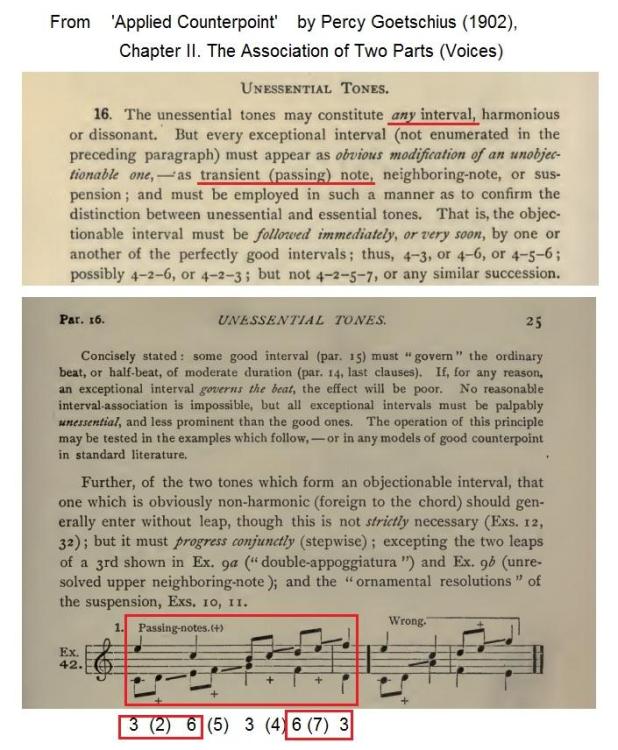
-
Hi to all my fellow musicians. Here's my latest piece for piano, that I spent the last two days writing. Haven't quite finished the phrasing and dynamics yet. I may possibly extend the work; but I'm not quite sure yet. Hopefully I haven't accidentally stolen ideas from other pieces I've heard? I know the initial chord progression of C#m to Am(maj7) came from a You Tube video; but can't remember which piece they were discussing. (Pretty sure it was from a film score; but can't remember which one.) Anyway, hope you like it. I wrote it for a concert in May. P.S. Can you guess which composer inspired me to write this? (N.B. Revised scores will be posted below.)
-
Hey, guys! I'm an amateur composer who recently attempted Celtic music for the first time. I thought it would be a fun idea to see if anyone would want to make their own version of it. 😄 I'm curious how you'd enhance the orchestration or add your flair. Feel free to experiment and share your versions! https://www.youtube.com/watch?v=CFX2w9EWaGs
-
 ScarletSelah joined the community
 - Yesterday
-
I’m trying to improve at improvising. I’d appreciate any feedback. Also im curious what kind of style of piano music this improvisation would fall into?
-
 piano1324 joined the community
 -
2-part invention in counterpoint
Fermata replied to Frederic Gill's topic in Piano Music, Solo Keyboard
By the issue of 'passing quavers,' I meant the following. Take a look at the attached example. As you can see, the G quaver connects two consonant intervals, while it forms a seventh with the upper voice, which is a dissonant interval. Technically this is not incorrect, but musically it's very disadvantageous — since we're dealing with two‑voice counterpoint, the musical texture is very 'thin,' and this dissonant friction becomes quite audible. The same problem occurs with the other G as well. Regarding the A marked with the exclamation mark: the harmony is too 'empty' this way. If you put the subject into the bass and try to harmonize it on piano, it's obvious that an F-major (first-inversion) chord should be implied there. I think most of these issues (including the ones I mentioned earlier) can be corrected fairly easily.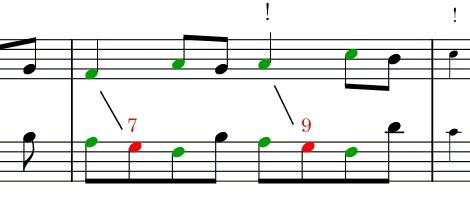
- 14 replies
-
- 1
-

-
- invention
- counterpoint
- (and 1 more)
-
2-part invention in counterpoint
Frederic Gill replied to Frederic Gill's topic in Piano Music, Solo Keyboard
Oh boy! parallel octaves! I didn't check these on fractions of a beat. BAD. {A,D} inverted to {D,A} on 3rd beat is bad indeed. 'Passing quavers': They are not essential by definition. Especially useless when they make an interval of a P4th! I guess I found it gave stamina and authority to the sequence in the motive. (NB, your picture above is not of mine). So I looked at the "frequent dissonant clashes with the passing quavers" in my exercise. I found one p4th (me24, to be corrected!), one p5th (me6, bad?), and 2 8ves (me9, 21, dissonant?). Is there more? Conclusion: I was so carried away and happy with my experience and creative process for that piece (developing the 'horizontal mirror' of the motive, what you call 'inversion' and that PC calls 'contrary motion'), that I didn't pay attention (deficit!) to all those defects and even neglected to check! That happens when I spend too much time on something, I just lose perspective. I'm definitely not a MATURE COMPOSER yet, lol. Also I knew the modulatory episodes were almost absent. I have to develop good episodes even when the tempo is fast and am afraid to lose momentum. Thanks for your feedback.- 14 replies
-
- 1
-
-
- invention
- counterpoint
- (and 1 more)
-
2-part invention in counterpoint
Fermata replied to Frederic Gill's topic in Piano Music, Solo Keyboard
There are some problematic parallels, such as the G–A octaves in m. 6 (this corresponds to m. 7 in your score — the notation software misnumbered the measures because the initial upbeat should not be counted as a full measure), or the E–F♯ parallels in m. 9 [m. 10 in the score], and so on. Also, you can’t reuse the countermelody that you introduce just after the lower voice’s entry simply by transposing it, because it is not written in invertible counterpoint. For example, the fifth on the fourth beat of m. 4 [m. 5] becomes a fourth when the two voices are inverted. You can see the result of this in m. 7 [m. 8], where an A–D fourth appears. The interval of a fourth is always treated as a dissonance in traditional two‑part counterpoint. A passing fourth may sometimes be tolerated in the instrumental style, though. You may also want to revise some of the crotchets in the countermelody to avoid frequent dissonant clashes with the passing quavers of the theme (see the example below).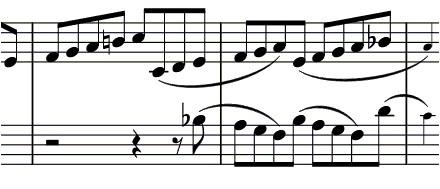
- 14 replies
-
- 1
-
-
- invention
- counterpoint
- (and 1 more)
-
2-part invention in counterpoint
Frederic Gill replied to Frederic Gill's topic in Piano Music, Solo Keyboard
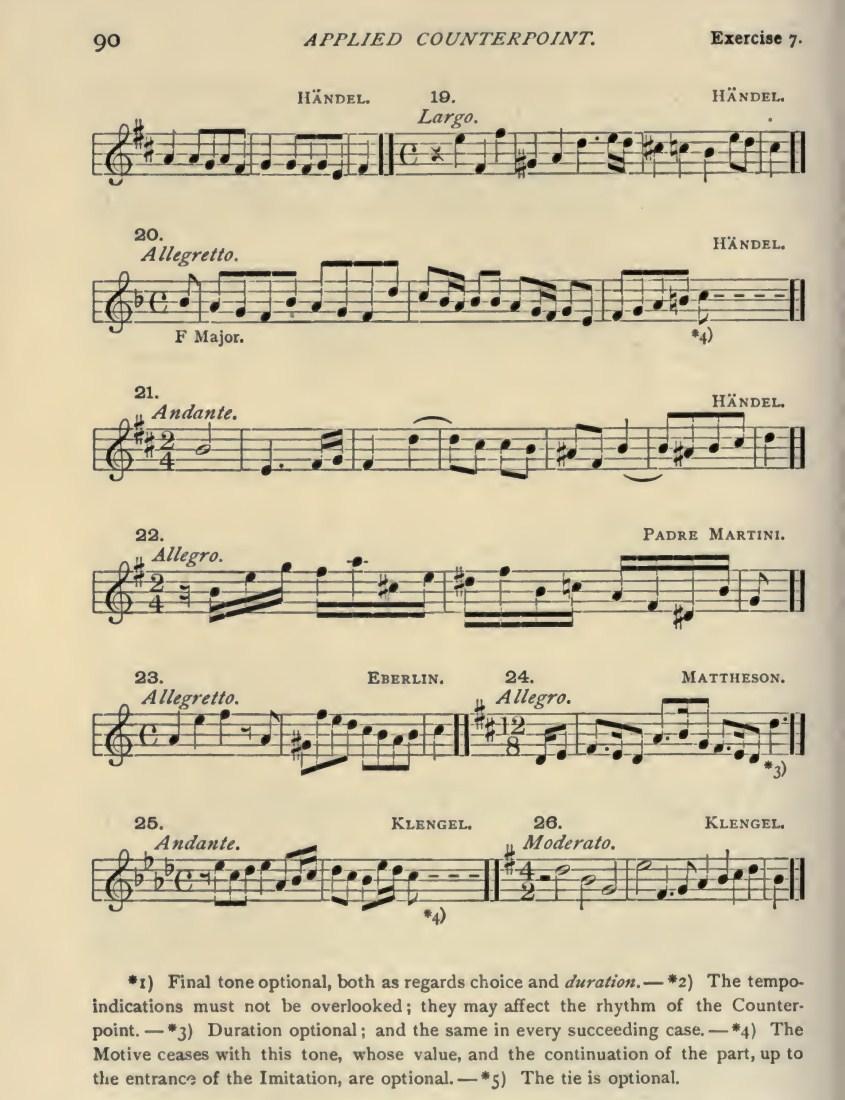
This was just an exercise from Applied Counterpoint book by Prof. Percy Goetschius. I made the inventory of octaves and there are 30! lol. Here are the details. too many 8ves 1st beat, Primary accent 5 in V or V7 = me6,9,12,15,18,24,27,30.These are good according to Goetschius. 4 in IV =me13, 16,25(?) 3rd beat, secondary accent 8 in I = me19, 25, 31 3 in I = me5, 8, 26 NOT GOOD 2nd beat, ternary accent 8 in I = me17 6 in IV = me7, 28 BAD 4th beat, ternary accent 8 in I = me11, 14 2 in I = me12, 15, 18 BAD because foreign to the chord. 2 in vii = me30 other unaccented fraction locations: me10: G is either doubled leading tone or doubled chord 7th. me22: F is doubled chord 7th According to Goetschius, these can be tolerated in fast tempo and at unaccented fractions. Is this fast enough? Any other mistakes I could learn from? Thanks.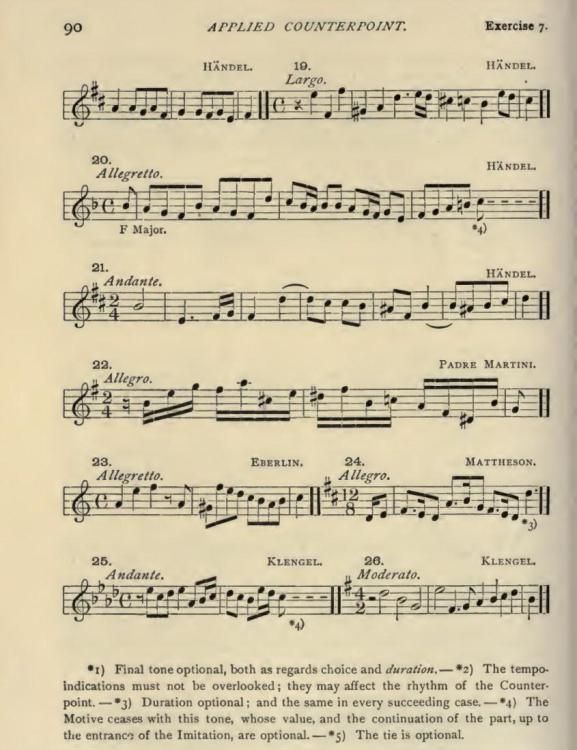
- 14 replies
-
- 1
-
-
- invention
- counterpoint
- (and 1 more)
- Last week
-
2-part invention in counterpoint
Fermata replied to Frederic Gill's topic in Piano Music, Solo Keyboard
I don't think this theme was meant to be treated as the usual antecedent/consequent imitation at the octave, like in Bach’s two-part Inventions. The subject comes from a harpsichord suite by Sheeles (not by Händel); the ascending F–G–A–B is actually a codetta leading to the real answer a fifth above. As for your solution, it keeps hitting the octave far too often — you should avoid that, as it’s too harsh for two‑part counterpoint (and there are a few voice‑leading mistakes as well). The modulations to related keys could be prepared more effectively, for example by using simple sequences built from fragments of the theme. Introducing the inversion was a good idea; it adds a bit of variety.- 14 replies
-
- 1
-
-
- invention
- counterpoint
- (and 1 more)
-
Challenge: Try to have a full year's time won!
-
I won another day!
Yay!
Hooray!
(11th Feb 2026)
(*fortesimmo C Major Chord held for 10 seconds with tremolo*)
-
A four-part fugue exercise composed on a given subject, with no particular instrumentation in mind. Developing the subject contrapuntally wasn’t difficult, but after a while it became rather monotonous. The labels A1, A2, B1, etc. indicate the various fragments on which the episodes are built. (The slurs are only meant to highlight motifs for my own reference.)
-
@TristanTheTristan Thanks for the welcome! and thank you for taking the time of your day to check out my music! I really appreciate any feedback and looking forward to hear what you got say more! It's already been very interesting composing for multiple instruments my primary background is piano. I especially am blown away how much you can get away with modifying the motifs cause it feels like the instruments themselves can ground a motif pretty well.
-
Hi there, @MinGry, welcome to the Forum! This is a decent piece of music, for a start, although, I do realize there a lot of compositional errors too. Bars 1-2: One of my favourite parts. It kind of has a nice, catholic tone to it. I would say, this quiet opening really fits my style. Appreciate that, though stop writing tempo numberic markings, and start using muiscal terms more. (eg. Allegro; Fast, or Largo; Slow, etc.) Bars 2-4: This is where thngs start to get messy. (not done yet, gonna come back later)
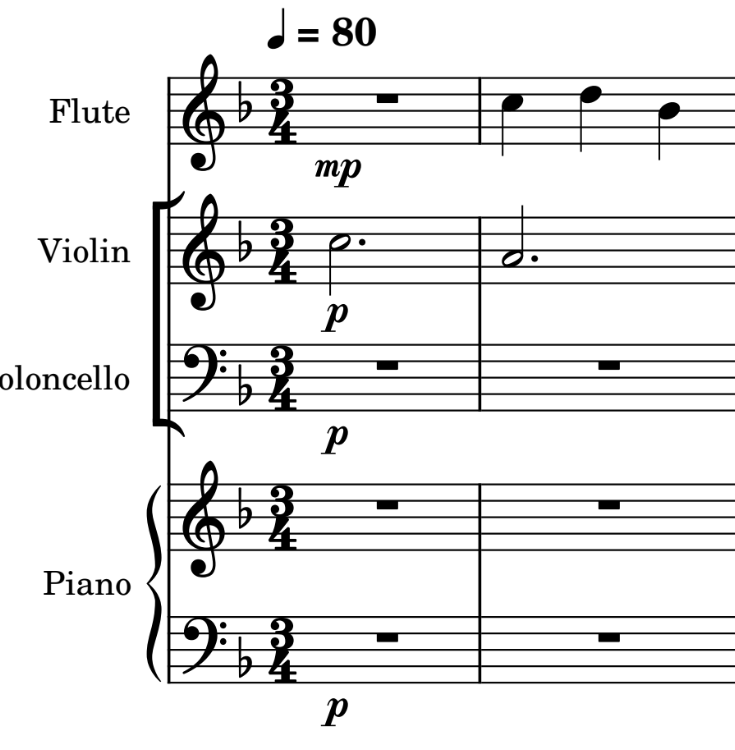
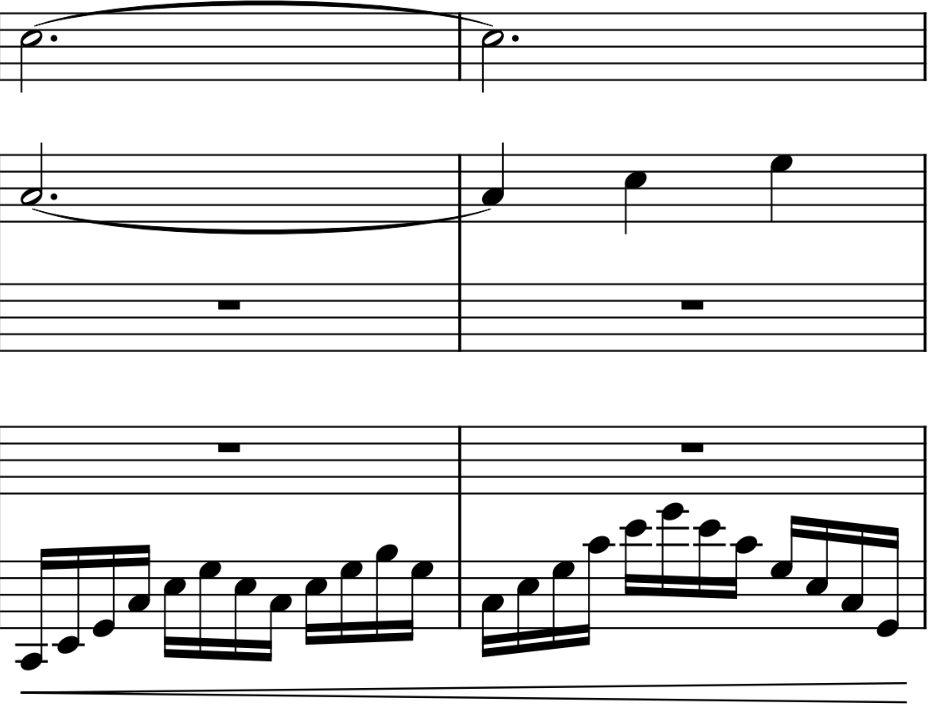
-
I don't know. Due to its repetitive and diatonic nature it sounds like a copy of Phillip Glass (first two movements) and Carl Jenkins (third movement) to me. And the violin part is relatively ineffective, it's just a slightly exposed solo of concert master above the orchestra. It lacks certain ammount of longlasting interest. This is the type of music I'd listen to at home as a background but I'd not be really looking forward to hear such one at live concerts.
-

Persichetti Exercise 2 - 8 for Clarinet Quintet
chopin replied to PeterthePapercomPoser's topic in Chamber Music
This is a good motif, supported by interesting harmony! This would work well as a jazz piece. All you'd have to do is change up the harmony, and add some drums. But the rhythms and theme can remain the same!- 1 reply
-
- 1
-