

All Activity
Today
-
OK, I saw some profession stuff that you added in the stuff at the end is fine. You cannot do you wanna also maximize maybe your bass a bit. timpani in concert bass drum would work well especially leaving a roomy feel for some stuff, especially some climaxes when I mean by climmax , I’m talking about like some of the stuff that just stands louder than the rest you could add some other things like a concert bass drum or timp or a sizzle cymbal
-
As another bonus, this inhumanly fast rendering is what the capriccio sounds like in my head ~ Sonata per corno – 3. Capriccio (fast).mp3
-
John Baldwin joined the community
-
Feel free to have a go at it if you feel like it. :)
-
Thanks Mark, much appreciated. And you're right, I guess that was the general direction I was headed in.
-
Peter asked me to write a little review, and I'm very happy to. :) For starters, I was ecstatic that Peter agreed to play even one of my movements for solo horn! At the time I was only able to offer a low payment, yet he thought the piece was interesting enough to learn, anyway. Then, after 18 years of not hearing any complete piece of mine performed, I got hungry for more, and when I got an extra paycheck, I gradually asked if Peter was interested in learning more movements I'd written for solo horn. He kept saying yes, and after he agreed to the fourth one, I decided to assemble them into a coherent four-movement sonata. Throughout the process, Peter was patient with my many requests for changes to his engraved score and for re-recording parts of movements that I thought weren't quite perfect yet. He spent many weeks practising for hours almost every day until we both were happy with the completed result, and I couldn't be more pleased with the finished recording. I added a tip to our agreed payment for his dedication to our project. I can highly recommend him to anyone interested in asking him for engraved scores or horn recordings. At some point I hope to be able to hire him for recording another horn solo sonata! :)
-
A lovely piano miniature in the style of Erik Satie. Mark
-
Yes, of course, you're right about inspiration. And certainly, a small change can suddenly open up an unsuspected dimension of new possibilities and you need to keep working till you get there, and after you get there... There's this seductive myth about the way Pushkin worked, but we won't get into that ;) About the appoggiaturas, I get it now. I didn't know it was old-fashioned to use grace notes. In fact I started using them very recently instead of triplets. Shows I'm perhaps living somewhat in a bubble and need to exchange more with others who compose - hence my starting to use various forums for the first time a few days ago. :) Thanks again for your comments.
-
-
This is so lovely! Congratulations on the performance and the composition. The slow, out of body piano part suits the text well and the spread range of the soprano part should be very satisfying for the singer.
-
Thanks Mark? Interesting harmonies is exactly what I was aiming for!
-
I think simply waiting for inspiration isn’t the best idea. As Tchaikovsky said, inspiration is a guest who doesn’t like to visit the lazy. Of course, there are times when a flash of insight comes. But often you have to grab yourself by the scruff of the neck and drag yourself to work :) I also sometimes go through many different versions of the same theme or the same piece. At times I’m amazed at how much changes from altering just one note or one duration. A theme that once seemed unsuccessful can be transformed so much that you almost consider yourself a genius and simply enjoy the result. So I think one should keep working and working. As for the appoggiaturas, no, the issue isn’t that the notes are too long or too short. It’s just that the notation itself, purely graphically, looks somewhat old-fashioned on the page. That’s how it was usually written in Mozart’s time. Nowadays it’s more common to write regular notes. For example, you could write a reverse dotted rhythm there, or a triplet, depending on exactly how you want it to be played. An appoggiatura gives the performer some freedom, whereas if you write out the notes, they have to play it exactly. But of course, it’s up to the composer. Your notation is by no means bad or wrong. Just unfamiliar. =)
-
A lovely lush work with interesting harmonies .... reminds me of pieces by Samuel Barber. Mark
-
-
Hi Alex, Thank you very much for your words about my piece. I'm glad it comes across well. I often labour for months over pieces and this was completed over a few days. I work every day on compositions and often wonder if it would not be better to do nothing until a rare moment comes when you're able to achieve complete concentration effortlessly. On the other hand, sometimes you chip away for hours and days and all of a sudden something gives and you're in the zone. So I guess it can work both ways, but I often think that the second approach is wasting time that could be spent differently. How is it with you? About the voice leading: removing some notes was just an afterthought, to be more "light", but it wasn't even played that way to be honest and I realised that it doesn't improve anything. About the appoggiaturas are you saying they are sometimes too long to be expressed as grace notes ? Thanks again for your comments, very much appreciate it!
-
Hi Julien, sorry for the late response! I want to thank you for the revision of my work, very appreciated and i will work on this little collection on the future. The idea of the seven pieces is from the idea of the woman's body. I've been inspired from the most common carateristic of it. I have a problem with repetition I know ahhaaha. I'll reply about your doubts: 1) the eight notes are meant to be played with the preferred hand, if you are skilled enough to trill while playing the voice you can do that. 3) not my favourite either. The idea was about a lulluby, so one simple melody with little changes in the armony, but not good as I thought it would become 4) I was in doubt about the repetiition section, now you convinced me to delete or change it entirely 5) I think there's some paralel, but not in my interest 6) the dissonance is very attuned on a real piano, in the MIDI is quite harsh to listen 7) this one piece (the little motif in particular) born from an impro which is recorded on my YT. The fragment remained in my head so long that I wanted to re-use it on this little piece. The single one bar which is blank is made for a cadenza ad lib. or a impro on the theme. I think I have to clarify it. The idea is to remember (like i remembered the fragment, which comes frome the past). I leave the interpretation with the other pieces of the collection to the listener :) Thanks again!
-
My composition. I would appreciate any feedback.
-
Hello. I’ve watched and listened to your work. It’s a very worthy composition. I like the thematic material, the harmonic language, and the form. It’s a complete and well-proportioned prelude. The only thing I don’t quite understand is why you use this notation with long appoggiaturas. It looks rather old-fashioned, as if it were still the 18th century :) I also have a question about the voice leading: why do you remove notes from the accompaniment when they are doubled by the melody? But these are all minor details. Best of luck, and may inspiration be with you! =)
-
Hello everyone! I'd be most grateful for any feeback on this piece. Thank you in advance! View-from-the-air.mp3 74PDF.pdf
-
Beautiful horn sonata, and this sounded exhausting to play lol. Also, the recording with the reverb is excellent. This would be really fun to layer with an orchestral backing.
-
Product in Music Jotter
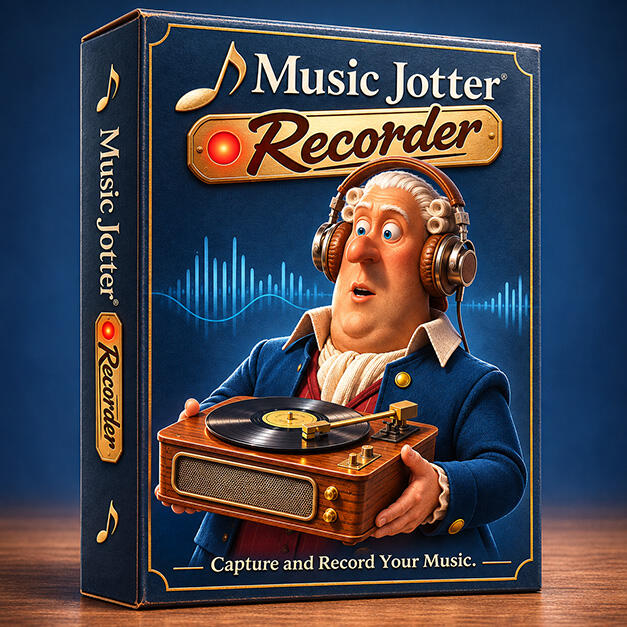
This Windows-only recorder will capture sound as you hear it. This is the simplest way to record audio from ANY app including Music Jotter.
Just press record, play your music, and let the app do the rest.
• Automatically detects when audio starts
• Intelligently stops when playback ends (no cutoffs, even with reverb)
• Works with Music Jotter, DAWs, YouTube, Spotify, or anything on your system
• No drivers, no configuration, no headaches
You don’t need to think about recording anymore.
Just hit record -> play -> done.
Perfect for composers, creators, and anyone who wants mastered audio without the hassle.$19.99 -
Thank you! It was a pleasure working with you! I hope to take full advantage of the embouchure conditioning that my chops have been through to get to be able to play your sonata! Here are the files with reverb as a bonus! (and also my preferred version for my own listening pleasure) Sonata per corno 1. Sonata reverb.mp3 Sonata per corno 2. Aria reverb.mp3 Sonata per corno 3. Capriccio reverb.mp3 Sonata per corno 4. Ciaccona reverb.mp3
Yesterday
-
I am absolutely ecstatic with Peter's recording!! Peter, thank you so much again for your hard work and dedication. I could not be happier with the result, and I feel I've made a new friend as well. ❤️ Feel free to upload your versions with reverb as a bonus! :)
-
I am stoked to finally release this great collaboration with @Maharani that we've been working on for over a month! I first found out about Marissa's Solo French Horn sonata through the United Composer's Collective discord server (UCC). I offered to play and record at first just one movement but then it turned into a full 4-movement project. I spent a lot of time practicing almost everyday getting my chops into a state of preparedness. Honestly - it was a bit like training for a marathon! LoL The movements are as follows: Sonata Aria Capriccio Ciaccona We are also including two versions of the score - the handwritten one by Marissa and a more official and mistake free engraving by me. Bandcamp link: https://maharajah.bandcamp.com/album/sonata-per-corno-op-4 Let us know what you think of the composition, engraving as well as performance of this work! We'd be stoked to hear any of your comments, critiques, suggestions or observations! Thanks for listening. Sonata per corno – 1. Sonata.mp3 Sonata per corno – 2. Aria.mp3 Sonata per corno – 3. Capriccio.mp3 Sonata per corno – 4. Ciaccona.mp3 Sonata per corno – handwritten score.pdf Sonata per corno Complete.pdf
-
I made an updated version below, with quite a few tweaks to the composition, and the midi production. Just wondering, since you're a percussion specialist, which instruments would you use to bring more texture? Not sure the seed shaker was a success. It sounded better in my head! Likewise the tambourine. (N.B. Dynamics are optimised for midi, not real musicians.) Full orchestra improv #15 (with ZL compressor).mp3 Full orchestra improv #15 (with ZL compressor).pdf
-
Hi all, It's been a while since I posted an orchestra composition. This is the first draft ... it still needs to be reviewed and brought up a finished state. However, it's all here. As I stated I have not titled the work. I am open to all suggestions .... My objective in the composition is to develop the introductory motifs and create a balanced arch from start to the end of the work. As always all feedback it appreciated. Marknewmusx10-24-26.mp3 Marknewmusx10-24-26.pdf