All Activity
- Past hour
-
A lovely, expressive little piece. It reminds me of those solo instrumental phrases that Messiaen would suddenly write into his works. I think it makes excellent use of the oboe’s most effective range, bringing out the expression in some of the high and low notes as well. As for the notation, well, it depends on how you look at it or interpret it. In my view, the piece is in D flat major. There are a few moments where it strays from the key (bars 12 and 13, and also 20 and 21) only to return immediately. There are indeed many passing or incidental notes. Even though a piece is for a solo instrument, the harmony is implicit (whether tonal or otherwise). It would be interesting to harmonise this.
-
It’s a beautiful piece and your version is fantastic. It’s restrained and balanced, without any superfluous filler that ultimately makes it sound muddy and indistinct. And it sounds absolutely lovely. You’ve done a great job of separating the different voices implicit in the keyboard version, and that voice leading accounts for a large part of the orchestration’s success. In my opinion. I think the brass section is good, as it’s handled delicately and adds that touch of colour. I also really like the English horn, though I do tend to hear it more in solo passages than in the ensemble because it has such a distinctive timbre. Orchestrating a fugue is a bit different; I did one recently (by Bach). And well, I think with these styles you have to be very faithful to the original and add very little (in terms of melody or harmonies). And keep the parts very well separated. In this case, there’s an added difficulty because, although it’s a Baroque-style fugue, it’s clearly Romantic, meaning that, as well as the horizontal voices, Franck allows himself to add chords and thicken the textures as he pleases. A challenge that can be very rewarding.
- Today
-
I'v been revising this piece yet again. This time I focused on a more rewritten exposition like introduction that is connected to the material later and tried to make it more cohesive overall. Any feedback is welcome. Thanks in advance. War born draft 5 04-07-2026 - Flow 1.mp3 war born draft5 score.pdf
-
I always noticed that the song "Wicked Child", which was the third level of the original Castlevania game would work perfectly with a swing rhythm instead. So I finally got around to making it swing.
-
PeterthePapercomPoser replied to BlackkBeethoven's topic in Incomplete Works; Writer's Block and SuggestionsHey @BlackkBeethoven ! I listened to your most recent mp3 with the string quintet pdf above. Overall it's not bad. I'd say there isn't enough spotlighting on the material the listener should focus on vs. the background - everything is the same dynamic and there's no balance between melody and accompaniment. Also it often sounds like a chorale exercise - chorales are a good beginning way to learn harmony and chord functions but when used as a model for other compositions can tend to create a cookie-cutter, chord-by-chord approach to composition - there are so many other ways of arranging things! The melody can be in any voice. There could be more melodically meaningful counterpoint and cross pollination between voices. Approached from a motivic standpoint your melody is non-descript and proceeds along with a lack of intensity and purpose. Overall, the biggest strength and flaw at the same time is the focus on harmony. When writing good melodies there’s often a lot of repetition and variation and potential for reinterpretation in different harmonic contexts (while the melody notes stay the same or repeat). There’s also usually a sense of ebb and flow in terms of climax and denouement which I feel this lacks. What I mean when I say this is that your melody lacks the terseness of say a Beethoven sonata melody. Your melody is very pedestrian and there’s no sense of rising and falling, of breathing. It lacks definition and there's just a vague blob of sound proceeding along slowly and it's really hard for the listener to focus on anything and get anything out of it. Imo and when I work on melodies, I don't usually compose a piece based on the first melody I come up with but keep popping out melody after melody until I have something that I think is worth spending some more effort on to refine or complete. To me it seems you're 1) focused on harmony too much and 2) pick your melodies poorly/without good judgment and consideration. Those are my thoughts. Keep composing and trying and you will get better!
-
BlackkBeethoven replied to BlackkBeethoven's topic in Incomplete Works; Writer's Block and SuggestionsUpdate - This is the structure I'm aiming for A - B - A1 - C - (ending) A - is lilty and slightly energetic with lush harmony B - is a chorale, hymn-like section A1 - original material returns (melody), but it's reharmonized, and with a different rhythmic feel C - I'd like to attempt something more modern where I have a this rushing overlapping rhythmic lines (like everything happening at once) before we go into this big chorale finish with suspensions and the like. String Quintet No.2.pdf https://drive.google.com/file/d/1SGU8fq9dRSEkF3T4KUgSZGHTdR4RvFs_/view?usp=sharing I've been working on the piece and I have some notes: Pg 1 - melody here needs to be edited with my new additions. And my accompaniment is so SATB, it's not sophisticated string writing at all I want this section to feel lilty and more energetic than it does rn. Really lean into the meter (maybe up tempo to 64-68) So that when we switch to 6/4 we slow down and bask in these lovely chorale harmonies. Pg 2 same issues as above - m. 15, get this smoooooth so our transition is nice. Decrescendo and slow the tempo down slightly, maybe add a measure of rest Pg 3 & 4 I love this (note for everything, add bowing and more dynamics) Pg 4 & 5 - transition back to A (this is A1) needs to make sense. Put melody an ocatve higher for variety and rhythm needs to be 3, while melody is in 2 (hemiola affect) One thing I want to focus on is getting some more variety out of the sounds I'm getting from the strings. Different counter melodies (especially in A1), passing the melody, pizz., ponticello, sul tasto, etc. I have some ideas sketched on later pages that I hope to use to play with the rhythm and sound more. This could be nice 👇🏾 1234.pdf 👉🏾 This is the edited melody for A mp3.mp3
-
I would give it to the bassoon ... you may have to adjust the other lines. By the way - why the contrabassoon? The timbre to support the melody is not the same as a String Bass or bassoon in resonance. Mark
-
Thanks Mark! I just love the colour of the English horn: so try to use it as much as possible, Would you suggest I move these passages into the bassoon or bass clarinet?
-
Alex, A lovely orchestration, though, I have some questions in the selection of the English Horn; especially in the lower register ... the actual projection may be more covered in the ensemble. Mark
- Yesterday
-
Hi to all, Just wanted to post my latest orchestration attempt. It's the prelude from Cesar Franck's "Prelude, Fugue and Variation" (Op. 18). This is a rough draft for midi rendition: so I haven't added slurs, etc... Not sure about my brass passage in Bars 26-32? Perhaps I should stick with woodwind and strings? I wonder if I should attempt the fugue and variation too? Though they would be more challenging. Anyway let me know what you think? Franck - Prelude in C minor (orchestration) #8 (mid).mp3 Franck - Prelude in C minor (orchestration) #9 (score).pdf
-
Hello dear Lithl, First of all, thank you so much for your wonderful words. They gave me a tremendous sense of satisfaction, and I’m incredibly happy that you felt the music the way you did and appreciated it so much. I’d be more than happy to tell you about the plugins I use. I don’t know if you’re familiar with Pianoteq 9, but in my opinion it’s the best piano plugin available. I use my iPad with GarageBand, where I load Pianoteq 9, and everything is connected to my Clavinova. By the way, my Clavinova is actually of pretty poor quality, but it’s good enough to let me do what I want. I simply record everything through GarageBand, which is completely free. For my needs, it’s the simplest and most effective solution. I think it’s an ideal setup for musicians who don’t have access to professional equipment.
-
-
To have the ability to say what I desire in so few words is something I strive to do. To put into words my exact feelings of this work seems a little daunting. While made for my sister, I find myself feeling selfish as even I feel a romance within the music. My hope now, is that you and others feel the same sense of connection I do. Thanks for the comments Red, I thought the voice leading was fine, and I couldn’t exactly remember what I wrote seeing your new example on the first read through. So after some back and forth, I realized there was a voice leading issue with the viola as it lands on the wrong pitch and breaks the stepwise pattern in bar 27 (I believe). I’ll take your suggestions into consideration as I amend the viola mistake. Thanks again!
-
-
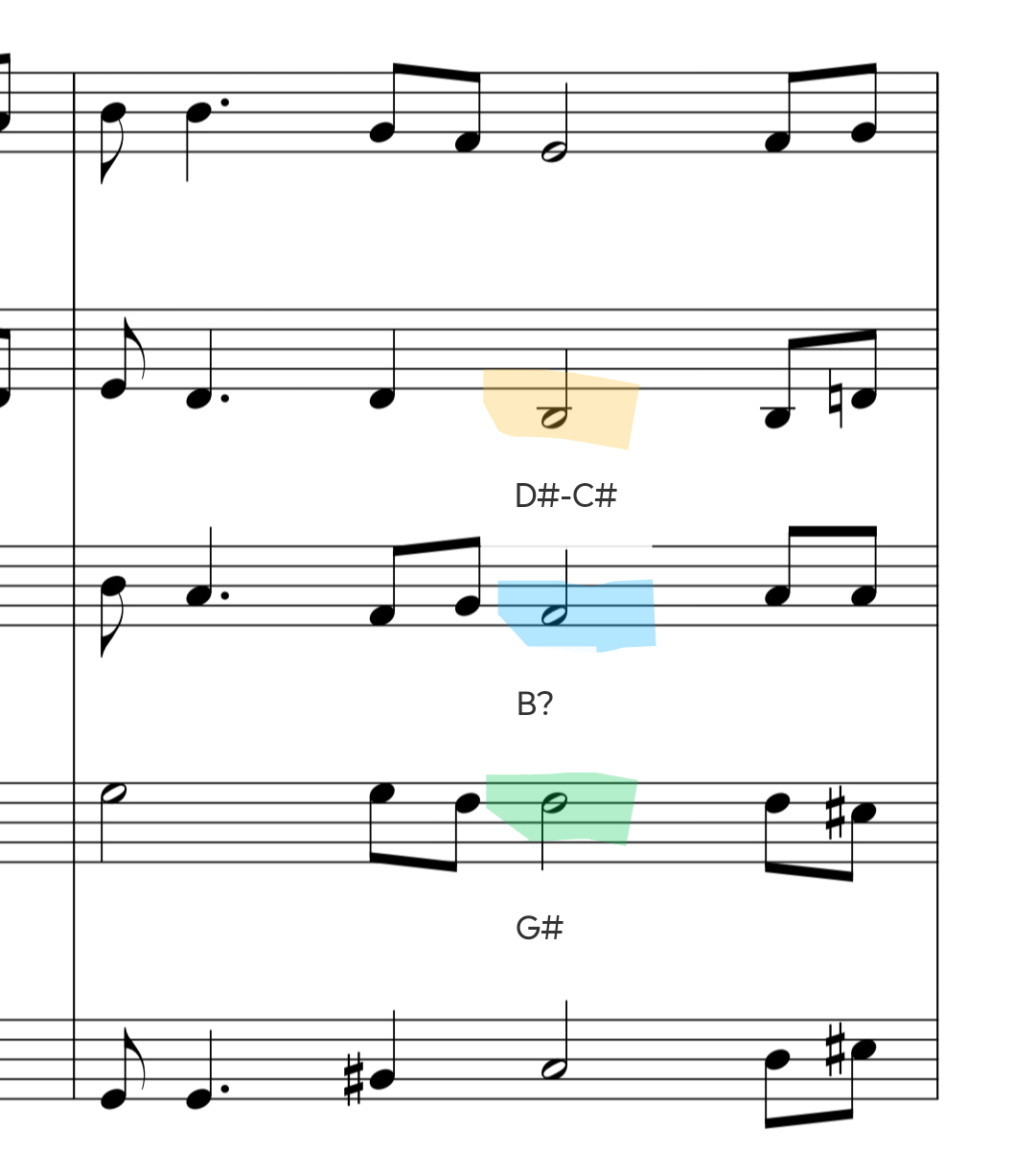
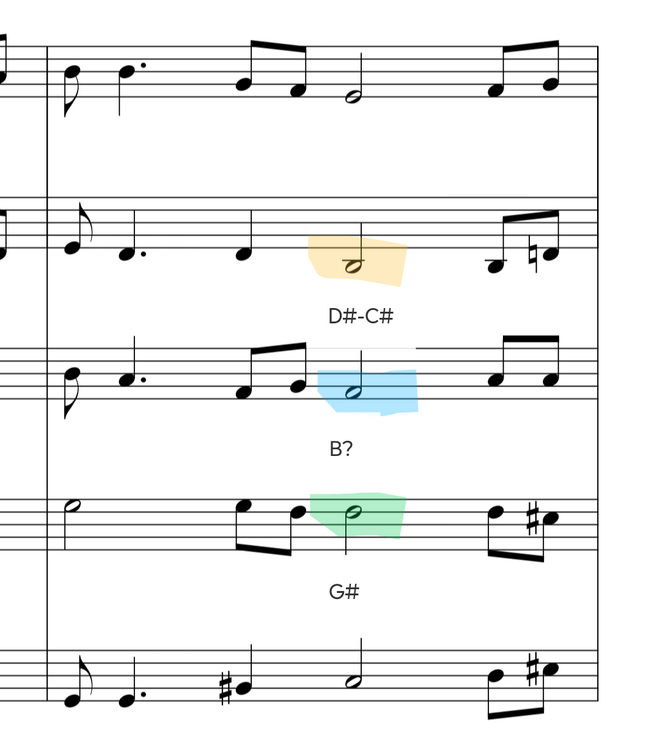
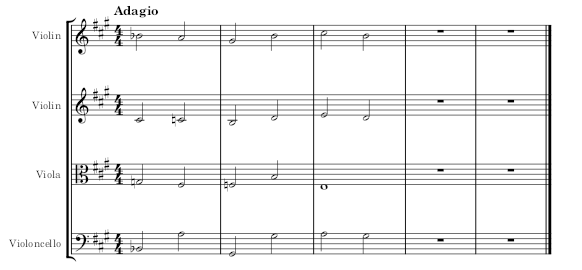
I'm so glad that I was given access to this score as it progressed, via DMs. Oh how much it has changed since you presented it to me, and in so little time! There was One point of contention that I had about this that I wasn't able to flesh out to you, when I heard it. And it's not that it's anything incorrect or bad per-say, just something that no matter how many times I listened back to it, it just never sounded right to me.. lol if you'll refer to b.26-27, where you chromatically move the harmony and chord progression down, and in b.27, the last 2 beats are on 1 (A maj.)... Something about the transition between Fdim/G# to (I think this is G#m7/F#?) just feels jarring, to me, and comparing those two chords to the rest of the piece, I feel, personally, that it stands out in a not-so-smooth kind of way.. So, below, I have written out a version that I think would help it, in my opinion, to sound less jarring and more smooth, without changing anything too drastically, and have also attached an MP3 for sound reference. (for the ease of comparison, this moment happens at about 1:28 in the original audio above). Untitled score.mp3 In my example, I've, instead of going to the chord you'd written, I just pivoted Fdim/G# > G#dim > A Maj > E Maj G#dim being the only change applied, here, along with a change in the viola's harmony. Overall though, I LOVE this score, and what story that you were telling with this one. It really hit me in the chesticle, in a great and relatable way. Had me over here reminiscing over things in my past, and longing for what I no longer possess.. Which, while that's saddening to me, it's what the essence of this whole music thing is about... creating art that is able to illicit that in someone is just an amazing thing, don't you think? -Unc
-
This is such a wonderful piece...I agree with the above comment about the length of the piece. It's the perfect length for the occasion - the piece itself feels like it's telling us a story, but it's just a beautiful beginning (again, perfect for the occasion). Your treatment of the strings and the way they interact with the piano taught me a lot. When you pass the melody, it's not jarring, but we'll thought out and smooth. I'm sure your sister and her fiance will love the piece. Bravo!! 👏🏾
-
Congratulations to your sister on her upcoming wedding!! She is sure to be so happy to have a sibling who can write such a wonderful piece of music for her. Above all, the fact that she asked you herself truly shows the deep trust between you two. This piece is lovely, and I can really feel how much thought and care went into creating it. Also, regarding the A-flat around 1:28, hearing that note appear within the overall diatonic harmony, and then watching it resolve, felt like it was telling a story. It was memorable. I think it’s wonderful how it emerges without being too jarring, maintaining the calm and gentle atmosphere of the piece. As for the length, I personally feel that this shortness has its own story, fitting beautifully for a wedding. Sometimes, a length where you feel inspired to add more, and the listeners wish they could hear just a little bit more, is right. Of course, that is just my personal opinion. It really is a beautiful piece of music. Best, Lithl.
- Last week
-
Hello Vasilis Michael. The quality of this piece is amazing. All of the progressions are really smooth as well. Incredible composing skills. I'm sorry I don't have any specific critiques to point out, but the piece is so dense for its length that I never got bored. By the way, what plugins are you using? I would love it if you could tell me. Best, Lithl.
-
Hello Everyone! I am here to share my newest work titled "Dear October...". Commissioned by my sister for the use in her wedding, this short work is has become a personal favorite. It had to be short for timing use during the ceremony, however, I find myself bleeding to write more. This said, if you want to find out more about the work, go to page 3 and read the "About" section. Thanks for taking the time to read this post, view my score and take a listen! (If you have any comments, both good and constructive, drop them in the comments!) [July, 2026 - Updated Score PDF] Chmbr- DearOctober.mp3 Chmbr- DearOctober.pdf
-
Hi, thanks for listening, I really appreciate it! I’m a student, so I can’t afford to hire live musicians, that’s why I’ve performed this myself using digital instruments. You’re right that this is a technically demanding composition, in fact, almost all of my work requires skilled musicians (except for the educational pieces, which I also compose). Thank you once again for listening, and I wish you all the best!
-
I find the music very easy to listen to in this "Jazzy" work. It's quite charming and I do find quite lyrical too! The interplay among the instruments work quite well and tell a very interesting story. Have you had musicians play the work. It sounds (without a score) technically challenging. Mark
-
Hello my friends . Here my latest binary Sonata no 25 . I hope you like it
-
This is a scheme run by composer Colin Matthews and the London Symphony Orchestra, in memory of Polish composer Sir Andrzej Panufnik. It's designed to help composers early in their careers. They only accept 6 students per year, and after the workshop, 2 are selected to expand their works for a performance at London's Barbican Centre. I've never applied to the programme myself; I just attended this year's workshop as an observer (since they're open to the public).
-
I re-listened to the (entire) work. "A tone poem (also called a symphonic poem) is a single-movement piece of orchestral music that tells a story, depicts a landscape, or illustrates a non-musical idea. Pioneered in the 19th-century Romantic era, it freed composers from traditional symphonic structures, allowing them to follow a narrative's mood and flow. [1, 2, 3] Key Characteristics Programmatic Nature: Tone poems are a type of program music, meaning they are explicitly designed to evoke an extra-musical idea, such as a poem, short story, painting, or historical event. [1, 2] Single Movement: Unlike traditional symphonies, which are divided into distinct, shorter movements, tone poems are typically played in one continuous stretch where the music evolves with the story. [1, 2] Thematic Transformation: Composers often use a technique called thematic transformation or leitmotifs—where a specific, recurring musical theme morphs in tempo, key, or orchestration to reflect changes in a character's emotions or the progression of the plot. [1, 2]" I feel the material could be integrated more, as per the leitmotifs. Each story to me feel too distinct isolated. It reminds me of the music used in telling stories/scenes in a adventure type video game. Now having said this, the orchestration is interesting and creative. In one section you have the English Horn playing against the piano ... maybe the dynamic of the piano should be softer since it overpowers the English Horn which has a softer projection ... Ravel has a piano duet with The English Horn where the piano is ethereal and supports the lush English Horn melodic line. Take a listen below: Listen at the 6 minute interval. https://www.facebook.com/reel/2867905410232600
-
Christan Diga joined the community
-
Alex, I greatly appreciate your pointing out the little notational errors. In regards to many of them: I'm just going to point out that I'm still using Finale! After correcting an error, a new one may potentially pop up later. My 2024 laptop continues to update, while the program doesn't anymore alongside it! Sooner or later, I'm going to switch to Dorico. But, I suppose for the time being my having been a decades-plus-long customer of Finale makes me stubbornly clinging to it! ha! ~~~~~~~~~~~~~~~~ As far as Celest' versus Celesta is concerned: I suppose you raised a nice little question mark even for me. I'm actually not sure why I did this!! I suppose at some point, I learned of the conversational-shorthand "Celest'"; and thought it sounded pretty; and no one had so far objected to it. ***shrugs*** Of course, depending on how big of a distraction it is, I can simply revert to "Celesta" with no problems. ~~~~~~~~~~~~~~~~ Notational issues aside, I've never heard of the LSO Panufnik Scheme. The festivals that I have participated in are typically (though not exclusively) Global Arts United LLC programs: Sophia Symphonic Summit, Brasilia Orchestral Summit, Venetian Art and Music Festival, Vienna Contemporary Composer's Festival, etc. They all have their little unique musical (and social/professional) vibes. What is your program like?


.thumb.png.8b5b433a341551e913a34392660bc95b.png)