All Activity
- Past hour
-
Hi @Bjarke! Your piece starts out quite similar to Prokofiev's Overture to Romeo and Juliet but soon turns into something definitely different. The intensity that doesn't let up later in the piece could really use some contrast with some occasional pp gestures - like a scherzo which is known for juxtaposing very loud and intense passages with very quiet and subdued ones. But, I'm not sure if composing with speed as the priority will really yield the best and most musical results. Thanks for sharing though!
- Today
-
.thumb.png.8b5b433a341551e913a34392660bc95b.png) Hi again @HoYin Cheung! What a charming sonata that I wasn't familiar with turned into a symphony movement! I think you did a splendid job transforming this piece into a work worthy of late Haydn. I didn't know that Haydn ended up including Clarinets in his later symphonies until I heard this piece and had to check if he ever used them. Thanks for sharing and great work! I'm stoked to hear the other movements!
Hi again @HoYin Cheung! What a charming sonata that I wasn't familiar with turned into a symphony movement! I think you did a splendid job transforming this piece into a work worthy of late Haydn. I didn't know that Haydn ended up including Clarinets in his later symphonies until I heard this piece and had to check if he ever used them. Thanks for sharing and great work! I'm stoked to hear the other movements! -
Hi @Fugax Contrapunctus! For me it seems like having the Soprano in such a high tessitura and reaching the high C (and ending on a sustained high C) is more demanding that the low E's in the Basses. I wouldn't hesitate to transpose this piece down a half-step if it were mine - the English Horn could still play its part. And the Altos could still reach the F#. From my cursory perusal of your score, I think every other voice and instrument could still reach their notes. Btw - I liked the coda and that you managed to end in the same key you began. Thanks for sharing!
-
Arrangement for Like JENNIE
PeterthePapercomPoser replied to HoYin Cheung's topic in Incidental Music and Soundtracks
Hey @HoYin Cheung! It's amazing that such a well trained musician as yourself was attracted enough to a song like this and sought out to transcribe and arrange it like this despite it's almost pitch-less spoken lyrics/dialogue. You did a really great job nailing down the almost indeterminate pitches in the song! It shows that you have a really great ear and I'm sure it was a challenging but lucrative (skills-wise) endeavor for you! Thanks for sharing! -
Hi @MK_Piano! The 1st movement fanfare reminds slightly of one of John Williams' Olympic Fanfare and Themes. But on the whole it has a very wondrous and magical sound to it that I like! 2nd movement - this has a surprising Arabic/Egyptian flavor to it. It might be because the main theme has a certain similarity to James Horner's Danger Theme. 3rd movement - this movement depicting the prospect of liftoff is a great hopeful ballad (at least in the beginning). The inclusion of the U.S. National Anthem brings great nostalgia to the occasion. It's also quite action-packed depicting well the intensity and explosive process of liftoff. You have a great intermingling of themes from the 2nd movement - it's great when writing a multi-movement work that you get to make these big melodic gestures through thematic association. 4th movement - quite an eerie start that would be very appropriate to the weightless tumbling of the Apollo spacecraft towards the moon. I can feel the enormous blackness and loneliness of space in this music. 5th movement - this starts off quite menacing. If I didn't know any better I would venture to guess that the Apollo 11 spacecraft encountered some kind of dire emergency in space while trying to land on the moon. Nice minor version of the National Anthem! That's cool that you included the actual audio of the voices of the astronauts. The music after that is so joyful and transcendent but still has a touch of wonder and awe. Overall this is quite an accomplished orchestral suite! Great job and thanks for sharing!
- 1 reply
-
- 1
-

-
Trumpet Concerto in C
PeterthePapercomPoser replied to Aiwendil's topic in Orchestral and Large Ensemble
Hi @Aiwendil! Surely, an accomplished classical Trumpet Concerto! It's both melodically satisfactory while providing the soloist an ample challenge and virtuosity. The cadenzas are well written as well! Not to mention they sound humanized rather than mechanical and metronomic. Cadenza writing is its own beast and getting a good rendering of a cadenza from a computer program is all-the-more difficult, but I think you accomplished it! Perhaps your 2nd movement could have been more challenging for the soloist, but that might have detracted from its great, stately solemnity. I think the 3rd movement is probably my favorite. It makes for a really great finale to the whole concerto. I played Trumpet for a short time before switching to French Horn and for me those high concert C's would definitely be too demanding. But the instrument is a higher C Trumpet so it possibly might be more feasible than on a Bb Trumpet. Also, it seems you do not exceed the high concert C anywhere, so it seems all-the-more practical. A professional virtuoso should definitely be able to play it, as I'm sure you well know. Great job and thanks for sharing! -
 SeekJohn14v6 changed their profile photo
 -
O Soul, Seek Revelation 14:9-11
SeekJohn14v6 replied to SeekJohn14v6's topic in Jazz, Band, Pop, Rock
oh my bad, i meant event. i can feel your elitist blasphemous aura emanating from the screen. “If Henry Ford asked people what they want, they would have asked for faster horses.” -
2025 Christmas Music Event!
PeterthePapercomPoser replied to PeterthePapercomPoser's topic in Monthly Competitions
@SeekJohn14v6 has also entered a piece which was created with the assistance of AI (Suno): -

O Soul, Seek Revelation 14:9-11
Henry Ng Tsz Kiu replied to SeekJohn14v6's topic in Jazz, Band, Pop, Rock
This is only an event and not contest. Lord Jesus will be happy of your service by clicking a button. -
interesting thread, since there is no rule against AI assist, I will enter the contest too. Took me a couple days to make this, I used Suno, I wrote all the lyrics and made it sound like the way I want. Suno is a blessing, I can go make a lot of music faster and reach people with the word of God in all musical genres. Christmas is about the Lord Jesus and our mission is to spread the gospel. We can use AI for good or bad, let’s all leave a trail for the lost souls to reach heaven. My submission, if you don’t have spotify ill put the file in too
-
SeekJohn14v6 joined the community
-
Motet a 8 "O Magnum Mysterium" in E-flat major.
Henry Ng Tsz Kiu replied to Fugax Contrapunctus's topic in Choral, Vocal
😳🥹 -
 Damn… the theme sounds so cool and elegant! It has a sort of dark urban fantasy vibe. I could imagine a dark trench coat wearing protagonist looking for answers in a weird underworld (oddly specific, I know). Quite elegant, crunchy harmonies in there and the interplay of timbres between the instruments you choose is quite masterful. Loved it!
 - Yesterday
-
Thank you so much, Peter! I was kinda reluctant at first to perform this myself, given I knew almost nothing about vocal performance beforehand—so it’s a great relief to know that my singing skills are passable for a casual performance, haha! (It’s a good thing I took a week’s time to gain some vocal literacy and work a bit on my atrocious passagios, or I would have caused your ears to bleed lol) Regarding the clef issue, as per my knowledge, for an art song/lied, it is standard practice to write the voice part in treble clef notwithstanding the range of the singer. The reason is, most singers, with the exception of basses, have been historically trained to read music in treble clef, and are expected to transpose the part according to their respective ranges. For example, there is this song cycle by Beethoven called “An die fernen Geliebte” which is also primarily for baritone, but all the scores I have seen so far have had the voice part written in treble. Same goes for songs by Schubert. Another reason is to make the song non exclusive and meant for any singer of any range. At least that’s what I know. (Edit: Now that I did some digging, I learned that the treble clef convention I followed is a bit old-fashioned, and that modern art songs favour using a clear bass clef for baritones and basses. Anyhow, I kind of wanted the piece to not be exclusive to a particular voice range, so treble use is still justifiable given my case. Thanks for bringing this up. I learnt something new.) Your observation about my singing having a sense of Indian influence is actually very interesting! Although I am untrained in Indian classical music, my knowledge about it being mostly realised through a western lens or framework (even though I am Indian myself), I did grow up in a household where Indian folk and classical music were played almost everyday. So my baby brain might have picked up the way Indian folk melodies are ornamented, phrased, and contoured haha! It’s interesting to think about
-
Moonfall for Voice and Piano
PeterthePapercomPoser replied to ComposedBySam's topic in Choral, Vocal
Hey @ComposedBySam! Great piece! I think, even though you wrote the voice part in treble clef 8vb, I think the actual range of your voice reaches to the levels expected of a Baritone rather than a Tenor voice! The Tenor voice's lowest note is usually B an octave below middle C. While the Baritone (I am one myself) can reach all the way to G an octave and a half below middle C. So I think it would have been more appropriate to write the part in bass clef. Like Vince, I love your singing! I think just from hearing your voice and your style of singing and composing of this song, I can hear an Indian influence/heritage in it. I am also stoked to hear more of the stanzas of your poem realized in this way! Great job and thanks for sharing! -
 Thanks for the response! It gives me confidence that I'm thinking along the same lines as you—that these aren't just my own thoughts. I agree that this material needs more development and elaboration. I wanted to gradually transition to the march-like musical material from the 0:50-1:50 section, but in a darker sound with different orchestration—predominantly brass this time—so I could then wrap up the first thematic section and start a contrasting scherzo. I've already started making the changes.
 -
 This would be in the "chorus" or "refrain" section of the piece, so I'd like to be the peak harmonically.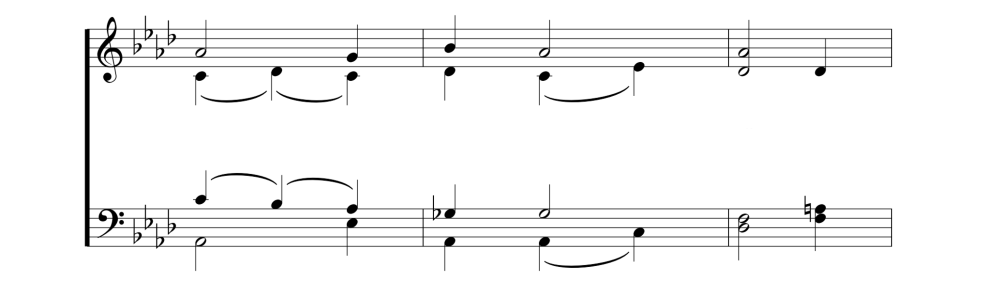
-

Concerto in C for Flute and Orchestra
Uhor replied to J. Lee Graham's topic in Orchestral and Large Ensemble
Haydn's is pale in comparison. -
So far it is very lovely in its Mozartian/early Beethoven ways. Perhaps the first movement I would not have made as long but tell that to the Eroica Symphony!. I'm also a sucker for lightweight farewell finales, it lifts the spirit.
-
As a final composition before I consider myself 'too old' for this forum I composed this Medieval-Renaissance Kyrie of a Mass based on a Royal Gregorian Chant. The counterpoint emphasizes octaves, fifths, fourths and seconds, but it still prioratices independence of voices. Not perfect but hopefully interesting enough.
-

2025 Christmas Music Event!
Vavrinec replied to PeterthePapercomPoser's topic in Monthly Competitions
My submission. Enjoy! ❄️☃️ -
March of the Snowflakes is an orchestral miniature written in a quasi march tempo, inspired by the playful motion of falling snow. This piece was composed as a small seasonal contribution to the Christmas Challenge 2025. I would be very grateful for any feedback, comments, or suggestions. Thank you for listening and sharing your thoughts.
- 1 reply
-
- 2
-

-
-
Hello All! 😀 In this post i present my composition called "Land Of Gods". It is not finished yet from an orchestration point, but i believe with the current score you can feel and understand its musical content. It is purpose is to convey the awe, the majesty , the grandeur, and the influence of the ancient deities of ancient Greece. The mighty gods, untouchable by humans, they are able to influence all aspects in the life of the people. Its dark at times, epic and very melodic. The divine realm, ruling the cosmos, both with good and evil intensions, but never within reach of the mere mortals.
-
 since i've only shared this part, i could see why it is jarring to hear the voice. the voice is just kinda there at the end with no resolution. however, the whole completed piece, which is 17 minutes, was built with voice in mind so i don't think i could substitute it. there are still ways to go with this piece. i also could see why the voice-synth is poor sounding. i've tried mixing it to better blend with the instruments but it's still way too thick. i'll try finding another voice bank/singer for the program that i use (openutau) orrr a real singer, which is unlikely cus i don't even know where to start with that glad you think the motives are very apparent! though we'll see when i finished scoring the whole thing thanks for the feedbacks ! i'll keep those in mind 🙂
 -
Motet a 8 "O Magnum Mysterium" in E-flat major.
Fugax Contrapunctus replied to Fugax Contrapunctus's topic in Choral, Vocal
Indeed. The similarity in timbre of instruments within their respective families often tends to muddle the trajectory of individual lines amidst the density of the texture, as has frequently happened in my keyboard compositions even for just 4 voices. But the human voice still retains that distinct timbral quality to it, somehow capable of preventing its integration into a larger choral whole from forsaking the uniqueness of its sound and the meandering of its melody. A testament, perhaps, to how vocal music was upheld as the most sacred during the Middle Ages and the Renaissance; not just because of the references to the purported sanctity of the natural human voice in the Old Bible and the Gospels, but because its endless versatility and potential in conjoining doesn't undermine the independence of each line nearly as much as it otherwise does for mere instruments. Thomas Tallis himself certainly took this to the absolute non plus ultra with his renowned Spem in alium, and yet, the fact that 40 voices singing simultaneously may still be perceived as individually separate with each listening instance still leaves room for even more ambitious polyphonic endeavours to be produced (although it would certainly be beyond overkill to even try). Thank you kindly as well! Though unfortunately I have bad news concerning the languages supported by the current version of Cantāmus: In any case, I'm sure a real choir would be far more adept at singing in Polish than the vaguely synth-sounding lyric renderings Cantāmus usually provides, though of course such an eventuality would come at a far greater cost. Perhaps an online choir with individual part recordings being carefully timed and assembled together might do the trick. Otherwise, a live premiere with a professional choir would be my best bet. Either that or browsing the Internet for competitors, of which I know none whose lyric rendering quality comes even close to that of Cantāmus.