All Activity
Past hour
-
PeterthePapercomPoser replied to UncleRed99's topic in Incomplete Works; Writer's Block and SuggestionsI just hope you don't use triplets as a crutch. I think beginning composers often struggle with writing good melodies that don't sound like just noodling up and down in a certain scale/key and introducing triplets or other novel rhythms is a crutch that many use to try and create melodic interest and imo it doesn't really work. Nothing can substitute for a good idea of where a melody is going and having a good form/structure.
Today
-
I have noticed that I love me a good set of triplets. Breaks from the steady 1-2-3-4, or 1-&-2-&-3-&-4-& rhythms that you get in the common X/4 time signatures, without deviating from the familiarity of it. Can't help myself. xD I also noticed that I tend to use add9 and 2 chords quite often, both in major and minor. with the occasional major 7th sprinkled in for good taste. I'm going to try and compare my scores, one of these days, to find out what my ear does when I'm composing, because I tend to just follow through with writing what feels right, while stopping to make educated inferences on what would be most effective moving forward, before reverting back to letting my ear lead the composition again, while the cycle repeats until the end of the score. I 'spose I have some reflection to do xD
-
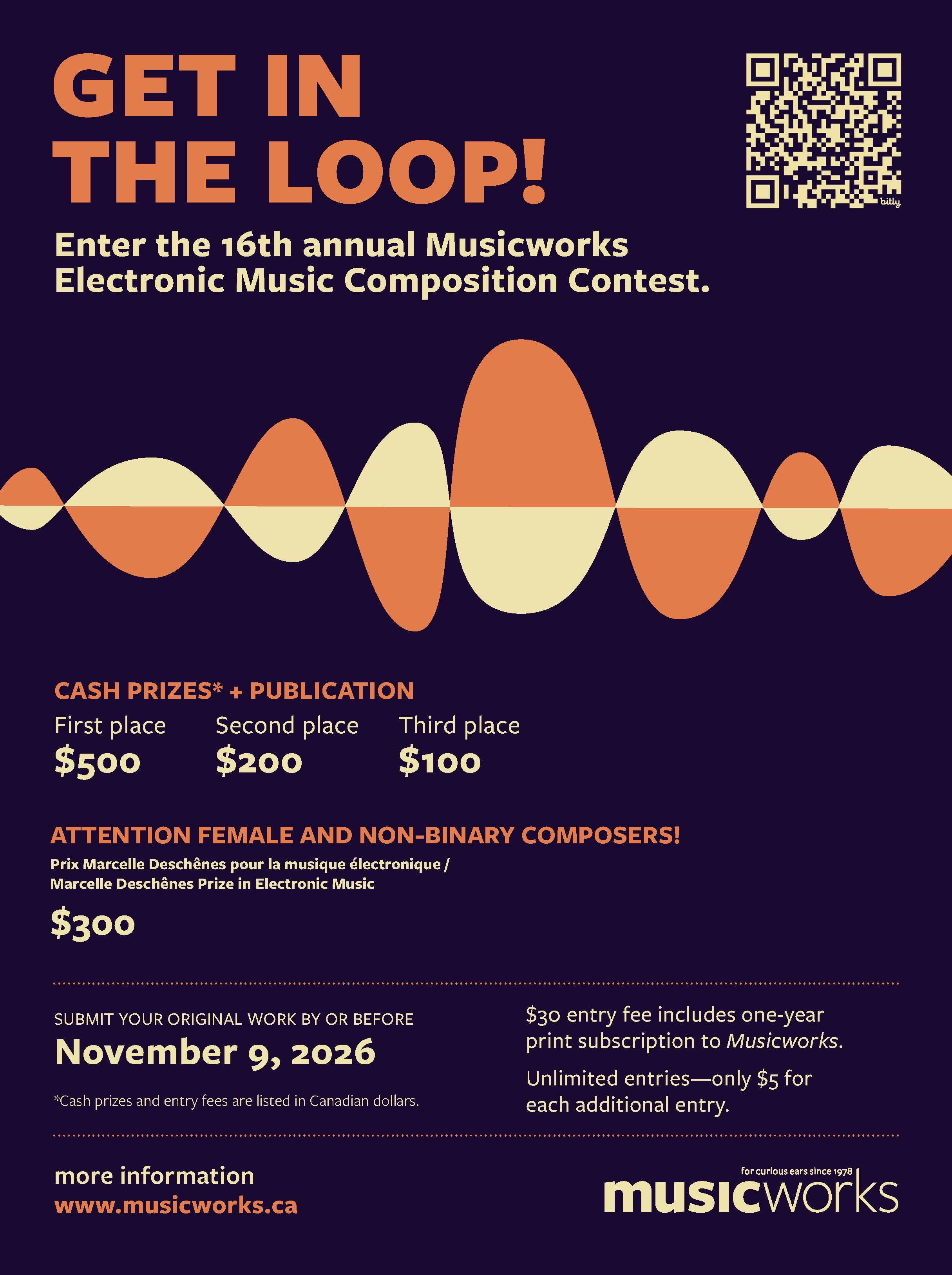
The sixteenth Musicworks Electronic Music Composition Contest is now open. Our annual juried contest spotlights new musical talent from around the world, offering four cash prizes and opportunities to be heard and published. In 2025, we received 127 submissions from 17 countries, including Canada, the U.S. and U.K., Italy, France, Japan, and others. First prize: $500, a composer profile in Musicworks in 2027, and the composition released on the accompanying Musicworks CD. Second prize: $200 and composer coverage on musicworks.ca in 2027. Third prize: $100 and composer coverage on musicworks.ca in 2027. Marcelle Deschênes Prize in Electronic Music / prix Marcelle Deschênes pour la musique électronique: $300 and a composer profile in 2027. This prize is open to entrants who self-identify as female or non-binary. Learn about the prize HERE. *Cash prizes and entry fees are listed in Canadian dollars. REQUIREMENTS Compose and submit an experimental piece in any electronic-music genre—acousmatic, electroacoustic, glitch, soundscape, intelligent dance music (IDM), turntable art, or video music. The contest is open to entries from anywhere in the world and from artists at any stage of their careers. Pieces must be previously unpublished (i.e. not released on a commercially available recording at the time of submission). Maximum length: 10 minutes. Accepted file types: MP3 or MP4 only. Contest entry fee: $30 CAD. Unlimited additional entries are $5 CAD each. All entrants receive a one-year print subscription to Musicworks ($44–$59 value). Contest closes November 9, 2026 Prize details, eligibility, assessment criteria, rules and restrictions, and the entry portal can be found HERE. Previous Electronic Music Composition Contest First-place Winners 2025 Panayiotis Kokoras (Greece/U.S.) 2024 Rocio Cano Valino (France/Argentina) 2023 Ningxin Zhang (China/USA) 2022 Leah Reid (U.S.A) 2021 Mariana Vieira (Portugal) 2020 Rocio Cano Valino (Argentina/France) 2019 Alex Buck (Brazil / California) 2018 Manuella Blackburn (Manchester, U.K.) 2017 Erik Ingalls (Windsor, Ontario) 2016 Craig Aalders (Vancouver, British Columbia) 2015 Juan Camilo Vásquez (Bogotá, Colombia) 2014 James O’Callaghan (Montreal, Quebec) 2013 Margaret Noble (San Diego, California) 2012 Bennett Jenisch (Los Angeles, California) 2011 Ian Battenfield Headley (NYC)
-
-
-
@Luis Hernández Thank you so much for listening and for the feedback! Totally get where you're coming from! While writing these, I kept trying to maintain fairly strict counterpoint, but I found that when both voices became too active, the music started losing some of the calmness I wanted from a lullaby. So in several places I made the second voice more of a harmonic support rather than an equally independent contrapuntal voice. I also found that stepwise motion was really important for the sense of calmness I was going for. So sometimes i prioritized that over strict counterpoint, which led to some of the parallels you noticed. I probably could have found a better balance between the two! And again thanks so much for listening!
-
If you limit yourself to one style, you might restrict yourself, and make it harder for modern audiences to enjoy your work. The modern audience today still attends orchestral concerts. But the programs that orchestras schedule are mix from classical, romantic, and 20th century composers...and some times music from other media.
-
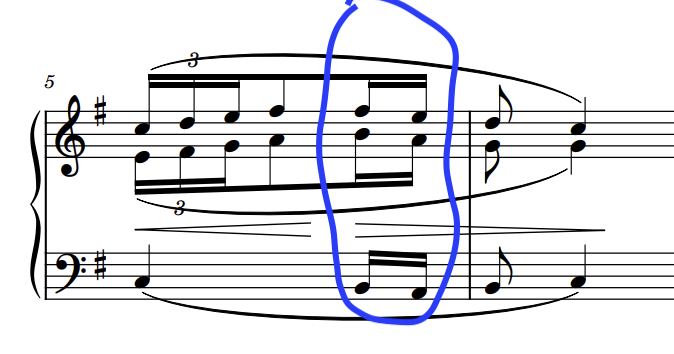
I’ve listened to two of them; I’ll listen to the others later. The one in C strikes me as almost perfect. It’s harmonious and has that lullaby feel to it. I just think the two-part section from bar 23 onwards has a sequence of parallel fourths that I’m not entirely keen on. I think what you’re trying to do is complete the chord. The other one sounds less like a lullaby, but I think it suffers from something similar. At certain cadential points, there are successive fourths (doubled, at that) which don’t quite sit right with me in this sort of piece. The thing is, in something so delicate, with such pure lines and drawing on the legacy of counterpoint, all this stands out a bit.
-
Hi everyone! This small collection of pieces I wrote that explores the concept of the lullaby from different perspectives: -The first piece uses more active and independent voices while still preserving the gentle character of a lullaby. -The second takes a more traditional approach, focusing on simplicity and a singable melody. -The third explores a more dreamy and suspended atmosphere, aiming to capture the feeling of drifting into sleep. -The fourth takes a darker direction, attempting to evoke sadness and longing through a slow, hypnotic atmosphere. Timestamps: 00:00 Lullaby I 01:05 Lullaby II 01:55 Lullaby III 03:30 The Last Lullaby YouTube link Score Once again I would like to thank you for giving me your time and valuable feedback that keeps me going and improving everyday! I couldn't be happier that I discovered this forum! Lullaby G Major.mp3 Lullaby in F Major.mp3 Lullaby in F Minor.mp3 Lullaby C Major.mp3 Lullaby C Major.pdf Lullaby G Major.pdf Lullaby in F Major.pdf Lullaby in F Minor.pdf
-
🎷 𝑯𝑨𝑷𝑷𝒀 𝑯𝑶𝑼𝑹 𝑨𝑻 𝑩𝑨𝑹 𝑱𝑨𝒁𝒁 HAPPY HOUR AT BAR JAZZ.mp3 HAPPY HOUR AT BAR JAZZ by Mavell.pdf HAPPY HOUR AT BAR JAZZ.mid

-
I completely agree with this. The thing is, when you’re learning, I think it’s good to explore and delve into a wide range of styles, given that we now have the resources to do so. Of course, it’s a process that, depending on each person’s circumstances, may never end. I think the level of commitment plays a big part here. A professional composer is not in the same boat as people who compose as a hobby (and do so whenever they can). Honestly, as I’m in that second group, I don’t think I’ll ever have time in my life to define a narrow circle of influence. That doesn’t mean, however, that when I set out to write something, I do so within a framework I’ve defined beforehand.
-
That’s true. Although I’m not sure what implications there are in music being a form of communication. I believe that music is, if anything, a metaphorical language. But the meaning of what it might convey is highly subjective. I certainly don’t believe that innovation has to come through new sounds or things like that. The expansion of the expressive techniques of many instruments has already been fully explored. I was referring more to innovation in terms of style, defined as the set of visual, technical and formal features that characterise a work, an artist or an entire artistic movement. And it is far more difficult to create a new language. As such, I believe there have been very few: modal music centred on a single note, tonal music centred on the triad, and, shall we say, the liberation from that centre in its many expressions. But who knows.
-
Which also raises the question: does the very idea of "musical innovation" have real significance in a world defined a pluralism of musical styles and languages? Many narratives of musical innovation imply not only a linear and one-sided view of history, but also that technique is somehow autonomous from the composers who utilized them. But especially with the rise of AI-generated content, I think it's the human element that remains most important. I tend to think that questions of technical innovation are secondary to the fact that music is essentially a form of communication and dialogue between PERSONS. That's where its real power lies--not as the craft of constructing progressively more advanced sonic artifacts.
-
I personally think in developing a personal language, composers need to strike a balance between indiscriminate absorption of everything they find, and limiting themselves to an overly narrow range of influences. I know the process varies from composer to composer, but I think it's important to find that balance. It's different today, where we have more control into what feeds our composer's mind--we kind of need to carve a personal ecosystem out of today's chaotic musical world. I've found it helpful to have a diverse cluster of a few core influences as a reference point (Sibelius, Messiaen, Britten), and then kind of expanding outside that. Polystylism is a fascinating approach, though it's not one that works well for my own process. If I composed in whatever style interested me at the moment, I don't think I would find the motivation to complete any full pieces. Again, it really depends on the composer, but as for me, my music is usually an expression of a philosophical vision, or a way of life. I can't really separate the styles and systems from the musical vision that bred them.
-
-
XanderTan.Composer joined the community
-
-
-
PeterthePapercomPoser replied to UncleRed99's topic in Incomplete Works; Writer's Block and SuggestionsLoL .. I really don't know and can't say. The judges at these things could be much stricter than our community here on Young Composers. Your rhythms - you have a characteristic way of meandering up and down and you can't resist the inclusion of occasional triplets LoL
-
With that being said, do you think I might have a shot at being the chosen work? 😅 I've only ever submitted work to 2 other calls before. This will make 4 now, once I submit this, after its completion... I'd also like to ask; what about my work makes it recognizable as "oh, yeah that's UncleRed's work, right there"? lol
-
The problem i have with that Composition-Video above is : .............................. i cant SEE or HEAR the CHORUS I cant detect where it "starts and where it ends" ............. i suspect the "Man on the street" wouldn't know either . Time is money.. so these HUGE gaps in the composition , make absolutely no sense whatsoever . just my opinion you don't have to agree with it.

-
Kyle, i think you've stepped out of your "Comfort-Zone" to explore the rest of the orchestra I see images with this track, that go further than the one "Theme-Category" personally i have to have a picture or film, in front of me , before i can start anything. The orchestra has a lot of different players, playing different instruments. Example : Breakfast - Lunch - Dinner - | " what do want today for your : Breakfast - Lunch - Dinner " ? chips-chips-chips .........................i want the orchestra to play | violins-violins-violins so the rest of the orchestra that doesn't play violins are .......REDUNDANT .......There just sitting there doing Nothing. so its so refreshing to hear you use The rest of the orchestra...... be nice to NAME the instruments your using in your productions.
-
-
-
PeterthePapercomPoser replied to UncleRed99's topic in Incomplete Works; Writer's Block and SuggestionsHi @UncleRed99 ! I think it's a very nice and sonically pleasing work! The inclusion of Taps in the piece (albeit with liberal artistic license) enriches the message of the piece being a dedication to those who died on D-Day (probably the most gruesome and intense engagement in WWII). I think I could compare you to Brahms in a way, because Brahms in his harmonic structuring of his pieces was so dependent on 3rds and 6ths (something he also had in common with Percy Grainger). Your music on the other hand is very suspension-heavy, constantly creating those major and minor 2nds that rub and resolve pleasantly to major or minor sonorities. I think you should be weary of this however, since this style of writing for brass is very common in the DCI (Drum Corps International) universe and doesn't win you points for originality, creativity or style. Although I would argue that you do have a certain personal style that is recognizable. Thanks for sharing!
Yesterday
-
.thumb.png.8b5b433a341551e913a34392660bc95b.png)