

Leaderboard
-
Fermata
Old Members4Points67Posts -
Frederic Gill
Members3Points33Posts -
Luis Hernández
Members1Points3,374Posts


Popular Content
Showing content with the highest reputation on 02/13/2026 in Posts
-
1 pointA four-part fugue exercise composed on a given subject, with no particular instrumentation in mind. Developing the subject contrapuntally wasn’t difficult, but after a while it became rather monotonous. The labels A1, A2, B1, etc. indicate the various fragments on which the episodes are built. (The slurs are only meant to highlight motifs for my own reference.)1 point
-
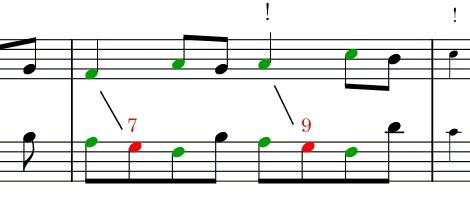
1 pointBy the issue of 'passing quavers,' I meant the following. Take a look at the attached example. As you can see, the G quaver connects two consonant intervals, while it forms a seventh with the upper voice, which is a dissonant interval. Technically this is not incorrect, but musically it's very disadvantageous — since we're dealing with two‑voice counterpoint, the musical texture is very 'thin,' and this dissonant friction becomes quite audible. The same problem occurs with the other G as well. Regarding the A marked with the exclamation mark: the harmony is too 'empty' this way. If you put the subject into the bass and try to harmonize it on piano, it's obvious that an F-major (first-inversion) chord should be implied there. I think most of these issues (including the ones I mentioned earlier) can be corrected fairly easily.
 1 point
 -
1 point
-
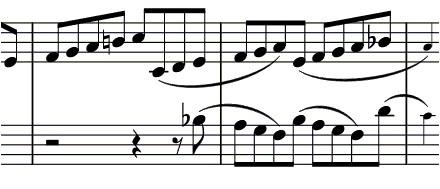
1 pointThere are some problematic parallels, such as the G–A octaves in m. 6 (this corresponds to m. 7 in your score — the notation software misnumbered the measures because the initial upbeat should not be counted as a full measure), or the E–F♯ parallels in m. 9 [m. 10 in the score], and so on. Also, you can’t reuse the countermelody that you introduce just after the lower voice’s entry simply by transposing it, because it is not written in invertible counterpoint. For example, the fifth on the fourth beat of m. 4 [m. 5] becomes a fourth when the two voices are inverted. You can see the result of this in m. 7 [m. 8], where an A–D fourth appears. The interval of a fourth is always treated as a dissonance in traditional two‑part counterpoint. A passing fourth may sometimes be tolerated in the instrumental style, though. You may also want to revise some of the crotchets in the countermelody to avoid frequent dissonant clashes with the passing quavers of the theme (see the example below).
 1 point
 -
1 point
-
1 pointI don't think this theme was meant to be treated as the usual antecedent/consequent imitation at the octave, like in Bach’s two-part Inventions. The subject comes from a harpsichord suite by Sheeles (not by Händel); the ascending F–G–A–B is actually a codetta leading to the real answer a fifth above. As for your solution, it keeps hitting the octave far too often — you should avoid that, as it’s too harsh for two‑part counterpoint (and there are a few voice‑leading mistakes as well). The modulations to related keys could be prepared more effectively, for example by using simple sequences built from fragments of the theme. Introducing the inversion was a good idea; it adds a bit of variety.1 point
-
1 point
-
1 pointSounds good. The 13th bar is strange, but I see you've made a correction. I think there's some pretty good imitative treatment, characteristic of the Inventions. So many colours confuse me a bit. I suppose they highlight imitations or motifs, but as I'm colour blind, I can't tell. Best regards.1 point