
Leaderboard
-
Luis Hernández
Members5Points3,420Posts -
PeterthePapercomPoser
Admin5Points3,007Posts -
DarwinNE
Members2Points7Posts -

Forty6
Members2Points4Posts


Popular Content
Showing content with the highest reputation on 11/14/2026 in Posts
-
Hello I’ve listened to the first two tracks; I’ll listen to more tomorrow… It’s a shame that, particularly with vocal works, we have to use our imagination quite a lot, given the virtual instruments we have. I think it’s a fantastic piece, with a distinctive harmonic language that I haven’t bothered to analyse – nor do I need to, because it sounds phenomenal. The choice of a string orchestra alone feels rather ‘restrained’ (one could imagine a larger orchestra), but I think it’s a good choice.2 points
-
2 pointsWelcome to the forum @DarwinNE ! I left you a thumbs up, subscribed and also a comment on YouTube! I'm impressed by how differentiated the video is! Including your own music notation of the composition as well as yourself playing it and also natural landscapes was just great to see and hear! I would have loved to see some images of Jupiter's moons thrown in as well! Thanks for sharing and welcome once again!2 points
-
Suite for mezzo-soprano and string quartet, “Forlorn Images”. The original title, "Неприкаянные образы" (“Neprikayannye obrazy”), cannot be translated into English exactly. The Russian word "неприкаянный" (neprikayanny) has no single equivalent in English. It describes someone or something that has no place to belong, no refuge, and no peace. It is a person or a spirit drifting without purpose, restless, a little lost and lonely, not accepted anywhere. The word is often linked to the old verb "каяться" (to repent), and it carries a faint religious shade: something left unreconciled, with no rest or shelter. English words such as “forlorn”, “restless”, “drifting” or “homeless” each capture only part of this. So “Forlorn Images” is only an approximation. Think of images, figures and visions that wander without finding their place. The 5th movement, "Звездочёт" (Zvezdochet), is an old, slightly fairy-tale word for an astronomer or astrologer. Literally it means “one who counts the stars”. It belongs to the world of medieval wizards, court sages and folk tales, where a person watches the sky and reads fate in it. The nearest English word is “Stargazer”, though it can also suggest a daydreamer. “Astrologer” is closer to the mystical side. Please read it as an old sage who observes the stars and seeks meaning in them. Music by A. Khomenko, lyrics by V. Osadchenko. In five movements. Silence Reflection Desire The Master (attacca) The Stargazer Part1 Part 2 Part 3 Parts 4-51 point
-
1 pointHi to all, I recently recorded an electronic music piece at a slow tempo (45 bpm). It is called Jupiter's Moons and I also made a video for it: The main instruments are a Crumar Bit 99 synthesizer, an Arturia Drumbrute Imact, an Arturia Microfreak and the main theme is played on a Stylophone. I hope you'll enjoy it!1 point
-
1 pointThis is my first post, but I came to this forum cuz I was desperate to hear criticism that I can use to hone my craft with (like for example, my mixing needs work and I can't tell if I made the song too muddy or not), This song uses a melody I created when I started making music mid 2024 I used the term 'video game music' because I plan on using this in a passion project video game I've been developing that being said, I made Ancaibe on FL Studio, the key is in B Major and it is 60 bpm Thank you for listening! ancaibe.mp31 point
-
Hello First of all, I’d like to say that I found the piece lovely and very pleasant to listen to. At the start, the piano has quite a ‘minimalist’ pattern, but then it breaks away from that and sounds a bit odd. However, given the prominent role the piano takes on later, I think it’s fine. I haven’t checked the range or anything. But could the clarinet be a standard one rather than a bass clarinet? In many places, it’s in quite a high register. Thanks for sharing.1 point
-
1 pointA beautiful score and piece of music. I think it keeps you engaged throughout. Brilliant orchestration. There are moments that I might perhaps have approached differently, but it’s simply a matter of one style versus another. Orchestrating is about making decisions all the time, and it’s brilliant. Thank you for sharing.1 point
-
Hello, everyone! My name is Thiago Ribeiro, and I am an amateur arranger. I would like to share two musical arrangements that I have prepared with great care and am making available for free, hoping they will be performed by orchestras, big bands, and other musical ensembles. These arrangements have a special feature: they are written in a hybrid format, meaning they can be performed by either a Big Band or a full orchestra, making them suitable for different ensemble configurations. 🎼 The two free arrangements are: 1. Joshua Fit the Battle of Jericho — Swing A lively and energetic interpretation of this traditional spiritual, featuring the groove and vibrant character of swing. The arrangement is designed to bring out the musical possibilities of both a big band and a full orchestra. 2. Amazing Grace — Samba Jazz A fresh perspective on this beautiful and beloved hymn. In this arrangement, the familiar melody takes on a samba jazz character, combining Brazilian musical influences, sophistication, and a distinctive personality. 🎧 Would you like to hear the arrangements? The YouTube links below will take you to demonstration recordings of both arrangements. https://www.youtube.com/watch?v=qWXDRKqV_xo https://www.youtube.com/watch?v=5J9hkc6to8Y 📥 Download links for the full scores and individual parts are available in the description of each YouTube video. My goal in sharing this material is simply to contribute, even in a small way, to the musical community and give these arrangements the opportunity to come to life through the performances of musicians and orchestras. If your orchestra, big band, conductor, or musical ensemble is interested in performing either arrangement, I would be absolutely delighted! I have just one small request: if possible, whenever you perform one of these arrangements, please tag me or mention my name in your posts. It would mean a lot to me to be able to see and enjoy your performances! I sincerely hope you enjoy these arrangements and that they find their way to many musicians, rehearsal rooms, concert halls, and stages around the world. Music becomes even more beautiful when it is shared! Best wishes, Thiago Ribeiro1 point
-
Congratulations. It sounds fantastic, with marvellous orchestration and such a clear score. It’s a distinctive style of orchestration, with a wealth of percussion and harmony, and plenty of doubled parts.1 point
-
EDIT: I composed a B section too and arranged the whole piece into AABABA. I modified the text to address that. Hello everyone! I recently composed an AABA jazz ballad. I wrote the melody and chords, made a lead sheet, and arranged it for piano using basic techniques from the jazz book I'm studying. The first measures' harmony is based on John Lewis's "Afternoon in Paris". I'm sharing this work-in-progress because I'd love some feedback on a few things: 1. B section composition: I wonder if the B section works. I do kind of like it, specially the ending where I use parallel minor chords. But I would like other's people opinion. 2. Overall jazz language: This is my first non-blues piece using jazz harmony, so I would like to know if it actually sounds correct and idiomatic. 3. Form: I made the arrangement into AABABA. I added quite some variety to the A, but still I am wondering if it is not repeated to much and maybe I should not repeat the A twice at the beginning and make it into ABABA. 4. Two really objectionable harmonic moments: a. m. 2: A Db on beat 4 over an Ab7 chord (a natural 4th against a dominant chord). b. m. 4: An F on beat 4 over a Gb7 chord (a major 7th against a dominant chord). These are textbook "avoid notes" for dominant chords, and both are approached and left by leap. I wrote most of the melody intuitively without analyzing much. Once I analyzed it and noticed the clashes, I tried everything to fix them (changing Ab7 to Asus4, trying other substitutions, reharmonizing the whole piece, and rewriting the melody to resolve them by step or remove them). Nothing sounded good to me. I just prefer how the dissonances sound. I know how unusual, and probably wrong, these choices are (for now, I couldn't find a single example of them in any jazz standard) so I’d love to know if they actually work here, or if they just make the piece sound amateurish. The audios are myself playing at the piano. The video is the ABA arpeggio arrangement. Before that, I would play A once in another chordal based arrangement, thus making it AABA. You can find the piano arrangement score and a slow version of this first chordal A in the attached documents. Thank you and any feedback is welcome! Ruby's_Prayer_Lead_Sheet.pdf Ruby's_Prayer_Ballad_in_Ebmaj_for_piano.pdf1 point
-
Wow, I can't do that at least as of now, unless very slowly, likely very much away from the intended tempo, or that it is a really really slow piece1 point
-
1 pointMany thanks, @PeterthePapercomPoser Two years ago, I (almost) discovered I had Final Cut pro that was coming along with Logic Pro when I bought it with my computer. So I thought it was the occasion trying to put together some music video. They require a lot of work, though, but I had great fun doing it. For my electronic music, I don't usually notate everything, but I still like to work on paper to scribble notes and thoughts. I found nice to show them in the video 😅1 point
-
1 point
-
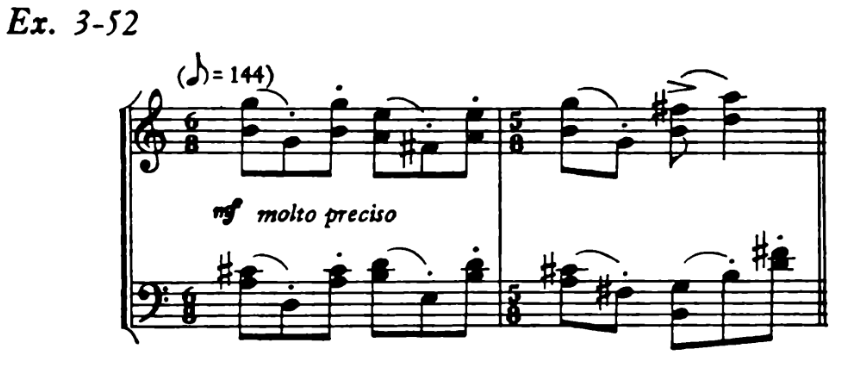
I have yet another short piano composition for you prompted by an exercise from Persichetti's "20th Century Harmony". The prompt was "16. Expand this piano passage of eleventh and thirteenth chords preserving the general character." I added lots of dynamics and tempo fluctuations to simulate rubato and bring expression to the music. Let me know how I did! Thanks for listening and I'd appreciate any of your comments, suggestions, critiques or just observations.
 1 point
-
1 pointHello again. I have composed yet another microtonal piece - this time a prelude for lumatone (or a piano). My intent for the piece was to explore subminor and supermajor chords, as well as the subminor 7th which is a more pleasing sonority in a minor or dominant 7th chord which isn't as dissonant and yearning for resolution (the dominant 7th chord with a subminor 7th is a common sonority that gives Barbershop quartets their characteristic sound). I think a performance on a lumatone can probably best approximate my intentions with this piece in 31 edo or 53 edo or something. Thanks for listening and I'd appreciate any comments, suggestions, critiques or observations you may have!1 point
-
1 pointThank you. It's the sound of blowing wind. Each sound was resampled. The train tracks were the bass drum, but I didn't think to make it punchy. Fun note, the wolf howls are the same material of sound as the bell. The wolf howls were made by manipulating the bell sound into a howl.1 point
-
[UPDATED - OCT. 2026] The following post was a formal submission for the 2026 Summer Competition: From Nothing, to Something. Below includes a detailed and extensive explanation of the work, both in inspiration and construction. If you wish to skip, the score PDF and Audio will be found at the end. Thanks for viewing this work! [TAKEN FROM SCORE] Plus belle encor votre chère beauté - Your dear beauty lovelier still Duration: c. 6:08 Written in 2026, Plus belle encor votre chère beauté is a work for piano quartet that evokes summer and the experience of love. It was composed for the “2026 Summer Competition” hosted by The Young Composers Music Forum and is inspired by Paul Verlaine’s poem “Donc, ce sera par un clair jour d’été,” whose opening line may be translated as: “So, on a bright summer day it shall be.” The poem is number nineteen in Verlaine’s collection La Bonne Chanson (The Good Song) Find the French text and translation to the poem here The title of this work is drawn directly from the French text and has similar inspiration as the Gabriel Fauré song from his op. 61 bearing the same name as the Verlaine poem. However, this work takes the title from the fourth line of text, and unlike Fauré, this work is late-romantic in style. The musical inspiration came from two places: Tchaikovsky and his Nutcracker ballet, and a spell of improvisation at the piano. This work was created in late July and early August 2026, and during that time, I was experimenting with modal improvisation, and felt drawn to G-lydian. Specifically, the iv 7 chord you can build and find in Tchaikovsky’s music. However, I did not set the piece into the lydian mode, only hinting at C# to use for predominant and secondary function. It was also around this time I was listening to parts of the Nutcracker, where I felt drawn to the idea of harp-writing, and thus, during a period of improvisation, the foundation of this work came to be. With structure, Plus belle encor votre chère beauté is in ternary (A-B-A’) form and includes an intro and coda. The B-section acts as our development while the outer A-sections are comprised of a smaller AABA form. The principal theme stated in the A-section occurs throughout the work, where it can be heard in the introduction, coda and within the development where the piano states the principal theme in inversion. Lastly, I composed this work following the end of a relationship. In short, this work evokes those unspoken emotions I harbored and the romance I long to have one day. A day where I too can say “Your dear beauty.” (The art on the cover page is Claude Monet's "Woman with a Parasol." A wonderful piece of art!) Comments are welcome, both constructive or positive! If you enjoyed this work, leave a react, and follow my page so you don't miss any new works in the future. It's free and you can always remove it later. Thanks and see you all soon! AUDIO_YourDearBeauty.mp3 SCORE_YourDearBeauty.pdf1 point
-
1 pointFor this piece I made two versions. While inputting the piece with all its microtones into Musescore, it ended up sounding quite bad with all the microtones that I had included (probably owing to the fact that the piece is already quite dissonant without the microtones). So I removed all the microtones and made a version of it that's free of any microtones. That's the 1st version. Then, once I was done with that version of the piece, I went back and made a 2nd version with very light microtonal embellishments, mostly only in the melodic voices and only on minor chords (making them sub-minor in 24TET, meaning I brought the minor 3rd of minor chords down a quarter-step). My intent with using those particular microtones is to make the piece even darker than it would be if it was just a regular minor key piece. But let me know what you think about both versions and which one you like better! I welcome your comments, suggestions, critiques or just observations. Thanks for listening!1 point