
muchen_
Members
-
Joined
-
Last visited
-
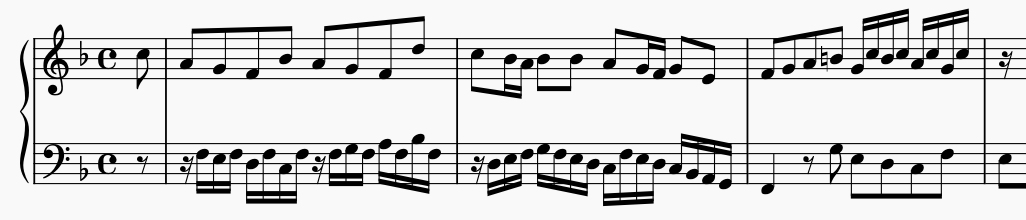
I've attached below the opening 32 bars of a movement for strings, chorus, and continuo in the late Baroque style. The text is taken from Goethe's Einsamkeit; the full text and a sample translation can be found at the end. The form of the chorus will probably end up being rondo-like: A B A' C A. Section A here refers to the opening 32 bars, and A' is A in the dominant key. Section B will deal with the next two lines of text, and likewise with C. I'm interested in how you might proceed with B & C. What kind of textures? What material from A do you want to use? How would B and C relate to each other? Einsamkeit Die ihr Felsen und Bäume bewohnt, o heilsame Nymphen, Gebet Jeglichem gern, was er im stillen begehrt! Schaffet dem Traurigen Trost, dem Zweifelhaften Belehrung, Und dem Liebenden gönnt, daß ihm begegne sein Glück. Denn euch gaben die Götter, was sie den Menschen versagten, Jeglichem, der euch vertraut, hilfreich und tröstlich zu sein. You who dwell in rocks and trees, o salutary nymphs, grant gladly to each what he silently desires! Create solace for the grieving, give instruction to the uncertain, and to the lover grant that he might meet happiness. For the gods gave you what they denied to men: to be a comfort and an aid to all who trust you.
-
-
It's a huge improvement from the previous piece. The countersubject you've written is very melodious, and you've exploited its scalar nature and its rhythm very well for the rest of the piece. The harmony in your counterpoint is very apparent and well-constructed too: the first bar outlines descending thirds, and the second bar is a dominant chord. The issues regarding accented 8ves are also no longer there. You can refine your countersubject slightly though. All of the semiquavers in bar 4 should be raised by 1 pitch. This will both highlight the underlying dominant harmony, and also lead to the E in the following bar more smoothly. With this change, your solution will be perfectly acceptable, but a slightly more musically "interesting" solution will be to turn the beginning of bars 3 and 4 into 4-3 suspensions. Then I'd raise the following points about the rest of your piece: As mentioned before, your piece needs strong cadences to serve as musical punctuations. You need a V - i (or I) in the tonic key at the end. You also preferably need another in a different key somewhere else. The tonal scheme of your work is perfectly sensible: tonic - dominant - relative - tonic, and so a second V - i at the end of either the dominant or relative section is desirable. A third or fourth strong cadence may also be added at your discretion. Your subject + countersubject together is invertible (in the sense of exchanging bass with soprano and so on) and so you should invert it! Every opportunity you've had (bars 7, 13, 19) you've presented us with a modified version of the subject and countersubject instead. You are allowed to do these pitch modifications (and I indeed like them), but given you have presented the theme consistently throughout the work as soprano -> bass pairs, you should also present these modified themes as pairs. Utilising these modified pitches as new motifs in your episodes would also be desirable. Whilst you will find episodes like these (i.e. repetition of one passage, with slight modifications) in the oeuvre, far more commonly you will see different episodes being constructed completely differently. They have different lengths, and are based on different harmonic progressions. Melodically they generally still play from the pool of the motivic material in the theme, but the exact details vary from episode to episode. The reason why is not because repetition is bad - repetition is good if done sensibly! But the journey you take to get from the tonic to the dominant must clearly be different from the journey from the dominant to the relative, so a different approach is needed each time. Writing different episodes will also allow you to place the much-needed cadences at will. When you can employ this repetition technique however, is when your starting and ending keys are separated by the same interval. In your case, this means you can reuse your episode between the dominant - relative (v to III) as an episode between the relative - tonic (III - i). If the subdominant was part of your tonal scheme as well then it means you can reuse a tonic - dominant (i - v) episode as a subdominant - tonic (iv - i) episode.
-
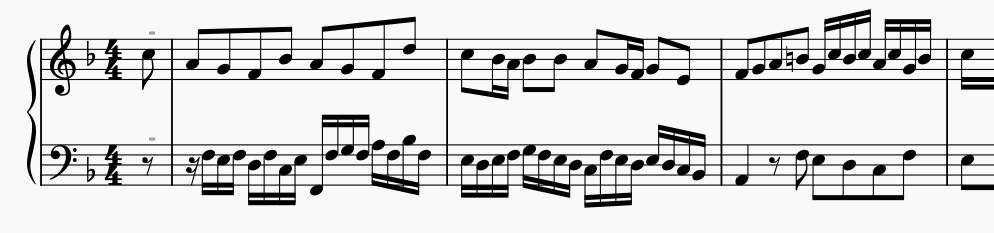
I suppose a subject beginning on the 4th is as about as allowed as an interrupted cadence in a chorale. You can find them every now and then but they are so exceedingly rare in the oeuvre. This fugue would also be the second part of an overture, following a perfect cadence in F. So the issue of your subject establishing the key centre is no longer significant. If one were to compose a standalone piece, the 4th would most certainly be raised to a 5th, then un-raised in later entries as tonal answers. How embarassing. Fixed below!
-
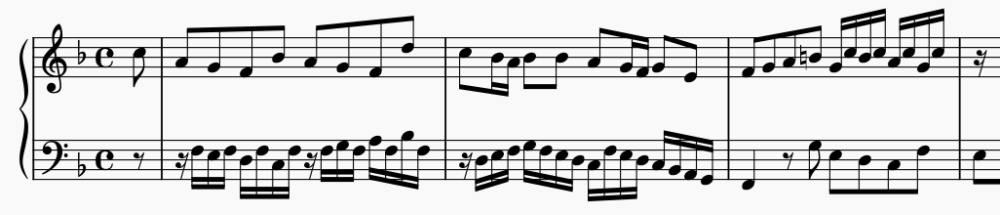
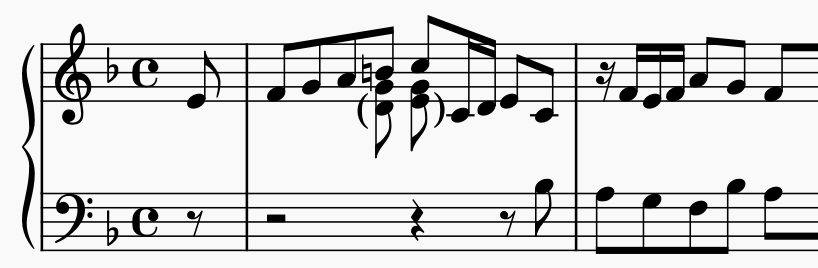
No invention themes/fugal subjects begin on the 4th degree of the scale. The theme does recur throughout but it also must be stated at the beginning of your piece, and here, the presence of the 4th degree is detrimental to establishing the home key of your piece. If you wanted to write an invention you would raise this note to the 5th degree instead. The themes of inventions are based on simple and common harmonic gambits (I-V-I, I-IV-V-I, I-VI-II-V and so on). This theme strongly suggests I-IV-I-IV in the first bar which I have never seen before in a theme/subject. It's nonetheless possible to write an invention here, but it'd require a few tricks. A possible solution for the countertheme is: The anacrusis has been raised by a tone, as discussed before. Note the presence of an inner pedal F in the first bar. This serves three purposes: it strongly establishes the tonic key, it introduces the semiquaver rhythm to be used throughout the rest of the piece, and it reimagines the otherwise problematic I-IV-I-IV progression as a simple decoration of the tonic chord I. The second bar uses scalic passages, and is essentially a decorated dominant chord V. Together with the first bar, what would be an otherwise very unwieldly theme (if harmonised at quaver or crotchet speeds) is now a simple I-V gambit. There is a nice phrase ending at the beginning of bar 3 with the bottom F reached by the bass. The counterpoint here is fully invertible. There's much material here that you can take for your episodes: the scalic passages, the lower mordent-like figure found in bar 2 of the main theme, and the bariolage introduced by the inner pedal in bar 1. Bariolage especially is an absolute motivic goldmine that you can and should exploit in the episodes. It's C and B-flat. Also this kind of dissonance, treated this way, is completely allowed. Take a look at BWV 773 (Invention No. 2) for some beautiful examples. There's nothing wrong with the fast passing vii6. No. Note that the imitation enters 2 crotchets earlier compared to the other solution. You can in theory not do this, and write a 2 crotchet-long continuation, but this is unnecessary for imitation at the fifth here, and therefore slightly inelegant.
-
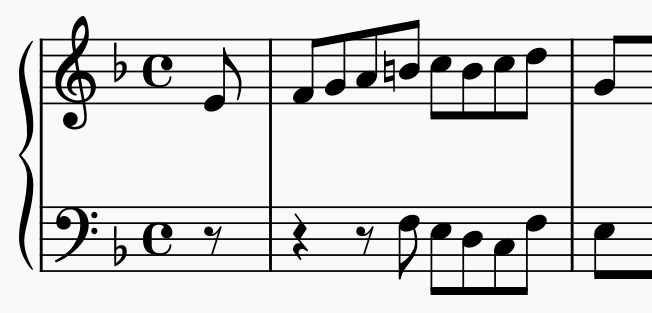
Where in the book does it ask you to use this specific theme as the basis of an entire 2-part invention? For imitation at the octave: This is essentially the same approach as yours: the last two crotchets trace out a C major chord, and the first note of the imitation introduces a B-flat. Together this forms a dominant seventh chord in the key of F, leading us back to the tonic key in the following bars. If you were to harmonise the sharped 4 then you'd use some kind of dominant-tonic chord progression in the key of C, an example of which is shown above. If you were to write a countertheme then it would naturally follow this harmonisation. For imitation at the fifth, the "correct" solution is surprisingly simple:
-
Well, we were missing the context here. I looked at the pages of the book you took the exercise from, and the exercise asks you to compose a countersubject to the theme in the bass, then repeat in the upper part, and no more. It's a simple exercise in composing a countersubject. If that was what had been advertised then my feedback would've been very very different because composing an entire invention is altogether a very different (and harder) beast compared to writing a countersubject (which does not even need to be invertible). So what is your goal here? You've done what the exercise asked of you in bars 4-6. There's a few errors in your countersubject but overall you have the right idea. But then you extended the exercise into a 32-bar piece, which you named an invention, and it doesn't work as an invention for all of the reasons I've listed. Do you want feedback on the specific countersubject(s) you've composed? Or do you want feedback on the whole piece?
-
Since this book is a fairly comprehensive text in harmony, you should keep what you've learnt from this book in mind - not only for these counterpoint pastiches you're writing, but for everything you write from now. The reason why I'm mentioning this is: 18th-century counterpoint (which is what the Goetschius book deals with) and all of the counterpoint-employing music that comes after, is completely interwoven with harmony. All of the harmonic devices/features you have learnt so far, you should find readily in these inventions. And so with this in mind, you can hopefully see the two major problems: There are no strong cadences (V-I in root position etc.) anywhere in the piece. This is the musical equivalent of writing a paragraph of text with no punctuation whatsoever. Some of what you write is either harmonically ambiguous, or does not follow common harmony rules. Examples: - In bar 6, what are the first two crotchets supposed to be? Is this V-IV? This is a forbidden progression. Is this I-IV? Then why is the root of I missing? Contrast this with the last two crochets of bar 7, which clearly spells out a C major chord and is well-written. - What are the last two crochets of bar 12 trying to spell out? Is this V? vii°? i? - What is bar 16? You start off with a G chord (fine), introduces the C# in the upper voice which strongly suggests a chord that is the dominant seventh in third inversion of D minor (also fine), but then this dominant seventh resolves to a B natural chord (?) Point 1 can be easily fixed. Regarding point 2: if you look at Bach's 15 Inventions, you will find that 14 of them have semiquaver prevailing rhythms, and the remainder uses broken chords extensively. This is completely deliberate in 2-part writing. Writing in semiquavers gives you more notes to work with, and one advantage of that is it allows you to trace out chords easily thereby making your harmony unambiguous. I would recommend a similar approach here. The other problem here is form. The main material in a 2-part invention is a section of invertible counterpoint, which is then repeated but often inverted (in the sense of two voices exchanging the material they play) and/or transposed, often called the theme. You have indeed written this. But you also need material between these sections, called episodes. These have multiple functions: they serve as modulatory material, they provide a break from the theme, they introduce devices not often found in the theme such as sequences, they allow motifs found in the theme to be presented in a new context (e.g. harmonised differently), they facilitate strong cadences mentioned above, and so on. You need to write these episodes in for your invention to adhere to the form.
-
-
I've used an 8-bit soundfont here because I have not found any orchestral soundfonts that I liked. Everything has just too much vibrato and too heavy a texture from a HIP (historically-informed performance) point of view. I think Bach works well realised as 8-bit music so this is the approach I took. If you prefer audio which is faithful to the original instrumentation then I've attached a version of it here.
-
This is an aria for alto, flute, strings, and continuo in the late Baroque style. The text is taken from Goethe's Ganymed, and a sample translation can be found here. The form is binary, with the usual closing orchestral ritornello joined by the soloist.
-
-
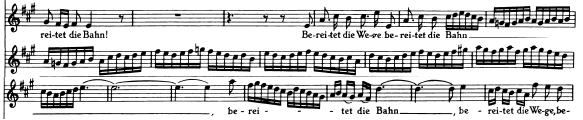
I forgot to add this last time, but I thought of this (infamous) aria when the breathing problem was mentioned. In addition, for historical reasons, this cantata is usually performed transposed up a semitone as opposed to down. Just look at the tessitura of this melisma! Bach must've really hated the poor soprano who had to sing this...
-
I especially love the meditative prelude. The section beginning at mm. 26 with repeated notes and chromatic harmony is extremely elegant and tasteful. The bass line is particularly well-written, and patterns like mm. 51-53 brings subtle drama. The entire piece is playable too! Personally I think some reordering/transposing/rerun of the material here would give the piece better cohesiveness. The reappearance of the quaver-dominated opening material at mm. 15 for example can be in the dominant or relative key, and rerunning it again later (though maybe not in its entirety), particularly near the end brings not only unity but also some excellent contrast to the surrounding French overture rhythms.
-
Absolutely! It's a real pain in the arse to do in Musescore though 😄 It's added to my to-do list (along with some dynamics shadings). I'm acutely aware of the problems of creating actually good-sounding music and I'm very grateful for you pointing this out. One of the nice things about the Baroque ritornello theme in a vocal context, is that your theme does not even need to be singable. The tenor aria from BWV 81 provides a particularly striking example. A common and easy solution for this problem is to just have your soloist sing an independent melody in counterpoint with the ritornello theme whenever it is reused. I've attached an example of this technique for my aria.