

All Activity
- Today
-
Wow, this sounds truly symphonic. I really liked it. To be honest, the whole business of bands is a bit of a mystery. Where I live, there are loads of them – they’re street bands… marching bands? What stands out here is that there are loads of clarinets. They’re bands designed to accompany parades and play ‘pasodoble’-style music and the like. I suppose there are lots of different set-ups.
-
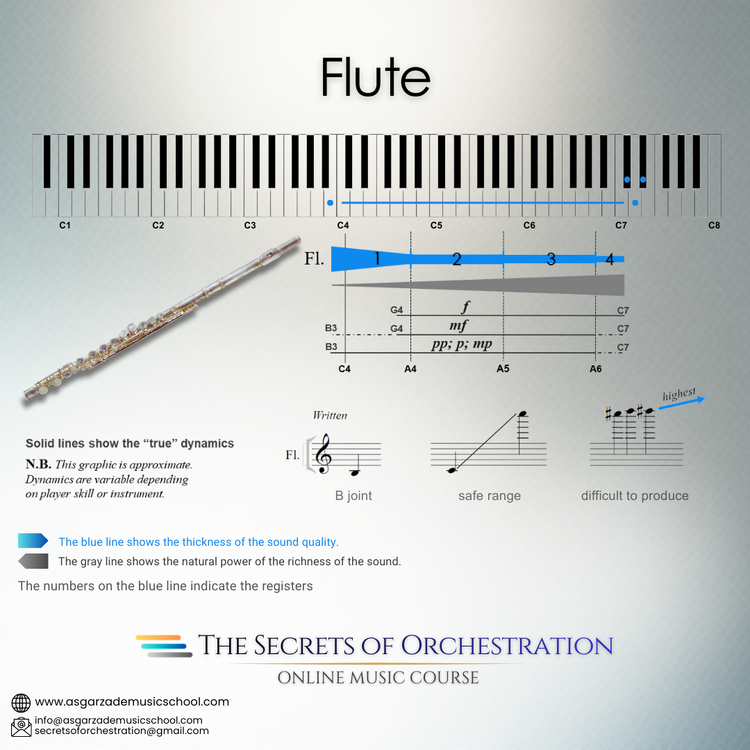
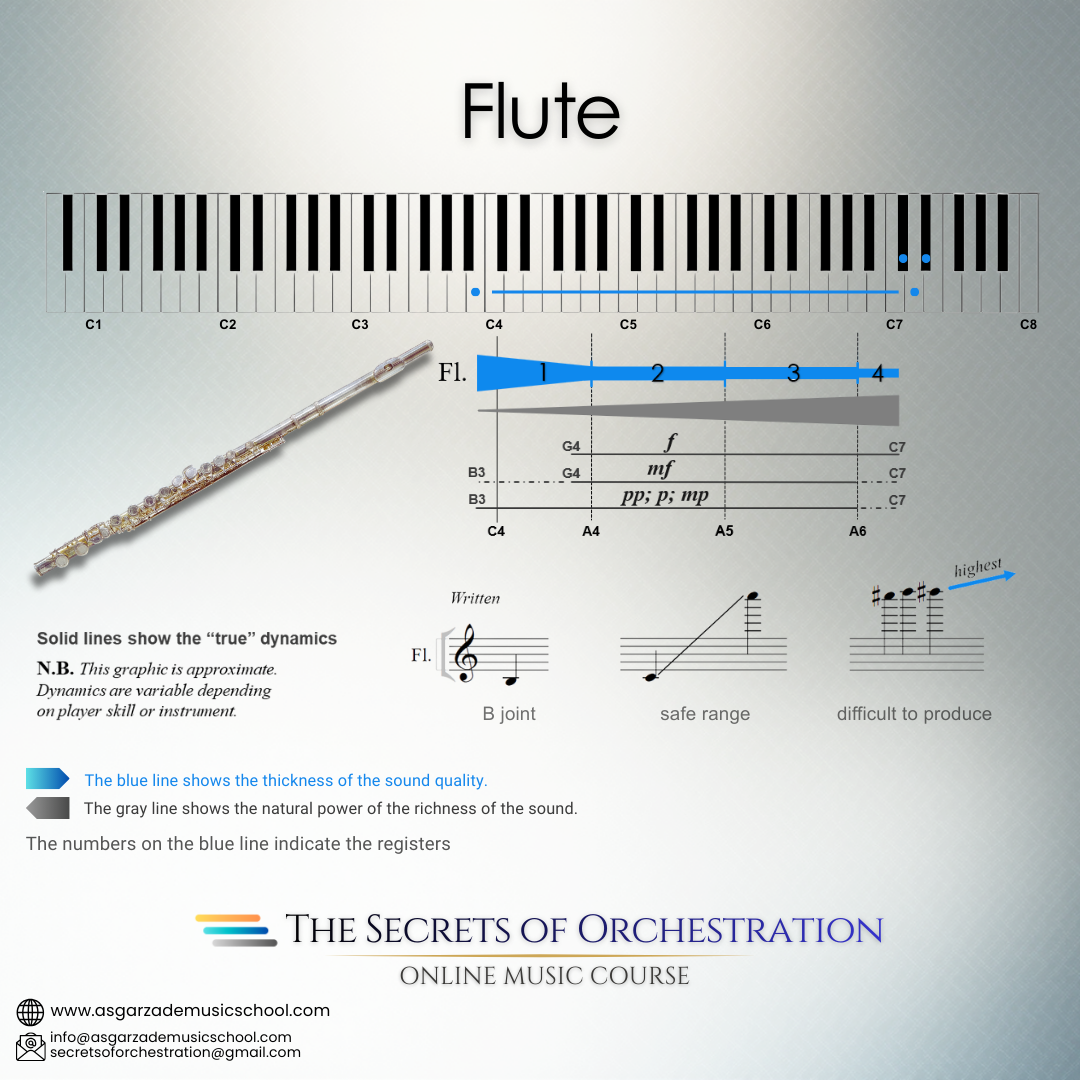
The Range of the FluteThe flute is a member of the woodwind family and is capable of producing a wide range of pitches. The blue solid line on the keyboard indicates the safe range of the flute, extending from C4 to C7. The blue dots show the flute’s extreme upper notes, where pitches of C7 and above are possible but not considered reliable in standard orchestral writing. Special attention should be given to B4, as this pitch is only available on flutes equipped with a B-foot joint and should therefore be used with caution. The Registers of the FluteThe blue arrow illustrates the perceived thickness and projection of the flute’s sound across its range. In the low register, the flute produces a relatively full but soft timbre, while in the upper registers the sound becomes increasingly bright, focused, and penetrating. This instrument can be divided into four registers, as shown in the graphic: 1st Register: C4 - A4 2nd Register: A4 - A5 3rd Register: A5 - A6 4th Register: A6 and above More Information: https://asgarzademusicschool.com/blog/blog-4-flute-woodwind-section-instrumentation-orchestration
-
Fantasia with a change of mood.pdfFantasia with a change of mood.mp3
-
I like what you have done here by essentially utilizing a well known (and somewhat cliched) sequence off the baroque period (Handel comes to mind) before demonstrating the range of tonal and chromatic possibilities with emerging romanticism. I admire your work. It at times feel they read too much as a technical exercise in counterpoint and voice leading. Your melodies need to sing! As Luis pointed out, the excessive use of arpeggios in the midi betray the experience. You could change the instruments to woodwind or strings to allow the suspensions to be sustained clearly, and utilize a quality sound set like the musescore library. You’re always on point with the technical delivery. But this doesn’t always guarantee that we ‘feel’ it. Just a suggestion ☺️ ps I’m Markus, nice to e meet!
-
P. S. I didn't have any specific inspiration, over the time I've been composing, I've developed my own style, which may not be to everyone's taste, so I'm grateful for every new listener. I only borrowed the thematic material from that old Czech spiritual song I mentioned, which is why this is a variation.
-
-
Interesting stuff. I appreciate what you are trying to do with the key idea although to only have one single motif risks monotony, particularly when in a largely homophonic style. That said, monotony can be delivered ingeniously such as that first movement in 3rd symphony by Goreki, in which he embed essentially a dark and soulless motif that he sustains for well over 13 minutes, starting within the bass before consistent layering with the other instruments of the orchestra it above while rising steadily in pitch and dynamic intensity… before descending with largely the reverse. All of this is said to depict the machinations of nazi germany. Perhaps even the banality of evil. the key thing is that his motif seldom stops… it keeps going and going. Modulations are sparse, again perhaps to make it devoid of color. All of this is beautifully contrasted with a human voice emerges from those depths afterwards. This piece just came to mind because of the political connotations you’re striving for. Here it is
-
Hi again! I listened to this piece, and it is a challenging and great piece. I like it. It’s hard to explain, but to me, it sounded like an organ piece that doesn't actually sound like an organ piece. By that, I mean it feels so fluid and the notes feel so scattered that, in a very good way, it felt like listening to a piano piece. Is there a specific work you used as a reference? I don't know of any other music quite like this. I like your composing style. I will check out any other variations if you release them in the future. Thank you. P.S. Just a small suggestion, but if you could embed the YouTube link so people can listen to it right here without being redirected to YouTube, I think even more people would check it out!
-
Hi, thank you so much for listening to my composition, I really appreciate it! And I also appreciate that you took the time to check out my other works. As for plugins (VSTs), I usually tweak the very basic digital instruments available on MuseHub and try to get the most out of them 🙂
-
Hello, I listened to this piece, and to be honest, I really liked it. It’s a fun and captivating work to listen to. The structure has great dynamics, keeping it engaging throughout, you truly have wonderful composition skills. I also checked out your other works, and Five-minute pieces for violin and piano in particular is another fantastic piece, with music that flows like a river. Please continue to share your work in the future. I did notice a little bit of audio clipping at around 1:15 in this piece (Suite for clarinet, soprano saxophone and piano), but that doesn't really matter when compared to your composition. By the way, I would be really happy if you could tell me what plugins you are using. Thank you.
- Yesterday
-
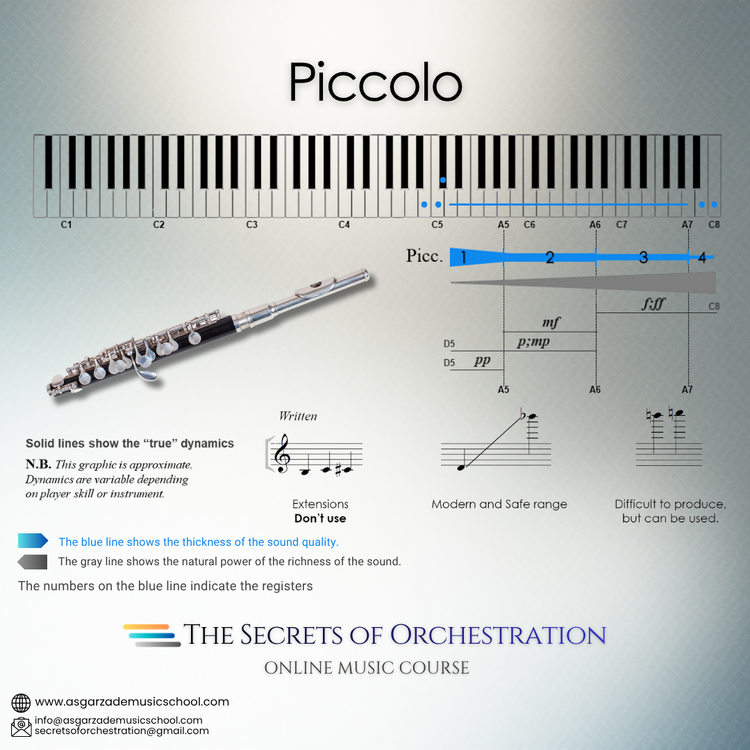
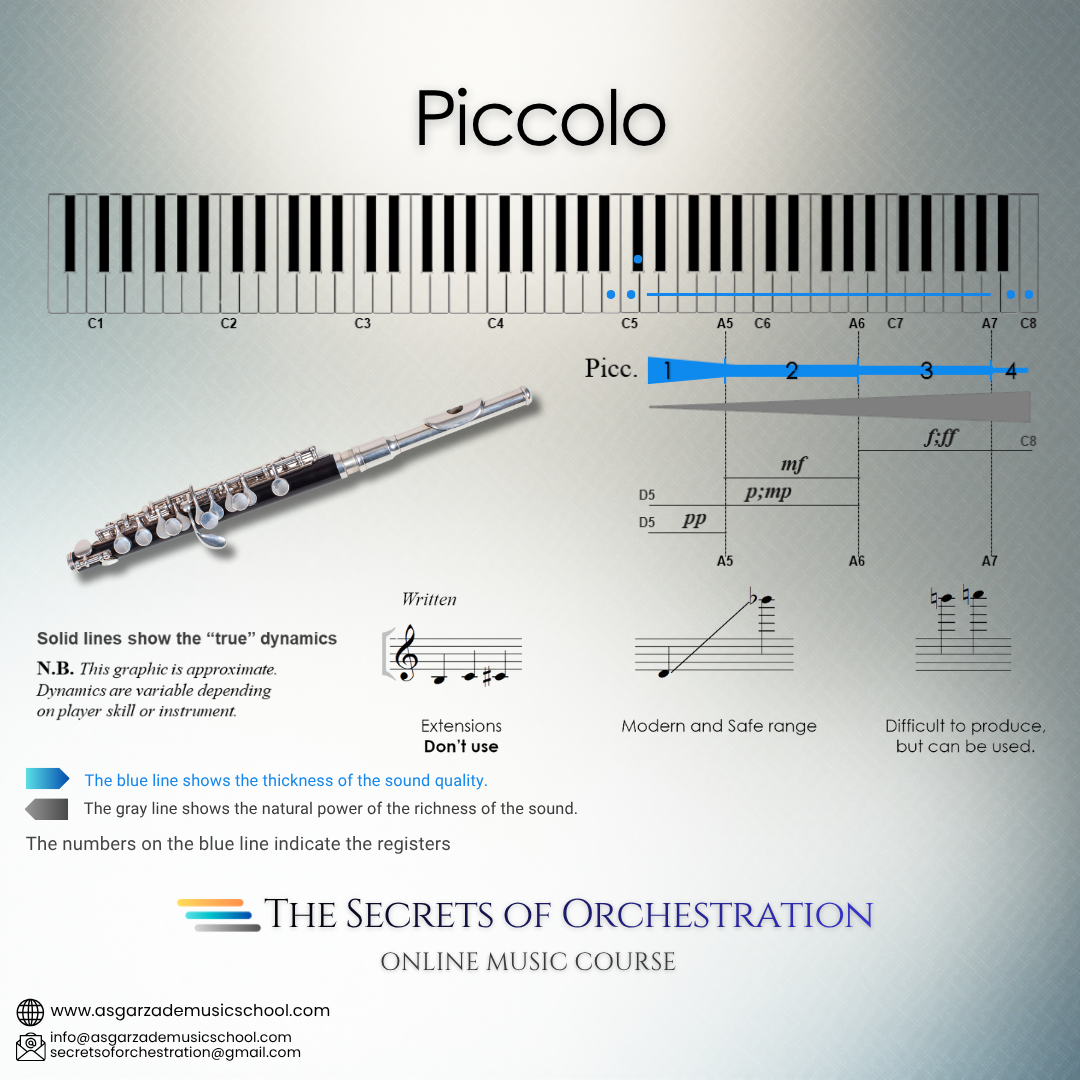
The Range of the PiccoloThe piccolo is a member of the woodwind family and is the highest-pitched instrument in the woodwind section. Despite its small size, it has a bright and penetrating sound that can easily cut through an orchestra. The blue solid line on the keyboard indicates the safe range of the piccolo, which extends from D5 to A7. The blue dots line shows that the piccolo can reach C8 or even higher, but these notes are not considered safe. Additionally, the notes B4, C5, and C#5 should be avoided, as they do not exist on a standard symphonic piccolo. The Registers of the Piccolo The blue arrow illustrates the sound thickness of the piccolo. In the low register, the piccolo has a fuller, thicker timbre, while in the higher register, its sound becomes brighter and penetrating. This instrument can be divided into four registers, as shown in the graphic: 1st Register: D5 - A5 2nd Register: A5 - A6 3rd Register: A6 - A7 4th Register: A7 - & Detailed information: https://asgarzademusicschool.com/blog/blog-3-piccolo-woodwind-section-instrumentation-orchestration
-
Thanks very much for your suggestions! I'm revising the score to make some of these fixes. The cello line is not really meant to be the main feature; I think of it more like a cantus firmus, and I prefer the familiar melody to be there more subtly. But I didn't write slurs into the cello part just to try to give it a little bit of detachment from the other parts. Not sure how well that works, but that was the idea. The two quarter rests in those measures you mention are because the a tempo comes only on the fourth beat of the measure. Thanks again!
-
A nice and cute miniature piece. It is (obviously,) one movement long, and has 124 bars. It is written in Ab Major. https://musescore.com/user/96214813/scores/35260994 Sketch No. 1.mp3 Etuden Op. 53.pdf
-
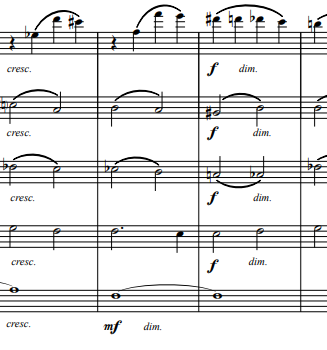
Hello! Interesting piece to have listened to. I must apologize now as I have some comments and in an effort to stay concise, I will be blunt. Here are my thoughts: (view on PC if able, not mobile) Double check the alignment of your diminuendos and crescendos. To me, it casts the illusion that the score is a little unpolished: With the slur groupings (two-note slurs), was it your intention to make it an ensemble feature? I saw some spots that have two-note slurs in one instrument, but not the others, even when the gestures feels the same: Measures 2 and 6 (in cello) as one example. Last thing would be dynamics themselves. If cello is the main feature, I think it a little asymmetrical to have the violin 1 be a dynamic marking louder than the melody. Shouldn't the cello be the loudest voice when presenting the melody? With the tempo markings, I think it looks better and easier to read when the text is a font size or two bigger or in bold. As a performer, it helps visually distinct the two text field types. Last few picky things would be measures 8,14 and 21. Why not just use a half rest for the other voices on beats 3-4? For the ending 4-bars, why not write "Sempre diminuendo" meaning "Always Diminishing" or "Morendo" to imply "dying away". Your pianissimo to Niente dynamic is a little messy with the spacing not consistent between all instruments. Final thing is to double check/ update is the idea of adding copyright information and a subtitle to say "for String Orchestra" or "for String Quartet". This helps as on first look of the score, the ensemble size is not mentioned. Good work!
-
I'd never written for concert band before, however, that's the only ensemble, aside from one performance, that I've ever rehearsed and performed a production within... So I am very familiar with how the instrumentation is utilized in concert band scores. This was inspired by some work from another collegue of mine, that with their permission, I was allowed to put my own "twist" on it, and it is very very far from it's original form... I suppose that makes it more original than arrangement, but ah. I can't take all the credit for it if I didn't conjure it up myself from scratch. It's very short, and I didn't really have any intent on developing it into a more lengthy, complete piece, despite my desire to do so... I think it's quite extravigant, triumphant and reminds me of a hopeful feeling. I suppose the idea is that it can be used, potentially as an opener piece for a band somewhere, somehow. lol Let me know what y'all think P.S. Yes, I know there are a couple of engraving errors, such as Dynamic marking placements for example. The score isn’t a polished and finished product, 100% as of right now. Just an FYI 😅 Thanks!! -Unc whatliesahead.pdfWhatLiesAhead.mp3
-
This is a short thing I wrote in one day, perhaps a bit self-indulgently expressing my rather, shall we say... mixed... feelings right now about my country as we near the 250th anniversary of independence. The cellos play the melody of "America the Beautiful" while the violins and violas add harmonies that subvert the simple tune. As always, any comments or feedback would be appreciated! Semiquincentennial.mp3 Semiquincentennial.pdf
-
@Alex Weidmann Thank you for listening. Yes, the piano version is very different – more ‘intimate’, perhaps? – despite that crescendo. I was in no doubt that the brass section was meant for that part... When I orchestrate something that already exists (for piano, generally speaking), I have two options: 1) to be as faithful as possible, which in some cases is almost essential, 2) to recreate the piece for the orchestra. In this case, it usually turns out quite differently.
-
-
BachInBlack joined the community
-
Ah, I see. (I thought Frank Bridge was a landmark; which I hadn't looked up yet. Ha!) Regardless, you brought Britten's advisor's piano music to life. Your rendition of it is quite stunning; and does invoke the urban late night mood as for-mentioned. And, the second portion of my post (regarding difficulty of percussion part) still stands.
- Last week
-
To highlight a few key differences between either piece, in Chopin's prelude the melodic contour seeks minimalism in a way that balances out the listener's focus and allows the left-hand chords to shine and be heard more clearly. However, in my composition, the melody is most of the time merely a product of the top line of the right-hand chords and while it does produce a distinctive effect due to the rhythmic motif and its characteristic contiguously rising and falling eighth note in the 4th beat of its initial measure, it is not a sufficiently distinctive part to be considered, in my view, integrally alienable from the lower voices or the right-hand chord progression as a whole. Well, some earlier pieces of mine, composed almost exclusively for piano specifically, were mostly focused on styles closer to that of this composition than those of my usual production, such as in this post: https://www.youngcomposers.com/t44435/triwaltzia-no-1 You're correct in pointing out the deviation from my usual style with heavy counterpoint. The title, however, was not actually a strict or entirely accurate stylistic descriptor, and instead it purely serves as an indicator of a particular style I sought to emulate from the Romantic era. It obviously does not account for the entire range of styles and genres that this period in the history of Western classical tradition has to offer, but instead builds an association based on the "vibes" of the music, if I may use such a term. I especially agree with your first line of criticsm: the constant reiteration of the same rhythmic motif ending up producing a far too monotonous, repetitive or boring impression was indeed a concern even before this piece was finished. However, every time I tried to vary the rhythms or change the bass, it felt jarringly sudden and unexpected, breaking pattern in a way that not only was far from subtle, but also completely imbalanced considering the listener's expectations after the first couple phrases. Adding a contrasting B section with an entirely different theme might have solved the issue, but I failed to execute such an option in time before the whole piece was nearly complete. The density of the chords doesn't concern me nearly that much. Reducing the number of internal voices in the middle sections seemed to create the same unexpected vacuum I just described, so as long it doesn't get in the way of the dynamic contrast across the piece I personally see no problem with it, since I'm certain any sufficiently skilled pianist would be able to perform those in spite of the uniform chord density throughout. I'm interpreting what you mean by the bass being "underused" as not providing sufficient rhyhtmic or schematic variety, which could just as easily be referring to the right hand chords, just as in your first point. As for the arpeggios, I disagree with the premise that it is merely an effect: it is integral to the motif across the whole composition. I do understand what you actually mean by that, however: it once again comes back to the original line of criticism. The bars you mentioned were unplayable without additional arpeggios merely included a major 9th and 10th. The 10th in question has been edited to an octave for easier performance with a smaller handspan, even though it is still arpeggiated. However, that doesn't solve the rest of the 10th in the 2nd beat of each measure in that sequence, so sorry in advance to pianists with smaller hands: I must admit feasible playability is still not my main priority (ah, what would I do without the wonders of modern technology...) Anyway, thank you kindly for your review and points of criticism. I will most likely take them into careful consideration when setting myself to write compositions similar to this one.
-
Hi, many thanks for the kind words, and thoughtful review. Frank Bridge is actually the composer. (Don't worry, I hadn't heard of him either until very recently!) This is my orchestration of his 3 movement piano work "The Hour Glass". (You can find the other 2 movements lower down in the Orchestral and Large Ensemble category.) Far as I know, it's never been orchestrated before. Frank was a British composer (1879-1941), who mentored the young Benjamin Britten. I think the main issue with the marimba part is whether you can actually physically get round the instrument to play those octave movements at this tempo. And also whether you can find an extra large marimba (and vibraphone) to cover the pitch range required. I'm thinking I'll probably rework those passages so they fall into a narrower range. I've heard those stories about orchestras not taking student works seriously; but what can you do?
-
Thank you for your review. I should point out, however, that the chorus is intended to sound louder in order for the lyrics to be at the very least audible and not drowned by the orchestra, let alone trying to make them sound barely intelligible. I find it optimal since the choir is singing the canon in th exact same configuration as the other instrumental sections: the placement of the voices across different lines and registers is the exact same for all three. And also, there is no brass in the score or audio. This is not intended as a symphonic orchestral arrangement, and I personally dislike the timbre of brass instruments and even some woodwinds such as the saxophone for example, so they are not getting included in the score anytime soon. Have a nice day.
-
PeterthePapercomPoser replied to PeterthePapercomPoser's topic in Music Appreciation: Suggest Works or ArticlesSuper Mario 3D World - Lava Rock Lair:
-
I'm wondering greatly why this piece did not receive any feedback (let alone positive and encouragingly complimentary feedback), even after 3 weeks and more. I absolutely love many elements that have been used in this score: Use of melodic Caliope (Baritone woodwinds, Soprano Strings) background call-and-response (alternating between Violone and Violin/Violinone) moment of introductory climatic moment (the herold of the Timpani's and Double-Bass's dotted-rhythmic march) Just to name the few things. It also invokes a beautiful sense of a late evening walk down an urban city. (I just checked the name of your piece again, and it speaks of the "Frank Bridge"! The setting illustration you were going for seems excellently executed!) ~~~~~~~~~~~~~~~~ I do concur that arranging 2/4-hand Piano works into Orchestra is quite the arduous and ambitious task. Most people don't realize how difficult it really is to learn idiomatic writing for 30 or more instruments; so that your performers can perform your work at ease and with joy; and your audience can, at the same time, enjoy the listening experience of it. (I have come across a lot of works that is a 'joy' to play, because it's highly idiomatic and "quite easy to perform" with "minimal rehearsal"; but with little thought having been put into the music, which makes the listening experience of it a bit dull and flat. "Boring" music, as some would call it. In short, easy and simple to play; not fun to listen to!) As far as difficulty of instrumental writing is concerned (you brought up your virtuosic pitched percussion lines being advised by Musescore as difficult): a lot of times, it heavily depends on the personal practice (as well as personal incentive and motivation) by individual performers to bring your works to life. From my own experience: if it doesn't sound like how it's supposed to and/or it seems like the performer is struggling and making the music seem too difficult to fully and viably perform.... a lot of times, it's because they haven't practiced the music, and/or they simply need to care about it more. In these instances, it often has minimally or not at all to do with your own fine writing. Just as a composer-to-composer word of reassurance. ;) (Check out my own music score that I posed two days ago! I have spent time writing fairly to greatly idiomatically for many of the instruments; making the line seem 'harder' than it actually is. Yet, the players of its earlier first edition still struggled, when I gave it to a Philharmonic (one of 'the best' in Europe, as it is reputed; especially considering the historic famous composers who had given it premiere music to perform! Not naming names, not naming the orchestra) to performed. Furthermore, guess what?? During the first rehearsal, the dress rehearsal and the final performance that premiered this Tone Poem), it sounded like an intermediate half-learned high-school concert band that's just learning how to get it together. Individual instruments were literally sticking out, and a few sections were quite off pitch, shrill, crass and.... not performing the affects I was intending/asking for. This happened, despite having the music 3 weeks to a month before their final performance; and, they have the MIDI mockup. They were given the resources to make it happen. And, it didn't. It was very embarrassing, seeing that, at the end of the premiere, I had to stand up and take a bow. Forever, that European audience saw my face and will remember me: that it must be me as a composer. After speaking to people later down the line who reviewed the (earlier first edition of this) music, the remark I received was, "....Why was it not performed better?" or "... Why did they sound like that?" "The line is fairly easy and straight-forward to achieve, with some bit of practice." See that? Was it my music, or was it simply that my performers didn't care enough to practice it? I suppose I can diverge into the topic about Philharmonics rolling their eyes when it comes to having to "deal with" new student works (You know, 'here we go again...student works.... let's get this done, so that we can enjoy playing Beethoven and Shostakovich!!'), but I won't get too far off the topic at hand. What was my point in all of this? Your Vibraphone and Marimba lines are likely fine. It's probably regarded as difficult, but that certainly doesn't make it not viable and easy to learn! Really, it comes down to the attitude and the desire by your percussionists to learn and practice it!)
-














.thumb.png.8b5b433a341551e913a34392660bc95b.png)