

All Activity
- Past hour
-
Seems about right.
-
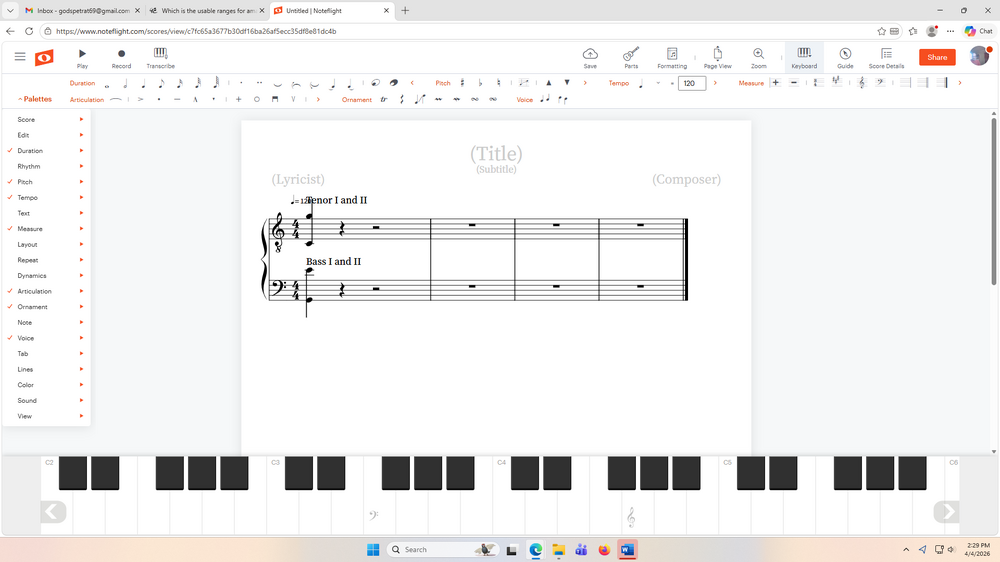
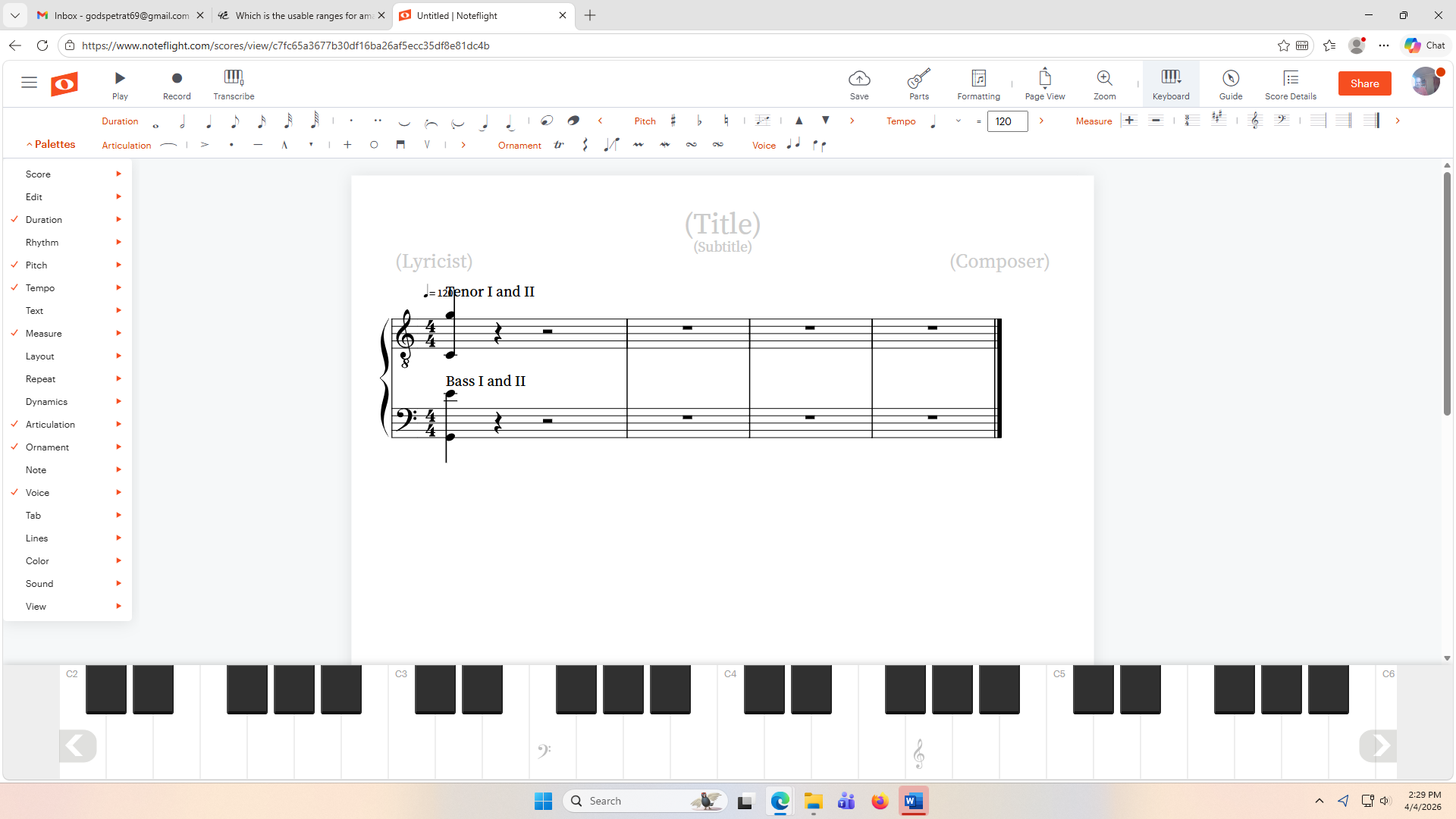
Thanks sir so tenor one around e3 to g4 Tenor 2 c3 to e4 Baritone a2 to c4/d4 Bass f2 to a3 or b3
-
Yep!
- Today
-
Please be careful everyone................................. 5) The name, surname and category of participation must be clearly written on the first page of the score. The following must be sent along with the score:– copy of identity card. 9) The jury also reserves the right to not to award a prize, as deemed appropriate. https://www.police.uk/advice/advice-and-information/fa/fraud/personal-fraud/identity-fraud/ https://netsafe.org.nz/scams/fake-competitions-prizes https://www.bromley.gov.uk/leaflet/249240/15/758/d https://www.foresters.com/en-gb/learn/our-articles/online-security-entering-competitions
-
Piro Gaqi joined the community
-
INTERNATIONAL COMPOSITION COMPETITION “GEORGE ȘTEPHĂNESCU” – 6TH EDITION Artistic Director: Piro Gaqi Executive Director: Ilinca Ștephănescu – Neagu COMPETITION RULES The competition is divided into 2 sections: A) Compositions for voice and piano, with the text in Romanian, between 3 – 5 minutes long. – the text may be written especially for this composition, or the composer may use pre-existing text, after appropriately securing the copyright from the text’s author. B) Compositions for voice and piano, with the text in Albanian, between 3 – 5 minutes long. – the text may be written especially for this composition, or the composer may use pre-existing text, after appropriately securing the copyright from the text’s author. General criteria of the contest: 1) Only compositions for voice and piano are accepted for this competition. Any composition that does not meet this criterion will be disqualified by the jury. 2) All composers regardless of age or nationality can participate in the competition. 3) The works must not be previously published, performed, nor recorded (CD, Video) and must not be available online in any form (audio, video or pdf). 4) The scores and all necessary materials mentioned below must be sent by May 1st, 2026 only online and in PDF format to: georgestephanescucompetition@gmail.com 5) The name, surname and category of participation must be clearly written on the first page of the score. The following must be sent along with the score: – participation form (https://www.stephanescu-arephy.com/wp-content/uploads/2025/11/LIDURI-For...) – copy of identity card. – a statement written by the composer attesting that the composition entered into the competition meets all the conditions mentioned in criteria no. 3. – statement of the right to use the text used for the work and whether for this text there are copyrights it must be stated in the statement that the rights have been assigned or paid for/by to the composer. – assigning the copyright to the association for the subsequent publication of the composition. – the author must agree that, if they are declared winner of the competition, the following must be included in all future public appearances of the composition (scores, posters, quotes): “The work won the Sixth Edition of the George Ștephănescu International Composition Competition”. If it’s not specified it can disqualify the work retroactively and may result in the return of the prize. – the author agrees with the fact that for the awarded works the first audition will take place only at the “International Composition Competition George Ștephănescu – Sixth Edition”. 6) The jury will be composed of 3 distinguished members of international renown from Romania and Albania. 7) AWARDS: Section A) The composer of the work being awarded the first prize will receive a cash award of 800 Euros. The composition will be published by a music publishing house in Bucharest and will receive its world premiere at a recital organized in 2026. The composer of the work being awarded the second prize will receive a cash award of 400 Euros. The composition will be published by a music publishing house in Bucharest and will receive its world premiere at a recital organized in 2026. Section B) The composer of the work being awarded the first prize will receive a cash award of 800 Euros. The composition will be published by a music publishing house in Bucharest and will receive its world premiere at a recital organized in 2026. The composer of the work being awarded the second prize will receive a cash award of 400 Euros. The composition will be published by a music publishing house in Bucharest and will receive its world premiere at a recital organized in 2026. * In order to be published, all the awarded works must be submitted in Finale format. 8) Composers are only allowed to submit a single composition for this competition. If several works are sent from the same composer, none will be considered. 9) The jury has the right to award additional prizes or diplomas for other works considered valuable. The jury also reserves the right to not to award a prize, as deemed appropriate. 10) The decisions of the jury are final and cannot be contested. 11) The contest organizers reserve the right to change the contest information if this proves to be indispensable due to force majeure. 12) The winners of the contest will be displayed on our website’s Contest page on 15.05.2026 (https://www.stephanescu-arephy.com/en/contest/) Deadline: 1 May 2026 Web site: https://www.stephanescu-arephy.com/en/contest/
-
Thanks sir so you say tenor 1 should be kept at g4 for practicality
-
Explain what you mean by this. It sounds like a criticism, which would be welcome enough, as I'm always looking to improve my technique.
-
The Creator of the Stars. This one turned out, I think, sounding quite majestic.
-
UncleRed99: Also, I noticed at M. 67, I have no idea what's goin on there with the ensemble, but it's definitely out of key between all the parts. lol Made me cringe a bit, if I'm honest. As far as I can tell, M. 67 is just an F# Minor chord, with a couple dissonant tones floating around it.
-
Obviously, this would be a huge orchestration project, and I'll finish my piano sonata first of course!
-
That is 笛子。Playing the flute is called 吹笛子。
-
So that is why your notation is... Ahem... Quite interesting....
-
Amateur tenors can't keep pounding out that high G; prepare it and don't overuse it. Basses as opposed to baritones might not like a whole lot of that E, so usually don't go higher than a D. Something I post like Part Songs or sacred music will take tenors (and sopranos) to A, basses as low as f below g, as high as the high e or even f occasionally, but that would be if I was thinking soloists, and I don't intend that stuff for amateurs.
-
Interesting; this is what some site gives for Barbershop Quartet, but these are soloists! From highest to lowest, the voice parts in barbershop are tenor, lead (melody), baritone, and bass. The following graphics indicate the common vocal ranges by gender of the four parts used in barbershop arrangements: Male: http://www.barbershop.org/wp-content/uploads/2018/06/malerange.jpg Note the subscript 8 under the treble clef to indicate that it sounds an octave lower than written. This is traditional TTBB notation. For four average male singers, I would just keep it, keeping in mind that with really good singers (pro or talented amateur) one can stretch the ranges a bit.
-
Please give me the safest ranges for each part
-
Abdul w joined the community
-
Hello again! After a few days of chaos in my life, I was sidetracked from getting these comments done. Attached on this reply is a pdf containing my annotations to your Score as well as two pages of comments at the end for simplicity. If you have any questions, I will do my best to answer! PDF: A. Karatzikis - Land of Gods (ANNOTATED).Pdf
-
Although I compose music, I actually do not play any instruments unless you count entering notes into a computer program and hearing them sound back. I'm sure learning to play something of a more organic nature would benefit me as a composer, but I've never been motivated to follow through on growing skilled at producing sound on a normal musical instrument.
-
-
-
Hi all 🙂 Here's my new study. Have a good Easter 🙂 Marc Quatuor pour flûte et cordes.mp3 01 - Conducteur - Quatuor pour flûte et cordes.pdf
-
Hellloooo! This is my submission for the Landscapes competition. For my landscape i have chosen the Italian mountainous region of the Lombardy. The instrumentation is (supposed to be) 1 Cornetto and 3 Sackbuts, but there is also the possibility of other instruments like a consort of viols or a broken consort.LOB 64 Padovana et Gagliarda Detta la Lombarda.mp3 OBS: The original insturmentation is sadly not possible due to the fact that i dont have good enough virtual instruments that have a good sound, the only ones that i have are soundfonts that sound quite unrealistic and robotic...
- Yesterday
drum and bass song drum and basss.mp3haha that was who i got some inspiration for this fromAdding onto both of the people above me, I am just going make my point. Firstly, it is interesting that you start with the subdominant. You decided to keep it just like mysterious at the beginning. I really admire that. Great that you have put in effort to do dynamics. That is nice. Dynamics are important for understanding the music completely. Maybe try to also have some italian terms in your music next time. It could really help with bringing out the right emotion. I know it is annoying. Structure, and I agree. It is in fact annoying, but next time, maybe try to do it in a sonata form without repeats and stuff. Try it. Don't worry about the amount of themes. Just focus on structure. have an idea, develop it, and come back. This is good practice. Try all kinds of forms. Don't stop yourself from trying new things. (!Self-Promotion Alert!) Just recently, I have written my second Nocturne, which is almost the opposite of my previous, incredibly virtuostic self. Overall, you have composed a well thought piece of music. P.S.: Are you told you have to write chord names?









.thumb.jpg.68de6ce8338a30f9d952280fecad70a0.jpg)