All Activity
- Past hour
-
I think his name is actually Mason..🤣
-
-
Thank you, Mason. I will amend the score layout this morning. I appreciate this will make it easier to scrutinize for those having a deep dive. The current view and lack of repeats is intention for my own eyes and there is often no point having repeats during this phase of work. But yet, with the repeats the first movement will be at least 10 minutes once I am done with it. You seem to be a guy who knows his stuff. Very much looking forward to your comments. Will check out your stuff too!
- Today
-
Hello people I don’t know if this is the right place to post this, but it has a lot of relevance to large ensemble and orchestra music that ill just throw this in here. question: orchestra director and you were to program music that was previously composed, and “published” to this forum what would you program? There is a lot of great music published on here and practically all of the music get their fair share of feedback, but there’s rarely any talk of logistical. What if they were programmed with this question I’ll break that barrier. of course, being a composer myself, this list will definitely include some of my works, but without the bias, here are a bunch of stuff I have found throughout the years Again, I’ll do a follow up later, giving rationale and credits, but these are the titles that stuck with me “Blue jelly” and “three crows in a tree” (from why we remember that was the title) we’re really good pieces very short great for introducing the concept of concert Orchestra “ The whale in the whaler” was another good piece that I remember coming across and by intent, this was technically chamber music, but it was so borderline that it passed as concert string Orchestra music “ sunset suite in c minor” would be a perfect ballad for any string Orchestra concert
-
You're welcome @JorgeDavid. I am planning to do my reviews in that manner. I am thinking it will be more helpful that way.
-
Hello! I have completed a first listen and looked over the score. I hope to do a deeper dive and analyze the score thoroughly, and the following are my initial thoughts. Very much classical style, and quite refreshing to hear something in that style again. Check your engraving. Over the entire score, you have rests with dynamic markings. Page layout can be bigger or staves made smaller. At least 4 measures per page. There is key information missing from the score. If anything, the number of instruments as well as copyright information. You just say "Flute, Oboe, Clarinet," however, do you intend for more than 1 player for this part? Between the two movements, in Musescore, you can add a "SYSTEM BREAK" which will end the piece and add a pause after a double bar line. On the next page, it will list the full instrument parts again. (in the layout palette) With the literal music, there is more play you can do with the structure or in your accompaniment parts I think. 5-minutes for a classical symphony is on the shorter side and you can mess with the idea of a repeat after the exposition and utilize a 1st and 2nd ending to propel yourself into the development. It's not a "double exposition" per-say, however very common for the music of the time.
- Yesterday
-
-
Hello @Kvothe , thank you so much for all the feedback and glad you enjoyed the piece! You are right, I had not realized until you pointed it out. I decided to change those measures so I modified m.14 and similar measures so now the transition to the contrasting section of A is done without stopping the waltz rhythmic flow. I experimented a little bit with the harmony. In general I am happy with most progressions except for m.7~9 where I do the following harmonic progression: Db7 --> Bbaug/D --> Ebmin. It was a solution I came across for moving from Db7 to Ebmin while having an enharmonic common tone (F#-Gb) in the melody. Yes, I agree. Since I composed it as a short piece I tried to have fun with the main melody (not trying to write sentence, period or hybrid, which I did in the B section instead) but it came out too Jazzy. I do like it but I think it gets too chromatic too early (so I like it the main theme much more during the reprise than at the beginning, once the ear got used to it). I think it is okay for a short piece like this but I am trying to learn ways to "smooth" the way to chromatism in themes like this one. Thank you so much for all the feedback!
-
-
Hello, I posted an earlier iteration of this work some time ago. A lot has since formed. The general structure of the first movement is complete; I still intend to vary the recapitulation somewhat as I prefer to not simply repeat the second subject verbatim. But it is more or less done. I have also made a start on the second movement. This movement has a slightly unusual disposition and is on the way for becoming an ambitious piece with its emerging structure in mind. I am posting here in advance of completion to gauge people's feelings about the musical ideas. Perhaps if anyone has suggestions I would love to hear perspectives. Or even if you like it, that helps to say too. Composing is otherwise an activity for solitude! Second movement is @ 05:40. Thanks! Markus Score.mp3 Score.pdf
-
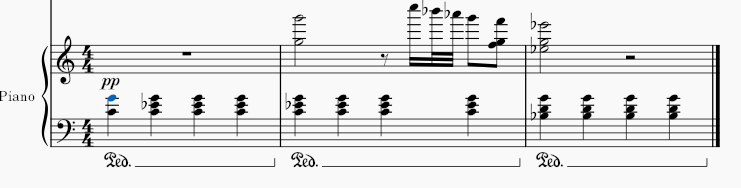
There is a key change but, I was meaning mostly the change of tessitura and texture (in that particular instance, besides changing the key, you leave large gaps between the accompaniment and the melody, which contrasts with the previous measures in which the G staff was clustered with notes). What I meant around 1:50 was not a modulation, but rather a change in tessitura for the melody. I might be wrong, but the same melody is played for the first time around the 00:59 mark, which, at the same time, is a variation of the main melody with which the piece starts. As a result, while my ear does not ask for a key change (the initial Cmin chords from m.34 sound perfectly nice to me), when the G5 sounds, yet once more, somehow my ear is tired of hearing the melody always in that range. I think, at that point, it would really make it much fresher playing the melody an octave higher or even in a bass (with the melody played below the Cmaj accompaniment chord), starting it in G6 or G3. For example, this is a fast draft I made of the initial measures when played an octave higher. Since the melody has already being played in around G5 for a few times, it might make it fresher going up an octave like this. The melody has some fast notes at times, so it cannot be played in octaves easily, but something like this might work at times. octave_melody.mp3 Hope it helps!
-
Thank you for your feedback! And I'm glad it was overall enjoyable to you :) I have one question though... When you say "Change of Texture at 3:22" are you referring to the Key change? And that you suggest that there should be more modulations? I fear modulating too much may throw listeners for a loop, no?
-
ddd joined the community
-
Thank you very much dear Henry. I hadn't seen your beautiful comment. I really appreciate your feedback which shows an attentive listening to details. Unfortunately, I lack the time to participate more in the forum but I will try to keep myself a little more informed of the news. Thank you again!
-
Hi @JorgeDavid, Below is my review of your waltz: Form: There are two district different sections that have their own character with the composition. The tonal centers and relations between is not common. I feel this would fit with in middle romantic period. I am not sure about the dramatic pause at the end of melodic phrase. It is rather sudden and jarring. It disrupts the natural flow of piece. Harmony and texture: There is a high sense of chromatism with in waltz. I wonder about how those harmonies are prepared and resolved correctly. The bass line fits with in the standard waltz type pattern in first section and breaks away in the middle section. Thematic material: A couple things to note: the ending of each melodic phrase with chromatic note seems unsettling. G-F#-A. While there is a sense of melodic sequence with each phrase, it is hard to detect the general structure (sentence, period, or hybrid). This was original piece and was truly creative. With in my musical taste, I like to hear more music like this. I.e. find a way to create a natural flow with each phrase. think about what I said about structure and form and how the works with the underlaying the harmony. Otherwise, you good start. Kvothe.
-
This is really lovely! I especially love the melodic ideas. However, I agree that it feels a little repetitive at times, particularly before 3:22. I listened without the score, so I can't give much feedback on the harmony itself. From a listener's perspective, I think the piece could benefit from a few more changes in texture here and there. Nothing too obvious, so as not to disrupt the contemplative mood. For example, I really loved the change of texture at 3:22. More moments like that, might help reduce the sense of repetition while still maintaining its contemplative flow. In particular, at 1:52, I found myself wanting to hear the melody an octave higher (perhaps doubled in octaves). As it stands, it presents a variation of the main theme in the same register, and my ears were asking for a change in tessitura at that point. This is really beautiful and an orchestral version would be so beautiful too! Orchestrating it would also give you lots of chances to add variety with the instrumental colors. Thanks for sharing!
- Last week
-
Hi everyone! I composed this short waltz for piano today. I'm still practicing it, so for now I've used the sounds from MuseScore 4. It was inspired by Tchaikovsky's Album for the Young, Op. 39. The opening melodic motif is quite similar to that of No. 8, "Waltz," and I also used some harmonic progressions that I learned from No. 14, "Polka." While studying and practicing pieces from that album, I started wanting to compose several short piano pieces and create my own "Album for the Young." This is my first attempt. It is a waltz in B-flat major, although the tonal center shifts around quite a bit. The form is ABA', with A being the main waltz theme and B a slower lyrical brief section in Cmaj. As always, every feedback, comment or suggestion is more than welcome and hope you enjoy it! Thank you!
-
Ivory joined the community
-
Hello everyone, My co-founder and I have spent the past while building Ivory (https://ivory-app.com), a tool for converting piano recordings into editable notation, and I wanted to introduce it here because this community is exactly who we built it for: people who compose at the keyboard. The problem we set out to address is a practical one. Composers who work at the piano routinely capture ideas as audio , a phone recording, a quick DAW take , and then face the slow task of transcribing their own playing by ear before they can develop the material. Manual transcription of dense voicings, fast passagework, or pedalled textures can take longer than writing the piece itself. Ivory is built specifically for that step. What it does Converts a piano recording (MP3 or similar) into notation in the browser : nothing to install. Uses a model trained specifically for piano, rather than a general-purpose audio-to-MIDI converter. Produces editable output, exportable to MusicXML (Sibelius, MuseScore, Dorico), MIDI (any DAW), and PDF. The intended workflow: record an idea, transcribe it in Ivory, then export to your notation software or DAW and compose from a working draft rather than a blank page. Why we focused on piano Piano is one of the harder instruments to transcribe automatically: overlapping voices, sustain pedal blurring note boundaries, fast runs, and up to ten simultaneous notes. General-purpose tools tend to struggle with exactly these cases. By narrowing the scope to piano, we handle chords, fast runs, and pedalling considerably better than the broader tools we benchmarked against. Honest limitations Piano-focused , not intended for full multi-instrument or orchestral arrangements. The output is a first draft; expect to correct some rhythms, re-bar passages, and make voicing/enharmonic decisions yourself. Free tier is capped at one minute of audio per transcription (unlimited number of transcriptions) , enough to evaluate properly on real material. We would genuinely value feedback from composers here, both on transcription quality and on how it fits your existing notation workflow. Happy to answer questions in this thread.
-
Another slightly longer quote from "Flow: The Psychology of Optimal Experience" by Mihaly Csikszentmihalyi:
-
The notes are the same for M-I-C-K-E-Y lol!
-
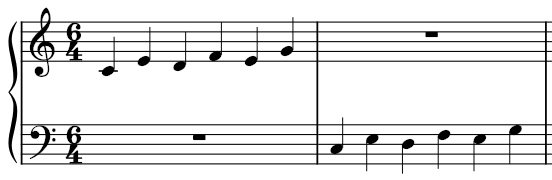
I share with you a very short musical quote from the book "Flow: The Psychology of Optimal Experience" by Mihaly Csikszentmihalyi: For the sake of convenience I have drawn up this little pattern in Musescore: I personally tend to tap out Bach's Invention No.8 in F major (at least in the right hand only) if I find my attention drifting. And if you've gotten this far, thanks for reading!
-
Hello Everyone! After a brief hiatus from the forum for a much needed vacation and music-recharge, I am back home and beginning to try out new ideas for chamber pieces. I have written a lot of music for large ensemble and wish to dial it back down to chamber and solo music over the course of 2026. The first part in this is to showcase an idea I felt passionate about a few weeks ago. As I began to write it out this week, I feel the flame has kindled and I may not finish/ expand upon it later as I have a lot of ideas I want to explore now in other places. This Fantasie is not as extensive as the classical and baroque styles, however it's a fantasie in the sense of my improvisation with the string quartet. The only thing I wrote down was the first four bars of melody, everything else was what I made in the moment and over the last few days. Let me know what you think and as always, thanks for viewing this post! AUDIO-Fantasie in F#-minor.mp3 SCORE_Fantasie in F#-minor.pdf
-
BlackkBeethoven replied to BlackkBeethoven's topic in Incomplete Works; Writer's Block and SuggestionsI've revised some things - any feedback? String Quintet No.2.pdf
-
-
A lovely piece. I like the relative simplicity of the composition. A suggestion: given the calm, dreamy, almost ethereal nature of the piece, perhaps you might have tried using harmonics on the violins in the upper register, as these are long notes that are relatively easy to play. I don’t know if you’re familiar with this, but it’s a very effective technique for pieces like this. Almost like a ‘rule of orchestration’, I think the harp should have a note at the very end. Otherwise, the player is left ‘hanging’. Of course, you can write whatever you like. Best regards.
-
The idea for this composition was inspired by @MK_Piano, after he sent me some footage of himself improvising in C minor on piano. I asked him if I could write something inspired by what he played, and was graciously allowed to do so. The piece utilizes a steady quarter note / eighth note moving rhythm and melody that symbolizes the passing of time during, and the emotional feelings felt in periods of contemplation, longing, rumination, and/or sorrowful reflection. Although, I feel as though it may be a bit too repetative, despite having variation in both rhythm, chord voicing, chord progression choice, including a modulation towards the end. I'm seeking to build upon the ideas I have in this score, more effectively. Any suggestions are welcome :) UnreadLetters.mp3 Unread Letters.pdf
.thumb.png.8b5b433a341551e913a34392660bc95b.png)