All Activity
Past hour
-
Hi James, Welcome to the forum and thanks for submitting this work! It's been wonderful seeing how various people have tackled the challenged I have laid out. Now, I am in the process of doing my reviews and it has come time to leave one here! To preface, I wish to address some things. I am a tonal composer and while I have written post-tonal, or post-modern, I have only done so in the academic scene. My taste is to romantic soundscapes and I may not be the best suited to properly address this work. However, I wish to give it my best shot! ENGRAVING: The engraving of this score is meticulous and leaves no errors. My only comments here is that in your copyright footer on the first page of the score, you misspelled "LLC" and put "LCC" instead. Just a heads up before you sell this work elsewhere. Another picky thing is with the front matter, I am not sure you need to specify "written for the YCF competition..." twice: before the notes and above the title on the first page of score. It makes more sense to see a dedication for the ensemble above the title or to the organization of the event versus saying "written for XYZ" twice. Seems a little redundant. The last picky thing is the page 19 to the end in the harp. I feel there is a better way to notate the cluster arpeggios. The accidentals tend to stick out way too much for me to say it makes sense. Visually it seems a little silly, especially the last harp chord. To me, even for those moments, using two stems, an extra stave, or voices to notate the individual notes, or help spell them out may be better; lastly, use of enharmonic spellings to keep the accidentals uniform (all sharps or all flats) may prove beneficial. Essentially, I am reasoning that it may be more effective if you make the readability easy for the performer because a lot of challenge will go into the playability and technique. Some of your pedal changes are cumbersome for a harpist. Outside of these comments, nice work! MUSIC: This to me, is the hardest to review as personal taste plays a factor. I did look at some snippets off your Instagram and Twitch of the process, but I do not have the time to do a proper analysis, which I feel may benefit my own understanding. Your use of the whole tone scale is most prevalent throughout the work, and there are certain motifs that come back and can be remembered by a listener during the duration. The form, if applicable seems to be a large binary with sub-forms within them. These forms being separated at rehearsal-J with the harp to break the piece in two. However, to me, the midi doesn't do a good justice as it seems quite monotonous, even though the score has very strong dynamic implications and a singer would actually sing the written lyrics. To add, when it comes to the context of the competition, it casts more a dream than a romance. The soprano and tenor help the visual of two partners, yet, the nature of the work doesn't cast unbridled love, but a complex and troubled relationship in my opinion. Verlaine wrote this before the marriage to his Fiancée and there is a level of raw joy he may have felt. The ending of the work, after rehearsal-J seems to better capture that point, versus the front half, which is weaker in my opinion. As a chance for another to give a better addressed review, I believe @HoYin Cheung will have the tools for more direct feedback. Good work on this piece, and we'll be eager to see what you create next!
-
Thank you so much MK_Piano! I saw the score comments you gave me, I agree with every single one. I was a bit sloppy with the score creation. For the sound, I did use a combination of the section and solo strings to smooth it out, but it still didnt quite get the sound I wanted. I see what you mean. I will take this information to improve my future compositions!
Today
-
Hi Matthew, Welcome to the forum and I'm glad to see another M-based name around here! It is wonderful to engage with other composers and I am very excited to see others participate in an idea of my creation. Thus, let's get right into my review! However, some things to address first: I am attaching an annotated PDF of your score with some comments. I do not have the time to sit down and do a thorough analysis, thus the feedback is aimed at the engraving and surface level details. However, I will elaborate my thoughts both on the annotations and the music here over the course of the comment. Please find the attached PDF at the end. Thanks! GENERAL COMMENTS: To start, your understanding of the ensemble is not quite right. It is not voice and piano trio, instead it is Soprano and Piano Quartet. Any piano ensemble INCLUDES the piano with the number of instruments. Piano Trio = Piano+Violin+Cello | Piano Quartet = Piano+Violin+Viola+Cello | etc. ENGRAVING: Next, I wish to address the numerous engraving mistakes in the score. The biggest being rest placement, dynamic placement and the spacing of the vocal text. These are annotated on the score, so please refer to the PDF to see exactly where and what I mean. To add, please ensure to add a double bar line when using key changes, and please restate the tempo when changing time signatures! A dotted quarter note and regular quarter note are NOT the same and you need to specify the change. As you did not in the score, it is confusing currently. Also, how come the articulations for the vocal line and instruments are not the same? There are spots where the violin and soprano are identical or state the same gesture over the course of the work, however they do not have the same articulation. I would consolidate and make sure the instruments also have the same articulations when they state the melody. Speaking of Melody, @Wieland Handke is correct with the writing of the text. You need to ensure there is at least one pitch for EACH syllable. A syllable can be sung over multiple notes, but two syllables CANNOT be sung in one note duration. An example would be measure 22, beat 3 with the word "Partner". MUSIC: The main issue with the music is how dense it is. You use all instruments constantly over the runtime of this work. There is no change, almost no instrument drops out for a long time, instead, it is just sound, sound, sound! What would immediately create variety is changing this. Drop out the piano, drop out the strings, and use other combinations. As is, because of the density, the voice can get overpowered quickly. If you wish to make the voice stand out, then make the accompaniment simpler or less active. If you have sounds going the entire time, then it beckons the question what is special? What needs to be heard? If you use all instruments all the time, then it makes them all less unique. Instead, if you were to reserve an instrument or chord progression for a particular moment, then you heighten its effect when heard! To add, changing who is playing the melody or doing the accompaniment is another aspect to look at. Lastly, spreading out the ranges of each instrument could be good as currently, I feel their ranges are all close and can lead to some pitch clashing if played live. Keep this as some food for thought going forward. To end, the recording is a little skewed too. I would not use the Violin, Viola or Cello Section soundfont for the singular instrument in MuseScore. It makes the strings sound way too lush and resonant for what a singular instrument can do. Consider changing it to be the solo soundfonts instead. If the violin sounds too whiny or slides too much, use a sound flag or text field to change the playing to "Ordinary". Good work, and we'll be eager to see what you make next! M. McAlister - So, on a bright summer day [ANNOTATED].pdf
-
Hi Nolan, Welcome to the forum! What a beautiful piece you have created and we appreciate you having created it for this competition. Now, it comes time to leave my review and I wish to address some things first. I am attaching a brief annotated copy of the score PDF. I do not have the time to sit down and do a proper analysis, so I focused on some light engraving things and will elaborate my detailed thoughts on the music in this comment instead. Please see it attached at the end of this comment. SCORE PRESENTATION: You have a very good understanding of score presentation, yet there are things you missed in the front matter and for your overall page layout. The first two pages of your document should be a cover page and another blank page. Why? Due to printing. The cover page is there to showcase what the score is, however the second page will act as the BACK of the cover page. So you need to keep the second page BLANK as it is the backside of the cover page. The Instrumentation page/ notes will then begin on the third page of the document. Currently, your notes begin on the backside of the cover page. To add, what is missing in the front matter is the instrumentation page. You did a shortcut by putting "written for four soprano saxophones" on the cover, yet that information is dedicated for the instrumentation page. Simply by the fact of you stating "Saxophone Quartet" on the cover implies four saxophones, yet it could mean "Sop. Alto, Ten. and Bari," or any combination. Thus, we need a note on the instrumentation to clear up the confusion BEFORE the first page of music. Your notes for each movement are fine, however, double check your fonts as it looks a little skewed to see font changes. On the first page of the score, you are missing key information like the title, what score it is, the composer field, copyright info, and movement number. See attached PDF for this point. MUSIC: Impressive to have read you recorded it on your own, and refreshing to hear non-midi renditions for something like this! This said, my main critique with the music is its homophonic nature. I feel you missed several opportunities to make the music have more motion and interest. Instead, you use all four saxophones for almost the entire time, stick to largely homophonic textures, parallel motions, and in the end, while pleasant sounding, becomes a little lackluster as a whole. The second movement is the best of the three in my opinion because of the variety in texture. Overall, this work is classical in style, and without breaking the style, I believe one suggestion is to keep the beat or divisions of the beat intact. To keep motion, simply adding a constant pulse of the 8th note in the texture. Mess with the tessitura of the instruments, and have them play low for prolonged periods, or even adding non-chord tones via suspensions and syncopation would be great. There are plenty of devices worth exploring and I think in later editions, you can experiment more. Also, in terms of the recording, be careful of having soprano 1 start on Pianissimo in the first movement. That high in the range and with such little air support is asking for someone to play sharp, and in the recording, you initial statement was sharp in the first soprano. This was also true for exposed notes in the pianissimo dynamic throughout the work. Good work on this piece and we'll be eager to hear the next one! N. Musonda - Un clair jour d’été [ANNOTATED].pdf
-
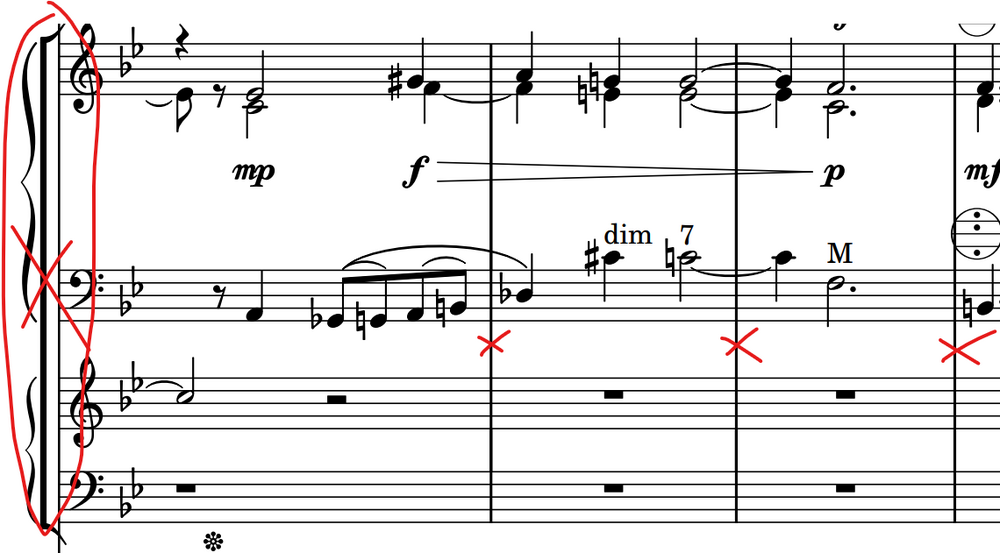
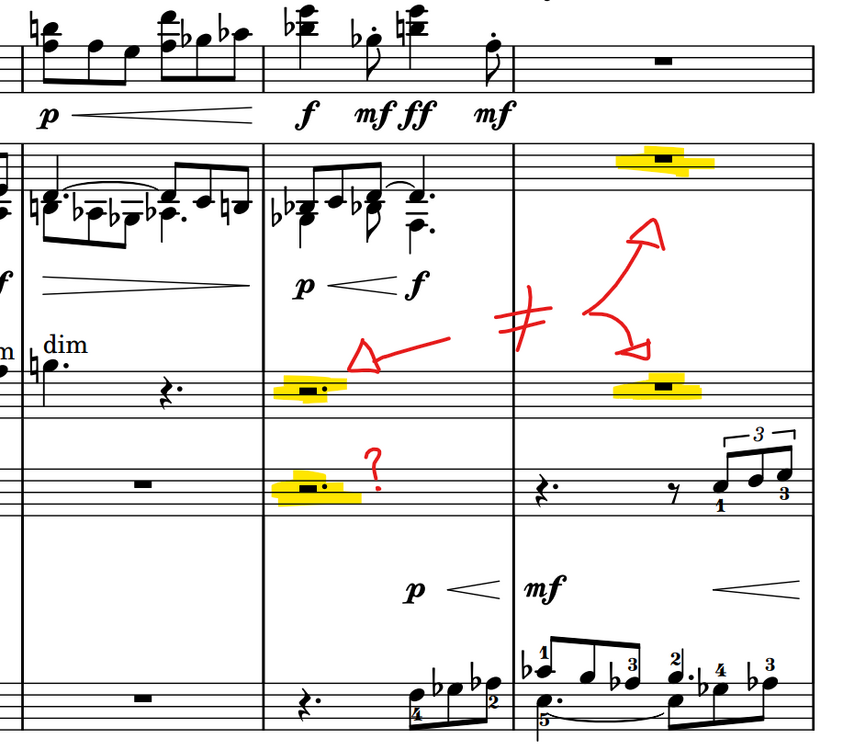
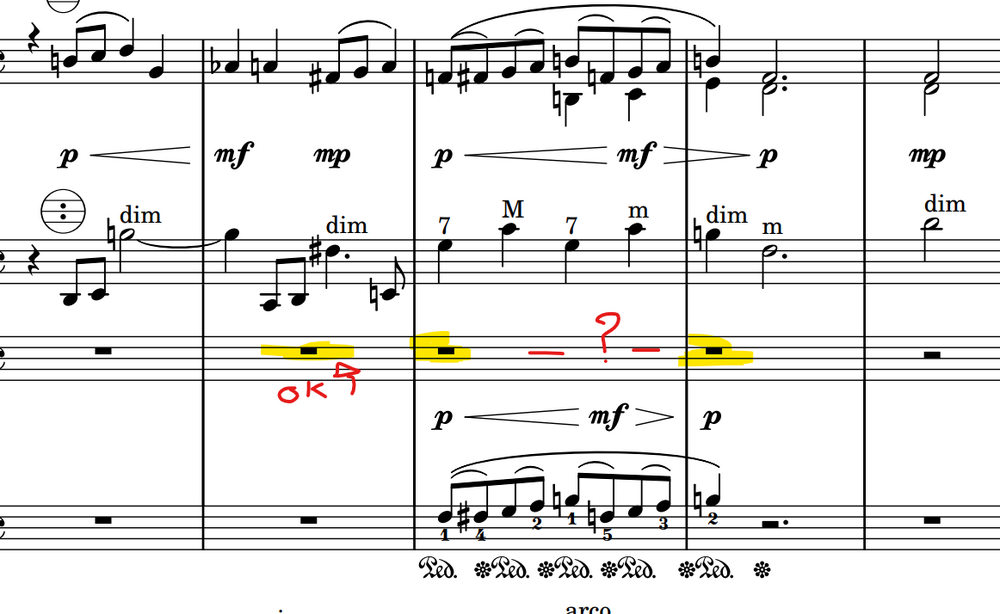
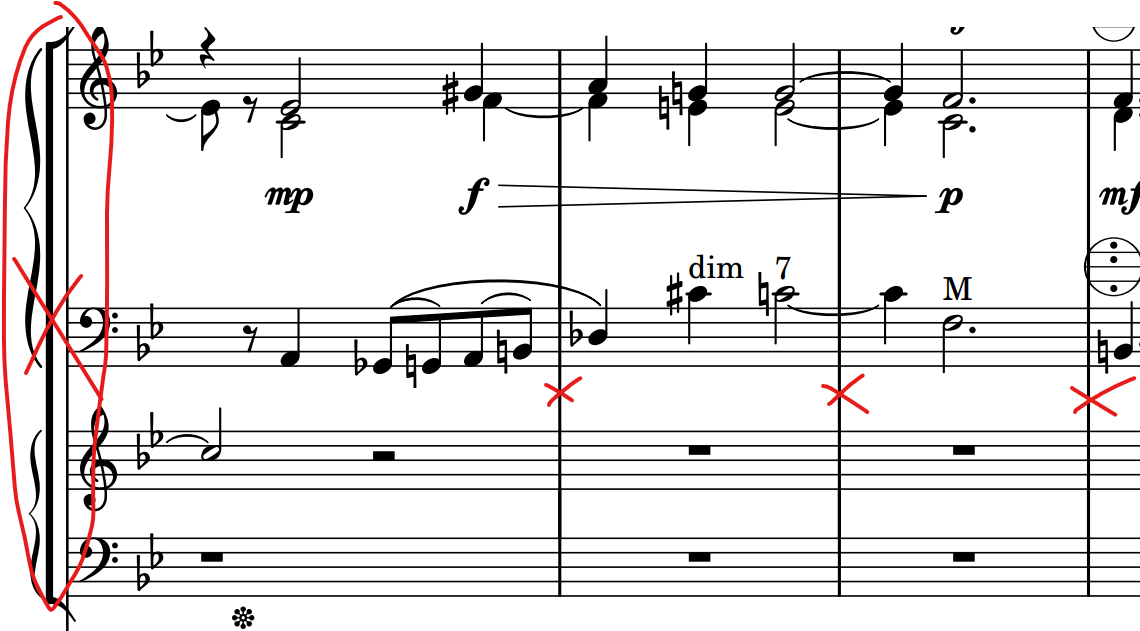
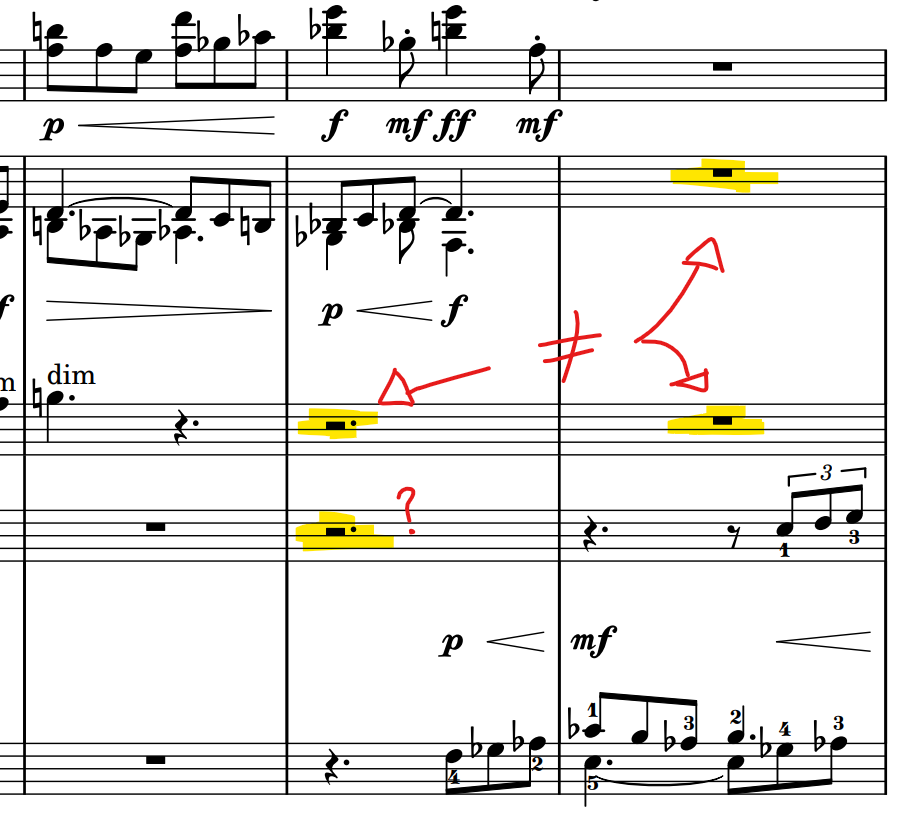
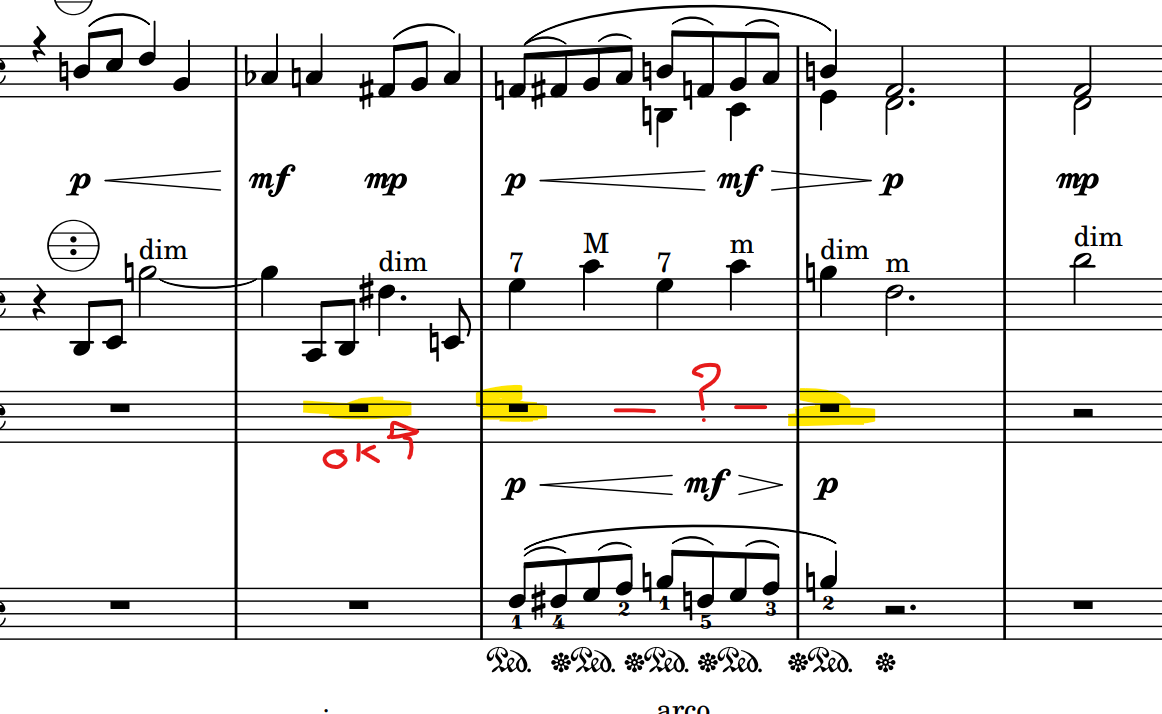
Hi Wieland, I am in the process of my reviews and would you believe it if I said doing a review at this stage is very hard? There are already so many good comments that it becomes hard to place one I feel would amplify the discussion. I will do my best regardless! SCORE: To be brief, you do not need brackets for individual instruments (Tpt, Guit, etc.). Single stave parts can just be shown by themselves unless you have multiple staves depicting that part or multiple instruments/ an instrument section. To add, the bar lines for the accordion and piano parts should be separated. Lastly, you also do not need a bracket for the keyboard instruments: Moving on, the score order feels a little asymmetrical. It is in concert order for large ensemble, however, in chamber music, it is quite common to put the keyboard-based instruments on the bottom and single stave instruments on the top. The correct order should be the following: Trumpet, Guitar, Violoncello, Accordion, Piano ENGRAVING: My biggest concern is the amount of dynamic information in the score; It feels suffocating look at all the dynamic information. Truly, I wonder if you leave any room for the performer to interpret or add their understanding in the music? It seems like you are trying to control everything they do purely based on the dynamic info. Another picky thing is your rest placement in the score: There are several moments where the score has little spots like this and it'll be good to do a once-over. MUSIC: With the music, I found it really creative to be honest. The idea of a fugato was so fun and I enjoyed this work. The only critique here is that overall, the work seems to keep going without any distinct climaxes. There are clear arrival points before each section, yet there is no apex for the journey in my opinion. To add, it does seem to utilize the same ensemble textures throughout, which amplify this sense of monotony. Good job on this work! Again, I must the fugato was my favorite part!
-
just the usage of the range of some stuff for the Frenchorn part and maybe some performance issues
-
Hi, thanks for the feedback! What do you mean by the French Horn part being iffy? Is it too hard? Because I do feel that a competent player could pull it off. Thanks for the Muse sounds suggestion though, been putting it off for a while, but my playbacks do sound bad. As for the empty space I really agree and I myself felt the same way, but I was also rushing other deadlines so I did the bare minimum I guess. Not the most proud of this piece honestly.
-
hello, this is my review for your piece it does sound very French, but not as much as the others, but it still has that Parisian vibe to it. Any ways I like the key changes that shows up near the end and the time signature changes much respect for that but the one thing that just bothers me is just that everything is using MuseScore basic so it wasn’t as much enjoyable as the other stuff that use muse sounds and other sound fonts if you have the time to you should definitely use muse. Sounds as it’s free. technique wise, there is some French horn stuff that I was a little bit iffy on and nothing inherently wrong with the violin part. One thing I must say is that if you’re going to mark something pizz, it would feel better to leave that to ring rather than a staccato to note. The piano writing was really nice and I like the textures that show up. other than that, I felt like there was some empty space that could be filled in the thing about that though is that I understand that you may put the purpose of a solo or isolation but something fell off when something was brought in isolation. Also, I felt like dynamics could also be brought out a bit more. just like with all the other pieces, the creativity score is being tanked a little bit due to the same aesthetic image that is convergently showing up. MelodiesThemes Motives Harmony Chords Textures Form Development Structure Time Originality Creativity Score Presentation Instrumentation Orchestration Playability Execution of Given Challenge Taste 7 7.75 7 6.95 7.5 7.5 9 7.5 average is 7.78 good job here. It was really nice to listen to. I feel like with some things to improve in practice. Will get you better. Hopefully, I’ll see you in the next competition.
-
Thanks for taking the time to review the piece and give feedback. Also, thanks for the tips about the solo notation. For the octaves with the flutes, it's not something I've thought about before, but does make perfect sense. I'll keep that in mind for the future. As far as the percussion section, I seriously don't ever expect anything I write to be performed by an actual orchestra. So honestly, any thought of how many players it may take to perform it never comes to mind.
-
Symphony in A (Second movement Draft).pdfSymphony in A (Second movement Draft).mp3 Hey all, This is the current iteration of the second movement. Eager to hear people's views so far on this... whether it works. The bit I am currently working on is intended to be a fugata, in the spirit of Beethoven's own in his Erocia, second movement (which I love). I am using that as a model. Never done that before and it's certainly a challenge. I haven't finished the wind writing which will have two parts for each instrument except for solo areas (i.e. the beginning). I wouldn’t bother looking for errors as it’s still a work in progress. There is still much to refine. It would just be helpful to just gauge how the ideas come together while i’m immersed in the rabbit hole! 🤣
-
Welcome all! I've gone back to the Late Baroque with my latest orchestration. I chose Rameau's Allemande in A minor, because I don't think it's been orchestrated before. (At least I can't find another orchestration.) I made a controversial choice to soup up the tempo: so I'd be interested to know whether any of you have different opinions on this? I had to write a short linking passage at Bar 37; otherwise the transition to the next section sounded too abrupt. Haven't put in the repeat of the second half as yet. I wonder if you think I should? And if so, what instrumentation would you suggest. Started putting in slurs; but haven't finished yet, because it's a long tedious job! Hope you enjoy listening, Alex Rameau - Allemande in A minor (orchestration) #19.mp3 Rameau - Allemande in A minor (orchestration) #19.pdf
Yesterday
-
Here is the rest of the Kids Songs. I've already uploaded Kid's Perfect/Kids Born/Kids Born Encore. They are technically meant to be listened in order, but each piece has it's own individual idea: I made a playlist on youtube, in case it's easier to just listen that way. 14 pieces. About 30 minutes total music: https://www.youtube.com/playlist?list=PLZW0Jz5b3gzU Full links below, I'll give a brief intro for each piece here: 4) Kids Learning: I had some fun with some cool key changes. A pretty straightforward piece of music. 5) Kids Talking: My boy had this really sweet, musical way of talking. So I tried to capture his voice into the music directly. Sort of a jazzier type of sound, but not really jazz. 6) Kids Jumping: I was reading up on the 12 tone method when I was writing this one. The song probably is still a very tonal piece of music, but I tried to experiment with the idea of having all 12 notes represented in the musical ideas. I also play the piano in a way that I consider somewhat unique to my style. I don't think I've heard of any other major musician play the piano in this style...so if someone else has done it before me, please let me know! 7) Kids Fighting: A fun piece where I am writing the song from the perspective of a very tired parent dealing with two kids fighting. The four note theme you might notice in the beginning is literally me calling "Ar-thur, Mar-lon!" 8) Kids Scared: I wrote this on Halloween. I sort of channeled my inner Ligeti for parts of it maybe. I also sample one of the greatest composers who has ever lived, hopefully in a way that is unique and somewhat memorable. The ending gets a bit loud. The whole song is delightfully weird and fun to play from my perspective. 9) Kids Hurting: This one is a bit more dark. It is based on a real experience I had with my children...being hurt and going to the hospital (He is 100% okay now, this happened 2 years ago). 10) Kids Crying: This one is heavily influenced by Schumann carnival! 11) Kids Sorry: This one is the sequel to Kids Crying, a bit more contemporary, but also influenced heavily by Schumann Carnival. 12) Kids Splashing: I am messing around with harmonic ideas. It is a pain in the butt to notate. If anyone is a pro at notating and wouldn't mind taking a look...that would be greatly appreciated. 13) Kids Sleeping: I try my hand at writing impressionistic music. It is dedicated to my composition teacher of the last year, Marcel Bergmann. 14) Kids Growing: This is the finale. While my boys are still young, this is me saying goodbye to the little infants/toddlers and saying hello to the slightly more sophisticated young boys who eat a lot more food and who I look forward to growing with together. Hope you enjoy. Any feedback...positive or negative is appreciated. Once again, if anyone can help with the notation for kids splashing, that would be greatly appreciated! 4) Kids Learning 5) Kids Talking 6) Kids Jumping 7) Kids Fighting 8) Kids Scared 9) Kids Hurting 10) Kids Crying 11) Kids Sorry 12) Kids Splashing 13) Kids Sleeping 14) Kids Growing
-
No you are absolutely correct. Of course, you wouldn't review your own music but it will still be counted towards your total works reviewed.
-
Even if I run the risk of being a little too petty, there are overall 9 submissions and I think nobody is supposed to review its own piece, the "Heavyweight Reviewer" badge would also be awarded to one that has participated with an own submission, if he has only reviewed the 8 other submissions ... 😀
-
@Lithl Thanks for your feedback. The kids and family are doing well these days. I am a lucky man. I hope that you and your family is doing well too :) I will tell my kids that a kind internet stranger wishes them well. They are still young now, under 6 years old. I wonder how they will see these music I wrote for them as they getolder. Would they feel embarrassed by it? Feel flattered? Want to write their own music? I guess I will report back in 10 years or so :)
-
Great work nothing to really criticize just some curiosities though since you definitely milk the hell out of almost every instrument in that piece with experimental extended techniques, I’m a strings player so I understand more information about the viola stuff and some information about the flute stuff. I’ll definitely be studying the harmonics and how flute harmonics work. (wood wind harmonics are a big part of my next upcoming composition for large Orchestra. “morse”). Anyways, the textures are amazing in the harmony, though is dissonant works extremely well with that dreamy quality of the whole tone scale. Time for interrogation in my assumptions again, this is more about curiosity as that these techniques are not thoroughly explained either in the actual score or in performance notes Xyl. -harp- i’m assuming this is a xylophone sounding technique though I don’t know how exactly is it to be reproduced I’m assuming that you kind of just strike the fingers against the strings bamboo tone flute- this is pretty self-explanatory as in the idea that they’re trying to achieve a sound similar to a bamboo flute, but how could it be reproduced? how is a jet whistle produced I’m assuming that you make a jet of air near the opening mouthpiece of the flute, but harsh enough not to make an actual sound for the flute harmonics there’s two ways I could feel about them that first they are usually used as a method to extend the range so they are played as a normal actual technique used in producing a “normal” sound , are the flute harmonic similar to artificial harmonics on string instruments? Melodies Themes Motives Harmony Chords Textures Form Development Structure Time Originality Creativity Score Presentation Instrumentation Orchestration Playability Execution of Given Challenge Taste 9.5 9.7 8.85 7.76 9.93 9.3 9.4 9.6 average 9.26. I also have watched part of your live stream about the composition process so that was nice only though five minutes of some parts. I don’t know if you explained the techniques there so I may have to look back. Anyways, other than the lower score for originality due to the convergent factor of all the pieces of this competition almost having the same aesthetic it was a very nice piece and it was amazing. Great job and I hope you join more competitions in the future.
-
Hello, Sounds great. Wow, so many scales. I sometimes wish that modern music used scales more often. I guess the old school 80's metalhead shredders used a lot of scales in guitar music...but it seems much less "cool" these days to use scales. You make the scales so nice and interesting. Is that actually you playing? I can't really tell these days, due to the amazing technology out there. If this is you playing, the technique/dynamics and "feel" is incredible. Around 2:58, when it slows down, it would have been nice to hear more slowness. But then again, that's more of a matter of personal taste. I think the overall piece works. Very nice, Bravo!
-
Hello @JDevorMusic, thank you for sharing such an incredible piece of music, and by the way – a hearty welcome at the forum. Interestingly, the very first submission to the competition, and the last one – so far – have the same instrumentation, a flute, a viola and a harp (while you’ve added two vocals). Melodies Themes Motives and Harmony Chords Textures: There is a memorable motif that recurs throughout the piece and is first introduced by the flute in measures 4–5. The sung poem features relatively long note values or coloraturas for the faster notes, so that the vocal parts are somewhat reminiscent of Renaissance singing. The accompaniment contrasts that with its – one the one hand „percussive“ arpeggiated chords – and, in other passages with energetic ostinatos (on the harp or viola), so that the piece unfolds a varied texture. As a piece in „contemporary style“, or to be said „atonal“, it is difficult to speak about „harmonies“ in the traditional sense. However, there are some chords which could be perceived as „pentatonic“. Form Development Structure Time: The piece has no „traditional“ form (such as sonata or rondo form), but is clearly structured due to the realization of the poem as a modern „aria“ (or better duet), with passages of increasing tension and „rests“, calming down between the stanzas. And finally, you were thoroughly enough to meet the requirements of the competition by finishing the piece exactly at the 7:00 minute limit. Originality Creativity: This piece is absolutely unique among all the submissions, obviously for its atonality, but also because of its detailed and meticulous craftsmanship. Score Presentation: The score presentation is absolute professional, starting with the title page, preface (including instrumentation, program notes etc.) and is full of information. So I didn’t look around to find some nitpicks but was rather impressed by the vast majority of details, including markups on articulation, playing instructions, harp pedals, breakdown of compound meter signatures etc. Instrumentation Orchestration Playability: The instrumentation works well, the three instruments from different families blend together and complement each other in their timbre, as well with the vocals. As for playability, you yourself mentioned the the difficult level, which would be suitable for professionals only. And I'm sure you've checked all the passages for “unplayable” notes or chords. Execution of Given Challenge: Your piece represents a very thorough realization of the task of the contest: To take Paul Verlaine’s poem and create „Something“ in music. The question remains, whether the dissonant character of this contemporary piece will evoke associations with summer, beauty, and love in the majority of listeners. Taste: That might be the problematic part. For me, it's a fascinating piece when I can really focus on it (maybe during a live performance). But I don't think it works as well if you're just listening to it in the background. Melodies Themes Motives Harmony Chords Textures Form Development Structure Time Originality Creativity Score Presentation Instrumentation Orchestration Playability Execution of Given Challenge Taste 9 9 9 10 10 8 7.5 5.5 Average Score: 8.5
-
Floating Dance77.mp3Floating Dance77.pdf
-
Hello @Musicman_3254 ! The piece has (at the beginning) a very calming character and is somewhat reminiscent of a fairy tale movie (especially one you’d watch in winter during the Christmas season) or—once the vocals come in— of @PeterthePapercomPoser’s Christmas mashup from last year. 😂 Just when one is (almost) fallen asleep (around 03:11, measure 102), you’re instantly jolted awake by the staccatos of the harp and cello, as well as the blood-curdling trill of the flute, which sounds like a piercing birdcall—perhaps that of a cockatiel. Melodies Themes Motives and Harmony Chords Textures: The piece is based on a memorable melody, reminiscent of a lullaby, which recurs repeatedly in the treble instruments (i.e., flute and oboe d’amore) as well as in the baritone voice. This contrasts with accompanying textures, chords, and arpeggios, which are played largely by the harp. While the song maintains a diatonic harmony throughout all three verses, the coda appears to be somewhat different, with a pentatonic impression. Form Development Structure Time: The form of the piece could be that of a song with three verses and a coda. As mentioned above, the verses unfold in a pleasant and calming manner, with the accompaniment employing various textures without losing that character, only to be turned into the exact opposite in the coda. Originality Creativity: The originality of the piece arises on the one hand from the contrast of the calming song and the surprising end, as well as from the instrumentation, combining two melody instruments, a human voice and two more or less accompanying and percussive instruments together. Score Presentation: The notation for the vocal part—that is, the baritone staff—is somewhat inconsistent regarding the use of slurs and beams: In vocal score notation it is important to distinguish whether a single syllable is represented by a single note or whether multiple notes are sung for a single syllable (i.e., a melisma). There are two possibilities: In older, classical scores eighths and sixteenth notes are notated with flags (not beamed) for a single syllable, but if there are multiple notes to be sung for a single syllable, those notes are beamed together. No slurs at all (except for quarter or longer notes). In contemporary music, beams are used to show the rhythmic pattern, regardless of the text. However, in that case slurs indicate whenever multiple notes should be sung for a single syllable (and nowhere else). For example, there should be no slurs in measures 18–19, since each note has its own syllable, whereas the slur in measures 62–64a is correct, since all the notes are sung on a single syllable. As for clefs, I believe that a vocal score for baritone uses the standard bass clef, and the cello in its middle/high register uses the tenor clef (and neither uses the alto clef). One more minor point: You forgot to remove rests from some measures on the high staff of the harp (for example, in measures 32–42). Instrumentation Orchestration Playability: The choice of the instruments is effectively used to achieve the mood and effect of the piece. However, there are a number of concerns on the playability – as already mentioned by other reviewers, especially in the harp part. Execution of Given Challenge: You have set the poem to music and, therefore, created a relation to the given challenge. However, my personal—and therefore subjective—impressions evoke associations with winter rather than summer, though I could be completely wrong—perhaps I’m being influenced by today’s cold weather at the start of fall. Taste: I like this piece because of the humorous contrast between calm and scare. Melodies Themes Motives Harmony Chords Textures Form Development Structure Time Originality Creativity Score Presentation Instrumentation Orchestration Playability Execution of Given Challenge Taste 9 9 7 8.5 6 5.5 7.5 7.5 Average Score: 7.5
-
Hello, a fantastic piece. Some really great combinations of timbres – a few of them really caught me out. For example, glockenspiel + trumpet + strings in Sequence II. It would be helpful if you could indicate at the start how many of each instrument there are (Flute 1, 2… etc.). When an instrument from a group of two or three plays solo, you need to specify which one it is (Bassoon 1, for example, at the start of Sequence III), not just ‘solo’ (because then you don’t know which one it is). A comment (which isn’t mine but comes from classical orchestrators): when you have a melody in octaves, don’t use the same instrument for both (flutes in Sequence III, bar 70) because one will clearly dominate. In this case, the upper one, as the flute in the lower octave is in a much weaker register. In this instance, it is better to double the upper flute with another instrument that has the same range in the lower octave (a clarinet here, for example). When we’re talking about MELODY (not harmonic chords), as a general rule: double at the octave with different instruments; melody in thirds or fifths with the same instrument; melody in sixths with different instruments… There will always be justified exceptions. In this respect, the two clarinettists from bar 80 onwards are fantastic. Sorry, these are just suggestions based on what I’ve learnt about orchestration. I always respect what everyone else does. But if you try what I’m suggesting, it might sound better to you. The climax towards the end is brilliant. And one more thing: I don’t know if you’re concerned about practical, real-world issues. Sometimes I get the impression that you need a lot of percussionists, given the number of instruments playing at the same time. Although I’m sure you’ve got this sorted. Best regards.
-
Melodies Themes Motives Harmony Chords Textures Form Development Structure Time Originality Creativity Score Presentation Instrumentation Orchestration Playability Execution of Given Challenge Taste 8 10 7.5 8.5 7.5 8.5 8 10 Avg: 8.5 This is one of those pieces where you have to listen to it a few times to understand it. But once you do, it's very rewarding. The improvised intro is a nice touch, what a dramatic opening! It sounds like your subject is trying to come to form in this section, but it's not quite there yet. Then you form it in the middle sections (the intro to your fugue) and that's when this piece starts to really shine. Anyone who has a hard time with fugues, must learn to train their ear on the main subject, and listen for that subject in the fugue. Once you do that, you realize how awesome and clever this piece is. Also, another strong point is that your harmony is very well done! Does it remind me of summer afternoon / evening? I'm not sure, maybe the end of summer or a rainy summer afternoon since this quite melancholic!
-
-
Ellie Smith joined the community
-
Melodies Themes Motives Harmony Chords Textures Form Development Structure Time Originality Creativity Score Presentation Instrumentation Orchestration Playability Execution of Given Challenge Taste 8.5 5 9.5 8.5 9 9.5 9.5 8 Avg: 8.43 Very nice relaxing theme, which was clear throughout the piece. Your form / structure was easy to follow, and this made the listening experience very enjoyable. I think you nailed the challenge with the mood. Aside from feeling serenity and peace, it reminds me of a night summer afternoon with a cool breeze. Your audio is great, and your usage of dynamics really bring out your music! Overall it's a very beautiful piece, short enough where the harmony isn't too much of an issue, but any longer, we'd need some changes in key in my opinion. This is why I marked you down with harmony. When harmony doesn't really change key, the music risks starting to sound like a hymn.
-
Down to the wire, but I just finished and uploaded my submission!







.thumb.png.8b5b433a341551e913a34392660bc95b.png)