All Activity
Past hour
-
Very nice fluttering texture in the woodwind section, and I enjoyed your key changes. Looks promising so far!
Today
-
Hey Peter! In fact I find it really melodious even it’s bitonal. The canonic imitation doesn’t sound mechanical to me, which is good job. In fact I’m going to use some bitonal treatment of your theme in my new work working so stay tuned haha. Henry
-
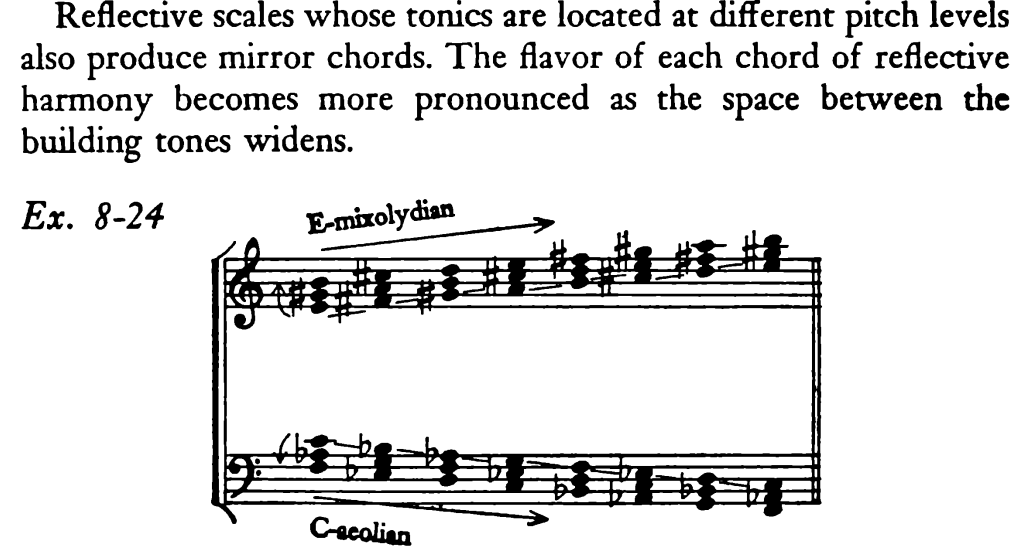
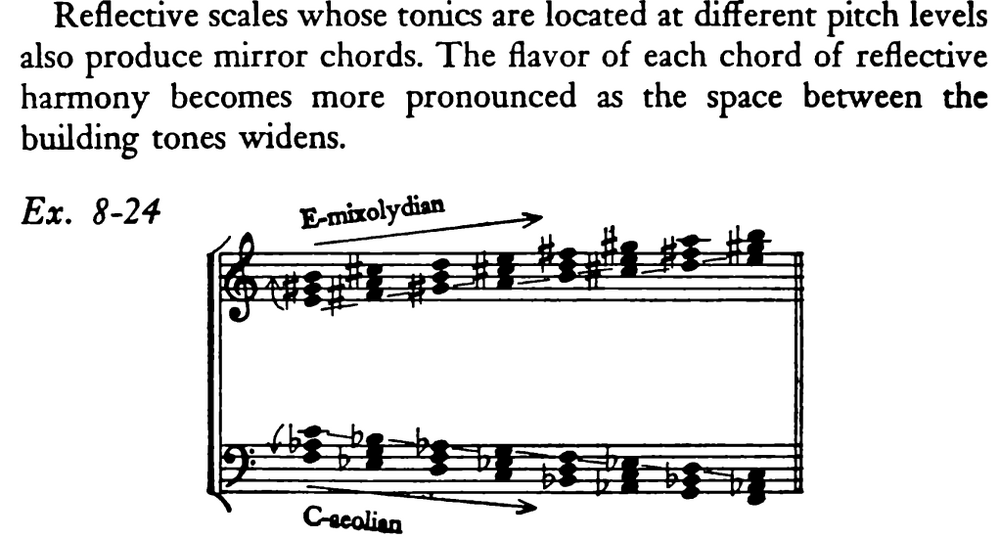
I've taken to another exercise from Chapter 8 of Persichetti's "20th Century Harmony" - "Compound and Mirror Harmony". This time I've chosen Exercise 7 - "Move a chamber group through several mirror chords where the reflective harmony is generated by the same tone and by different tones." In this case he is referring to using symmetrically invertible scales just like in Exercise 8 which I already did. In that exercise I built the respective mirror scales on the same tone (C) so in this exercise I sought to build the mirror scales on different tones only. I also created an inverted canon at a 10th and a quarter note between the Oboes and Bassoons. I used the following chart from the book to simplify the exercise for myself (so I used E Mixolydian in the Oboes and C Aeolian in the Bassoons). At one point I switch the Oboes to Ionian and Bassoons to Phrygian, just like in Exercise 8, but this isn't accompanied by key signature changes. Thanks for reading and for listening! I would appreciate any of your suggestions, comments, critiques or observations! Persichetti Exercise 8 - 7.mp3 Persichetti Exercise 8 - 7.pdf
-
Breznd joined the community
-
Yesterday
Ok very interesting, because I see and hear 2 key signatures played against each other. But the different key signatures themselves are "in key". I suppose this naturally gives us 2 different harmonies without having to manage accidentals. Interesting concept, and at times this sounded a bit like Ravel. Fun rhythms, and for an exercise this sounds like it could be a nice little standalone piece, maybe a prelude, or some type of introduction to a larger work.Yes, Lontano, but really all of her albums are great. I was first taken in by her playing on the album Gurdjieff & Tsabropoulos: Chamber music.Thank you, @Henry Ng Tsz Kiu, for your review :) Gothic scene, that's interesting. I've never thought about it. And your idea about the cello is nice—that's going to be a good one. Actually, I always intend to use extended techniques for string instruments, but I do not know how to play them in the DAW / software realistically. Is having someone play them the only way to get those extended techniques, after all? 😕 Anyway, thanks again, Henry! Best, Lithl.Hi, thank you for your feedback, @Brs. Your point about the cello's contribution is actually what I was concerned about. However, I followed my first idea and created a track. Next time, I plan to elaborate on it more. And above all, thank you for introducing me to Anja Lechner!! I really appreciate it and immediately loved it. Searching for it, the video features the album called Lontano from ECM by Anja Lechner, right? I'm listening to that, and it's such beautiful playing and a beautiful piece. Again, thank you so much :) Best, Lithl.Last week
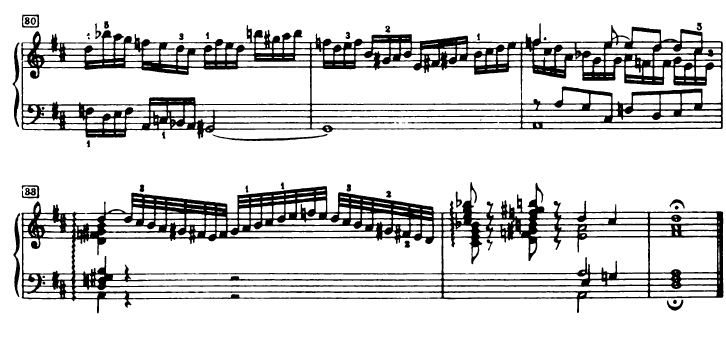
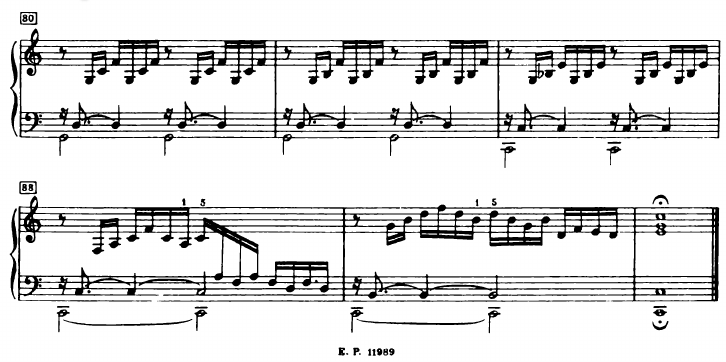
Great topic, @Grant Weep ! I am sure that @Henry Ng Tsz Kiu will be able to contribute to this topic given as how he always says that he writes his music over long periods of time. My Variations on "Deck the Halls" for Piano and Orchestra I started writing the beginning of and the 1st and Rondo Variation back in the late 2000's and only finished it more recently in about 2023 I think. So about 15 years. And there are other old works that I have access to that I am in the process of finishing and publishing thanks to the fact that I can open all my old project files with Cakewalk Sonar DAW. Thanks for your idea for this topic!Hello @Martynas123, this prelude is really a pleasant, short piece. Although there is nothing wrong with a „simple piece“, I have some suggestions which could perhaps improve it somewhat further: The time signature. I don’t think that this piece is in 6/4 meter. Even though this time signature matches the number of notes played in a measure, there is no pulse that counts from 1 to 6 (with the exception of the last two bars). There are clearly four beats to be counted in the left hand. Therefore, the prelude should be in 4/4 meter, and the texture of the right hand could be rearranged into four groups of three notes each as triplets. With that done, you could get rid of the dotted quarter notes in the left hand (which look a bit unusual). Otherwise, you could recall the time signature as 12/8 (again with four groups of three notes in the right hand) retaining the dotted quarter notes in the left. And there is another „funny“ possibility that has been used by J.S. Bach in its Prelude 15 of the Welltempered Clavier, Book 1, BWV 860: Different time signatures in the right and left hand (admittedly very unusual but solving the problem): You could use 12/8 in the right hand (four groups of three eights notes) and 4/4 in the left hand. Here is the example from Bach’s prelude (he uses 24/16 in the right hand due to its use of semiquavers). The repetitions and the ending. At the ending (the two last measures), the piece leaves its uniform texture with the „triplets“, slowing down at (yes here) six beats per measure. I would like to have a somewhat „more elaborated“ finale, perhaps with the slow-down to a desceptive cadence, another one or two bars of improvisation with, again, the eights notes pulse, before the piece finally finishs. Typical examples of such an ending can be found in the Prelude 1, BWV 846: or somewhat more complicated in the Prelude 5, BWV 851: And now, finally, regarding the repeats: I generally wouldn’t include the ending—and especially not after an extension such as the one suggested above—in a repetition. Perhaps you could omit the repetition of the second part entirely—though that would result in a shorter piece.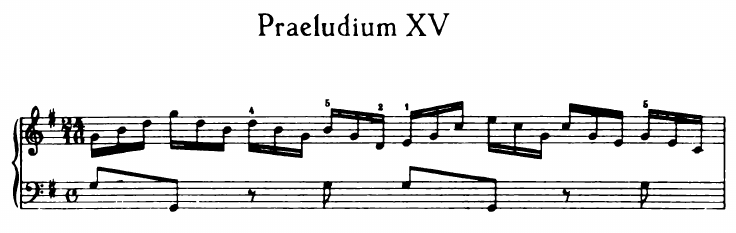
 Hello @PeterthePapercomPoser, this next Persichetti exercise was again a great fun. I just had to checkout what „symmetrically invertable scale“ means. Yes, it is indeed the case that the pairs you’ve chosen share the same order of whole-tone steps and half-tone steps between the different scale degrees, the one in normal order and the other one in reverse one! C Mixolydian: C 1 D 1 E ½ F 1 G 1 A ½ Bb 1 C C Aeolian (aka C natural minor) - reversed C 1 Bb 1 Ab ½ G 1 F 1 Eb ½ D 1 C C Ionian (aka C major) C 1 D 1 E ½ F 1 G 1 A 1 B ½ C C Phrygian – reversed C 1 Bb 1 Ab ½ G 1 F 1 Eb 1 Db ½ C Another thing is mirroring, that is whenever the left hand plays the melody/chords upwards, the right hand does the exact opposite. At some points, you have made some exceptions from the strong mirroring, introducing octave-wise steps or leaps which is – in my opinion – absolute correct and does not violate the intention of the prompt, but rather is a good device to make „an actual piece of music rather than an exercise“. Having different key signatures in the right and left hand scores is surely unusual, but makes the score looking very interesting, together with the meter changes, applying the odd one 5/4. How does it sound? Modern, ethereal, but pleasant and by no means “too atonal.” I can’t imagine this kind of exercise being expanded into a piece—say—7 minutes long. But I’d very much like to see passages based on this idea in a “real” piece of music, such as a prelude, combined with passages featuring more functional harmony and a texture that differs between the two hands to create variety. Thanks for sharing—it’s a very humorous and at the same time profound exercise, and perhaps an inspiration for one of my next pieces.Hello dear fellow composers! The two months of the YCF 2026 Summer competition are over and we have now the results. For me, participating in that competition was (again) a great fun – but also a huge challenge! And I think, I’m not alone with that impression, since – on the one hand – only roughly the half of that members which initially intended to participate have finally posted a submission and – on the other hand – the most submissions arrived during the last two weeks, signifying that almost all participants had to do a hard work to meet the requirements of the contest, to produce „Something“, that was related to Paul Verlaine’s poem, from „Nothing“ (in this regard, the specific task made it difficult to use an existing piece; therefore, I believe that most submissions were composed “from scratch”). I’m very pleased, that I could win the third prize, however the most takeaway from the contest are – in my opinion – the reviews which had an outstanding quality this time. It was the fourth consecutive competition (or event) I participated during the past year, and I think the overall quality of the compositions and of the reviews has been improved significantly in that period. The reviews tend to be longer and consist not only of the impression and taste of the listener/reviewer, but have become full of profound feedback and suggestions, concerning for example questions of engraving or of the playability and/or specific characteristics of certain instruments that a composer must take into account, even if he or she may not be very familiar with the one or the other instrument. With this respect, I would especially thank @MK_Piano, @Omicronrg9 and @Thatguy v2.0 for their reviews. I'm already looking forward to the next competition, though to be honest, I need a few weeks' rest until then. Finally, there is just another little concern I would share: I noticed that some of the participants voted for themselves in the final poll. That behavior ultimately had no impact on the awarding of badges and prices in that sense, that a participant has not earned the respective badge due to he did hesitate and not voted for itself. However, in my opinion, it is not a good practice to vote for oneself, since - if everyone would do so - voting would become merely useless, especially since we have relatively few voters at all, and this time more participants than other members. Therefore, I would suggest to introduce an explicit statement in the rules of upcoming competitions, that participants shall not vote for themselves in the final poll.Great musical ideas come and go, we all have different approaches to writing music...I am sure that some of us have grown as people as time passes, and the music may also evolve as well, stylistically etc... Just for fun, and perhaps for some perspective for the younger members of the forum - what is the longest time frame that people have actually taken to complete a serious piece of music? For me, it would be about 17 years. I started a piano piece when I was roughly 17 years old, never quite finished it. Was initially written in a way that was inspired by typical pop music at the time that I was into. I revisited it around age 20 and added a bit more to it during a time in my life where I was listening to more progressive rock. 14 years later, around age 34 - I put the finishing touches and completed it, and it retained a slightly jazzier/sophisticated feel near the end of the piece. The piece itself isn't anything that I would consider special, some 4 minutes long for solo piano. 17 years a long time, though I wouldn't say I struggled at all or was obsessed with the piece. I held the musical ideas in the my life as I aged, and it was fun to complete the musical idea when the time came due :) What about you guys?Hi @Lithl ! By listening to your music I actually think of a Gothic scene: just like @Luis Hernández noted the synthesiser sounds like ominous birds flipping. I actually don’t hear the cello much, maybe you can add more of it? I think an extremely high pitch harmonics or sul ponticello cello or col legno lowest register cello can make the atmosphere sound more scary. Thx for sharing! Henryhey @Markus Boyd ! Really thank you for your detailed explanation! I appreciate that. I think the “disparity” is only due to our different aesthetics and style. Bach’s Et Resurrexit is perfectly written as it narrates the pain of crucifixion, Dido’s Lament for the abandoned Dido. My movement here is none like theirs, as I want to talk about the confused state under depression or despair. Under a state of despair, in my case, falls into confusion and you almost see nothing bright; no drama there, no contrast of bright/dark or major/minor there, just confusion. Maybe there is some light, some reasonable power from human Logos, which is portrayed a bit in both 2nd subject which is in major key in both exposition and recapitulation here, but it’s only a small portion and will easily be crushed by blind confusion of despair. I don’t think I have ever fallen into depression myself but I have lots of friends fallen into it, and they see no light and reason to pick them up; what seems to a depression patient hopeful may be the one last false hope and the last straw which takes their lives away. I don’t try to set myself unprecedented but I just try to write that particular state of mind. Hope this explanation helps Markus! HenryHi @Markus Boyd ! I really love this prelude! The counterpoint is really rich and fluent and the pain real. Maybe an imitative entrance of each voice would make the piece more solemn but to me this one is already really good. Probably because the Dorian is the 1st mode? Just like Bach’s Die Kunst der Fuge maybe because of that too. Thx for sharing! HenryHi @Martynas123 , Is this one section of your D major Sonata? I ask because it’s more a G major piece to me. If it’s hard to continue you can for sure modulate to new keys. Easiest would be to modulate to D major by ending the first section in half cadence and then you can begin with new ideas. I actually really like the idea after 0:59, but like @Grant Weep said it gets really weird, to me because it doesn’t match with the style before it. HenryHey Peter, This bitonal piece sounds really funny, it sounds like a parody of a march! It's like someone saying "look at how serious I am!" by making himself 200% serious which makes him 500% ridiculous lol HenryI'm usually into Gustav Holst's music because of The Mystic Trumpeter. It's such a mature and emotional piece that's sadly very neglected. I also quite like Tan Dun, Antonin Dvorak, Ludovico Einauldi, Gustav Mahler, Fela Sowande, and many moreIt's been a while since I've composed anything, so I felt like getting back into doing some Persichetti composition prompts. I am now on Chapter 8 of Persichetti's "20th Century Harmony" which is titled "Compound and Mirror Harmony". The particular prompt for this piano piece was "8. Write an opening section of a two-part piece for the piano employing two symmetrically invertible scales. The mirror writing should be kept strict throughout." So I tried to do just that with this ~1 minute long piano piece. I tried my best to make an actual piece of music rather than an exercise, but let me know how I did! I'd appreciate any of your comments, critiques, suggestions or observations! Thanks for listening! Here's the form of the piece: A - Right Hand - C Mixolydian, Left Hand - C Aeolian B - Right Hand - C Ionian, Left Hand - C Phrygian A Persichetti Exercise 8 - 8.mp3 Persichetti Exercise 8 - 8 Score.pdfSATB, a cappella. Thanks for taking a listen! Come in the morning, and this is what is best: the wood thrush, turning every sunny path to a holy space. Go there in the evening, and this is what is best: the susurration of little screech owls. Hearts all full, and you, my love, step softly as the night. And the good, good crow chops wood and calls his family home. The great bowl spins, stars in flood, and all of beauty, some of use, hold their breath beneath. Who are we to choose which souls to save? The morning and the evening-Furtak.mp3 The morning and the evening-Furtak.pdf


.thumb.png.8b5b433a341551e913a34392660bc95b.png)