
All Activity
Past hour
-
Hi Vasilis! It was indeed very pleasant to listen to. I do enjoy a lot these works "alla Scarlatti". The whole work seems to have been crafted with great care, both engraving-wise and musically speaking. It breathes, and does it very well in my humble opinion. I believe I have not listened to other binary sonatas of yours; this is probably, or as far as I remember, my first one, but you got a new subscriber! P.S: Pianoteq9 is great. Kind regards, Daniel–Ø.
-
Hi Martynas. Harmony-wise, then, it works, but I suppose you'd like it less straight-forward. There are, again, countless ways of achieving a more rich sound harmony-wise. And that is something you'll only get through practice, trial & error, and studying other compositions and harmony/counterpoint books. Some rough advise, as there are many "what ifs" that can arise: Treat the bass as a melody with its own idiosyncrasy if you want more movement there. Treat differently the the bass (tempo 1) and the middle voices of the accompaniment (tempo 2, 3, generally). Mind chord inversions. If you don't want to add a lot of richness but you still want to make this a bit less plain in the accompaniment voices, well thought chord inversions can do the work. Using octaves in the bass, again well applied, could result in a more convincing result, too. And that'd be it, without getting much into details. Best regards.
-
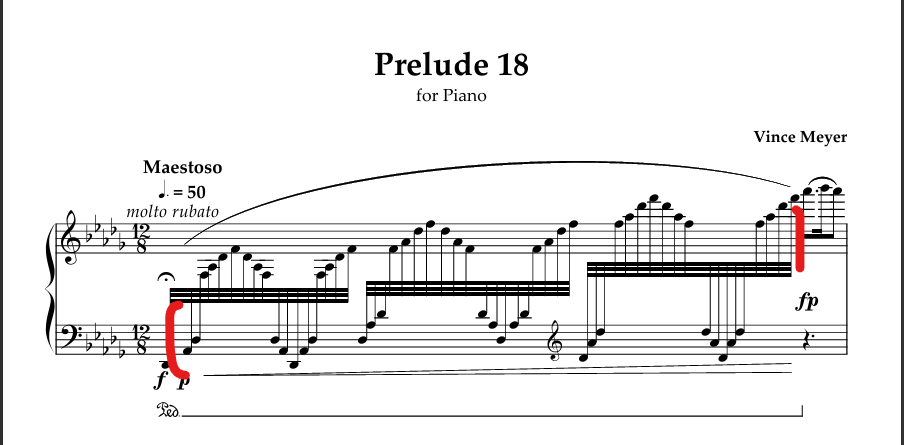
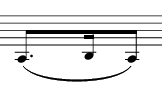
Hi Thatguy. I like the contrast between the arpeggiated chords and the almost solo voice passage. Both of them combined act as the structural pillar of the piece in my opinion, and you make good use of them. It may be true the midi doesn't do it justice. Engraving-wise I'd suggest putting these wide arpeggios in small notes so it's even clearer where the molto rubato acts and where the piece gets a bit more rigourus in tempo. I don't quite get the switching between Db and C#. Why is that? That aside, the prelude works for me but it wasn't my cup of tea compared to other preludes I've listened from your list. It's soft indeed and pleasant to my ears, especially the middle section in which the (1) seems to wander around chords. How many preludes are left? Or are they not gonna have a set end? Best regards!
-
For the chamber + electronics direction you mentioned, here are three specific starting points: Kaija Saariaho — Petals. Cello with optional electronics: reverberation and quarter-tone shifts above and below the cello. Look for a performance with electronics, since it can also be played without them. https://ressources.ircam.fr/en/work/petals Pierre Boulez — Anthèmes 2. Solo violin with live electronics that transform and extend the violin sound and move it around the room. Make sure it's the second version; that's the one with electronics. https://www.universaledition.com/en/Works/Anthemes-2/P0006667 Jonathan Harvey — Mortuos Plango, Vivos Voco. This one is entirely electronic, built from a boy's voice and the tenor bell of Winchester Cathedral. The composer's note explains how the bell's partials provide the pitch material and how voice and bell transform into each other. https://www.fabermusic.com/music/mortuos-plango-vivos-voco-1154 Those give you a few different ways into it: a cello with processing, a violin interacting with live electronics, and a piece made from transformed recordings.
Today
-
If you still have the notation or DAW project, changing the tempo there is usually the cleanest option. But sometimes all you have handy is a short audio render and you want to hear whether the idea feels better a little slower. I own Pitch Tempo, a free tool at https://pitch-tempo.online/ that can make that sort of listening copy. Here is a simple example: 1. Start with your own audio file, or one you have permission to upload and edit. 2. For a steady 100 BPM sketch you want to hear at 90 BPM, set tempo to 90%. Leave pitch at 0 semitones to keep the key. The calculation is target BPM / original BPM × 100. 3. Listen to the preview before exporting. Check the attacks and sustained notes: slower is useful only if the result still lets you judge the music. 4. Export the full file and save it. If you like the new pacing, you can go back to the source project when it is available and make the actual compositional changes there. This stretches the entire recording by one ratio. It will not rewrite tempo markings, remove rubato, turn audio into notation or MIDI, or change just one instrument in a mix. Files can be up to five minutes and 100 MB. Tempo runs from 50% to 150%, independently of pitch. The preview covers the first 20 seconds of the source, so listen through the export too. A full export finishes that editing session; another version needs a new upload. Guests get three uploads per rolling 24 hours. Processing is on our server and guest audio expires 24 hours after the original upload, so keep your original and download the copy you want. Happy to answer questions about whether a particular file-based task fits those limits.
-
PitchTempoAndriy joined the community
-
Good morning, my dear friends! I’m happy to present to you once again my latest work, Binary Sonata No. 28. It is personally one of my favourite sonatas, and I hope you will enjoy it as much as I do!
-
Thank you so much, my dear friend! ❤️ I must admit that I haven’t listened to Clementi extensively, although I have heard some of his sonatas that I found truly distinctive and beautiful. The composers who have shaped me the most, and who have had the deepest influence on my musical language, are primarily Mozart, Beethoven, and Schubert. As for being called Mr. Schubert, I can hardly imagine a more honourable compliment. Schubert is a composer I hold incredibly close to my heart, and to have my music bring him to someone’s mind is deeply moving to me. I could hardly ask for a greater compliment. ❤️ Scarlatti, however, occupies a very special place in my musical life. He was the one who gave me the courage and freedom to explore the binary form in my own way. When I first discovered his sonatas and began studying them, it was almost as if I had seen the light. Discovering his music was a truly defining moment for me. I was overwhelmed by the sheer genius of his writing and by how astonishingly far ahead of his time he seemed to me. His music opened up a whole new world of possibilities, and I began to realise just how much could be expressed within such a concise form. I sometimes wonder whether, had I never discovered Scarlatti, I would have become a composer at all. Through my binary sonatas, I feel that I can express myself with complete freedom, bringing together all the musical elements, influences, and sensibilities that define me. I have always felt that the binary form is somewhat underrated. Despite its apparent simplicity and relatively small scale, it offers enormous possibilities for exploration. Within this framework, a composer can push boundaries, experiment with harmony, develop unexpected transitions, and discover new musical horizons in countless different ways. For me, bringing together all these influences within the binary form has gradually become a personal creative approach, as well as a motivation to explore my own musical voice ever more deeply. Scarlatti gave me the freedom to begin this journey, but the journey itself has become my own. I don’t want merely to imitate the composers I admire; I want everything I have absorbed from their music to become part of something genuinely personal. Ultimately, my hope is that when someone listens to one of my binary sonatas, they can recognise a distinct musical personality and feel that, despite all these influences, the music belongs unmistakably to me. That there is something in it that makes them think: this is truly Vasilis. Thank you again for listening so attentively and for such a thoughtful and generous comment. It means a great deal to me! And being called Mr. Schubert will always remain one of the greatest compliments I could receive. ❤️
-
Baopuzi changed their profile photo
-
Thanks! Glad to hear another potential working on these prompts besides just me and @Luis Hernández ! I don't know if I'll be looking to expand pre-existing pieces that I wrote based on the Persichetti exercises. I think once I sift through the whole book and do exercises from every chapter, I will start the book again at the beginning and comb the exercises for potential prompts that could be utilized to write longer, more substantial works. I still don't know if these exercises are conducive to longer form works honestly. But I am also amassing my own google doc with prompt ideas inspired by these that I could use in the future to write more music, so who knows! Thanks for your comment!
-
This is super cool! I love the Persichetti book and have done a lot of these exercises in the past. Really nicely done. I personally think you did a great job with the inverted canon - very impressive to keep it in pure canon the entire piece. I wonder that if expanded, it would be interesting to change the distance of the canon the same time you change the modes used. The effect of having multiple articulations (slurred to staccato eighth notes) happening simultaneously is a fun touch.
-
-
I do have to admit the general textural density remains quite staunchly homophonic-sounding for quite a good few passages, mostly in the developmental section. As with my previous motet, the main focus here was once again textual intelligibility, so in order to break that lack of variety in note values and durations across voices I would need to add in new passages or modify the existing ones by pruning the underlying counterpoint to accommodate for longer values, which at this point seems... somewhat unfeasible, to put it lightly. I could have added an Amen section at the end but after repeating the same incipit in the stretti and then following up with a Da Capo al Fine at the very end, I doubt it would have made much structural sense compared to, say, placing it right after the "Qui vivis et regnas in saecula saeculorum" phrase where it is normally expected to be ennunciated. Nevertheless, pondering your suggestions has made me realize that the underlying structure was not calculated thoroughly enough, and even if it does have a clearer sense of direction, structural integrity, Fortspinnung, etc. than most of my other compositions by my usually fairly chaotic standards, it still falls short in the end. Had you not pointed out the textural flaws I might not have considered the whole absent Amen tangent. Thank you kindly for bringing these points forth.
-
-
-
You were mentioned!
-
When did I speak? 🤪
Yesterday
-
We meet again @Vasilis Michael or should say: Mr. Schubert. ❤️ While it says it sonata, the overall does not follow what we think in that sense. That is why there is the clarification: binary. Binary implies AB. We must ask this follow up question; How did manage write a Binary sonata? Rather easily. Muzio Clemeti wrote plenty of these. However, what I am impressive this time is the dramatic pause after the TR zone that leads up MC. I did not expect to hear that in early classical sonata(binary) form. To me, that is something that Haydn or Mozart would do. As @Henry Ng Tsz Kiu noted this does sound like Scarlatti. But I am extended the olive branch further and saying Clemeti, too. Late barque and early classical sonatas are rare to hear. It is refreshing to hear.
-
after procrastinating in enough time, I actually had listened to it, and after even more procrastinating, I am now going to write my opinion in review first off this is amazing piece of work and it was all enjoyable. Even the use of extended technique was good and also also the recording quality was also phenomenal. This would be programmed well for an Easter or coming of spring concert and I appreciate all the different tambre in harmonic use you use. especially at the last scene with the use of minor seconds to convey some sort of sour bitterness following jesus’s death. it also had a hymn like feeling to it as well. Great job
-
-
You do an excellent job here of exploring interesting harmonic ideas and making each line its own interesting melody. I wonder how this would sound with some longer note values as either a pedal in the bass or a slowly ascending or descending line to break up the texture a bit? (This would get your text out of sync between parts and less easily understandable, so maybe that's not something you want to explore). If you have a minute, could you add the full text and translation to your original post to help us all keep track as we listen without needing to open an extra browser window of our own and toggle back and forth? This sounds great, and looks like it would be interesting to sing!
-
-
Thanks again @gmm for your review. I will definitely have a go at extending the piece along the lines you suggest.
-
Hi @gmm , Many thanks for listening. I'll take another look at that divisi, and revise. It was optimised for midi rendition, as were the dynamics: so I will have to make quite a few adjustments when I come to make a proper orchestral score. Otherwise the dynamic balance doesn't work well for real musicians.
-
-
Hi @Alex Weidmann , I really like your arrangement! The orchestration is very vivid and colorful, and I overall found it very enjoyable to listen to! The only thing that seemed odd to me: in measure 20-21 the divisi in the violins seems odd. You have effectively four voices, but you have the entire Violin II on one voice, half the Violin I section on another voice, and the other two voices split between the other half of the Violin I section. It would seem simpler to just have these four parts split evenly between the Violin I and II? Either way, great orchestration and very fun to listen to!
-
As we transitioned into the off-season, I have finished a project that I intended to finish and to start for months ago before the competition on here in the competition on the music conservatory (the discord server with the tournament). So I am very proud to announce my next production in piece titled MORSE (I originally did it without caps, but it just sounds cooler with caps) Program notes: Monday when I was in my maths class with my friend, we were very bored and decided to communicate and make small jokes in Morse code. Of course, I questioned him if he knew any of it which he did sometimes, and we can just joked around teasing each other with it at the end of the day I had a thought. "maybe I could turn this into a actual piece of music." which I did. Other than just blatantly straight out just normal Morse code. There is a larger image to this. It's the idea to find the answer to many things. We may have to look where places where nobody expects us to look to find answers to simple questions. We must use clues in order to decipher ideas. There are, four movements a opening movement, drawing inspiration from infinity, percussion's "resønate" featuring various meditative percussion instruments, a slower, 2nd movement, a 3rd movement, which is to pose as a Scherzo and Minuit and a grand finale with its closing statement almost resembling that of Dvořák's seventh Symphony (which somehow I have transformed from a previous statement of a motif and theme presented in the 2nd movement So, after all these months of stalling and procrastinating and dealing with other stuff, I have present to you, my production MORSE Morse.mp3 Morse.pdf




.thumb.png.8b5b433a341551e913a34392660bc95b.png)