All Activity
- Past hour
-

2-part invention in counterpoint
Frederic Gill replied to Frederic Gill's topic in Piano Music, Solo Keyboard
Thanks. It's true. When the tempo is fast, it's an orgy of figures and motives, like fireworks. Because of repetitions ('imitation') it can become boring or harassing. You have to keep the interest of the listener with changes and satisfactory harmonic progressions. My style is sober compared to the heavy and insistant ornamentations in Bach's 2-part inventions. I have composed many other imitations, in all kind of tempi. I am still green into music composition. Learning and working on my own, after over 1600 small exercises in melody, harmony and counterpoint (all with 6 Goetschius books) + 25 invention, I don't know what 'level' I am at now. I've never had feedback until now! I'll look at yout posts 😉 - Today
-
 Obviously the censor nowadays is much stricter than before lol
 -
Thanks! @Luis Hernández
-
 I saw the viola in the bass clef thing; just a Noteflight glitch, it likes to change things! It was on a measure rest so didn't make a difference in the sound, but of course I corrected it!
 -
 Also listen to this one the whole way through. How did this get passed the censors lol
 -

2-part invention in counterpoint
Luis Hernández replied to Frederic Gill's topic in Piano Music, Solo Keyboard
Sounds good. The 13th bar is strange, but I see you've made a correction. I think there's some pretty good imitative treatment, characteristic of the Inventions. So many colours confuse me a bit. I suppose they highlight imitations or motifs, but as I'm colour blind, I can't tell. Best regards.- 4 replies
-
- 1
-

-
- invention
- counterpoint
- (and 1 more)
-
Nice text.
-
Persichetti Exercise 7 - 47 for Brass Sextet
Luis Hernández replied to PeterthePapercomPoser's topic in Chamber Music
That sounds great. I love this series you're doing on Persichetti's proposals. Organised, it would be a fantastic resource for anyone studying the book. -
Thank you for showing me a path. I’m very inspired with your ideology “start with what you’ve,” I’ve an electric guitar and a macbook. I’ve done my research and I have found that I can use the garageband to record my guitar and do my experiments with it. Now, I’m researching how I can take full advantage of garageband. I’ve watched a lot of YouTube tutorials on it. And yes this is a good idea to start with children's songs or folk music. God Bless You 🙂 Thank you for guiding me
-
 A lot of voice leading things that are weird. Very postmodern sounding to. I somewhat appreciate the dissonance. OK, I like the change to pace. I appreciate the different folk aspects of this piece. And I definitely like that electric guitar cadenza. A mixing issue with the winds burying the main theme. We are back at measure 59 with the folk melody There may be some difficulty at 83 and before that with the double tongue in the brass. I also like how some of the other instruments double the guitar with the runs. Why is the viola in the bass clef. I like the rhythmic interpretation and variation around 111. I enjoy the guitar solo and also the irregular variation with the rhythm although that the playback may not support this make sure you write some slurring around. At 179 a previous theme returns. Along with the folk melody running after that. Some of the guitar material had returned. And I like the end. Good job and I appreciate the amazing structure and the cool material that you have given throughout the first Movement
 -
Reach the Highest Rank "Transcendent" on 31st January, 2026, after joining the forum for 3 years and 9 months.
-
.thumb.png.8b5b433a341551e913a34392660bc95b.png) The prompt for this polychordal Persichetti produced piano piece was "6. Extend the passage of broken polychords (three units) for piano." Thanks for listening and I'd appreciate any of your comments!
The prompt for this polychordal Persichetti produced piano piece was "6. Extend the passage of broken polychords (three units) for piano." Thanks for listening and I'd appreciate any of your comments!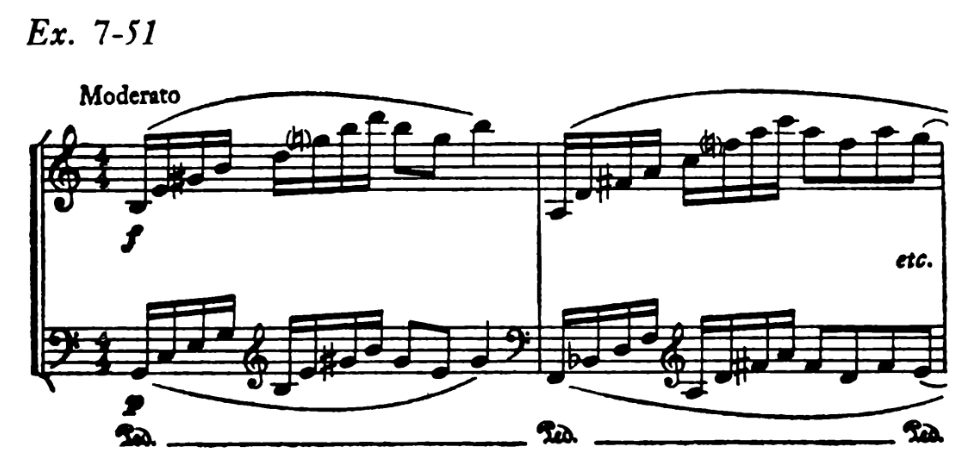
-
Favorite Musical Book Quotes?
PeterthePapercomPoser replied to PeterthePapercomPoser's topic in Composers' Headquarters
I come to you with yet another quote from Gary Lachman's "Beyond the Robot: The Life and Work of Colin Wilson". There is a pertinent insight about creative artists at the end of the quote in this chapter which has to do with peak experiences. Go forth and dominate the world with your creative "originative intellectual work"! -
Greetings, Space Cowboy! "Neo-Tokyo," describes the, Hayabusa Feather, coming home after gathering, Asteroid. As the space vessel operates, large asteroids clash in the background. I think there are at least 7 fugues represented in the piece. Some from, "Seraphim," some from Symphony No.2, two more on general texture, 1 final in the background, constant. Feel free to make 'stamps,' or short samples, to use for your work. If you wait until the fugue ends, make a sample, you have a 1 minute sample. 30 seconds of that could be used for anime, AI, or entertaining yourself. Complexity Magnitude, is the most complex fugue I could come up with, and it ended up surprisingly simple. Easily underestimated, easily understood, I wrote a tutorial: Atonal Fugue Writing Tutorial Other than that, feel free to alliterate from your favorite media - and keep the good times rolling. Splendid night, Space Cowboy! Complexity Magnitude_Harper.mid
- Yesterday
-
I want the melody around 25 seconds in to the piece to have a more “jumpy” rhythm, that sounds like the audio recording below. Not sure what exactly is happening tempo wise. Any help is appreciated.
-
Starting with what you've got is a great idea. Start with whatever you already know and are comfortable with, and then you can build from there. So you can try coming up with a tune to play on guitar, and then try writing the notes down accurately using free software like Musescore. Or, the reverse, try writing something for guitar using Musescore, and then try playing it. Either will help you get better at knowing when something is a half note, or a quarter note, or a dotted eighth note. Either will help you get better at reading and writing pitches and knowing when to use accidentals, and when the sharps and flats are part of the key signature. I like the advice to start with children's songs or folk music. You could also add Christmas music to that list, or songs from summer camp, or any music that you know by heart. Anything you are very familiar and comfortable with is a good place to start. Do one or two of those, and then when you feel like you can accurately write down the notes and rhythms you want and know the basics of the composing software you are using, you can start arranging pieces, or writing your own tunes. It's like learning to read and write. We start with picture books, so we know what is going on, even if we get stuck over the reading. We start with being read to by someone else, and following along with our finger on the page, and writing letters with a pencil. We start writing short, simple sentences. Then we write short stories or poems or book reports, and can read more fluently, and we learn to use Microsoft word and type quickly, and then can write whole novels if we like. But for now, don't overthink it, just get started. 🙂
-
I'm so confused... 😵💫
-
I have an electric guitar as of now, so should I start playing with it, right?
-
Yeah, I had some but a long time ago. 35 WOW! you are professional. Do we need real players to do experiments with compositions? Thank you for your advice! I'll do this.
-
Great advice! I do it sometimes but from now onwards I’ll make a habit to do it everyday. I think first I should start with self learning after clearing some basics then should invest in a physical teacher maybe?
-
There is an in-born thrownness in we human beings...
-
 Shuma joined the community
 -

Baião de seis(Flute,oboe,clarinet, horn, cello and double bass)
dhslamas replied to dhslamas's topic in Chamber Music
- Last week
-
Fantastic, even better because it doesn't sound strange at all. And the bass is very powerful.
-
Thanks for your review @Luis Hernández! No I usually keep the Violins and Violas on basic triads while giving the Cellos and Basses on added notes that don't belong to the upper triad. In the first few bars the Cellos and Basses have F (while C major above), Bb (with G7 above), A (with C major above), G (with D major above), C (with G major above), B (with C major above) ... and etc. I always try to give the Cellos and Basses a foreign note to the predominantly triadic harmony above. You should post some of your exercises here as well! Thanks again for commenting!