All Activity
- Past hour
-
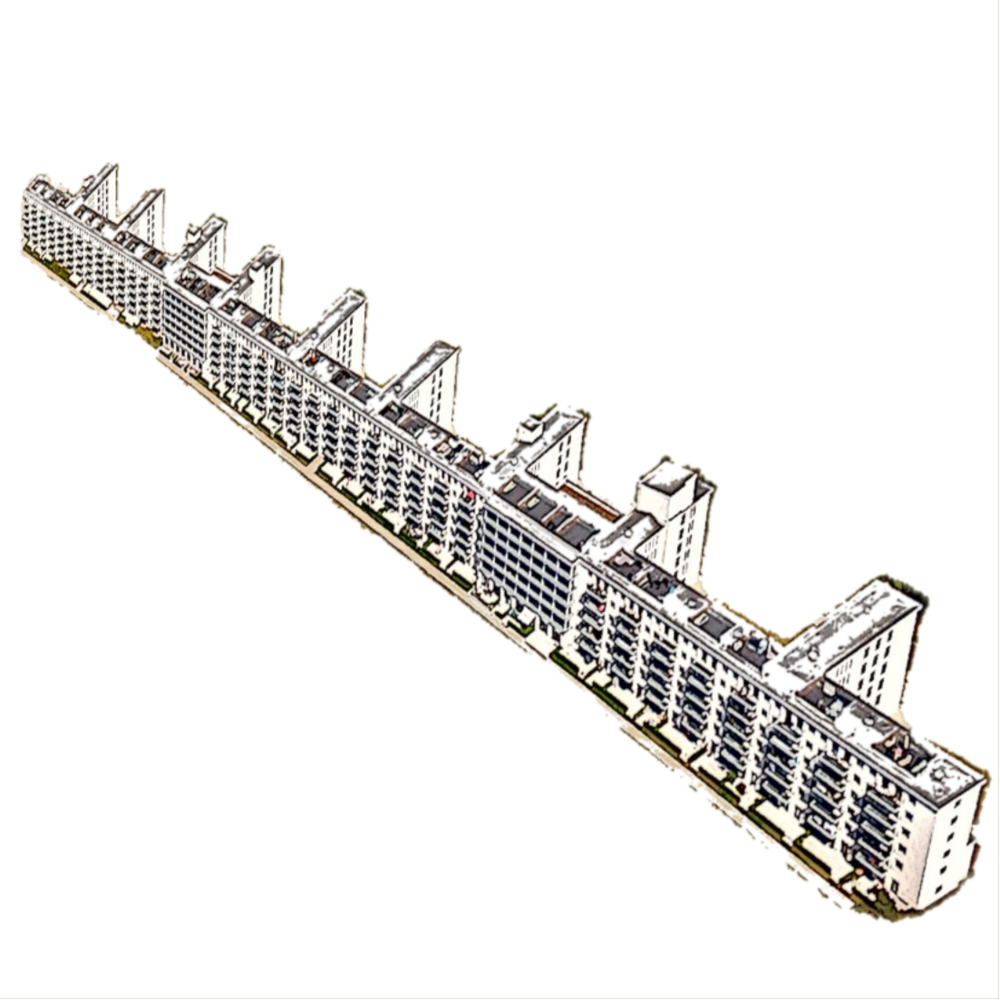
.thumb.png.8b5b433a341551e913a34392660bc95b.png) I present to you the new badge - The Colossus of Prora
I present to you the new badge - The Colossus of Prora - Today
-
 “Good evening, dear friends. Here is the scherzo from my third Sonata. I hope you like it.”
-
- 1
-

-
 LoL I'm wrong, Thatguy doesn't get the badge to be a better self!! 😜
 - Yesterday
-
The badge was already there! Even Thatguy himself got Better than Thatguy badge lol!
-
 Some parts are now used as living space, shops, etc. now, though. I am fully aware of it's history, and it is already thought of and I have a good reason for that choice. You see, it hurts to analyse long works...
 -
 Hallo @PeterthePapercomPoser, I have created a PNG which could be used as basis for a badge. Some considerations: The original photo can be found at Wikimedia Commons under https://commons.wikimedia.org/wiki/File:20-07-06-Prora-RalfR-DJI_0120.jpg. Please check whether it can be used concerning the license conditions. I have nothing against a „Collossus of Prora“ badge, but I would remind that this building did not have the best reputation because of its „problematic“ history. Originally erected by the Nazis as a huge holiday resort for their „Kraft durch Freude“ (Strength Through Joy) project. After World War II it was used a long time as military barracks, first by the Soviet Army, than by the East German Volksarmee. Since the mid-1990s, it stood empty for a long time and was exposed to decay and vandalism. Now it is (at least partly) renovated and houses a hotel, apartments etc. A more detailed overview can be found at Wikipedia under https://en.wikipedia.org/wiki/Prora.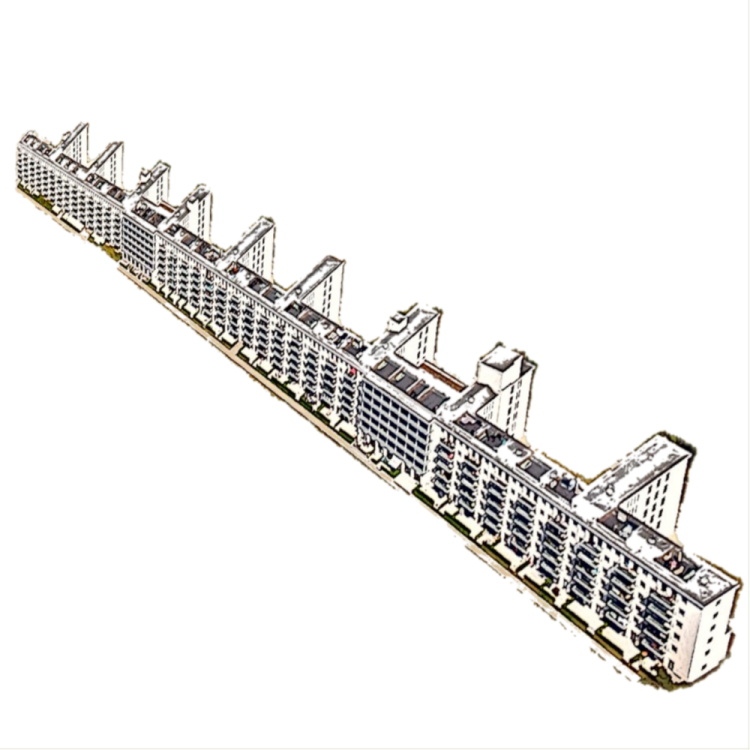
-
That would be a great idea! 'Better than Thatguy v2.0' is a great idea! Some of us would get a few more if it is about reputation...
-
...
-

He Likes a Girl (based off Nxdia's, "She Likes a Boy.")
femboy_sharky replied to femboy_sharky's topic in Choral, Vocal
Okay, thank you for your information, I greatly appreciate it. -

He Likes a Girl (based off Nxdia's, "She Likes a Boy.")
Aiwendil replied to femboy_sharky's topic in Choral, Vocal
You can upload whatever files you have by clicking on "choose files" at the bottom of the post box. I don't speak for the forum, but at least for my part I would say you need to post actual music if you want any feedback. Also, when you do, I suggest you consider first whether "Jazz, Band, Pop, Rock" might be a more suitable category. -
Oh, I didn't expect to receive an answer to my "badge" which was in the first sense ment to be a joke. Since I would welcome to award a badge to the "longest piece", it is a good idea to follow @TristanTheTristan idea about a "Colossos of Prora". Concerning the icon, it was really just a "joke" of me using a WikiMedia Commons Picture and mashing it together to a "badge icon". I'll look tomorrow, whether I have some better personal photos from that location or whether I can gather more background about "Prora" before creating such a badge for the YC forum.
-
@Wieland Handke I googled "Colossus of Prora PNG icon" and I couldn't find the graphic that you used in this image. Could you send it to me please so I can officially make the badge? Thanks!
-
 how about, "better than th..." oh nevermind
 -
Upps, the "Colossus of Prora". Did you mean something like that?
- Last week
-
Wow then I would get several of them for my works! My Clarinet Quintet is 62 minutes long so it will get 2 of them!!
-
The Colossus of Prora Someone who has written (music) something longer than 30 min. The Colossus of Prora is the longest building in the world.
-
 Here is a variation on a motive by Weber (B flat major) with figuration in middle part, as an exercise (ch64, 4.6) from the book 'Material used in Musical Composition (1909)' by the great professor Percy Goetschius. I learned everything I know on melody, harmony and counterpoint from 6 of his books (available for free on the web's archives). The key is to learn music like a language, experiencing rules and their licenses, through practice with a lot of exercises, which most books I have found don't offer. Although I am green at composition, I have completed over 1600 of his small exercises and a dozen larger (small inventions and this variation).
 -
 Pianoers.com joined the community
 -
All my piano compositions so far.
Pianoers.com replied to Ivan1791old's topic in Piano Music, Solo Keyboard
I also need some of your scores, can you send me? -
 This kind of breakdown is pretty cool, and I’ve found that battle music works best when it really drives the action instead of just sitting in the background. Fast rhythms, strong percussion, and some kind of hook or motif help keep it interesting since players can be in the same fight loop for a while. Also thinking about how your loops transition into each other without feeling repetitive makes a huge difference in keeping it from getting annoying mid-game. I usually try a mix of orchestral hits and rhythm ostinatos to build tension, then layer in more melodic stuff for big moments - that seems to work well for fantasy battle themes in most games.
 -
Ccool idea! Sounds like a fun - I like taking a modern melody and giving it an old vibe, maybe reharmonizing or slowing it down with more counterpoint.
- 1 reply
-
- 1
-
-
Fughetta in F minor for String Trio.
Wieland Handke replied to Fugax Contrapunctus's topic in Chamber Music
The first impression I had when listening to the Fughetta was – huh what a long fugue subject which already covers a kind of development on its own, for example with the sequences in mm. 3-7. Because of its chromaticism, it reminds me a little of the “royal theme” from Bach's famous Ricercar a 6 from the “Musical Offering.” I can well imagine how you had this melody in your mind and developed it into this subject, for example while you were out walking, and that you had to write it down immediately upon your return so as not to forget it. There is nothing wrong with such a long subject. However, creating a fugue from it will be challenging, as the exposition will fill almost an entire page! Therefore, I think it was the right choice to refrain from adding further complete subject entries and to leave the piece as “just” a fughetta, so that there is enough space to play contrapuntally with the material. And this has been achieved excellently, both rhythmically, where the staccatos are contrasted with the appoggiaturas, and harmonically, through the treatment of the chromatic sequences. This once again highlights the potential of contrapuntal composition technique, even if the piece does not necessarily imitate a Baroque style, but is, for me, more contemporary due to the dissonances that I like. (By the way, the key of E minor still remains in the title of your current score.) Wieland -
He Likes a Girl (based off Nxdia's, "She Likes a Boy.")
femboy_sharky replied to femboy_sharky's topic in Choral, Vocal
I appreciate your suggestion regarding the inclusion of instrumental music or vocal performances. The sole reason I have not incorporated such elements is that I am currently unfamiliar with the process of uploading or sharing them on this platform. Nevertheless, I appreciate your input and will certainly consider it in the future. -
 Ah yes)) Instead of predicting your love life, it predicts whether your flute and bassoon will get along, or if your oboe and piccolo will have major conflicts in the key of C
 -
Is this the orchestral version of fortune telling?🤔I have heard of cold, hot and warm fortune for different people born in different months!
-
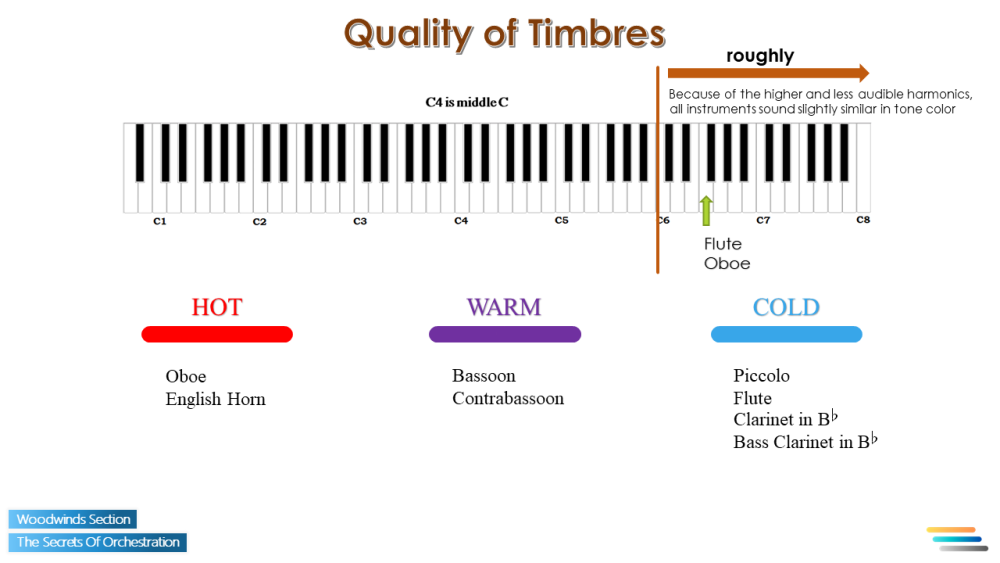
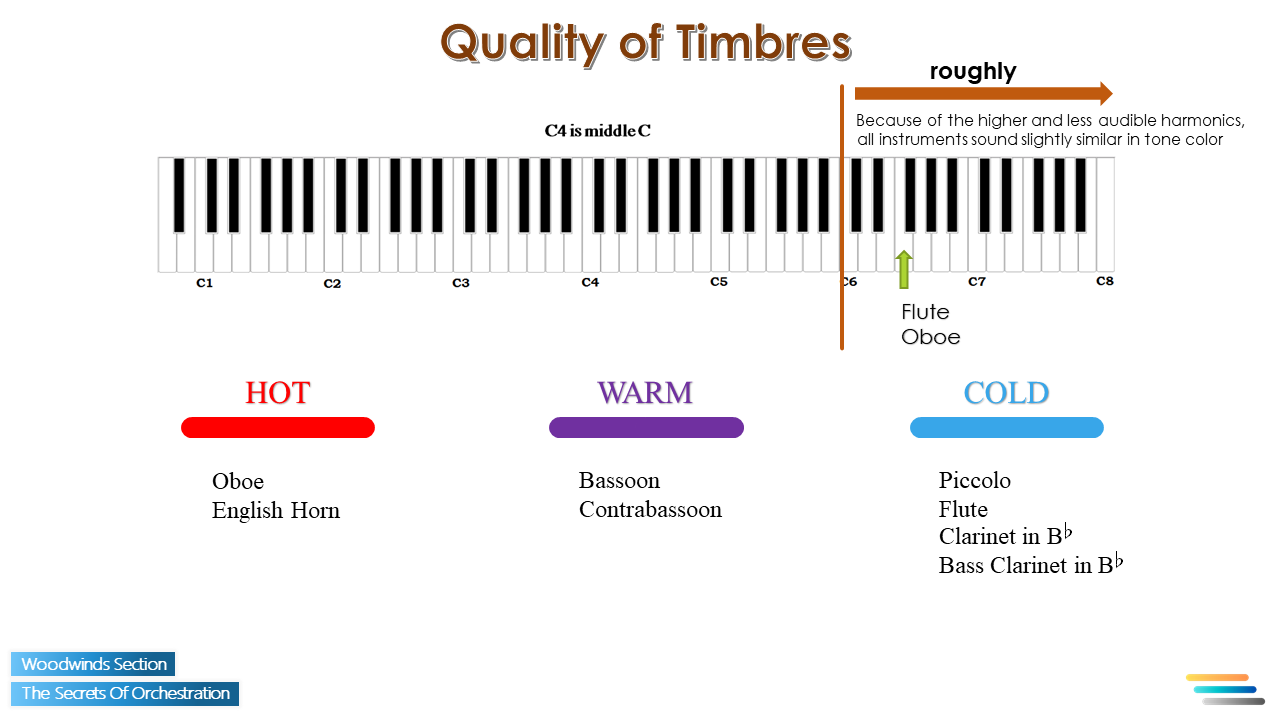
The woodwind section of the symphony orchestra can be categorized into three primary timbral color groups: Cold, Warm, and Hot. This classification helps composers understand how different woodwind instruments function within orchestral texture, balance, and emotional character. By organizing instruments according to their inherent timbral qualities, composers can make more intentional decisions when writing melodies, harmonies, and layered textures. Additionally, this categorization provides practical guidance on instrumental mixing, allowing composers to predict how different woodwinds will blend, contrast, or dominate within an orchestral context—and what kind of sonic result will ultimately be achieved. 1. Cold Timbres: Piccolo, Flute, Clarinet, Bass Clarinet 2. Hot Timbres: Oboe, English Horn 3. Warm Timbres Bassoon, Contrabassoon NB: Due to the dominance of higher and less perceptible harmonics in the extreme upper registers, the timbre of woodwind instruments becomes less distinct. In these ranges, different instruments may sound surprisingly similar in tone color. For example, when the flute and oboe play the same pitch—such as F6—it becomes difficult to clearly identify whether the sound is cold or hot, or even to distinguish which instrument is playing. For this reason, the following graphics and timbral classifications are based on the most effective, practical, and musically “sweet” registers of each instrument, where their characteristic tone color is most clearly perceived and reliably distinguishable in orchestral writing More Information and Free Orchestration Resources: Free Download