All Activity
- Past hour
-
- Today
-
Eurochestries changed their profile photo
-
-
I made one more improvement to the program, and I've also learned to perfect the settings more or less. The pieces in the above post now reflect this improvement, having been replaced with updated sound files, as do the ones in this post.
-
Eurochestries joined the community
-
The competition is open to nationals of all countries. It aims to enrich the symphonic repertoire, particularly for youth ensembles, while discovering new talents and fostering exchanges with experienced composers. It also seeks to draw attention to the importance of water as a vital and universal resource. The theme of this edition is “Water in All Its Forms”. There are two categories: one for candidates under 30 years of age (born after 31 March 1997), with works lasting 6 to 8 minutes, and one for candidates aged 30 and over (born before 31 March 1997), with works lasting 8 to 10 minutes. The selection process will take place in three rounds. The first round requires a sketch of the score (with audio recording); the second round requires a complete score (with audio recording); and in the final round, the selected scores will be performed by a European youth symphony orchestra. Prizes totalling €20,500. Seven prizes will be awarded: in each category, three prizes (€5,000, €3,000 and €2,000). In addition, an Audience Award (“Coup de cœur”) of €500, common to both categories, will be given. The registration fee is €50. Entries must be submitted by midnight (CET) on 31 August 2026. Candidates are invited to complete the registration form (https://forms.gle/Vn9XSMQcN4VoDnV59). Afterwards, a link will be sent for uploading the required documents. For more information and the complete rules, please visit: www.eurochestries.org Email: composition@eurochestries.org
-
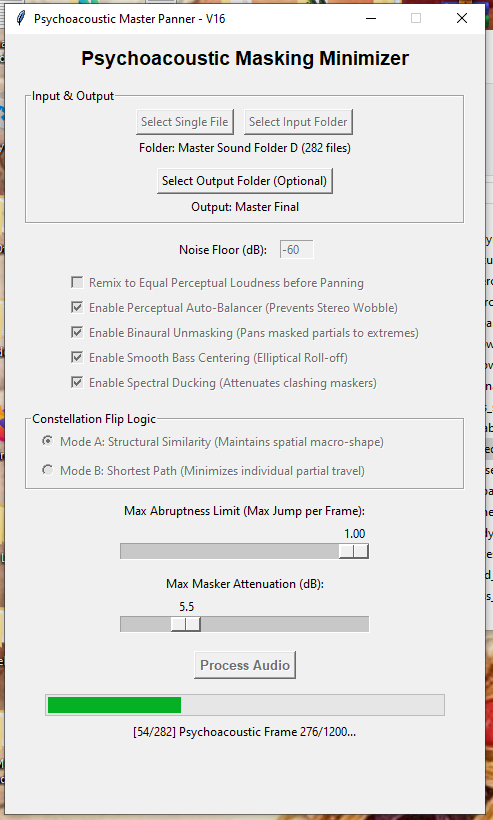
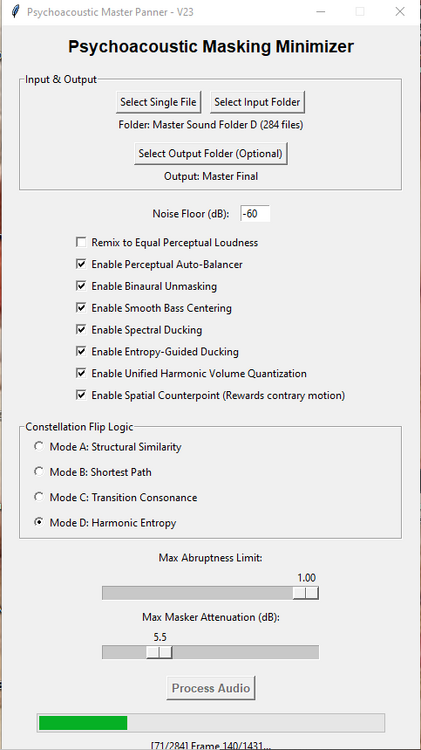
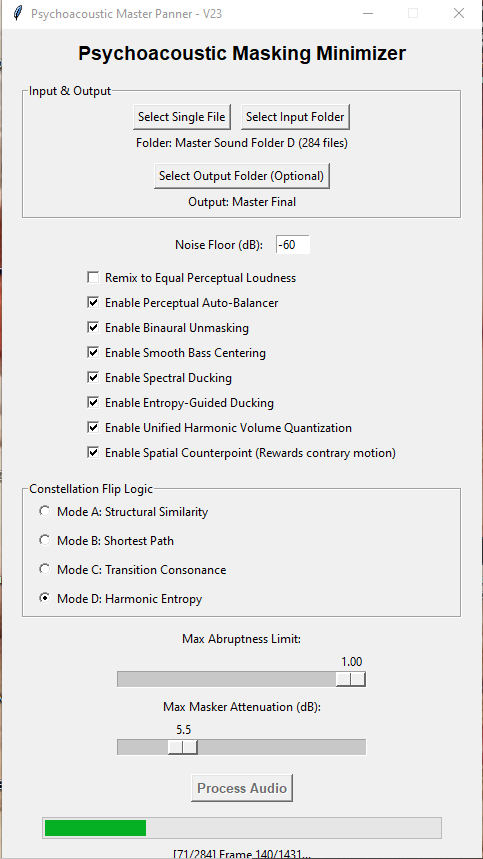
I am now on version 23 of my psychoacoustic remixer. Here is a screenshot plus three links to music it has modified.
-
"Do you perform your music?" It depends. If it's written for bass or guitar, usually--definitely if the rest of the band likes it. A lot of my work is composed in collaboration with performers of other instruments, so I'm not always writing things for ME to perform or even anyone, but I'm often writing for someone to perform. "Do you play or try out your musical ideas on an instrument while composing? Or do you just use software simulations for that?" I usually come up with the initial ideas on a real instrument. If I consider the proficiencies of an intended performer I know that's more skilled than me, or if I decide that this piece won't be intended for public performance, it's off to the software packages with it (although I write everything down in MuseScore, the works that are intended for the stage don't end their life there). "Does that sufficiently connect you to the performance practices of actual musicians?" This is the most interesting question out of the bunch, in my opinion, and I honestly feel like the answer is no. Fully digital editions of most music just feels somewhat hollow or lacking, although I believe that to be a sort of bias by association. Electronic music and videogame soundtracks, though often partially or entirely programmed into a computer to play, don't trigger the same response anymore. It honestly makes branching into the genres feel attractive on the surface, considering I'm often tired of dealing with other people...
-
I started on the trombone about 15 years ago (sorry, I'm a little older than someone that I typically call young, but I was looking for a community to engage with one of my healthier and more interesting hobbies). 3 or 4 years after that, I picked up the electric bass (I always wanted to get a contrabass to transfer my skills and diversify the contexts I can play in, but the cost is very high), and this has become my main instrument. Over the next 5 or so years after that, I picked up the guitar and most of the brass family to various degrees of competence. I have a flute I've never played lol. I really want to sharpen my skills in composition and piano performance at this point (without sacrificing my time with the bass--it's the only instrument that's made me any money haha).
-
I'd been interested in being involved with music since a very young age (longer than I can remember), but I didn't pick up my first instrument until I was about 11. I didn't write my first song until I was about 14. Shortly after that, however, a classmate told me he was writing a symphony for a class project (it was more of a tone poem, but I'm being pedantic rather than critical of the quality of his work), and he challenged me to write a better one than him. Not having much experience writing for strings or dealing with larger works, mine was pretty awful in comparison, but I fell in love with writing music after having sunk almost 6 months into this project.
-
Just looking for general feedback on a less adventurous work before I dive into a more involved work. I feel like advice on the use of harmony and motifs would improve most of my work, and I could develop those skills by learning to improve some of my existing work. Waltz in Eb.mp3
-
GMoneywroteasong joined the community
-
I was wrong. There was room to improve, plenty of room, and I have done just that. Give this remix a listen:
- Yesterday
-
Version 17 has arrived. I completely changed the logic for how panning constellations decide to orient themselves, using a highly complex and original idea that I came up with, and the result is very lucid and pleasing. I think this is the final stage of the program, actually, as I am finally quite happy with the sound. Below is a short sample, I will be adding more to this topic as I continue the rather slow and tedious process of reuploading all my music.
-
A Tribute to the Late Leonard Roseman
-
Thank you so much, @Churchcantor , I am really glad you enjoyed it! I had my doubts at first with those sections with the A-E against Eb-Ab, so it is nice to hear that it works! Thanks for listening and commenting!
-
Exposition of Rondo-Sonata in Ragtime form, AABBACCDD. Melody/leading line only, and now I need CCDD theme! Development will start with a fugal exposition; hackneyed, I know, but I like such indulgences...that's going to be three minutes of the beginnings of music, and the CCDD themes should be about 1'30" giving me 4.5 to five minutes for the exposition, aiming at 9'00" like the other movements. 10:20 PM exposition done, but subject to revision! Piano Sonata in A Minor-3 Free Sheet Music by Robert C. Fox for Piano/Keyboard | Noteflight On listening this morning, quirky, but so are the other movements. I need about 60 measures for a development beginning in C Major, but I don't know whether to start with my fugue or get to it! The recap will be the first part without repeats, though probably a key change to get back to A Minor, a little coda. It will go fast when I get the idea.
-
OK, HERE!!! I'll just allow others to go as I go, so here MIGHT be the first 80 seconds or so of the finale. We'll seeee, my prescioussss, how long it taaakes poor Smeagol; GOLLUM!!! First Theme Melodic Sketch-Piano Sonata 3 Free Sheet Music by Robert C. Fox for Piano/Keyboard | Noteflight
-
Hello, I'd like to share my new project - an organ mass for an actual use during a catholic mass. This Offertorium is the first completed part of this mass. I plan to compose this mass in the 19th century french romantic style inspired by small liturgical pieces by Boëllmann, Lefebure Wely and Guilmant. The remaining parts - Entree, Communion, Sortie and maybe an additional one will come soon. Thank you for listening (link to the video of me performing this little piece). Honest opinions are welcome :) Offertorium.pdf
-
-
-
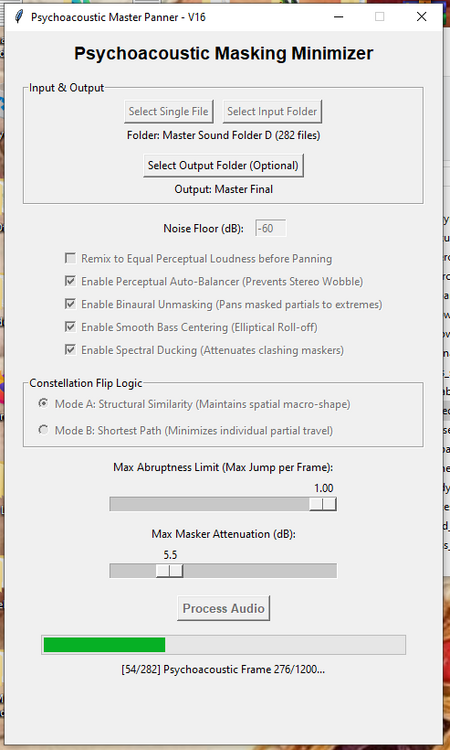
Here's a screenshot of the current version of the program, with which the music in the post directly above this has been remixed.
-
-
Now that I have more or less perfected the processing of adjusting panning, I have turned my attention to adjusting the loudnesses of sound partials. This second aspect of the program is already finished, I think. Here are some results.
-
A vast improvement. Formerly, below a certain frequency, partials were suddenly restricted to being panned hard center. Now there is a smooth transition rather than a hard cutoff, leading to a much smoother effect.
-
One of the last problems was that, while each stucture of panning was more or less optimal, the transitions between them were sometimes not. Sometimes, instruments seemed to jump about at random. I have therefore changed the logic behind this. Formerly, the program would flip optimally constructed "panning constellations" (partials with their orientations in stereo space) so that transitions would be maximally smooth. Instead now, they're connected to each other based on structural similarity, with the result that clusters of partials move around in a much more logical and coherent fashion.
-
-







.thumb.png.8b5b433a341551e913a34392660bc95b.png)