All Activity
Today
-
My dear friend, Henry I really enjoyed going through this Scherzo. There is so much musical thought behind it, and I found myself discovering something new with every page. What impressed me most is the way you handle the texture: the voices are constantly interacting, imitating, answering and overlapping one another, creating a very alive and organically developing musical surface. It never feels like simple accompaniment supporting a main line — the whole ensemble seems to breathe and move as one. I particularly loved the development section. I think this is where your compositional thinking really comes through. The way you take small fragments of the thematic material, redistribute them between the instruments, transform them rhythmically and harmonically, and gradually build the tension is extremely effective. There is a genuine sense of motivic development rather than simply repetition, and I found that especially satisfying as a composer. The harmonic language also really caught my attention. I absolutely loved the modulations throughout the movement — some of them are wonderfully unexpected, yet they feel completely natural within the musical logic. I particularly enjoyed how the harmonic changes are connected to changes in colour and texture, rather than functioning merely as changes of key. There were several moments where I felt a beautiful Schubertian quality, especially in the harmonic movement and the way certain ideas seem to expand almost organically. In other passages, however, I was reminded of Brahms, particularly in the density of the inner voices, the motivic development and the richness of the harmonic texture. I found that combination very fascinating. I also really enjoyed the character of the Scherzo itself. It has this wonderful mixture of playfulness, darkness, nervous energy and even a certain sense of irony. The “confuso” aspect is not simply created through speed, but through the interaction of rhythmic layers, accents, articulation and constantly shifting instrumental roles. That gives the movement a very distinctive personality. As a composer, what I appreciate most is that beneath all the technique there is a genuine musical personality. I can feel that you are not simply trying to write something “effective” for the ensemble; you have a very clear musical imagination and your own way of thinking about harmony, texture and development. That is something I respect enormously. It was a real pleasure to study this, my friend. I know how much you appreciate my own music, so I want you to know that the admiration is absolutely mutual. I have great respect for your work, and I genuinely enjoyed spending time with this movement. Congratulations on a beautiful and very thoughtfully crafted Scherzo! ❤️
-
📑 𝑻𝒉𝒆 𝑺𝑰𝑮𝑵𝑨𝑻𝑼𝑹𝑬 | 𝒃𝒚 𝑴𝒂𝒗𝒆𝒍𝒍 THE SIGNATURE by Mavell.mp3

-
My dear Henry, thank you so much, my friend! ❤️ I’m really happy that you noticed that particular moment with the Neapolitan — it’s one of those harmonic moments I especially love, and I’m very glad that it felt so magical to you. And the fact that you describe my music as a mix of Schubert and Scarlatti is a huge compliment to me, especially coming from a musician and composer whose work I appreciate so much. They are two composers I deeply love, and in my own way, I feel that I find something of myself in both of them. Thank you sincerely for your beautiful words, Henry. Your opinion means a lot to me, and I’m very happy that we can continue sharing our music with each other! ❤️ Also, when I find some time, I definitely want to listen to the Clarinet Quintet you posted. I’m really looking forward to hearing it! ❤️Hi @Lithl ! Thx for your review! I learn from my past failure and you can check out my first post here, it’s the earlier version of the quintet and the dynamic there is so bad 🫣 To me this movement is about dark and crazy energy despair brings me. The 1:53 melody is a sarcastic one to play with, and 5:27 even more sarcastic when I failed to claim transcendence for my suffering haha. The ending represents the exhaustion of energy with pizzicato as this gives way to internal reflection for the 3rd movement (which I consider the best movement of the work), so stay tuned! HenryHello @Nazariy! I’ve been interested in this piece for a while and have listened to it on and off; however, perhaps because of its length, I’m a bit late in sharing my thoughts. So, I’d like to take this opportunity to offer some feedback. First of all, I was impressed by the high level of craftsmanship. Beyond the overall structure and the unique appeal of each movement, the music is simply a joy to listen to, with wonderful melodies and rhythms. The melody starting at 9:39 in the "ELEGIE" stuck with me. Personally, the "SCHERZO" is my favorite; I love the balance it strikes between tension and a lovely atmosphere. The rhythmic section around the 5:19 mark is also great. However, there was one thing that caught my attention: the volume balance felt unnatural in a few places (for instance, around the 4:52 mark). It came across as somewhat mechanical. While the performance itself is excellent overall, that specific aspect did bother me a little. That said, the work as a whole is truly wonderful, and I really like it! Best, Lithl.Hi @Nazariy ! I will review each movement in each to earn more exp lol. The prelude is really solemn and to me well fits to the medium of string orchestra. My favourite moment is b.31 with that F# minor melody, and I also enjoy moments when you give the lower strings to shine. Make sure to mark divisi in b.20! Thx for sharing! I should continue reviewing the later movements. HenryHi @Vasilis Michael ! Another great work my friend! That Neapolitan F major resolved to E major in 0:40 sounds so magical to me. I would describe your style as a mix of Schubert and Scarlatti! Both composers are magical in their modulations and you too! HenryBlackkBeethoven replied to BlackkBeethoven's topic in Incomplete Works; Writer's Block and SuggestionsThank you, I just had for be honest and face the fact that it major structural holes and a I made a lot of poor choices, harmonically speaking, so it was time for it to go. It was fun to work on while it lasted.Henry Ng Tsz Kiu replied to BlackkBeethoven's topic in Incomplete Works; Writer's Block and SuggestionsReally need courage to cross out passages you wrote! But you can always recycle materials for other pieces so there won’t be waste! Henry@Henry Ng Tsz Kiu, @PeterthePapercomPoser, really thank you! You guys taught me how to fish! Thanks to you, I think I'm going to have a full belly. But wait. Where's the side dish?My dear friend, thank you so much from the bottom of my heart for this wonderful comment! ❤️ I’m incredibly happy that you enjoyed the sonata, and even more so that you noticed so many details in the music, from the dynamics and tempo transitions to the interplay between the two hands and the way the music leads towards its conclusion. These are things that are very important to me when I write. And what you said about my scores—that you can somehow sense the thought and warmth behind their creation—really touched me. For me, a score is not simply a way of writing music down; it is a part of my thoughts and a little piece of myself. And as for Scarlatti, your comment is an enormous compliment to me, because his music has had such a deep influence on this part of my musical journey. 😊 Thank you again for your kindness, for taking the time to listen to my music so carefully, and for continuing to find something of your own in it. I truly appreciate it my friend! ❤️Um... is this an undiscovered work by Scarlatti or something like that? Anyway, some people in this forum have amazing compositional skills and knowledge. Not everyone does, though, and I mean, hats off to such people. And I think you are one of them. At least, I think so. You have amazing composition skills. I appreciate this piece. The resonance of the sound is great, and it excels in every respect—from the dynamics and tempo transitions to such a smooth, flowing quality and a well-executed conclusion. The interplay of sound between the left and right hands is also nice. It feels as if the sound is sparkling. By the way, I like your sheet music. I’m not qualified to judge the technical accuracy of the scores, but there is a certain quality to them—you can sense the deep thought that went into their creation. They have a real warmth to them. Ok, this world is "so fair" that even when we compose for ourselves as a hobby, etc., there are magnificent differences, haha. Hats off to you, again, @Vasilis Michael!! I like your pieces! Best, Lithl.Hello my friends! I’m happy to present my Binary Sonata No. 26 to you as well. I hope you enjoy it!A friend on discord provided me with this virtual treasure trove of an article about the topic of Fragile, Emergent and Absent tonics from the popular music of the 60's, 70's, 80's and 90's: https://mtosmt.org/issues/mto.17.23.2/mto.17.23.2.spicer.html There is an available pdf link to download the article and musical examples.In a sense Chopin's Ballade no.2 does the same thing, although Chopin goes even one step forward by destroying the false repose of F major all along with the cruel but real tragic A minor ending.I agree the key of the song should be C# minor modulates to E minor with heavy reliance on deceptive cadence. Maybe the songwriter wants to signify the peace represented by the VI chord is full of undercurrent of i. HenryBlackkBeethoven replied to BlackkBeethoven's topic in Incomplete Works; Writer's Block and SuggestionsAfter some thought, I think I'll scrap the piece, just keeping my A section and seeing what I can do with that."Nature's Way" by Christopher Cross: The song starts out on A major.. the chords are as follows: (Verse) (Chorus) ||: A maj | G#7sus4 G#7 :||: C#m A maj B maj :|| E maj B maj | A maj || (repeat) then in the middle there's a modulation in the chorus: (Verse and guitar solo) (Chorus) ||: A maj | G#7sus4 G#7 :||: Em C maj D maj :|| G maj D maj | C maj || ||: C maj | B7sus4 B7 :||: Em C maj D maj :||: G maj D maj | C maj :|| The song ends on a D major chord. I posted this song because of it's ambiguous tonality. The song starts on an A major chord which sounds temporarily as if it could be the tonic chord. But soon enough it turns out to be a bVI chord in a bVI, V7sus4, V7, i progression (C# minor being the key here). But then that is immediately contradicted by E maj, B maj and A maj which in isolation sound like they could be the I, V and IV chords in E major. Finally, there's a modulation after the guitar solo to E minor, emphasizing the i, bVI and bVII (a common trope in rock music and in VGM often referred to as the "Mario Cadence") . The whole pattern of chords is now transposed up a minor 3rd. So the temporary modulation into the relative major is now targeting G major. The song ends on a D major chord, leaving many unanswered questions about its tonality. First off, most of the chords in the progression are major chords. But if you follow the roman numeral analysis, the tonic could be considered to be minor (either C# minor or E minor after the modulation in the middle of the guitar solo). This all just serves to underline the songs harmonic ambiguity. What key do you think it's in?
Yesterday
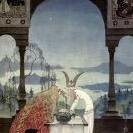
I started this few years ago and posted a couple pieces of this suite before. I had intended to finish it but set it aside and hadn't worked on it in a while. I finally cam back to it a few weeks ago and decided to finish it. It's based on the Hans Christian Anderson story of the Steadfast Tin Soldier. My goal was to write each piece in 3/4 timing, as I don't often use that timing and to keep each piece to less than 4 minutes (thought the finale is just over 5 minutes). I included a description for each piece to describe the action. I. The Tin Soldiers Play War There were once twenty-five tin soldiers, born of the same old spoon. The little boy lined them up together, all splendid in their uniforms of red and blue. They all looked the same, except one. He looked a little different as he had been cast last of all. The tin was short and, in turn, so was he. But there he stood, as steady as his brethren. The little boy marched them around the table, clashing them together and making booms like cannons and musket fire. II. The Paper Ballerina’s Dance He lined them up to protect the model castle and the other small toy figures inside. One of those was a little paper ballerina, with a fluffy gauze skirt and a glistening jewel around her neck. The little tin soldier thought to himself, “I would so love for her to be my wife, but maybe she’s too grand for me. She lives in a castle, and I have only a little box that I share with twenty-four other soldiers.” He hid behind a little box, steadfastly watching her as the other soldiers continued to play. III. The Soldier and the Ballerina’s Pas de Deux When night came and the children went to bed, the toys came to life and began to play on their own. The little tin soldier moved toward the ballerina and offered his hand. To his surprise, she did not reject it; she clasped his hand, and the two began to dance. As they whirled around the table, they looked into each other’s eyes and knew they had found their true love. IV. The Jealous Goblin But in the shadows lurked the goblin who lived in the jack-in-a-box, and he was not pleased with what he saw. For he thought the ballerina belonged to him and did not appreciate this newcomer taking his place. He approached the soldier and said, “Keep your eyes and hands to yourself.” He pushed at him, but the tin soldier stood stiffly in his spot. As the goblin stalked away, he said, “Just what till tomorrow!” V. The Soldier Falls from the Window The next day, maybe by chance or maybe because of the goblin, the little soldier ended up on the open window ledge. Whether it was a gust of wind or a goblin spell, the little soldier fell three stories to the ground, landing between the paving stones. VI. The Journey on the Paper Boat He lay there all night till two boys found him and placed him on a little boat and sent him sailing down the river. The little soldier thought about his dear ballerina and if he would ever see her again. The stream began to move faster and faster, carrying him toward the drain to the sewer. VII. The Escape from the Sewer Rats The tin soldier found himself floating through the sewer. Suddenly, a group of rats came toward the water, demanding that the little soldier pay a toll for passing through their land. They scurried around to find debris to throw at the boat. The little soldier tried to steer the boat around them, but it led him into a fast-moving tunnel and through a drain that led out to sea. The boat turned over and the soldier fell into the water. VIII. The Fish and the Surprise Inside Before he could sink to the bottom, a passing fish swallowed him and the little soldier found himself in the fish’s belly. He moved back and forth as the fish swam. All of a sudden, the fish began to move wildly and then fell still. He then heard loud noises coming from outside before turning quiet. A knife suddenly cut through the fish’s belly and before the little soldier stood his former master’s cook. He had miraculously found his way home. IX. The Reunion and the Fireplace The little soldier stood on the table, his paint worn off, but he still stood as stiff as ever. Across the table, he saw his ballerina, his love that he thought he would never see again. His heart was filled with so much regret for the time together they had missed. But lurking in the shadow was the wicked little goblin. He would not let the little tin soldier take his girl away. Maybe by chance or maybe it was the goblin, but one of the children picked up the soldier and threw him into the fire. The goblin danced in delight of his victory, but suddenly a gust of wind blew the paper ballerina into the fire with the soldier. The next morning, when the fire had died out. The maid saw in the ashes a tiny tin heart, and at the center was the jewel that the ballerina wore. Joined together, as one. 14 The Tin Soldier's Play War.mp3 15 The Paper Ballerina's Dance.mp3 16 The Soldier and the Ballerina's Pas de Deux.mp3 17 The Jealous Goblin.mp3 18 The Soldier Falls From the Window.mp3 19 The Journey on the Paper Boat.mp3 20 The Escape from the Sewer Rats.mp3 21 The Fish and the Surprising Dinner.mp3 22 The Reunion and the Fireplace.mp3








.thumb.png.8b5b433a341551e913a34392660bc95b.png)