All Activity
Past hour
-
Hi everyone! Next to my composing and conducting work, I am also the Music Director of Helvepic, a Swiss concert production company. One of our recent projects is the creation of the World of Warcraft: 20 Years of Music concert that is currently touring worldwide. We're launching a new event called Epic Montreux, taking place in Switzerland on March 5–6, 2027, featuring music from 2WEI, and others, performed by a large symphony orchestra and choir and featuring singer Edda Hayes at the Auditorium Stravinski in Montreux (home of the Montreux Jazz Festival). As part of the event, we're organizing an international composition competition. Three composers will be selected to have their original music performed live by the orchestra and choir. The finalists will also get to work with a professional orchestrator to prepare their pieces for the concert and will be invited to Montreux, with accommodation, meals, local transportation for official activities, and travel covered (see the website for official details). At the concert, an overall winner will be declared, with a separate winner prize to be announced soon. While the concert features a lot of trailer music, including some of the most iconic music for League of Legends cinematic, the competition will put a particular focus on storytelling, musicality, and originality. We want to hear pieces with a clear musical idea, a sense of journey, and genuine musical development. The jury will be led by Russell Brower (Audio Director at CD Project Red), and will also include Ludwig Wicki (conductor), Alex Moukala (composer), Cédric Baravaglio (composer), 2WEI (composer collective), Alexandre Pican (choir director), and myself (composer and conductor). A few practical details: Compose an original 4–5 minute orchestral or hybrid orchestral piece, with substantial use of the orchestra and choir. Submit an MP3 mockup. No written score is required for the competition. One entry per composer, open worldwide to composers aged 18+. No AI-generated music. Very important! Submission deadline: November 8, 2026. Three finalists announced December 16, 2026. Needless to say, the participants keep the copyright and ownership of their composition. There is an entry fee of 40 CHF (currently a bit under 50 USD). I know entry fees for composition competitions are a point of discussion here. We've tried to keep the fee reasonable while offering something substantial to the finalists: professional orchestration, live performances with the full orchestra and choir, accommodation, meals and local transportation for the official activities, as well as support towards travel. in addition, an overall winner prize will be announced soon. You can find the full details, instrumentation, artistic guidelines, rules, and submission form here: https://epicmontreux.helvepic.com/international-composition-competition I'm personally very excited about this project. Having spent a lot of time working with live orchestras, I know how valuable it can be for a composer to hear their music brought to life by real musicians. We hope to give three composers that opportunity while discovering some exciting new musical voices. Happy to answer any questions here!
Today
-
Yesterday
-
Hello, It's nice. I had this image of a robot colony on mars, working hard with the two moons and the ethereal beauty of space. You got this really spacey-feel going on, but also this sense of busy-ness. It feels beautiful in an out of world sort of way. There are moments of emotion, but for the most part it feels almost kind of coldish with the type of harmonies you are throwing it. Hence...robots in space! Parts of it don't even sound like piano, I kept thinking that perhaps a guitar (around 2:00) was playing in the background. But of course, this is probably supposed to be a keyboard piece.
-
karlmarx changed their profile photo
-
this is my untitled piece for piano its one of my proudest works, i would appreciate any feedback and suggestions for titles :D idk what to say, ive been working on it for a few months on and off... probably finished? maybe ill change some voicings and harmonies idk. dissonant greie.mp3 dissonant greie.pdf
-
karlmarx joined the community
-
Thank you for your feedback, @Thatguy v2.0! I'm familiar with Rautavaara and actually, on this topic, I suggested it, but thanks for citing that work :) I like Rautavaara. Apparently, many of the people who kindly commented on this piece say it somehow sounds like birds: you suggested a Concerto for Birds and Orchestra to me, so probably that is a common perspective. That's interesting since I didn't think of anything like that when I composed this piece. Also, thank you for your kind words—I'll share some of my pieces in the future and... aim to get the "Better than Thatguy badge" someday! Best, Lithl.
-
I have finished "The Occult" by Colin Wilson and have picked up the sequel "Beyond The Occult: Twenty Years' Research Into The Paranormal". Here is the very introduction that also delves into some discussion of music. Thanks for reading!
-
So, wanted to expand upon this a little further. In my original comment, I did not mention your use of independent voices, instead focusing on the engraving of the rests, which in the score's current state, are inconsistent when an instrument is resting. Some measures have a centered whole rest, while others have a whole rest aligned to the left of the measure. Not necessarily an independent voice issue, but a score presentation one. In my opinion, Debussy and mid -> late romantic composers are a good reference for using independent voices and keeping it feasible for the keyboard. With baroque notation, like the C-major fugue you referenced, it can be pretty strict with establishing the 4-voices the entire time and always notating when they rest or sound. However, over time, the rules relaxed and today we can see a variety of notation for multiple voices on the keyboard. The main thing is to be consistent with your use. Check out Debussy's Suite Bergamasque. This score video is really great to see 4-part writing expanded. He uses independent voices, blocked chords, interchanging voices and from an engraving standpoint, is really nice to see how flexible/ advanced keyboard notation can be. I played this set and the way the score is engraved really helped my learning. You can clearly see melodic ideas, texture placement and more.
-
Hi @Markus Boyd , I really like what you have so far. I like the minor key fugue at the beginning, the string entrance at around 0:45 in the major mode is a welcome contrast, then I really like how the texture thins out around 1:05. The buildup around 1:35 is also very effective, and the succeeding string melody and arpeggios are lovely. Keep it up!
-
Hi @Alex Weidmann , really great orchestration here! I thought your treatment of the voices was very good. And I really liked how you gave each instrument family (woodwinds, strings, brass) their own section, it really highlighted the piece’s overall structure. I think it would be a good idea to add the repeat, and maybe end with a more full tutti orchestration? That would give the ending more finality. Thanks for sharing!
-
-
Yeah I think this was really interesting. For me I felt like it was really easy to distinguish the two parts, as my ear could effortlessly listen back and forth between them. It didn't feel like oil and water like a lot of bitonal stuff I've heard, but rather the two parts worked much better than what I anticipated. Very cool Peter, I'm interested to hear how all your studies acquiesce into larger works. Maybe something along the lines of blending two themes together at the end of a sonata or something.
-
Hey Lithl Very cool piece! For some reason your piece reminded me of this: Know the composer? This may help if you want to keep learning about a style with "tape" playback (or whatever avenue you use) mixed with instruments. Your piece is more abstract, but I'm sure they're parallel in some ways. I'm not too familiar with the style, but I'm always curious how more abstract music could be developed further. Thanks for sharing, and don't ever be bashful about posting something against the grain of what's here :)
Last week
-
LackyLacky2 joined the community
-
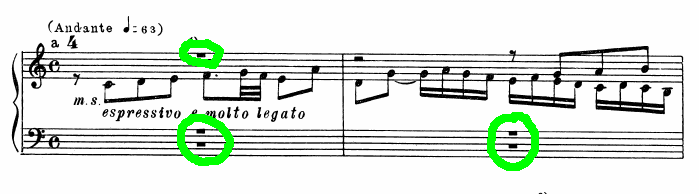
Hallo Mason, now that the contest is over, I’d like to go through the feedback I’ve received over the next few days, analyze it a bit more thoroughly than I’ve been able to in the last weeks, and respond accordingly wherever I have some clarifications or comments. That „bracketing“ and the connected bar lines between the accordion and piano have already been mentioned by other reviewers (for example, @Kvothe ). Not to be too repetitive, that approach was intentional, since I considered my „special quintet“ as an „orchestra“ rather than a chamber ensemble—which, of course, may seem “strange” or “wrong”. However that consideration has sometimes been recognized by other reviewers as well: To avoid that unusual score order/grouping, perhaps it might indeed be the better decision to notate this piece as a “chamber music work“. However, in that case I have a different „headache“: In my piece, the piano part is not as prominent as usual in a piano quintet. Moreover, I would say, the accordion is somewhat more „the chief“, so should the accordion be placed at the very bottom, with the scores for the other instruments written in a smaller font size? No, of course not—the best compromise would be the traditional order you suggested (trumpet, guitar, cello, accordion, piano), but with all instruments in the same font size. Yes, I should use dynamic markings a bit more sparingly in the future. That exaggeration possibly results from the fact that I’ve been following the rule: “Never a hairpin without a dynamic marking at the beginning and end” (I’ve already discussed this in another thread). However, I think it’s feasible to take this “rule” seriously only when it seems appropriate, rather than applying it to every single note or short phrase. We already had „the pleasure“ of discussing whether „whole-bar rests“ (which are placed in the middle of the bar) should be used or not. And until now, I was convinced that those rests are used only when the entire instrument is silent, and not if only one hand of the piano or accordion, or one voice in a polyphonic score, has a rest for the entire measure. So I looked in the „Bible“ (i.e. the Welltempered Clavier, especially at fugues) to reconfirm my opinion ... ... – but I was proven wrong: Even there, “full-measure rests” are used, i.e., placed in the middle. So, I will now finally go to bury my „whole-note rests“ in 4/4 meter or my „dotted half-note rests“ in 3/4 time, and so on. Thank you very much. Yes, the fugato—and especially the moment when the trumpet played the main subject for the first time (without a mute)—was a lot of fun for me to compose. Unfortunately, however, I faced the “dilemma” of having to set two more stanzas of the poem to music. As a result, I had to shorten the development sections of the fugato and resolve the tension to make way for the more contemplative mood of the “sung lines of the poem.” After the poem ended, I wondered whether I should now let the fugato pick up speed again and develop it fully, perhaps with a climax of strettos and a pedal point. But this approach seemed to me to make the piece a bit too long, so I recapitulated the first section in a more melancholic manner, bringing the „arch of tension“ rather down than to a triumphant finale.
-
Hello A lovely piece. One of the key lessons I took away from this ESSENTIAL book by Persichetti is that if you use a system – that is, if you are consistent with a musical organisation, whatever that may be – the result depends solely on each individual’s skill and artistry, just as it would if you were composing tonal music. I think it’s a great decision here to have divided the timbres for each mode-scale. As well as the different registers. The fact that each part has been harmonised in thirds and sixths gives it a very familiar smoothness (common in tonal music). Yet these modes lend themselves perfectly to fourth-based harmony.
-
-
Hey Peter! In fact I find it really melodious even it’s bitonal. The canonic imitation doesn’t sound mechanical to me, which is good job. In fact I’m going to use some bitonal treatment of your theme in my new work working so stay tuned haha. Henry
-
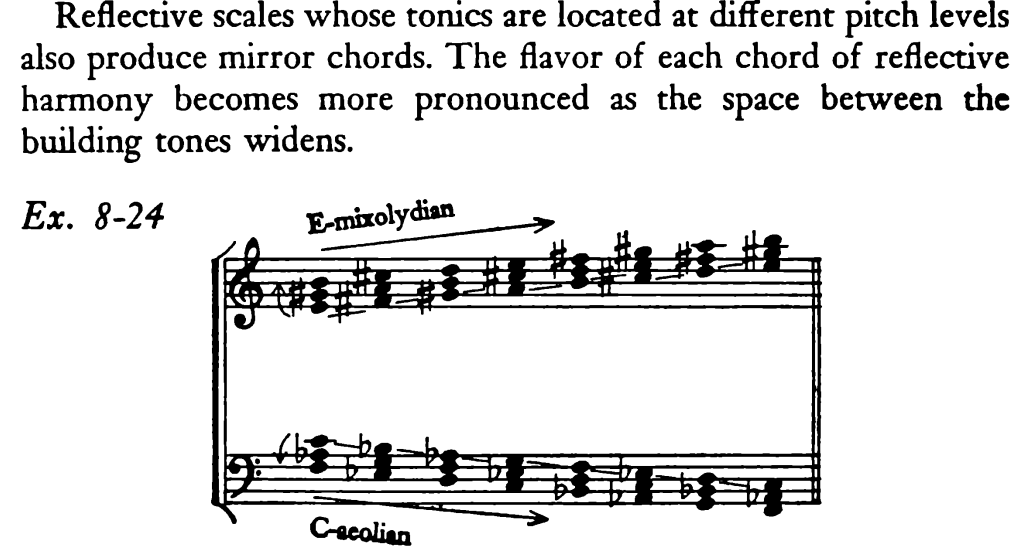
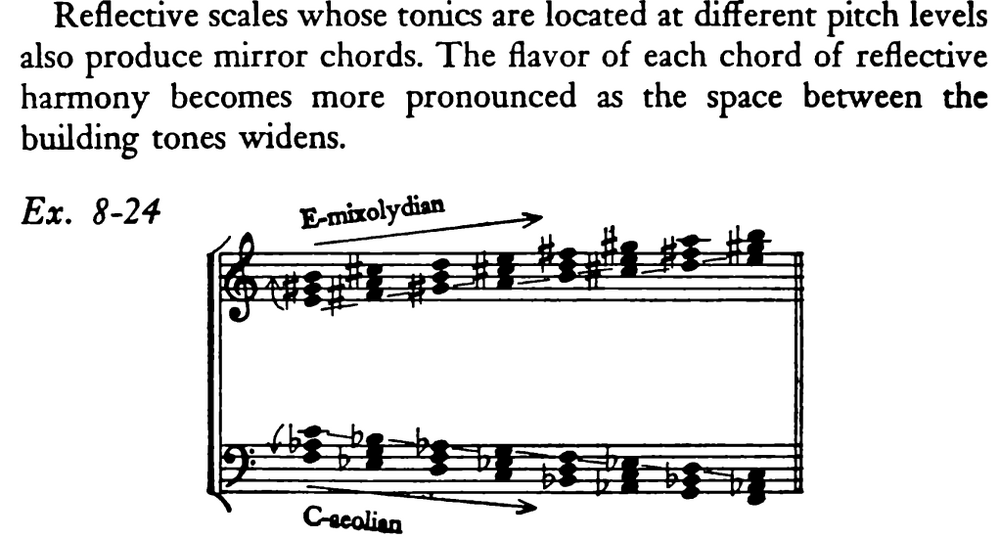
I've taken to another exercise from Chapter 8 of Persichetti's "20th Century Harmony" - "Compound and Mirror Harmony". This time I've chosen Exercise 7 - "Move a chamber group through several mirror chords where the reflective harmony is generated by the same tone and by different tones." In this case he is referring to using symmetrically invertible scales just like in Exercise 8 which I already did. In that exercise I built the respective mirror scales on the same tone (C) so in this exercise I sought to build the mirror scales on different tones only. I also created an inverted canon at a 10th and a quarter note between the Oboes and Bassoons. I used the following chart from the book to simplify the exercise for myself (so I used E Mixolydian in the Oboes and C Aeolian in the Bassoons). At one point I switch the Oboes to Ionian and Bassoons to Phrygian, just like in Exercise 8, but this isn't accompanied by key signature changes. Thanks for reading and for listening! I would appreciate any of your suggestions, comments, critiques or observations! Persichetti Exercise 8 - 7.mp3 Persichetti Exercise 8 - 7.pdf
-
Breznd joined the community
-
Ok very interesting, because I see and hear 2 key signatures played against each other. But the different key signatures themselves are "in key". I suppose this naturally gives us 2 different harmonies without having to manage accidentals. Interesting concept, and at times this sounded a bit like Ravel. Fun rhythms, and for an exercise this sounds like it could be a nice little standalone piece, maybe a prelude, or some type of introduction to a larger work.Yes, Lontano, but really all of her albums are great. I was first taken in by her playing on the album Gurdjieff & Tsabropoulos: Chamber music.Thank you, @Henry Ng Tsz Kiu, for your review :) Gothic scene, that's interesting. I've never thought about it. And your idea about the cello is nice—that's going to be a good one. Actually, I always intend to use extended techniques for string instruments, but I do not know how to play them in the DAW / software realistically. Is having someone play them the only way to get those extended techniques, after all? 😕 Anyway, thanks again, Henry! Best, Lithl.Hi, thank you for your feedback, @Brs. Your point about the cello's contribution is actually what I was concerned about. However, I followed my first idea and created a track. Next time, I plan to elaborate on it more. And above all, thank you for introducing me to Anja Lechner!! I really appreciate it and immediately loved it. Searching for it, the video features the album called Lontano from ECM by Anja Lechner, right? I'm listening to that, and it's such beautiful playing and a beautiful piece. Again, thank you so much :) Best, Lithl.






.thumb.png.8b5b433a341551e913a34392660bc95b.png)