
All Activity
- Past hour
-
 The Colossus of Prora Someone who has written (music) something longer than 30 min. The Colossus of Prora is the longest building in the world.
 - Today
-
 Here is a variation on a motive by Weber (B flat major) with figuration in middle part, as an exercise (ch64, 4.6) from the book 'Material used in Musical Composition (1909)' by the great professor Percy Goetschius. I learned everything I know on melody, harmony and counterpoint from 6 of his books (available for free on the web's archives). The key is to learn music like a language, experiencing rules and their licenses, through practice with a lot of exercises, which most books I have found don't offer. Although I am green at composition, I have completed over 1600 of his small exercises and a dozen larger (small inventions and this variation).
 -
 Pianoers.com joined the community
 -
All my piano compositions so far.
Pianoers.com replied to Ivan1791old's topic in Piano Music, Solo Keyboard
I also need some of your scores, can you send me? -
 This kind of breakdown is pretty cool, and I’ve found that battle music works best when it really drives the action instead of just sitting in the background. Fast rhythms, strong percussion, and some kind of hook or motif help keep it interesting since players can be in the same fight loop for a while. Also thinking about how your loops transition into each other without feeling repetitive makes a huge difference in keeping it from getting annoying mid-game. I usually try a mix of orchestral hits and rhythm ostinatos to build tension, then layer in more melodic stuff for big moments - that seems to work well for fantasy battle themes in most games.
 -
Ccool idea! Sounds like a fun - I like taking a modern melody and giving it an old vibe, maybe reharmonizing or slowing it down with more counterpoint.
- 1 reply
-
- 1
-

-
Fughetta in F minor for String Trio.
Wieland Handke replied to Fugax Contrapunctus's topic in Chamber Music
The first impression I had when listening to the Fughetta was – huh what a long fugue subject which already covers a kind of development on its own, for example with the sequences in mm. 3-7. Because of its chromaticism, it reminds me a little of the “royal theme” from Bach's famous Ricercar a 6 from the “Musical Offering.” I can well imagine how you had this melody in your mind and developed it into this subject, for example while you were out walking, and that you had to write it down immediately upon your return so as not to forget it. There is nothing wrong with such a long subject. However, creating a fugue from it will be challenging, as the exposition will fill almost an entire page! Therefore, I think it was the right choice to refrain from adding further complete subject entries and to leave the piece as “just” a fughetta, so that there is enough space to play contrapuntally with the material. And this has been achieved excellently, both rhythmically, where the staccatos are contrasted with the appoggiaturas, and harmonically, through the treatment of the chromatic sequences. This once again highlights the potential of contrapuntal composition technique, even if the piece does not necessarily imitate a Baroque style, but is, for me, more contemporary due to the dissonances that I like. (By the way, the key of E minor still remains in the title of your current score.) Wieland -

He Likes a Girl (based off Nxdia's, "She Likes a Boy.")
femboy_sharky replied to femboy_sharky's topic in Choral, Vocal
I appreciate your suggestion regarding the inclusion of instrumental music or vocal performances. The sole reason I have not incorporated such elements is that I am currently unfamiliar with the process of uploading or sharing them on this platform. Nevertheless, I appreciate your input and will certainly consider it in the future. -
 Ah yes)) Instead of predicting your love life, it predicts whether your flute and bassoon will get along, or if your oboe and piccolo will have major conflicts in the key of C
 -
 Is this the orchestral version of fortune telling?🤔I have heard of cold, hot and warm fortune for different people born in different months!
 -
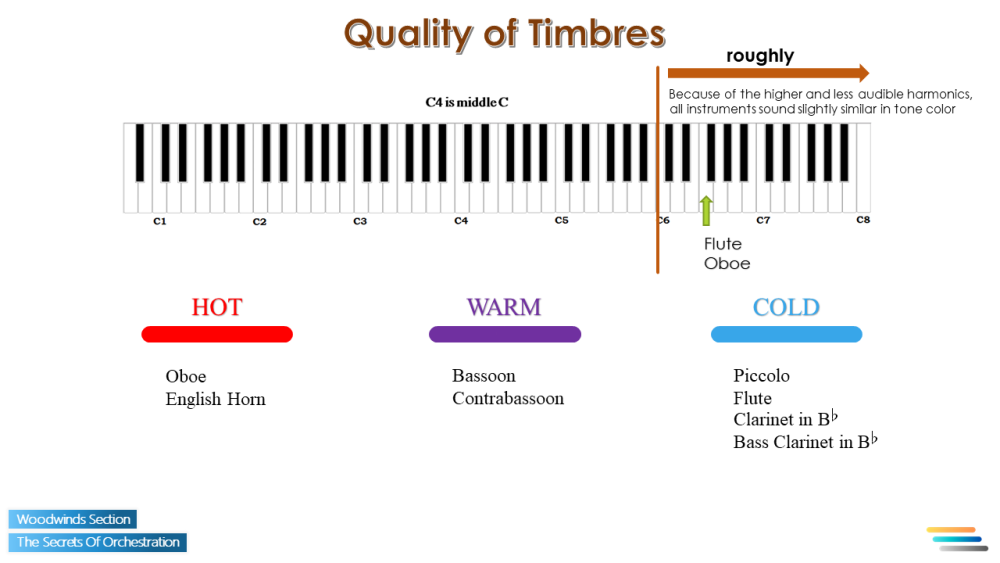
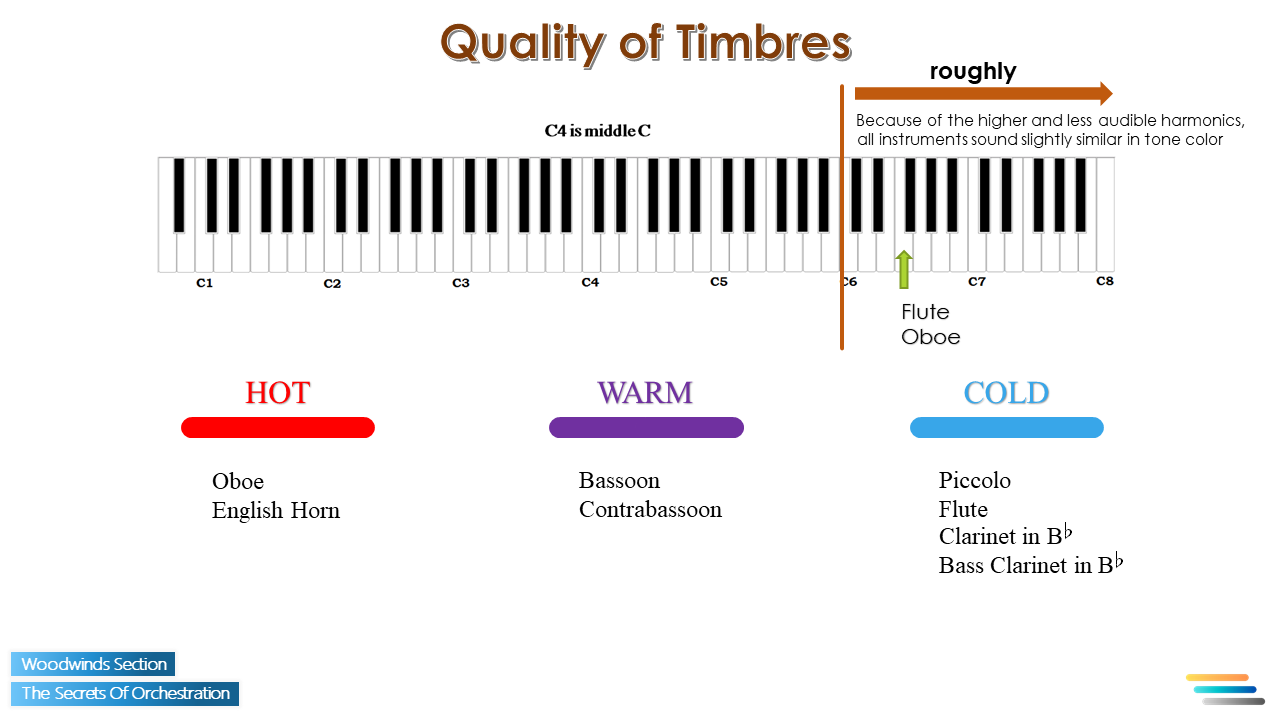
The woodwind section of the symphony orchestra can be categorized into three primary timbral color groups: Cold, Warm, and Hot. This classification helps composers understand how different woodwind instruments function within orchestral texture, balance, and emotional character. By organizing instruments according to their inherent timbral qualities, composers can make more intentional decisions when writing melodies, harmonies, and layered textures. Additionally, this categorization provides practical guidance on instrumental mixing, allowing composers to predict how different woodwinds will blend, contrast, or dominate within an orchestral context—and what kind of sonic result will ultimately be achieved. 1. Cold Timbres: Piccolo, Flute, Clarinet, Bass Clarinet 2. Hot Timbres: Oboe, English Horn 3. Warm Timbres Bassoon, Contrabassoon NB: Due to the dominance of higher and less perceptible harmonics in the extreme upper registers, the timbre of woodwind instruments becomes less distinct. In these ranges, different instruments may sound surprisingly similar in tone color. For example, when the flute and oboe play the same pitch—such as F6—it becomes difficult to clearly identify whether the sound is cold or hot, or even to distinguish which instrument is playing. For this reason, the following graphics and timbral classifications are based on the most effective, practical, and musically “sweet” registers of each instrument, where their characteristic tone color is most clearly perceived and reliably distinguishable in orchestral writing More Information and Free Orchestration Resources: Free Download
-

He Likes a Girl (based off Nxdia's, "She Likes a Boy.")
Aiwendil replied to femboy_sharky's topic in Choral, Vocal
I hope you don't take this the wrong way, but I'm not really sure why you're posting these here. This is a music composition forum, and you're posting lyrics without music. We can't give feedback on them as music compositions. I think perhaps a creative writing forum would suit your purpose better, and would yield better feedback for you? -
I'm beginning to write a small oratorio
Wieland Handke replied to Cafebabe's topic in Orchestral and Large Ensemble
Dear Cafebabe! Since you really are a „Young Composer“ – I have double checked you profile – and today is your birthday (a special one, at that), first of all, congratulations. Now, to your Oratorio. Without going into detail today, I can only express, that I’ve really enjoyed it! With an overture called “Sinfonia” and an aria for tenor as the second piece, which have this mood and style, I was immediately reminded of Handel's Messiah – perhaps you have already heard it 🙂. Writing an Oratorio is a great challenge, and – if you are not Handel accomplishing it within three weeks – this can be a long lasting, not to say a life-time project. However, don’t think this is a problem. Having such a large, challenging project in mind should be considered as a framework where you can put time after time more pieces into, which has the great advantage that compositions, otherwise produced occasionally, have a place where they are not forgotten or lost. And for that purpose, having a framework which fits different kinds of pieces, the project cannot be ambitious enough. As mentioned in some other comments, the movements can be extended to reach their full potential. But that’s the fun. I’m curious how you’ll proceed in that project over the next years! Wieland - Yesterday
-

Lazy Day Background Music
kaiyunmusic replied to kaiyunmusic's topic in Incidental Music and Soundtracks
hi @AngelCityOutlaw, thanks for listening and for your feedback! By sudden rests, do you mean measures 32-38? -
 You call the first theme folk melody...that's a compliment; I thought of it as a fugue subject in disguise! There are romantic-era nods as well. In the first movement, the slow intro sounds a bit like Tchaikovsky, and the final cadence is a direct rip-off (well, tribute to?) of the final cadence to C.M.V. Weber's Der Freischütz first act! Different key. It has always been my favorite opera!😉 It is not postmodern, but could that be true in a way? Basically a Nineteenth Century symphony, but has Baroque elements, even some Classical ones. We LIVING composers have the luxury, especially today with everything on the Internet, to be eclectic.
 -

Mozart-style Sonata in F Major
Luis Hernández replied to Cafebabe's topic in Piano Music, Solo Keyboard
A very enjoyable piece. Leaving aside some noise and clicking issues in the audio, I think it lacks something to bring it closer to the style, and that is dynamics. Although classicism (and Mozart, of course) did not make extensive use of gradual dynamic contrasts (but rather more powerful ones such as piano and forte), there are none here either. More than that, it is the accents, sforzandos, etc., which were very common in this period, that make it sound like it. -
Fughetta in F minor for String Trio.
Luis Hernández replied to Fugax Contrapunctus's topic in Chamber Music
A beautiful piece. I think the subject matter is very original and distinctive. That really helps with the recognition of the entries. The parallel descending movements are very beautiful, with those appoggiaturas, etc., as in bars 19 onwards and later with the reinforcement of the bass. I think it loses none of the essence of counterpoint, but it has many touches that make it sound modern, such as the profusion of articulations. Best regards. -
 PROGRESS 3 hello, it's been a month. work on finalizing the piece has been dwindling but i'm here to start it off back again!!! this progress is all about the repetition of the A. section. you can see that i tried to variate the accompaniment, most prominently with the active celesta section and the climax at b.329, which is taken from b.180 onward. The counterpoint from that section is now sung by the vocal with a new stanza, which is another piece of the second part of the main theme: from the sky x to y distant light just keeps calling me from the sky aight that's it for now. hope you all enjoyyy
 -
The subject of this one first came to mind roughly 7 hours ago already in its current form, and realizing its potential I wasted no time in writing it down, lest I forgot its exact melodic contour whose progression has been able to accommodate for elaborate chromaticisms in the other voices. Now, after yet another sleepless night put to good use with tireless contrapuntal machinations, this little fugue for string trio is at last complete in my eyes. YouTube video link:
-
Hello everyone, I recently updated a little draft of music for string quintet on the incomplete works forum and I just developed it into a full piece. After some thought, the section felt somehow like a developed theme, so I composed a main theme by using some of the musical features found in that draft I composed. The piece is an elegy and has the following sections: [m.1~m.9] Introduction -- The introduction was composed by making use of the most important harmonies of the piece: Cmaj, Cminor, Dbmaj and Gmaj. [m.10 ~ m.25] Main theme -- Main theme in C minor. It works as a period but, in this case, both statements end in a half cadence (the second has a stronger modulation to G) [m.26 ~ m.40] Development section (original draft) -- Developmental section which starts with the main theme in Cmaj. This section is repeated once. [m.41 ~ m.51] Restatement of main theme -- second part of the main theme repeated once, this time ending in a perfect cadence (with picardy third in last chord). I think the atmosphere fits the title of "elegy", but let me know what you think! Also, a distinctive feature retained from the draft is the use of pauses that resemble deep sighs (or holding ones breath). I took as much care as possible to make those moments sound natural but the midi sounds showed its limitation in those cases :S. I am thinking on updating it so both violins get to play the melody at some time, doing some voice exchange like that one I did in measures 14-15. Is it standard practice to share melodic material between the two violins in order to create an echo effect and add variety for both performers, even if the melody could be written entirely for Violin I? Also, I used dotted notes for those moments in which they need to cut the phrase a little earlier. Would there be a better way for notating that? As always, every feedback is more than welcome and hope you enjoy it!
-
- 2
-
-
Here's an unlisted video of a track from another album I wrote themed around crime/spy thrillers that will be out later this year probably via my usual publisher, but after the gothic/dark neoclassical album I wrote for them. So I'm expecting it to be out around summer or fall. This in particular is the first electronic-driven tune I've composed in I don't know how long, since I had abandoned that genre since I wasn't really good at it (and didn't enjoy it as much as the orchestra anyway) and hate designing synth timbres, but writing this one I was kinda like See what you think. Side note: I expect most of my YouTube DAW videos going forward to be unlisted. YouTube has kind of become a joke since the AI slop takeover you just get buried in the algorithm; better use of time to just show these to film directors and such, which has been going much better anyway.
-
Lazy Day Background Music
AngelCityOutlaw replied to kaiyunmusic's topic in Incidental Music and Soundtracks
Sounds great. I think my only complaints is that I think you overuse the sudden rests a bit in the latter half of the piece, but it is good listening and does what it says on the tin. -
This is an aria for alto, flute, strings, and continuo in the late Baroque style. The text is taken from Goethe's Ganymed, and a sample translation can be found here. The form is binary, with the usual closing orchestral ritornello joined by the soloist.
-
- 1
-
- Last week
-
We staff have decided that it might be a good idea to open the awarding of badges up to the members, not just the staff. The staff aren't perfect and can sometimes miss some good opportunities to award badges to members for some of their excellent or distinctive content. So if you feel like you have been overlooked for an award you deserve - let us know! Tell us which piece you think deserves what kind of award/badge and why and we will consider granting it to you. You can also suggest awards for other fellow composers' works! Refer to the following list of manually awardable badges. If a badge doesn't exist for your particular achievement you can suggest new badges/awards in that thread:
-
- 3
-
-
I just want to let you guys know that I greatly appreciate you guys joining The Arcane Alchemy. Here we will make some amazing pieces and come up with some great q&a's, so again thank you guys so much for joining!
-
- 1
-
-
 Something that may be of interest to young composers who use virtual instruments for their own orchestral music: an example of producing a high complexity level piece such as Mahler's 6th Symphony with Vienna Symphonic Library. (This is the first part, up to the transition to the 2nd main subject. I will be adding the coming sections in this thread as they are finished.) If you are aware of any other (good or bad) attempts at producing (even an excerpt of) the 6th Symphony with virtual instruments, do let me know. Also, if this should inspire you to make your own attempt at this piece, I'll be happy to listen to it and discuss it with you.

.thumb.png.8b5b433a341551e913a34392660bc95b.png)