
Leaderboard
-

Omicronrg9
Moderators3Points595Posts -
Thatguy v2.0
Moderators2Points1,360Posts -

Henry Ng Tsz Kiu
Moderators2Points3,143Posts -
ComposaBoi
Members1Points151Posts




Popular Content
Showing content with the highest reputation on 04/04/2023 in all areas
-
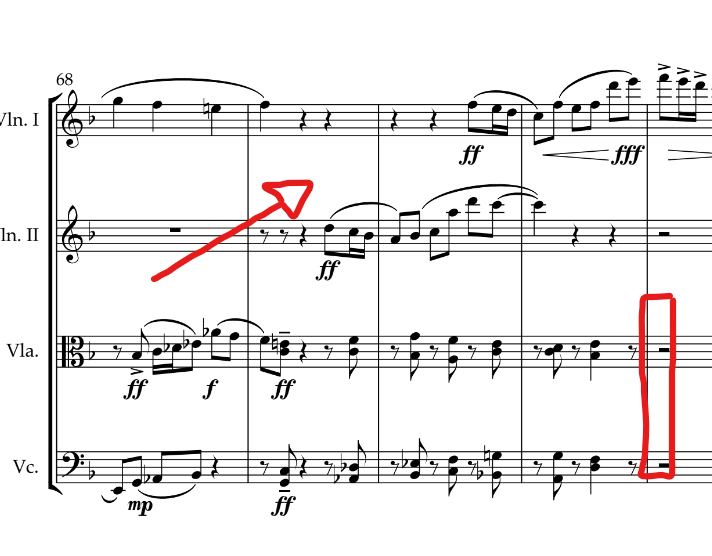
1 point1 point1 pointHi @MrSaxobeat, Not much too add, but I think " 'Blah Blah Blah (The name) Suite- for Sax Quartet) a good name! Thanks for joining us and please feel free to visit other members' posts here too! Henry1 point1 pointI would say that a mini suite sounds good enough, specially since there's a thematic link between movements. Looking forward to check your finished work. Kind regards!1 pointHey thanks, Alex! For some of them, I went with a key signature. For others, I opted out. After looking at this again, I agree with you. By the end of this set of pieces, I'm going to refine all the scores based on yours and others suggestions. Thanks for checking it out 😄1 pointI'm liking this series of preludes Vince! Can definitely see the influence of Bach's "Well-Tempered Clavier" here. My only suggestion is, perhaps it would be better to use G minor as the key signature rather than A minor. Then you would reduce the number of accidentals.1 point1 pointHi & welcome to Young Composers! Sax quartet sounds like a solid choice. Labels nowadays are not that strict, specially when you compose for instruments that were invented after those concepts were manipulated and adapted by many different composers during different eras. Still, if you are unsure, I would say that a 10 min, four-movement composition for 4 a sax quartet is definitely a sax quartet. A few questions though: • Are your movements "linked" in some way? If so, how? • Does the order you play them matter? • Have you followed any conventions of any compositional style in particular? This question might be the most important for baroque compositions, since the constraints you have to follow in order to make a baroque suite are indeed more "written in stone" than in other periods that followed it. Of course, posting your piece is encouraged, as that is probably the best way to find out in which "category" or "label" your piece fits the most. We have a sub-forum for incomplete works (link here). In case you consider your piece finished, feel free to post it in the according category, which in your case would likely be "Chamber Music". Kind regards, Daniel–Ømicrón.1 point1 pointI thought I'd post my first symphony on here to see what people thought. The piece is finished, so any feedback you give, know that it won't be changed. Thanks for listening!1 point1 pointHi, Giacomo. I would agree with this generally; the more the piece advances, at least up to the re-exposition and specially in the section starting at 50, the further it goes from the usual harmony shown in the prior passages. What does seem to be a constant here is the question-answer passages that stain the majority of the piece for its own good in the majority of cases, but I don't think this kind of feedback is what you're looking for so I'm going to try diving a bit deeper. • After a 3rd listening (of the most up to date version of your piece you brought to us), I noticed that the "crescendo" you do from M68 to the beginning of M72 felt unsolved in the lower voices (image of how I view it below the whole text), so I thought that extending the off-beat to that measure and resolving it at the same beat the decrescendo from fortississimo to forte begins in the first violin might be a good approach towards making clear that this section featuring strong "fake resolutions" —one at M67, off-beat; another one at M69, off-beat too— is over and the more fluid passages that come afterwards take control of the piece for a while. • As a recommendation that I applied to myself regarding engraving, and which was recommended by some teachers of mine, try to compress silences where they not be meaningful or useful for reading. For example, look at Vc. part in M78,79 and 80. There are many more like these throughout the piece, which suggest me loads of try & error made —and thus, that this piece might be everything but effortless, which I highly value— cause these uncompressed silences are often left by the notation software after modifying/erasing/adding stuff. In order to not make this denser, I'll stop here and give some more superficial opinions. • My favourite parts were the exposition (the whole, up to M50) and the passage that goes from M86 to M92. The ending section was also good but not as good as the beginning and the aforementioned section. • The 4-5 bars preceding M86 didn't convince me too much, but I'm not sure why. Perhaps because you reached fortissimo too soon: already in M80 we have forte but the music seems to be building up tension from that point till M82, hence I would say the dynamics don't exactly match with the intention... Perhaps I would have begun a bit less loud so the point of maximum tension is successfully reached and better noticed when the last legato [M83B3 to M85B4] and only it hold the maximum loudness in comparison with the preceding two. But perhaps not, again I'm not sure :B. All in all, a very enjoyable work (for me, specially in the parts I mentioned). Kind regards, Daniel–Ømicrón.
 1 pointHello @Pano, Tonicization is a way to modulate, as "tonicization is the treatment of a pitch other than the overall tonic (the "home note" of a piece) as a temporary tonic in a composition." (From wiki). The A# is both a signal of tonicization and modulation since tonicization is the method for modulation. Henry1 point1 point1 pointThank you so much for such a kind feedback Daniel! I noticed the equilisation problem too in the playback. The Musescore 4 soundfonts are kind of unbalanced in the string section, so maybe I need to tamper with it manually to make it work. I am really glad that you liked that the fugue took its time. To be honest even I was scared of putting slow sections in a fugue but I wanted to express a story from start to finish rather than just following conventionally styled fugal episodes. Thank you again for taking the time to listen and giving such a valuable feedback!1 pointI had just been working on the one in D....whoops 😄 hmm yeah good catch, I'll dig into it to make it better. Thanks! Yes! From now on I should just ask for your opinion before I post lol I'm ahead, so three more to go! (though I'm feeling the wear of trying to finish up. I want to finish before taking a break though, this has been keeping my creative juices flowing.) Thanks man, but I still feel like I can do better with engraving. Omicron ending seal of approval. That should be your trademark badge thanks for checking this out Daniel and Henry, I always hope one of you two will stop by when I post1 point1 pointWell, hats off to you for having the determination to complete a full 4 movement work, and the courage to post it here for comment and feedback. It’s too bad that the first commenter felt free to snipe at your effort without even listening to it; that’s not typically a way to earn respect for one’s opinions. I did listen to your entire symphony. That said, I’m not going to listen a second time. It’s clearly a beginner’s effort and a learning exercise. My advice would be to call it done (I agree with your decision not to make changes), set it aside, and begin to work with smaller forms to develop your skills. Here are some things I’d suggest you work on: 1. How to craft a melodic line. With a couple of exceptions, your melodies are just little patterns that don’t go anywhere. If your intent is to write in the classical-romantic tradition, you need to figure out what makes a melody and what makes a developable theme. 2. Types of polyphony other than melody-and-accompaniment. The vast majority of your symphony consists of little melodic-like-patterns against a block-chord accompaniment. This just gets tiresome. 3. How to develop a musical idea. A symphonic movement is long because it takes that long for the material to be developed and for the composer to say what needs to be said. Your symphony has, to my ear, about 8 minutes of content stretched out to 47 minutes by repetition. Repetition is NOT development. 4. An awareness of what real instruments, played by real humans, can and can’t do. Your second movement scherzo has some potential, but your tuba player has died of hypoxia before it’s half done. The rest of your brass section expires in the finale. You don’t gain credibility by being that conspicuously unaware. I don’t want to pile on any more or be discouraging. I also once tried to write a symphony, long before I knew what I was doing. I finished the opening movement and a little bit of a scherzo. The experience taught me that I had a lot to learn about symphonies, but that it was learnable. It’s possible that I know what I’m doing now, but I actually don’t think I’ll ever write one, mainly because the expectations of audiences have changed so much.1 point