Leaderboard
-
Carl Koh Wei Hao
Members2Points74Posts -
PCC
Members2Points137Posts -
Awsumerguy
Members2Points90Posts -
Saltypenguin
Members2Points8Posts


Popular Content
Showing content with the highest reputation on 06/01/2023 in all areas
-
1 pointHi all. This is a little orchestral piece I wrote some months ago, now it has been improved (or I think so). After Ligeti, it develops some techniques such as mass sonority and micropolyphony.1 point
-
as if string players won't decide for themselves lol jk I just wanted to point out in reality, no matter what you write string players will try to find ways around it, so yes write in the details but don't get flustered too much1 point
-
1 pointMass sonority is a technique in which the same melodic line or structure is played by several instruments at the same time, but the exact contour of each is different. It's sort of like a big heterophony, and that's how this short piece starts. Micropolyphony is based on a great density of themes, melodies, harmonies, etc. Sometimes it is achieved by minimal changes in a structure, other times by superimpositions of the same structure as a massive canon, etc...1 point
-
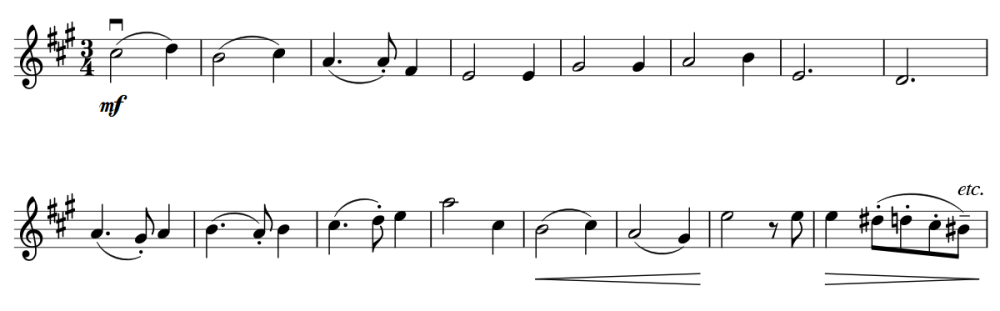
Hi @Awsumerguy, This version is definitely an improvement from the previous one. Changing the key from A-flat major to A major has brightened up the character of the waltz. However, I want to mention the following issues: Playing the notes in bars 29-32 with a single bow stroke may be less practical. At mezzo forte, the bow speed is expected to be high, and you may need more bow strokes to play those notes. The same goes for bars 37-40 in the violin part. Here's a better bowing for bars 29-44: notice that the note at the start of each four-bar phrase is always down-bowed. The double stops in bar 136 are unplayable because the B cannot be played on the D string. However, the double stops in bar 135 can be played: D on the G string and F-sharp on the D string. I hope this gives you an idea about double stops. Regarding Henry's concern about whether the quick double stops can be played, I think this should not be a problem for well-trained violinists. However, the alternating thirds in bars 72-73 may not be easy to play at this tempo. Carl Koh Wei Hao
 1 point
 -
Haha don't worry! Sometimes you will miss details if you're in a rush! I do that often!!🤣1 point
-
Darn it! Despite all my efforts trying to spot out those stray accidentals, I've come up short on some 😰. I'll clear those up real quick, thanks for the reminder! I would have totally missed all of those.1 point
-
1 pointHey @Luis Hernández, I really find this prelude very interesting with all those extended techniques like glissandos of horn and harp, and the bassoon is very percussive here. I am not immersed in Ligeti's music at all. What is mass sonority and micropolyphony? Can you help explain that? I always enjoy your didactic output here Luis! Sorry I don't check your blog often even though I know there's English version on it! Henry1 point
-
1 pointThis thread only has one track from the Lord of the Rings. That's unacceptable. The best part of the Above track by itself: Not a movie but Game of Thrones has excellent music:1 point
-
Thanks for the detailed critique, @Carl Koh Wei Hao! I looked through most of the examples you've given on the bits I should change, and it seems my changes were more or less on the mark: the unplayable harmonic at b. 19, the triple/quadruple stops on b.s 179 and 203, etc. I fixed by either removing or replacing some notes and making them double stops. It seems that the key change was rather necessary regardless of whether or not some sections are actually playable, and I've thankfully grown to quite like the sound of this piece as it stands now. I'll look into changing the bowing and adding the slur lines and phrasing sometime tomorrow, as it's nearly midnight where I'm from and I'm getting rather tired 😪 I'll try and get the finished product on here as soon as I can tomorrow! P.S. You the man yo 💪🤝1 point
-
Hi Awsumerguy, Pretty much has been said by our peers here, and my criticism is still primarily about your violin writing. My sister plays the violin, so I know a little bit about writing for the violin and may be able to give you some insight: Notes in downbeats (especially if they begin a phrase) and accented notes or chords are usually played with the down-bow stroke. For example, in bar 104, the B-flats should be down-bowed instead of up-bowed. The same goes for bar 127: while you mentioned con forza in the violin part, it is recommended that the accented B-flat be down-bowed. Some triple and quadruple stops may be unplayable, as mentioned by PCC and Henry. For example, the chord in bar 209 may not be practical to play because it would require the fingers to be placed awkwardly on the fingerboard. Also, the F major chord in bar 175 is utterly unplayable because the middle C cannot be played on the D string. Like what PCC mentioned, there are very few slurs in the violin part. Notes under a slur are played in a single bow stroke, and I suggest you use it for expressiveness when writing for the violin. For example, consider applying it on the sixteenth-note runs in bars 127-128. When writing for a musical instrument, it is crucial to understand its limitations and common usage, such as keys. For example, musical keys such as G, D, A, and E major are well-suited for the violin because they are based on the instrument's standard tuning (G, D, A, and E). While playing pieces in A-flat major on the violin is possible, its usage is limited because the A-flat major scale contains very few open string notes: only G. Therefore, this makes flat keys most suitable for slow and expressive pieces that involve the violin. I am pretty confused about bars 19-20, 105-106, 116-117, and similar passages in the violin part. While it is a tie, both notes are played on different strokes, making them sound separate. I am not sure how violinists would play these passages. Lastly, as PCC said, the E-flat in bar 19 cannot be played as a natural harmonic. Although harmonics are a great way to change the instrument's timbre, it is essential to research playing harmonics on the violin, which includes natural and artificial harmonics. For example, the harmonics that can be naturally played on the E string (fundamental note: E4) are E5, B5, E6, G#6, B6, and so on (notes are named according to the scientific pitch notation). This pretty much summarizes what our peers have said. Anyway, thank you for sharing this piece! Carl Koh Wei Hao P.S. By the way, A-flat major is one of my favourite keys!1 point
-
notation is not too much of a difficult thing, just move everything up and down and trial and error, a bit tedious but nothing impossible Do you find A-flat major more grandiose because it's more of a "Piano" key, so to say? Many famous piano pieces are in A-flat, such as Chopin's polonaise, Pathetique second movement. Henry's recently posted sonata as well. But if you really want A-flat major to work for the violin you really need to find a violinist to help with the parts, I'm out of ideas on this page. Otherwise you might consider keeping A-flat key but make the Piano part shine more. I guess what I am trying to say is certain instruments lend themselves to certain keys. Most violin concertos are in the key of D, I recently learned. Then again take my words with pinches of salt, I haven't offer a lot of my own pieces here on YC and I'm already ranting lmao1 point
-
1 pointHello! I don't post here much anymore, but I'm an older "Old Timer" from the early days of this community. I compose mostly in Classical style of the late 18th-early 19th Centuries. I've been extremely busy writing all kinds of stuff, but here is one of the best examples of my recent output, my Symphony No. 9 in C. This work was premiered by the Delano Chamber Orchestra, Wichita, Kansas, under the direction of Dr. Wesley DeSpain on February 5, 2023. I may post a link to the live performance once I figure out how to edit it down. In the meantime, here is a link to a YouTube scrolling score video with high quality electronic rendering. Details on this work: Composed: August 29, 2019 - July 22, 2021 at Austin. Scoring: Full Classical-period orchestra - 2 Flutes, 2 Oboes, 2 Clarinets in B-flat, 2 Bassoons, 2 Horns (in C and G), 2 Trumpets in C, Timpani, Strings. Style: Classical, ca. 1790-1800. Duration: 33:30. I. Allegro maestoso (00:00) II. Andante sostenuto (08:00) III. Menuetto: Allegro brillante (16:25) IV. Vivace (22:55) - Electronic Rendering by Finale 26 music notation software "Human Playback" with NotePerformer 3 artificial intelligence assisted interpretation. I hope you enjoy, and let me know what you think. Incidentally, the structural repeat in the last movement is optional, and was omitted at the premiere.1 point
-
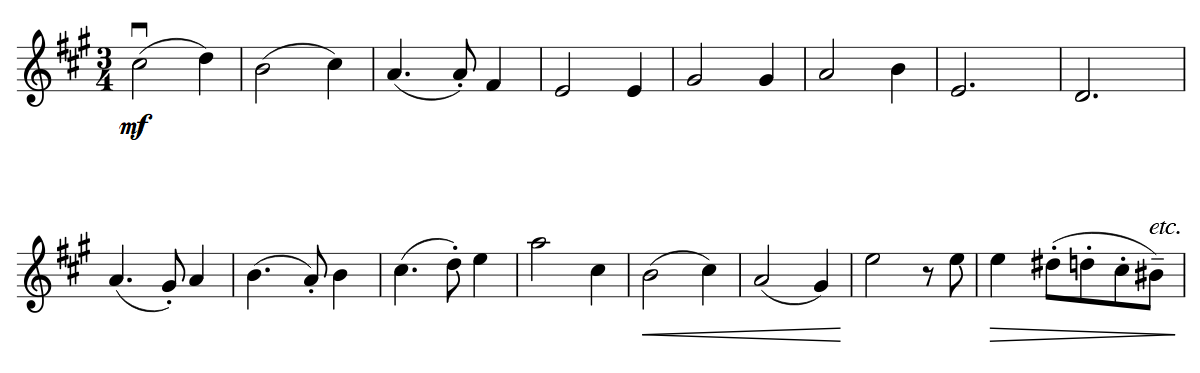
Hi guys, this is a piece I wrote recently, and I'm already stuck at bar 21 😞 I feel like my music is proceeding far too quickly, but I have no idea as of how to slow it down to make it more logical. I also get stuck easily whenever my initial ideas ran out... PS:It is a homework assigned by my music teacher, we were given a one-bar rhythm (I used it in the first bar) and are required to write a piece based on it. However, the music lesson does not focus much on composition- also there are many students in my class- so the teacher only glanced through my work and gave a few suggestions without telling me what I should actually do. (I've never had any formal training on composition, only some music theory knowledge at about ABRSM grade 6) PPS: I am a very slow composer and spent like four weeks writing these twenty bars of music. Sometimes it takes weeks to generate ideas. Is this normal? How should I improve on the speed and quality of my work? All suggestions/advice and criticisms are welcomed! Thanks in advance 😉 Saltypenguin1 point
-
@expert21, thanks for the criticism! I will try to improve on my melody and share it when I finish the whole piece ;)1 point