Leaderboard
-
Henry Ng Tsz Kiu
Moderators7Points3,052Posts -
Awsumerguy
Members3Points90Posts -
Wastavino
Members3Points15Posts -
Alex Weidmann
Members3Points531Posts



Popular Content
Showing content with the highest reputation on 07/20/2023 in all areas
-
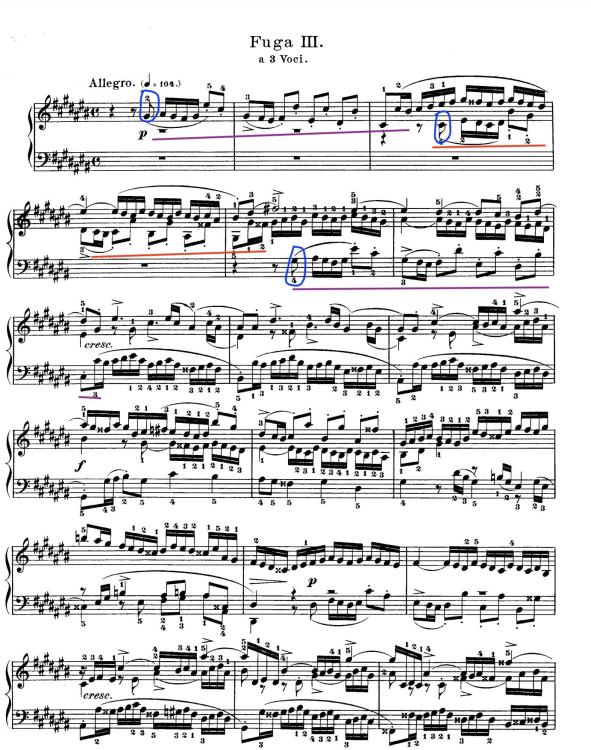
2 points2 points2 pointsHello Guys, Yes, this is a typical "aaah" song, but it's not arbitrary, it's because of the theme of the track. Of course, feel free to add a comment or criticism! Thank you!2 points2 pointsHere's a very basic crash-course I made which discusses the structure of fugal answers from a slightly different point of view.2 points1 pointHi to all our genius composers! Have posted this work previously in the incomplete section, but have now more or less finished it off. I'm excited to hear what you think! It's become much bigger in scope than I'd originally intended, and has morphed into a work for symphony orchestra with a large choir. Also has an electronic synth component. Dare I say, it sounds symphonic at times; though it's not intended to be an actual symphony! I hope it flows well, and has enough variety to be interesting? The score is going to be a big challenge to complete: so I won't have that for quite some time. Also haven't got round to adding a triangle yet (which was Henry's suggestion); but I fully intend to!1 point1 point1 pointThanks Henry! Wasn't even aware I was using modal scales really, as I tend to sequence the music instinctively, without thinking about musical theory. Which modal scale am I using, just out of interest? Thought it might be useful if I attach an unedited score, translated directly from the MIDI data. This is NOT a proper score by any stretch, and it shows the haphazard way I work when sequencing a new piece. As you can see, I'm using close harmonies in the choir, and dense voicing in the strings, with lots of octave doubling. It seems to work; but perhaps there are too many close harmonies? Will have to re-score the woodwind parts where I'm going out of range. Will be moving those passages into bass oboe, bass flute, and bass clarinet (or bassoon). Many thanks for listening!1 point1 pointYour brass section makes me think of swashbuckling pirates on the high seas: so I think you hit the brief! I also hear echoes of the Harry Potter movies, and the vocals almost sound like a shampoo commercial on first impression. (Not necessarily a bad thing, since adverts tend to have catchy music!)1 point1 pointHaha maybe I'm a good fortune teller for that! Your effort (not procrastination) definitely pays off and you're brave to try writing it! I'm still chamber music haha! I guess you are definitely much faster in writing than me!1 pointA bit of a throwback piece: I believe this was the second piece I wrote after coming out of a rather worrisome bout of composer's block, some time around February 2023. I was in somewhat of a rush to write this piece (for no other reason other than I wanted to get it done as soon as possible so I don't fall back into a creative slump), and I had gotten it done in three days. After finishing the piece on the first day, I was compelled to add more and more content until it felt right to me, and spent the third day adding finishing touches. It is my longest piece to date (so far), at around 7 and a half minutes. Compared to my earlier pieces, this one is more harmonically diverse, and contains several modulations to different keys (shocker!). This piece is written in a (sort of?) ABCDA form (although I did not envision it as such at first): I named it 'Contemplations Atop a Mountain High' as I felt the piece's meandering nature sort of felt like the remembrances of a person contemplating the nature of their existence before rejoicing in it as the dawn breaks. I was inspired a great deal by the works of Liszt (especially the Allegro pastorale from his Album d'un Voyageur) and the nocturnes of John Field; I lifted the name 'Idyll' from a piece Arnold Schoenberg wrote before his plunge into atonalism. Would appreciate some feedback on this!1 point1 pointThat's great to hear. Thank you for the kind words, @Luis Hernández! I have learned from my mistakes with structuring the piece, rest assured! 😉 Thanks, @Henry Ng Tsz Kiu! I'll take in mind some of your added orchestration choices, and I'll see if the spacing on MuseScore would allow for the removal of the octave markings on the violins (without them, I was worried it'd push the v.c. and c.b. off the page!). Funny enough, I actually planned having an oboe solo right after all of this, so I suppose your comment about the cor anglais was pretty spot on haha I went into this project with lots of skepticism: I had never written for a proper-size symphonic brass section (or a woodwind one, for that matter), and I haven't had too much experience writing for strings. I'm especially relieved, though, to hear my orchestration's at least somewhat competent, because I spent the better part of a month or so thinking about what to write and sketching out the structure for just this introduction. I first wrote my ideas on a two-piano stave so I could 'discover' the direction I wanted the piece to go to before orchestrating; I then took about a week or two to sit and think things through and let them sit before I got to writing everything down (which you could easily brush off as procrastination, probably). In the meantime, I spent time listening to loads of mid-19th century Romantic symphonies (from Mahler, Brahms, Tchaikovsky, Nielsen, et al), slowly absorbing the little quirks in orchestration and identifying the instruments and timbres before using what I learned on my own score. I guess all those weeks of procrastinating really paid off 😄1 point1 pointHi @olivercomposer, LoL haha! The opening is very colourful like the Harry Potter or the Sugar Plum Dance. I like your accompanying the voice with harp or lute like what Orfeo's doing. That F minor(Ab major) colouring throughout the piece is lovely. Again in the latter half starting form 1:56 you're going for the grander brassy climax, but I like it especially with that modulation from A minor to C minor. But I think you can add the voice here as well as I think the passage will be too instrumental and you can just add more "aah"s in it for me! Is there the story of Odyssey included here too? Maybe it can be more dimensional with the story added. Thx for sharing! Henry1 point1 pointHey Alex, LoL LoL again haha! It's very soothing to listen to. For me I think it flows well and love your modal usage combining with the synth. Your woodwind usage is again my favourite thing from you. I like that extensive passage in 1:33 by the oboe family. I like in 3:53 when your strings passage having the previous section as contrast, appear more emotional and desolate here. The xylophone in 6:47 and 8:10 is attractive to me. Again your altoflute ending is great! Thx for sharing! Henry1 point1 pointHello @Wastavino, Welcome to the forum! This is an enjoyable romance in the romantic style! Most notable for me is in 02:26 where the modulation is frequent! Will you also provide the pdf score so that we can view in the details more clearly? Thanks for joining and sharing your music! Henry1 pointHey @Awsumerguy, I do find some of the passages very contemplative. My fav. passage will probably the Andantino Grazioso section since I like the simplicity in it. I agree with @Luis Hernández that the passages are not cohered enough. I think rather than having them bunched together into one piece, you definitely have enough materials for several contemplative pieces! -For the opening material is beautiful, but I think you can have it reappear in later passages, as in @Omicronrg9's famous nocturnes when he often has the opening material reappears in later passages! -For the Andantino Grazioso section it's interesting that no dominant chord appears there, and you substitute a I6/4 chord for it, for example in b.14 and 19. Maybe I will just go for a conventional dominant chord there. -For b.41 quasi minuetto, I think a minuet is a dance in triple meter, so you may just use other words to substitute it! Maybe Leggiero will be a good choice. -For b.56-57 I'm confused as well, as I think you are going for a F minor chord there but no. Maybe you can just change the F natural to E#, Eb to D# and Ab to G# will make it clearer. So in b.62 your opening is returning right? I think you can have it stay longer and let audiences notice that! -In b.70 suddenly the texture change, and I think you're going for a fugue but actually not. I think the passage doesn't fit here though, since it's too forceful for me, both in terms of the texture, dynamics and mood, and the ending of the section is too strong like the actual end of the piece, when you have no transition to link to the section after it. -The last section has the Andantino Grazioso materials coming back at E major, and the codetta ends with the opening. It seems casual for me but it's absolutely fine if the piece is shorter. I think it's just that you are in a rush! I mean giving how good you are in your symphonic introduction I don't think your harmonies are not fully developed at all! It's not shameless at all! I agree that your symphonic introduction is a great deal better than this, not because this one is bad but because that one is very good. I agree on this too. Just make sure you treat the broken chords as if they are real chords and prevent the parallels as in SATB. I think you are learning from Schubert here to use the accompaniment as a linking device, which is good but also is the point Schubert's being criticized sometimes LoL. I agree absolutely Luis!!!!!!!!!!!!!!!!!! Thx for sharing! Henry1 point1 pointI hope that by "ensemble" you mean "duet"...1 point1 pointJust wanted to drop this off here: I forgot you could do that! 😅1 pointWe have another example in the Fugue in C# major from the i book of the WTC (Fugue nº 3):
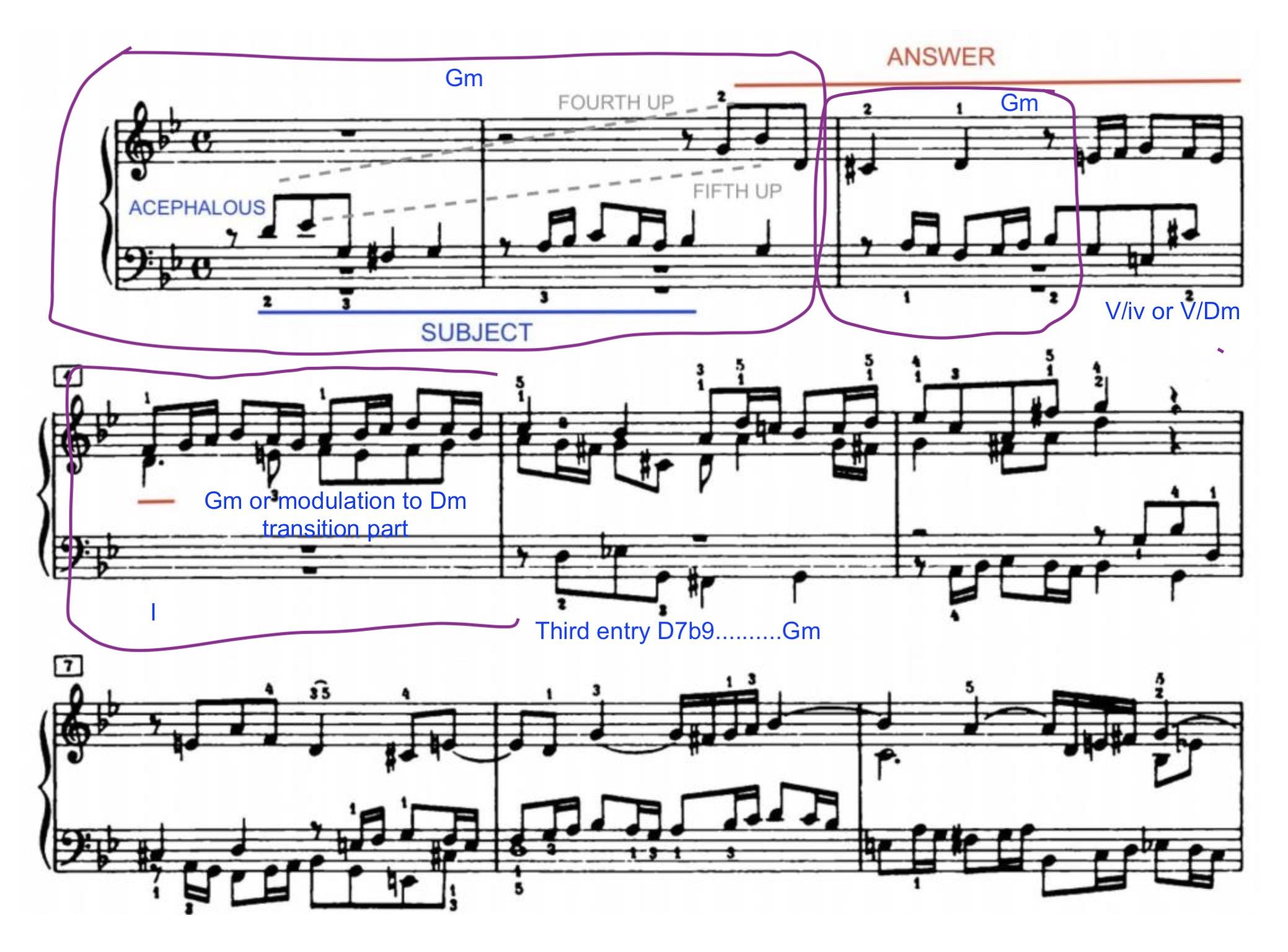
 1 point@Guardian25 @JorgeDavid @Henry Ng Tsz Kiu Regarding the other issue, we can find in the books what was previously said: "Actually in music history, a tonal answer with the fourth and fifth interchanged in the answer is a default rather than a strict real answer in Bach's time. (I remember it's from the book "Theories of fugue from the age of Josquin to the age of Bach" by Paul Walker, but I'm not sure whether it really does come from there). It may not be a theoretical reason, but rather a historical reason Bach choose to write with tonal answer." Specifically, the degree that is affected by this change is the 5th of the key. Thus, in the fugue in Gm, the note that changes is D (the 5th) and in the fugue in Cm it is G (the 5th). In fact, what we can also read in the books is that "when the 5th appears noticeably in the subject, especially at the beginning, a 4th (just that note) will be transposed"...... But why or what for? I think there is a tonal or, rather, a tonal transition reason. As the beginning of the fugue begins in Gm, the answer "must be in the key of the dominant". If the first note of the fugue (D) had risen to a fifth (A), the dominant harmony would have already been almost defined by the fifth and the fundamental. However, Bach did not want the modulation to be so abrupt, in fact in measure 3 the F natural still appears and not the sharp. So it is prolonging the dominant. In this way measure 4 can be interpreted as having modulated to Dm or is still in Gm. When the third entry occurs in measure 5, it returns to Gm by means of a clear dominant. This is why it is the "rule": when the fifth a appears noticeably in the subject, a tonal response is appropriate, and the fifth is transposed a 4th. The same applies to the leakage in Cm. The 5th (G) appears early in the subject. When it is transposed in measure 3, if it had been transposed as a 5th, it would have been a D, and the key of G would have been Definite. But transposing it a fourth (C), the key is still Cm, according to what sounds underneath. Yes, even though there is an F#, but this is a passing and a tonicization, insufficient to establish the new tonality. This tonality is not established until the end of measure 4 and the beginning of measure 5, in that cadence. It has modulated to Gm, but in these two transitional measures 5 and 6, the dominant G7 appears for the new entry in measure 7. In this third entry, the note remains as at the beginning, because the interest now is to reinforce the key of Cm again, so it makes more sense to leave the note as G than as F.
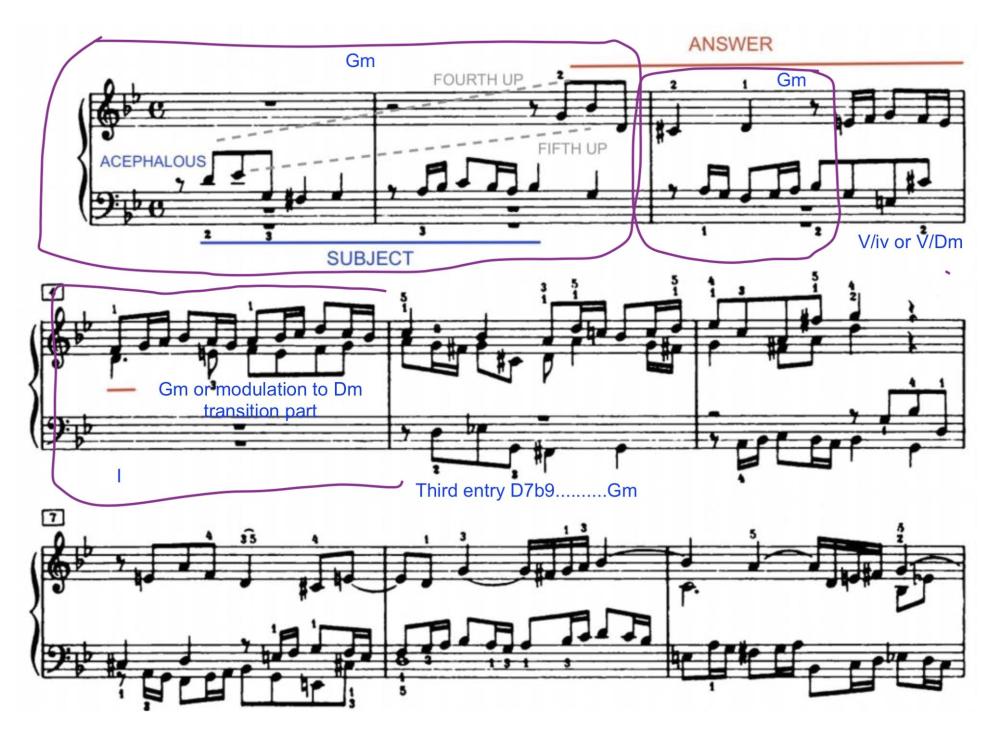 1 point@Guardian25 @JorgeDavid @Henry Ng Tsz Kiu I give you my thoughts after studying some things and checking them out. Of course there is no single answer but one thing is quite clear to me, and that is that Bach did not do anything without a reason. Or to put it another way: if he did something out of what we expect, it was for a reason. Why many leaks have an acephalous start has to do with what @Henry Ng Tsz Kiu was saying. But being more specific, we have to take into account that the resolutions (or cadences) must end in strong beats. If you start a fugue with a "free space", you have a simple way to build that cadence, since it will provide just the right space, in strong time, for the corresponding tonic. Of course there are fugues with other types of beginnings, but think about it, it is more difficult to do all this when the beginning is anacrusic or thetic.1 pointHey @Luis Hernández, That's an interesting question!! Actually in music history, a tonal answer with the fourth and fifth interchanged in the answer is a default rather than a strict real answer in Bach's time. (I remember it's from the book "Theories of fugue from the age of Josquin to the age of Bach" by Paul Walker, but I'm not sure whether it really does come from there). It may not be a theoretical reason, but rather a historical reason Bach choose to write with tonal answer. Regarding the third staff of the fugue in C minor, I think you're mixing the subject and answer. It's the initial appearance of the subject for the tenor voice, and I don't think Bach will change the notes for harmonic reason in expense of the integrity of the subject. Actually in all the subsequent G minor answers Bach retains the tonal change of that particular interval, that is changing the 4th to a 5th. I think it's more the historical reason for him to do so. Maybe there's no reason for it except Bach wants to. But I think with a weak beat in the later entries it makes the music more moving forward instead of having the metrical and rhythmic accent happens at the same beat. It fits more to the Baroque fashion with its driving forward. The fugues with the subject in the first beat, like the one of C# minor, D# minor, Bb minor in WTC I are more serious in their tone and more "stile antico" in general. Henry1 pointcompletely started over, i have a super exciting new idea using an duo that i dont think there is much music for0 points


.thumb.png.8b5b433a341551e913a34392660bc95b.png)