Leaderboard
-
Wieland Handke
Members3Points194Posts -
MichaelJohn
Old Members2Points39Posts -
Vonias
Members2Points150Posts -
UncleRed99
Reviewers2Points263Posts



Popular Content
Showing content with the highest reputation on 03/27/2026 in all areas
-
Thank you! I'm glad I was able to capture the intended mood of the overall work. Found the pattern while messing around on my MIDI keyboard the other day, playing with spitfire LABS VST3 piano sounds. Also, if you've seen any of my other works, you'll notice I tend to have a bit of favoritism for open-spelling chords & triplets / tuplets in general. 😅 I like the suggestions for the form, here. I sort of just allowed my ear to guide it up to the point seen in the post. If you have the time, I have an entirely different conceptualized structure written out in a separate score file, that was inspired by some creative liberty granted to @MK_Piano while in a discord call the other day. I will share this new info right here: Aurora-UpdatedVersion.pdf Aurora-UpdatedVersion.mp32 points
-
2 pointsHello @MichaelJohn A beautiful piece with a calm, serene mood which I very enjoyed to listen! I must say that I did not spend many attention – when reading the score – to the harmonic structure of the piece (as Peter did), because I was really captivated and fascinated about the detailed performance concerning articulation, dynamics and tempo! I would love if every piano piece presented here at the forum had that quality. I especially like the accentuation of the melody which is interwoven in the triplets, so that even if the score looks „simple“, I had the impression that were more voices involved as one could think from a short look at the score. I just did not understand completely your comments how you created the score and recording: The recording is a live recording resulting into a midi file which you have now reproduced with a better piano sound. That’s great, so we know that you are not only able to compose or improvise that piece but also to play it in that intense and expressive quality. But what about the „quantized notes“? I can’t imagine what a software would produce for a „score“ from a live recording with such an amount of rubato, fermatas and accentuation … I’m asking such silly questions since my approach to compose is quite opposite. I first write the notes down (even not as a „paper composer“) but using notation software and produce my score and midi files from that input. And, yes, I’ve always the intention in mind how I would interpret it on the piano. Therefore I always maintain two scores, one to print out and one for the recording with a huge amount of additional articulation, dynamics and time changes to achieve a satisfying recording result. And I must admit, it would a hard work to encode that amount of interpretation you gave your piece!2 points
-
1 pointOn my birthday, I will be in Poland, (again), so I decided to post this impro earlier! Allegro, Rondo. Adagio. Scherzo. Finale. 4 movements on Happy Birthday.mp31 point
-
1 pointIt becomes catchy quickly. I can't sleep after listening to it 15 hours ago.1 point
-
1 pointAbsolutely! Form is where the depth of a composition lives! It's really simple. I always put form on graphing paper. Then the fun part in that is when you absolutely commit to form. It's not something you could half bake in music. Form, could exist as smaller compositions within the whole. Don't be afraid to be too violent with transitions. I think the difficult part comes when you try to make things too coherent, which is a viable solution too. But! Form is lost in that lucid 'elision' of notes where they become jumbled together, like melted cheese. On graphing paper, I create arcs of music on a concrete line and divide it mathematically. This also makes it easy to include advanced techniques in beauty such as: phi and the golden section. Try making a musical joke to in the form of ABACADABA. You'll have fun!1 point
-
1 pointHey @nathanstravinsky! I just finished my annotations and I am here to share! The attached PDF are my comments on your work. You will find a written out summary at the end. To add, I am attaching this 5-minute long YouTube video covering the Harp. I felt it important to make a dedicated video as some moments for the harp in your work were not practical for the instrument. For anyone else viewing this comment, it is a basic introduction to the harp for composers. Find both resources here: https://youtu.be/_Stiy-uh12k?si=luX9YTfy-8DASSxx N. Janco - Philly (ANNOTATED).pdf1 point
-
1 pointWow yes, absolutely! I have done some shorter text-based scores before, often with a lot of improvisation and have often had these sort of textures in mind, one way or another... But here's a question: How do you approach form or the overall arc of the piece in this process? Asking because it is something I often struggle with myself. -P1 point
-
I very agree with your approach to create a new piece having a musical idea in mind, if not yet a melody or motif to be used as the main subject, but a rather „technically“ one – here your choice of the interval pattern you described. Even if you did not invent a new chord or a new scale, this is a unique, this interval pattern is a „unique selling point“ of the piece and creates the mood of the piece which is indeed „ethereal“. And with your realization and recording so far, you have really caught this melancholic feeling with the warm timbre of the cello and the soft piano. I especially liked the small details such as the grace notes, the arpeggiated two-note-“chords“ and the triplets. Now, to get the piece continued and finished, I think it’s time to think about the form. Since it is already lengthy and although it has just separate sections, the listener is somewhat lost not exactly recognizing the structure and find out where the climax is. And in that sense it becomes a bit repetitive because there is a lack of contrast to the overall calm and „airy“ mood. Therefore, I would suggest to consider to put the piece, for example, in Rondo form where you could use the existing material for the different A (or A’) sections and there were room to introduce sections with a contrasting mood (in the B and C sections). For such a contrast I could imagine passages with a more dramatic expression or a final, triumphant resolution. Another possibility would be to have a section with a more distinctive and memorable melody (e.g. a „real theme“).1 point
-
1 pointYa! Sure, thing! It's a very long process to create this music. I love the experience of rasterization, the beginning song sounds NOTHING like the end product. It begins, simply: pen and paper. First, compose the song. Envision it as best as know how. Then becomes the fun part. So, I use Finale to create the sound and score file including Garritan instruments. Once I have the midi, I convert the midi file to a CSound score. From CSound, I also create the instruments, usually heavily inspired by, Kim Cascone! He's wonderful! That's all it is! But, fair warning: the process takes weeks. lol1 point
-
1 pointHello everyone, I'm back, this is my new piece, hope you like it! Op.9 Nr.2 Spring Symphony.mp31 point
-
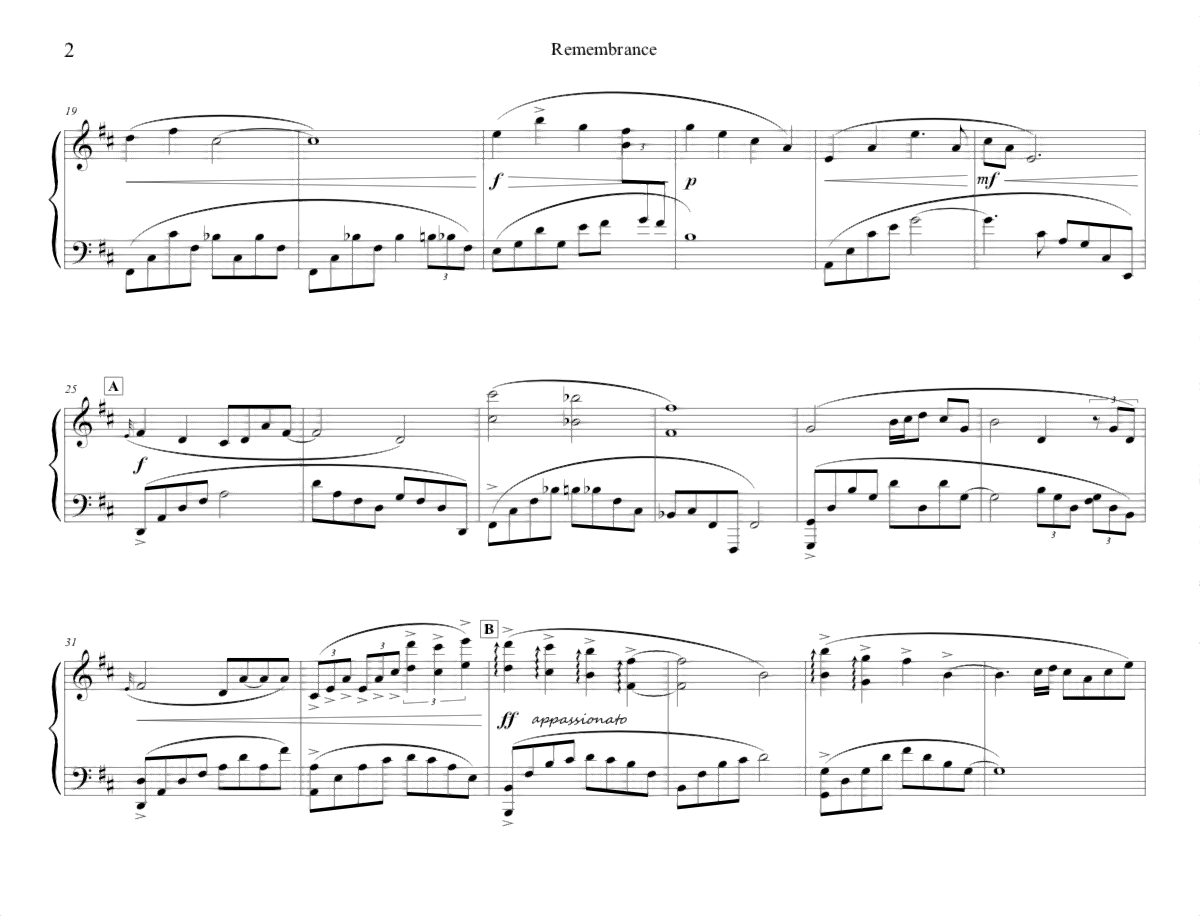
1 pointThis original piano piece has very simple chords and melody, with the goal to create a soft, intimate and peaceful mood. Yet also with some underlying uplifting feeling and emotion. Simple, with 'stirring' quality if you know what I mean. Hope I achieved that. Let me know. 2019: This is an improvisation I made in 2019, recording live into my DAW without following the DAW metronome. So I had it in midi but measures do not follow a metronome beat. I couldn't record to a metronome anyway because there is much intentional rubato in this piece. 2026: Now I wanted to use a better piano sound and that was easy- just play the midi file with a good piano vst. The piano you hear is the UVI Model D Piano vst playing the original midi file I improvised in 2019 (with some minor note improvements) However what was not easy is creating the score! Which requires quantized notes. So I had a lot of work remaking every measure to have midi notes quantized, not for playing, but for the score. So the score does not play the piano but does show the accurate notes of the midi file that is playing the piano. Comments and suggestions welcome! score available for purchase at: https://www.sheetmusicdirect.com/se/ID_No/1956655/Product.aspx Follow score pdf:1 point
-
1 pointHi and thanks for nice review. I've found that recording to midi while playing an expressive piano piece without following the metronome creates the best result - a live and expressive piano performance. Because if I perform to a metronome the live feel is lost and sounds digital/computer like. But I WANT what I perform/improvise capture to midi anyway so that I have the performance captured as notes. I usually do not create a score with my piano works because of the work involved quantizing by hand every single measure! The printed score needs to be quantized to look correct, and be playable. This piece took hours of manually quantizing every measure to create a correct score. With my pop/electronic/etc music I do create notes in the piano roll to beats like you do. That type music I want played quantized anyway. But not an expressive piano solo piece that is not to played by a metronome. I should be that indication on the score!1 point
-
1 pointI'll try to listen to more of your improvisation, but to hear that gawdawful tune for thirty minutes...1 point