Leaderboard
-
MK_Piano
Reviewers4Points176Posts -
Kvothe
Members2Points1,110Posts -

PeterthePapercomPoser
Admin1Points2,959Posts -
pateceramics
Members1Points821Posts


.thumb.png.8b5b433a341551e913a34392660bc95b.png)

Popular Content
Showing content with the highest reputation on 05/06/2026 in all areas
-
Hello! It is time. As you asked, I have delivered. Attached on this comment are my annotations on the arrangement thus far. Directly under, I have attached a sample PDF and sample Audio file to pair with my notes. The notes are found at the end of the current score and if you have any questions, please do not hesitate to ask! Kvothe - Reger Humoresque (ANNOTATED).pdf Attached Files: Kvothe_Example.pdf Kvothe_ExampleAudio.mp33 points
-
Hello YC gang, Below I have attached the first ten measures of arrangement of Meger second Humorquse. The cast is woods in pairs and two horns. Here is what needs to you check for me: Score this as if this this was entry for YC contest. My goals; I want to successfully score for orchestra->check balance, texture, and timbre. Check for engraving errors I have missed. check for instrumation errors Harmony errors etc Reger Humor no. 2 untitled.mp3 Meger.pdf1 point
-
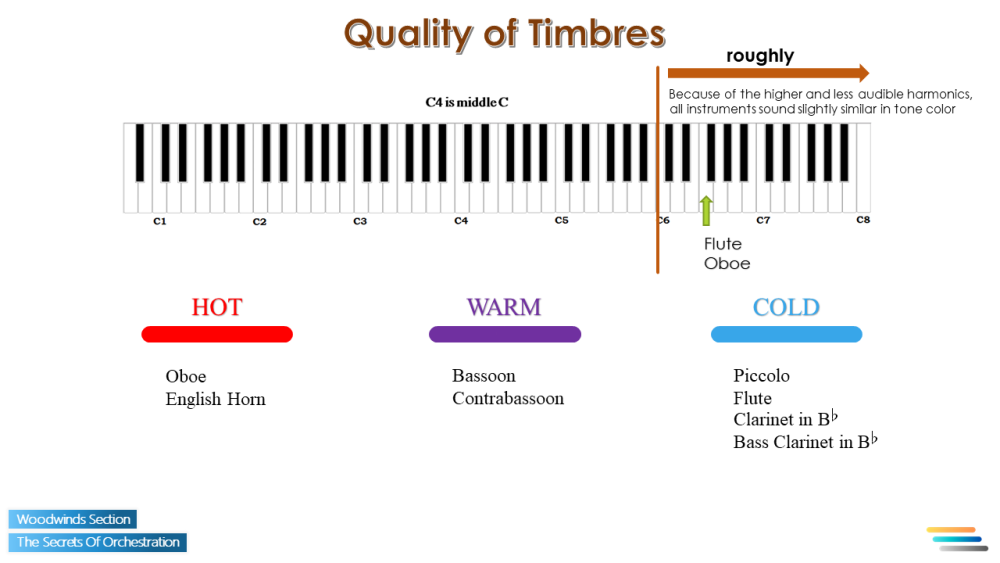
The woodwind section of the symphony orchestra can be categorized into three primary timbral color groups: Cold, Warm, and Hot. This classification helps composers understand how different woodwind instruments function within orchestral texture, balance, and emotional character. By organizing instruments according to their inherent timbral qualities, composers can make more intentional decisions when writing melodies, harmonies, and layered textures. Additionally, this categorization provides practical guidance on instrumental mixing, allowing composers to predict how different woodwinds will blend, contrast, or dominate within an orchestral context—and what kind of sonic result will ultimately be achieved. 1. Cold Timbres: Piccolo, Flute, Clarinet, Bass Clarinet 2. Hot Timbres: Oboe, English Horn 3. Warm Timbres Bassoon, Contrabassoon NB: Due to the dominance of higher and less perceptible harmonics in the extreme upper registers, the timbre of woodwind instruments becomes less distinct. In these ranges, different instruments may sound surprisingly similar in tone color. For example, when the flute and oboe play the same pitch—such as F6—it becomes difficult to clearly identify whether the sound is cold or hot, or even to distinguish which instrument is playing. For this reason, the following graphics and timbral classifications are based on the most effective, practical, and musically “sweet” registers of each instrument, where their characteristic tone color is most clearly perceived and reliably distinguishable in orchestral writing More Information and Free Orchestration Resources: Free Download
 1 point
 -
Not normally, no. They are standard in our industry. The only time it would be broken is when you have a larger ensemble or other instrument combinations that are not standard. In this case, it’s not about orchestral order, it’s about highest-> lowest instrument for the layout.1 point
-
1 pointHi long time for no posting! I decided to post an old work of mine.This Nocturne in C-sharp minor is a juvenile work of me as a 16 year old. I didn't think much at the time of composing, but I did write in the style of Chopin Nocturne then. And then a sudden thought caused me to have a 1st try in fugue in 2:35! I revised the work recently to improve on some voice leadings and transitions except passages after the fugato, but retained as much the original intention as I can as a 16 year old then. The work, even though as immature as it is, does reflect some of my feelings then. Here is the Youtube video and the score of the piece: (Final Draft) Nocturne in C sharp minor.pdf This work can be regarded as in a rondo structure: 0:00 1st part(A), typical Chopin Nocturne texture. Don't know why I modulated the music to F major but the music did so himself... 0:58 2nd part(B) Main melody in F major, but with a new b motive in b.31-32 1:35 3rd part (A') The main melody in the original key can't wait to enter... Gets more agitated and cools down. 2:35 4th part (B'). A fugato using motive b as subject and main melody as episode, modulates once more to F major 3:57 Last part and coda (A''): The A section returns with some registeral change, then gets more agitated. 4:29 is the climax of the piece which is my favourite too, I like the agitation in it. 4:47 starts the coda and finally the mood cools down and ends in tonic major. I played the recording myself. I do make one major slip in 3:22 but the recording is otherwise good enough for me. Feel free to leave comment below! Henry1 point
-
1 pointHi @Henry Ng Tsz Kiu! Below you will find in depth review of this haunting piece! First, let me say what your piece reminds of. It reminds me of Chopin's Nocturnes and Rachmaninov musical moments and preludes. Both, in their on right, wrote lush, emotional themes over triplet 8th pattern. In fact, Rachmaninov used that pattern in his 5th prelude. Nonetheless, we can still bass patterns in our own works! I love how you establish the harmony using that pattern over theme. The pattern slowly changes as the theme moves. The chromaticism creates sense of mystery and wonder, by the way. The transition into the B section is exactly what we need to hear: a break down of the thematic material before a new section! (why does this remind of Franz Listz) After we hear the B section, we return to A, briefly, to remind us of the haunting theme we heard at the start. Then it finishes all together. Overall, I thoroughly enjoyed this.1 point
-
I would be tempted to just add a caesura marking between the repeated section and the continuing bars of #5... Since this is a work for solo instrument that doesn't need coordination between players, there is no reason you can't trust the musicality of the soloist to add an appropriate amount of rest. It's always nice to see something written for solo instrument, as so many of them are a bit neglected by composers. Very enjoyable and I think a live performance would bring out the phrasing nicely.1 point
-
1 pointThose are very different things. If I buy a hydraulic press and use it to flatten a stainless steel pipe, obviously I'm morally responsible for flattening the pipe. If that pipe belonged to someone else, I can hardly evade responsibility by saying, "Hey, it wasn't me! It was the hydraulic press!" On the other hand, it's equally obvious that I can't lay claim to flattening the pipe as a feat of strength. If I cry, "Behold my strength!" as I hold the flattened piece of steel aloft, I am quite rightly met with, "Uh... you didn't do that. The hydraulic press did."1 point