
All Activity
Today
-
-
I'll try to be in the Christmas spirit this year, And, through my music, spread Christmas joy to everyone here! I want to join this merry event, And with my song, give to everyone a time well spent.
-
until
Come join our Christmas Music Event!!! -
I did not know that, thank you! Glad you enjoyed it. I may send it to a real quintet, just in case they might want to play it.
-
YouTube short:
-
YouTube video:
-
I like it! It's a nice arrangement of the work! For a critique of the score: have the Oboe actually switch to English Horn at the appropriate place so that the Oboe and English Horn don't both appear as separate instruments in the score. Also, the score order is wrong. In a wind quintet setting, the French Horn should be above the Bassoon. Thanks for sharing!
-
@林家興 Thank you for listening and for your kind words! I did write a pentatonic application in exercise 4 - 40 for string quartet! Thanks! I am always sequencing the given material in various ways in hopes of creating an ear worm for the listener. I am glad you found that it worked despite the "random pauses"! LoL You should totally do some of these exercises yourself and post the results here when you're done! It would be interesting to hear our different approaches to developing the initial conditions! Thanks for listening and for your review!
-
Hi to all. I've never arranged a work purely for wind quintet before: so I thought I'd have a go. This is Rameau's Courante in A minor, originally for harpsichord. Haven't put slurs in yet, and some of the dynamics may need adjusting for real musicians? Do you think it's well balanced, and are there any practical issues I've not spotted? I'm assuming the clarinettist and oboist will be able to change back and forth between bass clarinet and cor anglais in the middle of the piece? Will merge these instrument changes onto the same staffs when I can get round to it. Rameau - Courante in A minor (orchestration) #7 (adapted for quintet).mp3 Rameau - Courante in A minor (orchestration) #7 (adapted for quintet).pdf
-
I'm still working on a set of preludes (it's been, what, at least 2 years in the making?) and even after lopping off the minor ones for this goal, I've still got way too many to do and not enough motivation to seemingly do more than 3-4 a year, and then there's life...welp. I wrote another one recently though after a few months and think I might give learning this one a go? Hoping to hear what others think of this :D Happy composing! Prelude (2026).mp3 Prelude (2026).pdf
-
I see you've put the four in Exercise 4-37 with the abundance of fourths 😂 Oddly, I'm quite a fan of how this prompt sounds on first listening and I've actually just filed it away in my overflowing stash of languishing ideas to work on sometime. At least in my head, I thought it seemed to call for something jaunty and pentatonic, but yours seems the more interesting avenue to take...out-of-the-box, as it's been put! You seem comfortable splicing and gluing bits of the original prompt material (e.g. that oscillating figure) in various manners, configurations, directions. In a way, it kind of rolls itself out like an ever-unfurling development section, both economical and discursive. On looking at the score, I thought the caesurae at major transition points would make it a little disjointed, but it does work, seeing that everything is tied together with fourths and the gestures and material are well-recycled to prevent it from feeling too modular. I'll see to tinkering around with the Exercise myself at some point, but neat piece!
-
YouTube short:
-
Ignis Concentus It's on Newgrounds, so I hope you enjoy it! Make suggestions if you want, I'll take it as feedback to make my next major composition better!
-
JacobDgr8 joined the community
Yesterday
-
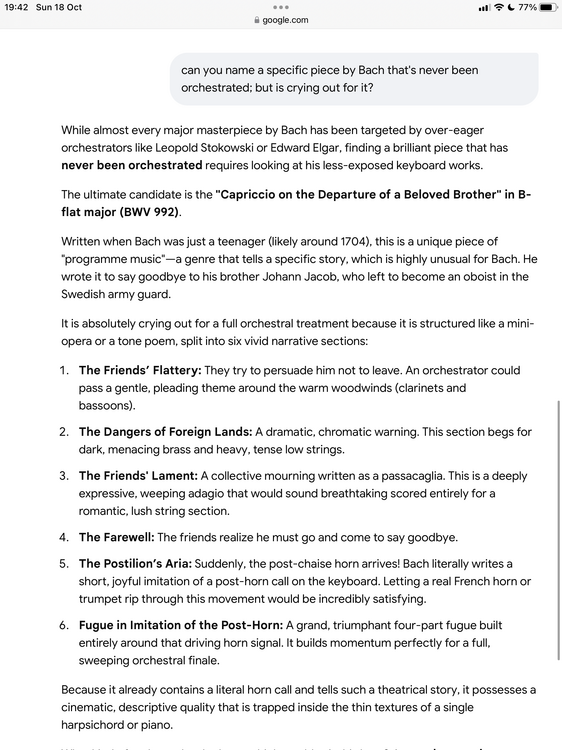
Hello friends. I've now orchestrated another two movements of the Bach Capriccio. I'm still working on the score; but interested to get your thoughts. Once again I've had to add quite a few extra voices to fill out the harmonies, as well some additional counter melodies; otherwise the material would've sounded too thin. I wonder if I should try to fill out the harmonies even more? Have also attached the advice the AI gave me when it selected this work for me to orchestrate. It gives some interesting background about the piece that was very helpful. Bach - Capriccio (BWV 992) #16 (5th & 6th movements).mp3 Bach - Capriccio (BWV 992) #16 (5th & 6th movements).pdf
-
Hello Tyler and welcome to the forum! (I haven't posted in a while... I was busy preparing for an international piano competition and writing my melodc studies and first symphony...) This is a nice piece, but some places need polishing. Exposition: Main Theme Starting a piece with a big opening is possible, but maybe, considering playability, your opening isn't ideal for the pianist. This is a duo, two instruments, and they start on the same time... Atleast they are supposed to (In your piece)... But this opening doesn't allow any rest before non-ostinato left hand arpeggios. Talking about the clarinet, it's always in most cases great to have a melody! Just make sure the melody is clear... I love the clarinet in bar 3 though. Beautiful. On bar 4, the piano has a Gsus4. Sounds nice, but the score keeps telling me "Rach 2!". Exposition: Secondary Theme Here, right before the second theme, I recommend a little ritarlando. It could give it a 'End of Section vibe' you know... About the second theme: Same problem. No clear melody. Bar 17: Piano left hand is just atypical use of arpeggios blahblahblah.... Oh Bar 18! HOW DO YOU EVEN REACH THAT? Exposition: Final Theme I exclaim proudly, that one has finally settled on a pristine-clear melody! (And it is beautiful!!!) One problem: Your piano is still acting like the following: Treble: Clarinet melody + few random notes Bass: Chords ... (Repeat without transposing, completely ignoring the Development Section and jumping straight to the Reprise) Bar 71 of the repeat: I don't know what you want to do. Bar 88 of repeat: Left hand, what the rhythm are you playing? Conclusion Despite having many playability, theoretical, and listener-based errors, this piece has potential (Like Gravitational potential, Electric potential, Magnetic scalar&vector potential, Elastic potential energy, Chemical potential / chemical potential energy, Nuclear potential energy, Internal energy, Enthalpy, Helmholtz potential, Gibbs potential, Grand potential, Effective potential, Lennard-Jones potential) Good luck improving! -TristanTheTristan
-
Thank you very much, @Ali Baghbani I'm glad you liked it! I think you are right, I should try to see if I can take one or two passages as a basis for a more structured piece. I will think about it! I don't remember if the improvisation grew from a melody, I think that I set up a few general harmonic passages and then improvised on top of it. By the way, I remember that the moment in 2007 when I recorded the improvisation was quite a hectic period as I was incredibly busy with my work. Moreover, I lived alone in a city far from family and friends. The efforts were fruitful, but it was not easy to live through, at the time.
-
Thank you for letting me know — I am glad the idea sounds useful. Since the vocals are already a little more present in Dream Catcher, that piece might be a good place to try it first: one short passage where the vocals carry the melody, with the strings held soft underneath, would show whether the line comes through the way you want. I look forward to hearing how it turns out when you try it. Will you try it in Dream Catcher first, or in Flowers and Ivy?
-
Thank you for sharing this, DarwinNE — I listened to the first few minutes, and it is a pleasure to hear a 2007 improvisation brought back like this. The Model D sound is warm, and the free form suits it: the playing moves between flowing passages and quieter, more reflective moments, and the gentle tape hiss gives the whole recording a slightly distant, nostalgic warmth. One suggestion: one of the stronger passages could become a short piece of its own. If you took the passage you like best and gave it a clear return near the end, the free form would keep its freedom while gaining a sense of arrival. Do you remember whether the improvisation grew from a melody you had in mind, or did it come out of the playing itself that day?
-
Thank you for sharing this, Luis — I listened to the recording, and the Spanish dance character comes through right away. The Phrygian color gives the theme its flavor, and I liked how the melody passes between instruments, so the orchestral colors keep changing while the dance rhythm stays light and steady. The septuplet figure, with the two instruments alternating, is a nice touch — it adds a little sparkle without breaking the flow. One suggestion: since the piece is short, I would love to hear the main theme return once more at the end, perhaps with a fuller string sound, so the close feels like a return rather than a stop. It would also give the dance rhythm one more chance to settle in the ear. Do you plan to expand this back toward the longer solo piano version, or keep it as a short orchestration study?
-
Thank you for sharing this version, Laurent — I listened to the new mix, and the flow still holds for me. The clarinet line carries the piece through the places where the piano drops out, and the sparser piano makes the clarinet's long notes stand out more, especially in the opening, where the repeating piano pattern used to fill every gap. The one spot that feels a little jumpy to me is where a phrase ends just before a gap and the next phrase starts without the piano to bridge it — the note before the gap does not quite prepare the note after it, as you said. Bringing the accompaniment back there, even as a single soft chord or a quiet held note under the clarinet, would smooth that join without losing the airiness you gained elsewhere. The simplified bars sound cleaner to me, and the ending still resolves gently on the clarinet. Which passage were you thinking of for bringing the accompaniment back — is it the one where the gap falls right after the clarinet's longer phrase?
-
Last week
-
YouTube short:
-
Dear all, I found a MIDI recording I did of a solo piano improvisation I recorded back in 2007. I recall I thought it was nice and it only needed some small cleaning of some stray notes and a little hesitation. But I was very busy at the time and I couldn't work on it, so the file (called Laika) remained forgotten for almost 20 years. The recording resurfaced a few days ago, I played it with an UVI Model D grand piano and I finally took the time for the minor editing. I like the free form, typical of an improvised piece combined with some of the passages. I wanted to record a video, but I did not record the performance video back then, so I played the piece through the Revox B77 Mk II (the tape is a little worn, so there is a certain amount of hiss and some dropouts).
-
Yesterday, my piece Galope was premiere by Camerata de Cordas da UFRJ. Soon I will post with score.
-