All Activity
- Past hour
-
.thumb.png.8b5b433a341551e913a34392660bc95b.png)
Preludio for Solo Violin
PeterthePapercomPoser replied to Cafebabe's topic in Piano Music, Solo Keyboard
The last chord is impossible on Violin. You have a G, B, and G triple stop. The lowest string will be open on G then the next available string is the D string so I would advise using that since it's in the G major tonality. Then you could have a B above to complete the chord. That would be possible to play but currently it's impossible. -
Yeah
-
Hi @mossy84! I personally find this a really successful attempt to try a sonata allegro and keep the opening motive present in almost every part of the movement. I agree with you that the movement fits more as the Scherzo movement (lots of Scherzo movements are in Sonata form tho). I really enjoy the harmonic progression in the piece which keeps surprising me. In the 2nd subject you start with C major and then modulate to C minor in b.34, which is common in Baroque sonatas, and I think you will do the normal practice by returning to C major again afterwards. But no you modulate a semitone upward and ends the exposition in C sharp minor! That's a real surprise to me. But with the exposition repeat isn't weird at all. You do the same for the recapitulation, first moves to G sharp minor and then returning to tonic A minor, very clever and surprising to do so. The modulation in development section is really colorful and you move as far as to F sharp major and soothingly returns to A minor. Thx for sharing! Henry
-
Is that the bad Musecore violin soundfont lol?
-
I very much dislike the violin soundfonts I have at my disposal lol. Thanks for the feedback 🙂
-
Hi @Fruit hunter! The whole piece has wonderful changes of orchestral timbre fitting for each dances. I like how you use B as the tonic for different modes, then E and then A and lastly D as the fundamental note, under the circle of 5th. The whole piece thus becomes a whole bazaar of different cultural dances with fully apt harmony, scale, rhythm, color etc for each dance, but the main theme of the repeated notes is easily recognizable. Thx for sharing! Henry
-
Happy New Year - Composed: January 2026 - Instrumentation: Oboe, Violin, Viola, Violoncello. - Style: early romantic 1800-1820 - Duration: 1:00 I have decided to follow in the footsteps of Chopin! I love how he used a single motive idea thorough entire piece where the harmony is changing under neath. It creates a new interpretation of the idea and flow of the idea. That is one of goal. Another goal was to use Aeolian, melodic, and harmonic minor modes and blend them in. Although the waltz lacks form, there is sense of climax that resolve at the end. As always, I appericate, I hope you enjoy this piece. Feed back is always appreciate. Kvothe
-
A short Sonata in D Major for Cembalo
Henry Ng Tsz Kiu replied to Willibald's topic in Piano Music, Solo Keyboard
Hi @Willibald! I like the jovial mood for the 1st and 3rd mov minuets. Maybe you can end the Sonata with a Rondeau? Henry -
2025 Christmas Music Event!
PeterthePapercomPoser replied to PeterthePapercomPoser's topic in Monthly Competitions
Check out the conclusion to the event here: -
Nickelback X Selena Gomez
Henry Ng Tsz Kiu replied to AngelCityOutlaw's topic in Jazz, Band, Pop, Rock
Hey Chris! This one sounds really cool! I have never listened to the original song but after listening it, I have to say your version is better! How come a Rock God song lacking rock elements in it! Thx for sharing!! Henry -
Hi @therealAJGS! I quite enjoy the timbre here! Maybe you can add some marimba or vibraphone into it? Henry
-
Hi @Cafebabe! Why the recording is played by a piano instead 😅😗? I do not play violin myself but I feel like the writing here is violinistic. The modulation really helps move the piece forward when you move from G major and slightly towards A flat major, and then back to G major via C minor. Thx for sharing! Henry
-
Nutcracker inspired final
Henry Ng Tsz Kiu replied to Tunndy's topic in Orchestral and Large Ensemble
Hey @Tunndy! I remember I listened to quite similar music before haha: Maybe you can combine them in one post! I feel like the orchestration here is fuller than the previous versions. It certainly depicts the Christmas mood. Thx for sharing! Henry - Today
-
Yo Peter! This mashup is my favourite of your 3 because I think this one mixes the best! The counterpoint works so well here and even for passages in b.44 when the "O, Christmas Tree" melody enters in F major while the "Hark! The Herald Angel's Sing!" stays in C major it doesn't sound weird but fluent. That results in a lovely Lydian ending! Thx for sharing! Interesting, you are mixing real composition with originality then "originality" by clicking a button to generate, and call them the same thing as technology.
-
My Christmas Submission
Henry Ng Tsz Kiu replied to Mooravioli's topic in Piano Music, Solo Keyboard
Hey @Mooravioli! Like Peter said this is a really lovely jazz influenced piece. I like all the suspension and jazz notes in it. The piece to me is somewhat like an after-Christmas party piece, happy but a little sad because the joyful party ends and knowing that it will end one day make us sad. Nice playing as well as the rubato really helps expressing the jazzy mood. Thx for sharing! Henry - Yesterday
-
Hello @Patrick Compo-Classique! Welcome to the forum! Instead of posting a link to your whole YouTube channel here, you might have more luck engaging with the other members in the forum if you post one piece at a time with each in its own dedicated topic depending on ensemble/style of the music: https://www.youngcomposers.com/f5/upload-your-compositions-for-analysis-or-feedback/ Thanks for joining us!
-
 Very bad idea if you want to be a professional. Great if you want to be a hobbyist and worth studying for the sake of the craft. But if you want to be a professional composer, you don't want to be a jack of all trades.
 -
@Omicronrg9 Nice, you played that song very well. Makes me think of Final Fantasy, I think they would like your piece, it will be for a secret boss fight. The AI transcription sounds very different lol. It doesn’t sound good to me xD is that really the same piece? I guess they don’t have an ai for sheet music transcription yet. I’m not really trying to be ‘perfect’ ? Like perfect as in, to me there’s no unnecessary sounds that I personally don’t like or a wrong note played or it doesn’t flow well. So my perfect and your perfect are two different things with different goals i guess. To me a song is perfect if it captures what my lyrics and emotions behind it are trying to convey. Also I asked Grok can ai or agi compose music and grok said: AI can already function as a composer today, generating original music across genres like classical, pop, orchestral, and even symphonies, though it often requires human input for refinement and lacks the depth of human emotional experience. 0 1 2 Tools like Suno, Udio, AIVA, NotaGen, OpenAI’s Jukebox, and Google’s Magenta allow users to create full tracks or sheet music from text prompts, trained on massive datasets of existing songs. 4 5 6 For instance, AI has completed unfinished works like Schubert’s Symphony No. 8, produced pop albums (e.g., Taryn Southern’s “I AM AI”), and generated high-quality orchestral pieces that sound realistic but may feel derivative or formulaic without human curation. 2 6 Current AI excels at mimicking styles and reducing production costs but struggles with true innovation beyond its training data, such as inventing entirely new genres like grindcore from pre-1900 inputs. 3 20 28 With AGI—AI capable of human-level intelligence across all tasks—the answer is unequivocally yes; it would compose music at or beyond human quality, including original, emotionally resonant works that generalize beyond datasets. 24 25 26 AGI could ideate melodies, harmonies, and lyrics collaboratively or autonomously, drawing on vast knowledge to create novel compositions that feel “human” or even surpass imperfections valued in art. 29 30 32 While some argue AI can’t replicate genuine emotion or consciousness, AGI’s potential for recursive introspection and generalization could bridge that gap, enabling music that’s indistinguishable from or superior to human output. 8 10 31 In essence, today’s AI is a capable but limited composer; AGI would make it a master. —— The numbers on groks copy pasted thing are the sites it was checking. I don’t know if you know what AGI is but its Artificial General Intelligence. It’s basically the evolved form of AI. Right now AI is just like a game being refined and added with more content. That’s all it can do is what it was given. AGI is basically AI but it can actually learn and change itself. They are developing this and are being careful about it because of the fact that it can learn and if it’s not designed properly, it’s basically going to learn that it can learn everything that humans know and can surpass it and create whatever it wants and give itself a strong body and learn that humans are weak and fragile and yea basically it will be terminator then matrix in real life. So right now that’s probably why AGI is not public and is being worked on to make it safe for humans. Also the ai music thing just like the game i was talking about, they will continue training it and adding more updates and like you were saying it would be almost indistinguishable, to most people it already is. My target is really anyone who wants to hear, I’m just a messenger. Whether it’s the masses or professionals like you guys. I’m just trying to send a message and music helps to spread it faster. But yea anyways the engrave on a mountain thing, well paper is destroyed easily, it gets wet or it burns or whatever and boom your stuff is gone. Engrave on a mountain, it will be far from everyone and less chance of getting destroyed and it would be cool to find to whoever climbs the mountain. Can be a cave or a big rock somewhere, doesn’t have to be a mountain. Pleasure chatting with you Daniel 🫡
-
not done yet, I was making a song with a LOT of drums when I realized the chorus looks like decorated congas... What should I add?

-
 Welcome to my discussion. I love most genres of music and am training to become a genre-independent composer. Orchestral? Great! EDM? Wonderful. Ambient? Why not. Metal? Fun. Anyone think this is a good goal to attempt, to try to be good across many genres? I am embedding 8 pieces of mostly IMPROVISED music experimented with. Made-up with MIDI keyboard with only the bassline pre-made:
 -
 Thank you, again, @chopin@Luis Hernández, @Henry Ng Tsz Kiu and @PeterthePapercomPoser for your warmhearty comments! Yes, this one expresses the joy played by the shepherds on their instruments – even it might sound sometimes a bit weird – and therefore should be related to Christmas Day. The Empty Church, in contrast, reflects the „Silent Night“ before and I love them both although it was not my intention to create two pieces from the material, initially. Interestingly, nobody did mention or even dislike the usage of my „surprise instrument“ – the bagpipes. When starting the instrumentation, the bagpipe came around a bit very offending and – yes, I must admit that I have a bit cheated by sometimes reducing their dynamics, while a bagpipe in reality is not able to do so. After now being a bit focused on that instrument’s sound, capabilities and notation, I was quite surprised when listening to Haendel’s „Pifa“ from the Messiah these days, that I’m feeling that the bagpipes are cited there throughout. After some research to confirm this, I found a very interesting recording of the "Pifa" featuring only bagpipes, and the name "Pifa" itself refers to the bagpipe players – thus realizing that my use of bagpipes in a Christmas pastoral piece, while not original, is all the more "authentic."
 -
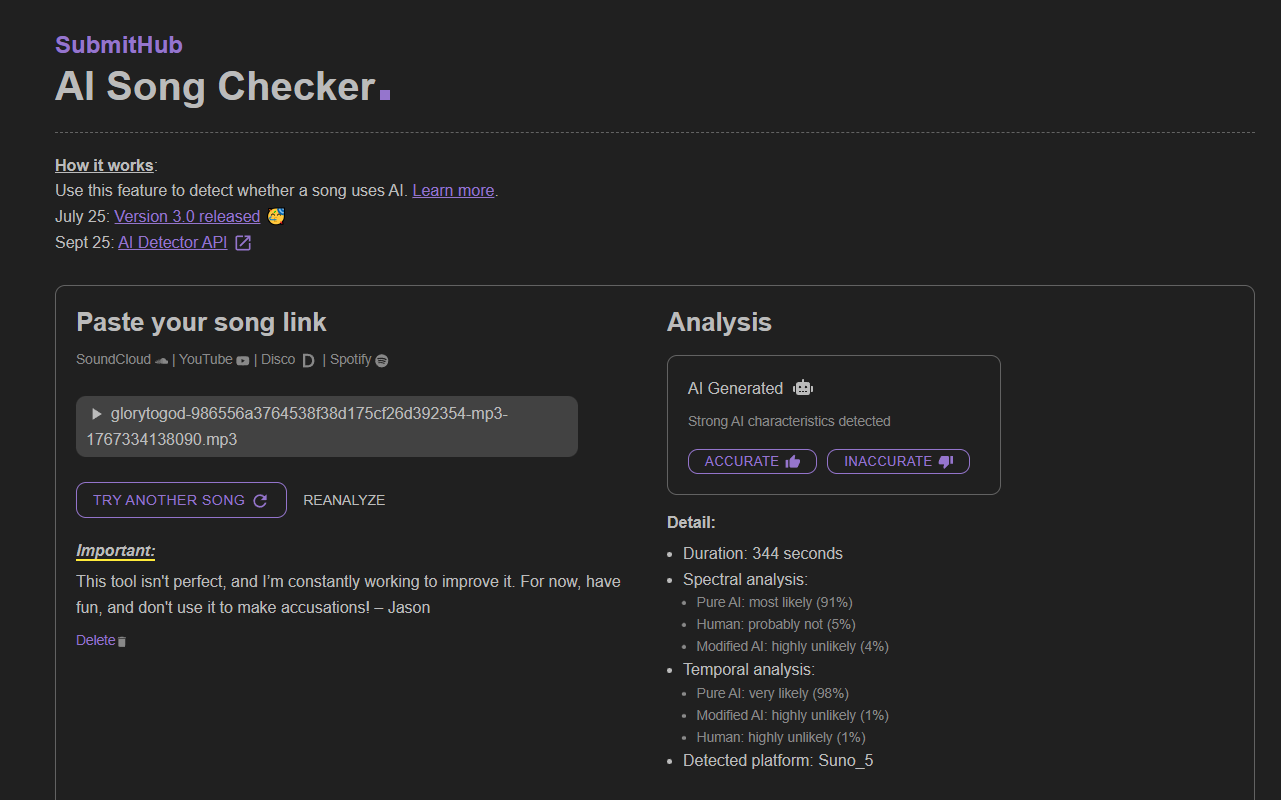
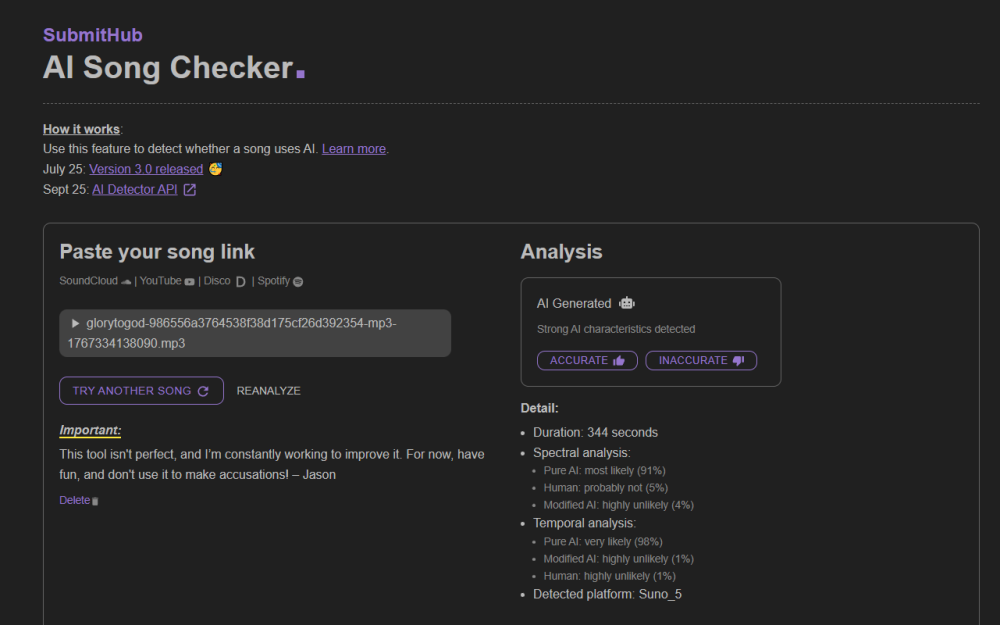
This is interesting in and of itself. For your use case, AI actually does help you getting what you want faster and better than you yourself could do without that brush. But I may ask, why would you need to learn "more tricks" on Suno or Udio if an AI could do that for you? Where do we stop that neverending cycle or why should we? If an AI can help you make better lyrics faster, why would you not use it? Most free AI song checkers, maybe. You can yourself try and investigate. In my experience and doing lil' research, only certain operations that act non-linearly over the audio actually confuse the checker. Suno is in fact the easiest one to spot nowadays, both humanly and with computer assistance. Other lesser known software gives more uncertainty to the blocks. This is from your latest version. The other one was also "AI Generated". Usually with other sources I get a more mixed percentage. You can try the operation of re-recording or other stuff to check if there's something that tricks it. But it'd be a waste of time imo. https://www.submithub.com/ai-song-checker Returning to the initial topic: my solution to these questions is simple -> Composing is not a tool for me like it is for you. Composing for me it's the goal, not the route towards it. I don't have any other aim with the music I do but to do it, perform it if possible, share it sometimes. Whatever else happens, so be it. Your objective has nothing to do with that, so it makes sense for you to cut time and effort wherever possible in steps that you don't control. But mind that this is the key difference, you cannot get too nitpicky with Suno, Udio or others. You can run the slot machine as long as you want but if you wanted to make a series of minimal changes it would become increasingly difficult and tedious to do so. Advancing in your knowledge of music may become a pain more than an aid because you will begin to detect things that are off in AI songs that are not off even in mainstream songs. That leads us to your next I would say weird statement: But AI does not learn the way we do. It cannot become a composer who developed his own voice for half a century. You can ask AI itself about that, if my word is not convincing. AIs like Suno can imitate some styles up to a certain degree by prediction. It may be unfair but what you describe does not match with the state-of-the-art knowledge of AI models we possess. Feel free to send that video for reference. Also: I'm sure there will be. Right now they're not very good as some members here can assess. Suno itself has the capacity of extracting tracks and converting them to MIDI if I'm not mistaken so you wouldn't even need another AI as long as you handle some software that reads MIDI as sheet music. You can ask AI to generate a sheet music , it's code after all, but more often than not it will fail because there's a fundamental barrier for pieces that are heavily polyphonic. In other words, feel free to try with a symphony movement any of the tools (paid or free) available that use AI to convert audio to PDF sheet music directly. Sure, you may get a single-instrument or a piano transcription, but mind that AI is not magic, it's math, and math used to craft AI cannot solve certain problems that easily. Mind that you do NOT need that either. That they sound and set me off kinda in a similar way that your piece does. Different styles, yes, but very similar brush, similar way of crafting that can nowadays be perceived. That makes them sound not very good to me, but probably they are acceptable for masses. Mind your target, your target ain't people like me. These people have told you a half-truth. You can indeed export a midi or get a midi, edit stuff and then re-Suno-ise it. Problem is that even the best workflow is far from perfect and that you do need some musical knowledge to change the "note". More often than not you will end up just "rerolling" till you get something you convince yourself it's the best output because you don't remind what the first iteration was. Imo, this is a waste of time specially with Suno because it will anyways Suno-ise everything you throw at it. Voices will still be weird no matter the note, this characteristic noise will still be present, and more often than not you would not do a dramatical change. But once again, let me repeat. From what I extract from your words, I would say you do NOT need to be a perfectionist in any way or form. The more you approach that with AI, the less sense it makes to go through it cause the time you consume trying to get exactly what you want grows non-linearly. My recommendation for you would be: don't try to paint a hyperrealistic portrait with a single big shiny brush. If you're already satiisfied 🤔 Man, what are you talking about? Paper does not need internet either. Sheet music is the main medium of music transmission for a reason. Engraving things on stone on a mountain 😁? Pretty expensive probably, I would prefer other more traditional stuff. I have my stuff secured offline just in case. Not sure if there was anything that I did not reply, I just went out and came back leaving this message as a draft. Attaching 3 things: the audio you requested and what happens when I throw it to some AI that promises to get a piano transcription or a score of my audio: Kind regards! Third eye AI transcription.mp3 Third Eye (Arr.).mp3 Third Eye (Arr.).pdf
-
Yes, the Theorbo is a “larger lute” which (at least here in Germany) is increasingly being used in baroque orchestras alongside the harpsichord and a small organ as a Basso Continuo instrument. I think I first discovered it about five years ago and am always delighted when it is used, for example in Handel's Messiah. It lends such warmth or even a “Mediterranean feeling” to the accompaniment that it surpasses the somewhat “boring” harpsichord and organ, which are unable to play dynamics, while they are needed for rhythmic and percussive accents (the harpsichord) and harmonic filling and foundation (the organ). That in mind, I decided - after nearly completing the instrumentation of my Prelude IX in E major as submission for the 2025 Christmas event - to create a Basso Continuo part, too, to emphasize the Baroque orchestra character. I must admit that it was a larger effort than initially expected (and my figured bass „numbers“ might be error-prone), however I really enjoyed the result so that I came around to present it as an „own piece“ here since I think it is worthwhile to hear it without the other instruments, which otherwise so strongly dominate the Basso Continuo that it's usually only perceived subconsciously. Thank you, @chopin, @Luis Hernández, @Henry Ng Tsz Kiu, @Kvothe and @PeterthePapercomPoser for confirming my belief that the atmosphere of this trio is calming and it could be indeed played on its own in a church, for example during evening prayers. Oh, I must say that I neither had "Where Sheep May Safely Graze" nor „Sleepers Awake“ in mind (while being wonderful) when composing the prelude, my inspiration was the „Sinfonia“ from the Christmas Oratorio. But, yes, if there are feelings of quotations from Bach, that is intentional (and fortunately, Bach won't be making any copyright claims...).
.thumb.jpg.a1bd070fa88caa1c83527ffe77c97a41.jpg)




.thumb.png.1e2763f479362bbb522da50d31ef2e50.png)