All Activity
- Past hour
-
I'm wondering greatly why this piece did not receive any feedback (let alone positive and encouragingly complimentary feedback), even after 3 weeks and more. I absolutely love many elements that have been used in this score: Use of melodic Caliope (Baritone woodwinds, Soprano Strings) background call-and-response (alternating between Violone and Violin/Violinone) moment of introductory climatic moment (the herold of the Timpani's and Double-Bass's dotted-rhythmic march) Just to name the few things. It also invokes a beautiful sense of a late evening walk down an urban city. (I just checked the name of your piece again, and it speaks of the "Frank Bridge"! The setting illustration you were going for seems excellently executed!) ~~~~~~~~~~~~~~~~ I do concur that arranging 2/4-hand Piano works into Orchestra is quite the arduous and ambitious task. Most people don't realize how difficult it really is to learn idiomatic writing for 30 or more instruments; so that your performers can perform your work at ease and with joy; and your audience can, at the same time, enjoy the listening experience of it. (I have come across a lot of works that is a 'joy' to play, because it's highly idiomatic and "quite easy to perform" with "minimal rehearsal"; but with little thought having been put into the music, which makes the listening experience of it a bit dull and flat. "Boring" music, as some would call it. In short, easy and simple to play; not fun to listen to!) As far as difficulty of instruments, a lot of times, it really depends on the personal practice (as well as personal incentive and motivation) by individual performers to bring your works to life. From my own experience: if it doesn't sound like how it's supposed to and/or it seems like the performer is struggling and making the music seem too difficult to fully and viably perform.... a lot of times, it's because they haven't practiced the music, and/or they simply need to care about it more. In these instances, it often has minimally or not at all to do with your own fine writing. Just as a composer-to-composer word of reassurance. ;)
- Today
-
-
Hello It’s a rather mixed bag. Some tracks seem to be aimed at a sort of children’s album, like ‘Pulling Together’ or ‘Little Walk’ – which isn’t to say they’re bad. Others have a more serious feel to them. Overall, it’s worth a listen, but those challenges of writing a piece a day… I don’t know, we’ve all had moments doing that or thinking about it… but in the end, and over time, I think you learn to try and make the most of the ideas that stand out. And even then, you might like them or you might not. Best regards.
-
Hello I was surprised by this piece, which is in a very different style to what I’m used to. I must say that the melody works well and it gives me the feeling of a ballad from a 1960s film. I’m not sure to what extent you’ve worked in these styles, or in styles other than ornate counterpoint. What I notice here is that, curiously, there isn’t much of a counterpoint underpinning, which is nevertheless present in the Romantic period. I think the rhythmic motif, in particular, becomes a bit monotonous after more than 4 minutes. I also notice that the bass is underused as an accompaniment, and that the chords are excessively dense; the arpeggio loses its effect when it’s played all the time. And some sections are unplayable unless you resort to arpeggios again. (bars 8, 9 ...) The idea is good, but I think the overall approach falls a little short. Oh, I’d also like to mention (something I’ve said before) that Chopin’s Prelude in E minor takes a very different approach. The chords are the essence of the piece, due to their minimal movement and the perfect voice leading they achieve.
-
Bois, lads, (or anyone of persuading affiliation), it is time for this piece to not die! I have found another call for scores fitting the instrumentation requirements in Boston, MA. I have just finished my application and will find out mid or late July. Here's to some success! (Also, updated the score to match new engraving... once again lol)
- Yesterday
-
It's an absolute gem for a piece of music, my awesome @danishali903. Thanks for sharing such uplifting, mood-changing and stimulatingly lovely music.
-
Pseudonymous changed their profile photo
-
Excellent 🗿. Can't help you much with the inspiration thing, but it's a great start. I'll follow the topic in case you drop some news!
-
Thanks for the comments! In short, we'll see what happens with it. It something I will keep for later, but am unsure the direction I want to take it (Final form, duration, etc.) The main thing that is stopping me is inspiration specifically. While the summer, I am still rather busy and easily distracted currently. To your point about the note duration: It's more-so due to the computer. In performance/ final copy, I'd change it to a staccato and hopefully imply it's just meant to be the landing point of the run.
-
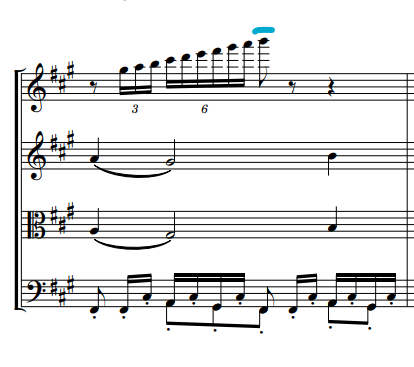
Unexpected crescendo! It bought me. Not that much the più mosso, but it's still good, yet I feel it could be extended, and each time I listen to it I am more and more convinced, maybe a repeated section or something else playing with the material you have already put over the table would not hurt. That there are no measure numbers is a bit painful to me, but I'll use an image: These notes duration don't convince me too much, specially the first time they appear: I'm not 100% sure why but it's either that the attack of the computer performance that sounds too plain or something else. I think I have little more useful feedback this time. Great job, MK! Best regards, Daniel–Ø.
-
A lighter composition for the early Summer, conceived as an exercise in harmonic development, apoggiaturas and chromatic saturation. Greatly inspired by Chopin's Op. 28 Prelude in E minor. YouTube video link: https://www.youtube.com/watch?v=ZwInFjwKJUo Romantic Prelude in A minor.mp3 Romantic Prelude in A minor.pdf
-
Hi, cloud10000. I think this piece of yours is well-structured and very good. In particular, I felt that it is not completely in a traditional Japanese music style, but rather blended with Western music, so to speak. Creating a smooth blend of different genres is difficult, so I think it is wonderful. Since I feel this style is not very common (or maybe I just don't know many examples, so if you know of any, I'd appreciate it if you could share them with me.), a piece like this is stimulating and intriguing. On the other hand, a few parts caught my attention. First of all, the clipping. I noticed it especially around 0:48 and 3:00. Related to that, I also felt the volume of the flute at 1:46 was a bit too loud and hard to listen to. Additionally, the vocal part at 1:33 felt a bit out of place, including the timing of the performance. This is probably because it feels like a preset pasted directly in the DAW. While it might be unavoidable, I thought that if these points were improved, it would turn out to be an even more appealing piece. This is just my personal opinion, though. Best, Lithl.
-
Earl_of_Sandwich joined the community
-
Meant to reply to this sooner, I apologize. The idea I had with that example was to sort of lead-up to the octave shift, rather than to have it abruptly being played 8va from the initial melodic line. I wanted to avoid any abrupt changes in tone, and attempted to sort of smooth that transition out a bit. I suppose it didn't land as well, in your opinion? 😅 In regards to the chord volume, I could alter that a bit. The way I tend to write for solo piano is to create 2 piano parts, with one always hidden after editing that contains copy/pasted notation from piano 1. From there, I would select all notes on the left hand staff, use selection panel to deselect pedal lines, and uncheck the "play" property to silence the left hand, leaving only pedals, dynamics, and the right hand staff playback, to emphasize the right hand / melodic line. I could increase the volume of the right hand to accomodate for any playback balancing issues. Would you say that for the whole piece, as is currently, that the left hand notation is playing back a bit too loudly?
-
This melody timestamped at 3:14 from Borodin's Polovtsian Dances is unique for starting on the ii - the supertonic:
-
Oh, how I am lull'd into the wonderous era, which is Classical orchestral music! All I have to say is, this work is pure beauty. I can listen to this during my entire 6-hour drive from Northern to Southern California. Don't change a thing about it.
-
Well, it's been so long since I was last here! I hope this community has been well since. I’m looking for some nice detailed peer feedback on my first Tone Poem, Myst o' Foryst a Spryng Nyte. It is a 5-part programmatic work written for a large woodwind/brass configuration, percussion ensemble, and features a prominent chamber core of Viola, Double-Bass, and Piano. (My "Alto Piano Trio" ensemble) I would be nicely interested in your thoughts on the orchestration, the pacing of the sections, and how you perceive the overall structural architecture as you listen along with the score. Please tell me of your stylistic impressions of this piece! (Note: this is a computer generated audio RENDER; not a live performance. Some of the techniques were lost in translation when it rendered, so it wouldn't sound correct. This is ESPECIALLY true of the audio files IIa and IIIa. If in a moment something sound so "wrong" and "off" in any of these audios, please rely on what is written on the page.) Thank you for your time and ear! Myst o 'Forest a Spryng Nyte (Composition) - 2nd edition - Audio portion I - meas. 1-149.mp3Myst o 'Forest a Spryng Nyte (Composition) - 2nd edition - Audio portion IIa - meas. 150.mp3Myst o 'Forest a Spryng Nyte (Composition) - 2nd edition - Audio portion IIb - meas. 151-223.mp3Myst o 'Forest a Spryng Nyte (Composition) - 2nd edition - Audio portion IIIa - meas. 224-236.mp3Myst o 'Forest a Spryng Nyte (Composition) - 2nd edition - Audio portion IIIb - meas. 237-275.mp3 A. Chen - Myst o' Foryst a Spryng Nyte - 000 - FULL SCORE (with Conductor's Rhythmic ref).pdf
- Last week
-
I transcribed many scores, so far, but wanted to share this one. I tend to do these to increase my level of understanding of how some of my favorite composers write their music. I'm certain it isn't 1-to-1 original, since this was done simply by ear, listening and trying to write in all the parts that I could physically hear in the audio... I take no credit for the composition itself, only for the ear transcription written out for it. The piece is owned by Microsoft Studios, and composed by Kazuma Jinnouchi. Original Track Audio Referenced, Here. Light is Green.pdf LIG.mp3 How close did I get? :)
-
-
-
Hi Luis, For me the most successful part of this orchestration is your highly effective brass writing, especially in Bars 19-22. Overall it reminds me of "5 Orchestral Pieces" Op.16 by Schoenberg. I like the piano version too: I find it atmospheric and relaxing. Surprisingly mellow compared to the orchestral version!
-
Hello! For anyone wondering, this is the little video I sent him. It is not the original improv I did, however, a visual aid to help with seeing chords and simply for fun: https://drive.google.com/file/d/1vOLvUgbz4eGiWmd8e35tuUoJ3TkpUdR0/view?usp=sharing Red99, I will make my own comments later/ soon!
-
@Luis Hernández Yes I know Chopin's piano concerto's well. Some immense moments those particularly in the minor!
-
I think transitional periods are very interesting. This is the case with the galant style, which is firmly rooted in Baroque conventions but where dense counterpoint begins to give way to clearer melodies and accompaniment. Something similar happens between the Classical and early Romantic periods. I’m listening to your recommendation of Kraus, whom I wasn’t familiar with (Symphony in C minor), and it’s fantastic. I think the choice of instruments in your symphony is spot on. It depends on whether the approach is more chamber-music-like, as seems to be the case here, where there are many independent lines. As if it were an expanded quartet… It’s true that as soon as you move on a little in the style, chronologically speaking, you already come across flutes, oboes, bassoons and horns in pairs. Besides, if you don’t know what to do with so many instruments, you’re bound to get it only half right. This reminds me, albeit in a different context, of the fantastic versions of Chopin’s two piano concertos with a string quartet or quintet. Although it seems that Chopin himself used this arrangement for the music salons of the time, there are versions arranged by other composers. What I mean is that some pieces lend themselves to different approaches. Others do not lend themselves to interpretations that stray too far from their original spirit. Like when Wagner reorchestrated Bellini’s Norma in a ‘massive’ style, and then disowned his own version (it’s never performed; Bellini requires lightness, not a Wagnerian orchestra). Anyway, I’m getting off topic. Best regards
-
Thanks, Luis. I am definitely being pulled towards early romanticism, and I am glad this is apparent. In recent years I have begun to listen to more Beethoven (generally early Beethoven, though) and his contemporaries (Like Reis, Anton Eberl). But I have also become increasingly influenced by the Sturm und Drang tradition. As such,Kraus Is one current influence, particularly his c minor symphony that Haydn, after hearing, declared Kraus a genius. Sudden dramatic shifts are a hallmark of this style; the intention is often to keep the audience on edge, unsure what is coming next - despite remaining in the 'confines' of common practice. At least in historically informed performance today, top orchestras utilize stacatissimo technique in the strings (especially in the bass) during such moments in the minor that generates a kind of "badass" or "rogue" vibe that conveys an immense attitude that quite often overwhelms my own senses. If you listen to the Kraus, you will hear this effect in the climatic opening from around the 3 minute mark. There is also some late Mozart. I first thought it was derived from Beethoven's slow movement from symphony 1 but is in fact Mozart's Prague symphony (compare the passage from bar 29 of his slow movement with 51 of mine). It essentially serves a modulatory function. Quite often these influences are subconscious and I find only later where they came from. Borrowing should be acceptable provided it is aligned with my own motivic development (hence my own unique spin rather than verbatim that might otherwise be out of place). You have found a weakness of mine. Orchestration is not a skill I have cultivated nearly as much as counterpoint & voice leading. This is why I tend to write chamber music only. Writing this work is intentionally out of my comfort zone. There is brass in this work but is used sparingly. And the woodwind pairings is something I should explore. The main thing is that the voice leading is outlined; the rest should largely be a doubling exercise. I will have to do some studies into this, however. The winds, brass and percussion is the default muse library (the base subscription package). The strings are the 'spitfire' package that cost me around £40.
-
Hello It’s a beautiful ballad that stands out for its delicacy. It’s true that some accompaniment patterns are repeated quite often. Particularly the quarter-note chords in a steady rhythm. Yes, I know that when this happens, many people say: ‘Ah, look what Chopin does in Prelude No. 28, No. 4’. That’s true, but in that piece – apart from the fact that it’s very short – those steady-rhythm chords are the essence, because the charm lies in the voice leading within the same chord. There are many ways to explore changing that. You could even try moving the melody to the left hand and the chords on top…
-
An interesting question. I’m not going to add anything substantially new to what has already been said. What would happen if a generation of children were exposed only to contemporary music, completely ignoring tonal music? We’ll never know. The point is that we cannot ignore tonal-functional music. For two reasons: 1) Historical. It is impossible to understand how Impressionism, late Romanticism and Schoenberg emerged. 2) Some musical languages are closer to the traditional (Impressionism?), but they will always be based on concepts from earlier music. Furthermore, since the 20th century, there has been an enormous explosion of styles. Many composers developed their own musical languages (Bartók, Messiaen, Cage, etc., etc....). I believe that delving into each one requires that solid foundation. The same applies to understanding and using extended harmonies, harmonies in fourths or seconds, clusters, mirror composition and a thousand other things....







.thumb.png.8b5b433a341551e913a34392660bc95b.png)