All Activity
- Past hour
-
Thank you very much for your in depth a detailed review!
-
-
Hello The important thing: a massive piece of work... Very interesting, it really draws me in, and it’s very well presented; the sound is brilliant. I must admit that variations aren’t really my favourite genre, but then again, when there’s quality, there’s quality. One thing I particularly liked is that, although some of the variations are very short, the transitions between them are, on the whole, very well executed. That gives it continuity, within the nature of the genre: variation. I’ll just mention a couple of things: One is a matter of personal taste: all those fast sections – vivace, presto, prestissimo, etc. – tire me out a bit. But as I say, that’s subjective. And another thing – this I do find a bit odd. Bars 20 and 24 in the first variation… My ears and brain weren’t prepared for that. Mind you, I’m no stranger to dissonance, but it has to be in context. Those extremely strong minor second dissonances – there aren’t any more powerful ones in the entire consonant tonal environment – sound like a mistake. If they’d been set up, if they were repeated… but like this, so suddenly and in isolation… You could have used other, more subtle dissonances here and there… Yes, we sometimes think that in music ‘anything goes’, but well, in moderation. Later on there are sections that include dissonances, but they’re well contextualised. Congratulations on your work.
- Today
-
James McDonald joined the community
-
Hi again, I am going to listen and examine the score once more. You are correct I only wanted to highlight the last part of the quote in regards to the leitmotif. As you highlighted ... English horns are not the same as Oboes. During your rehearsal (and congrats on the live performance) the conductor most probably will balance the piano against the English Horn. As per me I see the English Horn as a solo instrument within the ensemble because of its tonal/projection/character. In a larger context its uniqueness can be lost as a line in a full orchestration. Mark PS: I enjoyed your pun about my criticism not being fully developed!
-
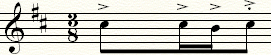
By the way, I just wanted to clarify that the red notation in the first motif's diagram is not supposed to mean anything. That's just the colored layer being displayed in Finale: the second layer.
-
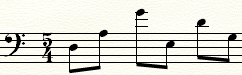
You list the entire description of what a Tone Poem is typically is considered to be and to contain (edited); almost as if I'm guilty of not accomplishing the very bullet points contained within. I very much realize that that wasn't what you meant. It certainly gives that impression. 😁 But, more pertinently, Let me ask you: how many leitmotifs are there in "Rite of Spring"? Furthermore, in regards to the most famous introductory Bassoon motif, which defining presence is what "Rite" is known by: how many times does it transform and gets developed? Or, does it get developed? Furthermore, would you have known whether it was developed, and how it was, upon first second, or even third listen? ~~~~~~~~~~~~~~~~~~~~~~~~~~~~~~~~ Now, let's get back to "Myst": (added in edit) How many times do these motifs come back, in various form? ~~~~~~~~~~~~~~~~~~~~~~~~~~~~~~~~ Also, consider the following arc'd quintuplet motif (from my Tone Poem): middle-low pitch leaped highest pitch second higest pitch third highest pitch leaped lowest pitch (lower than the first middle-low pitch) How many times does this motif get transformed and varied? (One variation includes switching around the orders of the first, second and third pitches in the peak of the arc. Did you catch it?) ~~~~~~~~~~~~~~~~~~~~~~~~~~~~~~~~ Have you noticed that the A-Section's themed melody became a part of the B-section accompaniment, the B-section's melody became a part of the C-section's accompaniment, and the C-melody was actually the materials that made up the A-section's accopaniment? (It's not a ~~~~~~~~~~~~~~~~~~~~~~~~~~~~~~~~ Please do take all the above into consideration. lol Not to humorously twist the usage of the word in this context, but you haven't really developed this point very much. (What exactly are some things that make it "interesting and creative"? But, I appreciate the compliment. I agree fully. And, I'm sorry the MIDI played the piano part back too loudly. (I could be wrong, but Oboes usually have a pretty dynamically penetrating quality about it. At least the Oboe does. If the English Horn needs to be louder, I'll simply let my conductor know. We shall see in the first rehearsal of this edition 2.5 in about 5 days; which compositional summer program I'm in is the explanation as to why I've been rather slow at responding to this thread myself.)

-
Of course, it was a treat! In my opinion, I think in terms of creating motion, it makes more sense to try simple things. Pulsing eighth notes or quarter notes. In terms of orchestration, creating effects of sustain or replicating the piano sustain pedal is a good goal to try. I don't have source material now off the top of my head, however, I may reply back tomorrow (for me) with some sources. Using French horn or trombone to hold sustain notes around Middle C and another instrument to pulse the same pitches on any note duration is a simple way to create the illusion. If not the brass, doing so in the strings is another way. Lastly, to not over complicate my words, keep it simple. If you have the melody sustaining, have the accompaniment move. If the melody is moving, pull the accompaniment back.
-
Hello @MK_Piano , It's an honor to get such extensive feedback, and I'm especially thankful for your notes on engraving in particular. As a string player, I know how much notation matters for performers, and I'll be sure to make those changes as I revise (though I don't anticipate this piece seeing a live orchestra any time soon, especially as an amateur composer). I fully agree that this piece is pretty texturally monotonous, and think that I'll need to continue studying scores to gain a better grasp on orchestration, texture, thematic development, and the likes. Thank you again for your time, knowledge, and the depth of commentary you've provided! I was wondering if you had any particular suggestions for creating more motion throughout the piece, and if you know of any particular scores/treatises that I might be able to study and make my piece more effective (I'll do lots of listening/studying on my own as well) -- I would definitely like to develop more robust parts for the brass and other areas that I haven't quite done justice.
-
Hello! Over the last few days, I’ve listened and looked at the score quite a lot. I felt it within my interest to analyze the score. The attached PDF is culmination of my annotations and comments. If you have any questions, I’ll do my best to answer! Good work! A. Ko - Poem for Orchestra [ANNOTATED].pdf
-
GMoneywroteasong replied to GMoneywroteasong's topic in Incomplete Works; Writer's Block and Suggestions@TristanTheTristan Here it is! https://musescore.com/user/118018538/scores/33357896
- Yesterday
-
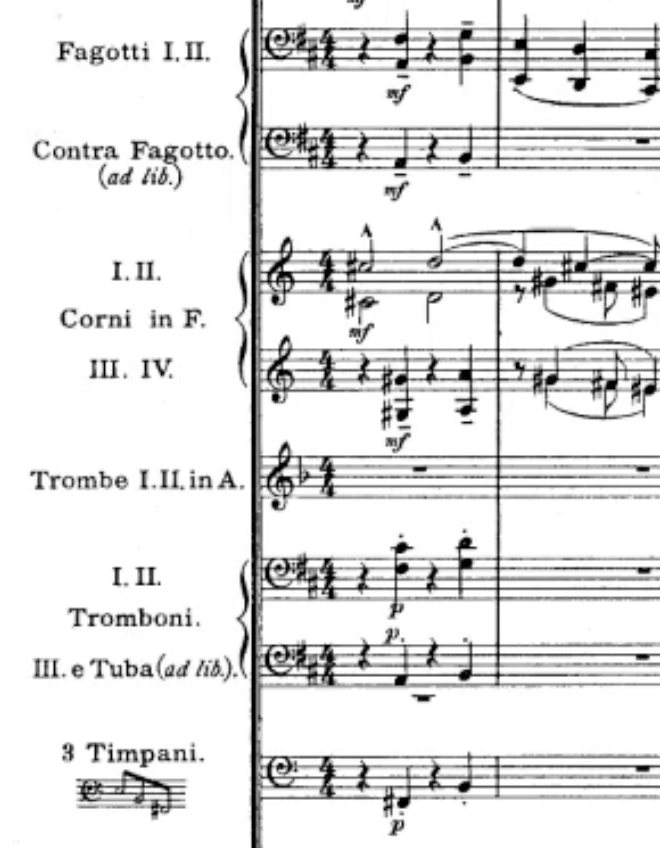
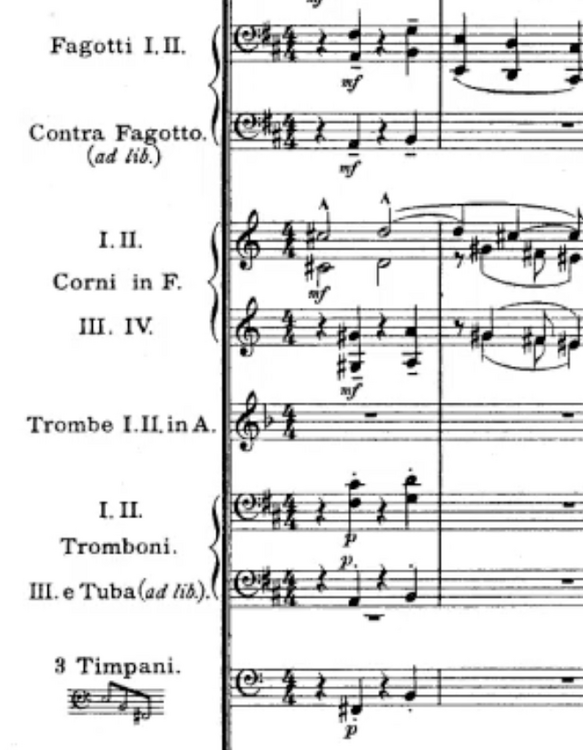
Let me add something, even though it goes beyond the specific work in question; by chance, I came across an example just today. This is part of the first page of E. Elgar’s Concerto for Violin and Orchestra. A dense piece… Note that for the contrabassoon and the tuba it says ‘ad lib’ (ad libitum). This does not mean that these instruments should ‘play whatever they like’. It means this: -Optional instruments: The contrabassoon and tuba may be omitted. -Lack of players: If the orchestra does not have them, the piece is performed as normal. -Conductor’s decision: The conductor decides whether to include these instruments. This is what I was referring to earlier. Best regards.
-
Ok then, Sometimes it's 6 weeks, other times it's 3 months, but the longest is probably this, which from start to end was 10 months and 6 days. (42 weeks 6 days, nearly a year)
-
yw
-
dudeeee this is the coolest sh*t. ive never had a work dedicated to me before and with words from my own old poetry writing too? i'll have a lot more to say but for right now like, thank you so much!!!
-
Hello! As a pianist, I have no idea how an organ works, as in what is possible to be played, and what is not, but, harmonically speaking, I like the middle section very much. This piece truly brightened my day! The ending was a bit too 'straight-forward' I think you could went for a more 'voice-using' coda instead of spamming chords. In conclusion, I really liked this!
-
TristanTheTristan replied to GMoneywroteasong's topic in Incomplete Works; Writer's Block and SuggestionsHi! This is great! Do you have sheet music, perhaps?
-
Guys I am done https://musescore.com/user/96214813/scores/35442947 Ferrum, here is your dedication https://musescore.com/user/96214813/scores/35260994 @ferrum.wav Times.mp3 Times.pdf
-
https://musescore.com/user/96214813/scores/35416328 This is my set of 34 variations on the famous theme Caprice 24. It is written in a minor, and has: Allegro Theme (A minor) Var 1 (A minor) Var 2 (A minor) Var 3 (A minor) Var 4 (A minor) Andante Var 5 (A major) Var 6 (A Major) Var 7 (F# Minor) Var 8 (D Major) Var 9 (E Minor) Vivace Var 10 (E Minor) Var 11 (C minor) Tempo Primo Var 12 (Bb Major) Var 13 (B Major) Var 14 (C# Minor) Var 15 (C#Minor) Var 16 (E Minor) Var 17 (A Minor) Prestissimo Var 18 (A Minor) Var 19 (A Minor) Adagio Var 20 (A Minor) Var 21 (A Minor) Var 22 (F# Minor) Var 23 (Ab Minor) Andante Var 24 (Ab Major) Var 25 (Eb Minor) Allegro Var 26 (Autism) Prestissimo Var 27 (B Major) Presto Var 28 (G Major) Molto Vivace Var 29 (G Minor) Var 30 (G Minor) Var 31 (G Major, Alla Polacca) Prestissimo Var 32 (A Minor) Allegro Var 33, Fugue (A Minor) Presto Var 34, Finale (A Minor) Variations on a Theme by Paganini.mp3 Variations on a Theme by Paganini.pdf
-
Thanks Luis, great points you raise. Hopefully you will have a symphony orchestra at your disposal one day! You never know...
-
xApollo08 joined the community
-
Good luck! That's a very good one. I’ve been thinking about the comment on the role of the contrabassoon here, following on from what’s already been said. I understand that you’d like to use the woodwinds as a bass line in those sections; that’s simply a matter of timbre and so on. Although I’m a firm believer in absolute freedom when it comes to composing, it’s true that I also bear in mind certain general principles. One is the ‘economy’ of instruments. Although I’ll never have a symphony orchestra or anything of the sort at my disposal, I do like to write as realistically as I can. That’s why, if the parts for one instrument can be played by another, I don’t use it. The other principle is to double the bass (an octave up or down), and I notice you do this. This is something I was taught very early on. And there’s a reason for it: the low register is the least audible to our ears. There are exceptions, of course: when the orchestral texture is very light, it isn’t necessary. In this piece, most of the notes for the contrabassoon can be played by the bassoon. Let’s say up to the low C (B flat, actually). To put it another way, I might have used the bassoon for that contrabassoon line and supported it on the lowest notes with the tuba or the double bass. There are sections of the contrabassoon part that can be taken over by bassoon 2, for example in bars 22 and 24. It’s true that the bassoons are in part 2, but it isn’t necessary (with those dynamics – diinuendo and ppp). Well, anyway, that’s just my opinion, based partly on how I learnt it. I was taught that instruments such as the contrabassoon, the bass clarinet, and even higher-pitched ones like the piccolo, were there for when the standard instruments couldn’t play the parts. Sometimes I’ve been guilty of wanting to be too literal when transposing a piano piece for the orchestra. But I’ve also realised that there are times when you have to take certain liberties or make changes to adapt the sound to the orchestra. Best regards.
- Last week
-
-
Hi, Bjarke. It's a really energetic piece. I feel a vibe close to Peter Bence. The flowing feel is good. However, I felt it's a bit cluttered. If you add more extreme dynamics to each section, it might resolve that issue and make it even better. I think the piece itself is good, though! Best, Lithl.
-
Hi, A Ko, listening to it, I felt it sounded a lot like a movie soundtrack. It’s a piece with a strong sense of storytelling. I can’t express it very well, but I imagined a medieval warrior returning home from war. It might be cliché, though. Up until 3:30, they are taking a detour, passing through peaceful meadows and areas with somewhat mysterious trees. Around 2:45, there’s a sign that they are getting closer to home. Then at 3:10, their hometown finally comes into view from an open landscape, and shortly after, they return to the brick-paved streets of the medieval town with their comrades. At 3:32, the local townsfolk are incredibly overjoyed. At 3:52, the warrior spots their children and family among the crowd, and after that, the credits roll. I'm starting to confuse myself with what I'm saying... This kind of thing is difficult for me since I don't have synesthesia, so please just take it with a grain of salt as one person's perspective. On the other hand, I feel like a title with more movement would suit this piece better rather than just "Poem for orchestra", though words related to a "journey" might be a bit too boring. Overall, I think this piece is going to turn out wonderful. Good luck with your piece! Best, Lithl.
-
Hi everyone, I recently completed a draft of a short symphonic poem, after a long period of writer's block and not writing anything. I haven't put all the finishing touches on my scores (divisi, part divisions, crescendos are all lowk messed up etc.), but I would really appreciate feedback/suggestions relating to development and harmony. I'd also appreciate knowing what images, if any, it conjures up for you as you listen to it (I'd like to figure out a more evocative title). Thank you for your time :D! Poem for Orchestra.mp3 Poem for Orchestra.pdf
-
Thank you so much for the kind words Luis. When I heard this prelude, I thought it was crying out for an orchestration: so I couldn't resist making one! Will probably have a go at the fugue and variation some time; though at the moment I'm working on an orchestration of Rachmaninoff's Prelude in B minor (Op.32 No.10), which is proving quite challenging!