All Activity
Past hour
-
🇸 🇵 🇴 🇷 🇹 🇾 | 𝗘𝘅𝗲𝗿𝗰𝗶𝘀𝗲 𝗧𝗿𝗮𝘅 : 𝟭+𝟯 | How many Press-ups have done this morning ?................I lifted a Cup of Coffee !
Today
-
Thank you all for the feedback! The past couple of days have been busy, so I’m only just getting around to responding. On the choice of key @Luis Hernández I did consider transposing the piece to E minor to make it more comfortable for the musicians. Ultimately, I decided against it because I think the key contributes to the harmonic “color”—something that becomes even more significant in orchestration. Speaking from a string player’s perspective, the reduced resonance from open strings and the frequent need for vibrato help reinforce the piece’s somber, melancholic mood. There are also contrasting sections that modulate to more string-friendly keys, such as G major. In those passages, I use open strings and natural harmonics to make the contrast more pronounced. @Alex Weidmann , speaking as a semi-professional string player, I’d say it’s definitely playable. That said, it’s an uncommon orchestral key and creates plenty of intonation challenges for the ensemble. I can also confirm from experience that orchestral players generally aren’t too thrilled when they see a key signature with five or more flats or sharps! Orchestration choices Thank you for the detailed feedback, @Luis Hernández I agree that I may have written the English horn parts a little too high in places. Honestly, if I’d had the option, I might have scored the piece for two English horn players, since the instrument’s tone and timbre fit the atmosphere so well. Strangely, I’ve never been especially fond of writing two oboe parts—but maybe that’s just me. You’re probably right about bars 52–53. My intention was to thin out the upper octaves so that the viola-and-cello octave line would come through more clearly, with the upper voices adding a kind of “shine” to it. In a live performance, I think it could work reasonably well, depending on the strength of the flute players. I’ve been using Dorico since Finale went bust. I used its automatic condensing feature for this score, but I’m not always happy with the choices it makes. I usually go back and manually condense or uncondense the parts, but I didn’t have time to do that for this piece.
-
Oh, no not at all. I believe I use them well, within good context of the phrasing. If you have a different opinion of it, based on the score I have in this post (Which I am about to update after publishing this reply), I'd be happy to hear it. Any level of feedback is a chance to improve for the future :)
-
@Wieland Handke I feel noticed. 😁 And nah-nah-nah-booo-booo he listed me fiiiiirrsst 😝
-
Hi everyone, This is my latest piano composition that I wrote. I'm very happy with how it turned out. Hope you enjoy listening!
-
Avey Tare & Panda Bear - Alvin Row ignore the first 2 minutes of this song
Yesterday
-
Hello @Alex Weidmann , this post is a bit „off topic“, I wanted to respond to your yesterday’s post „Drozdov - Au Tombeau De Rachmaninoff (orchestration)“, which has now disappeared (for good reasons). But the “internet” never forgets (I, fortunately had the page still open ... 🤪), so I can quote one of your lines: „I'm totally hooked on orchestration now. You enter notes from a score, like a recipe, and something magical comes out! And it's in a form no one's ever heard before. What could be better than that?„ Yes, that’s been my experience too, that - while it does take a lot of effort to expand a piano piece (let’s say with four or six voices) to an entire orchestra which literally has more than 30 „tracks“ that can be used – it is really fun to play around with the instruments. Normally, my compositions are for piano (and I think I’ll continue to compose pieces entirely for piano first, before I begin orchestrating them), so that I thought for a long time, I would not be interested in pieces for full orchestra. But there were two experiences during the last few month which have caused my interest in orchestration to grow more and more: First, there is a choir and an orchestra in Berlin (the “Orso Choir”) that were founded by a very dynamic man and are under his direction. About twice a year, they perform special arrangements orchestrated by the conductor at the Berliner Philharmonie —for example, interpretations of rock music, film scores, or even themes from video games. And even though these genres aren’t usually among my interests, it’s great fun to watch the conductor “play” with his “toy”—the symphony orchestra. The second was a performance of of Dvořák’s “Stabat Mater” with a full orchestra and a massive choir (430 singers). This was a real fun, not only because of the bombastic sound, but also because I was able to follow Dvořák’s orchestration live. For example, in the opening movement, Dvorak stays very long on the harmonies and even single tones – letting them „rotate“ through the entire orchestra. At one point, you hear and see the cellos playing a chord while the double basses accompany them with pizzicato. A moment later, you can still hear the chord, but you see that the cellos have stopped playing, and after a moment of surprise, you realize that the horns have taken over and the pizzicato has been reinforced by the timpani. Yet the transition was so seamless that you didn’t even notice the change in instruments, only a slight shift in timbre. So, let’s go on orchestrating (and composing)! Wieland
-
Thank you very much. I think this prelude is a good example of my approach to developing a “personal style” by combining an intended musical mood (festive D major) and a musical model (the “Gloria”), a clear musical form (sonata form), my contrapuntal compositional technique, some “more spicy” harmonies and dissonances, as well as a “crazy” idea as a “unique selling point”—namely, the unusual 11/6 time signature. By the way, apologies that I’ve replied so late. But this gives my piece the chance to appear again in the topic list, since it has not received another review over the last few months. 😀
-
I don’t think that you—as a composer at this level, as here at the YCF—should try too hard to develop a personal style, since it seems impossible to me to even intend to do so; for, on the one hand, “almost everything” already exists in terms of musical forms, systems, and languages, and on the other hand—even if one of us were the absolute genius who shapes and influences an entire era—he would unfortunately never live to see it, since such groundbreaking developments are usually only recognized decades or even centuries after the composer’s death. With that said, one should not bother much about it, since a personal musical language actually develops almost automatically as long as your composition exercises and works aren’t too “random,” you follow a consistent approach in your work, and try to incorporate only a few influences from different musical styles or languages into your next piece, rather than imitating a specific style in one piece and then switching to the style of a completely different composer or era in the next. After a year of being a member here on the forum and participating in three competitions or events, I think, I could identify some composers based on their “personal style”—for example (this is a very arbitrary list and by no means exhaustive …): @UncleRed99 – famous for the „warmth“ in its pieces, its chord progression and beautiful utilization of woodwinds. @Fruit hunter – very interesting percussion pieces. @Fugax Contrapunctus – everything about fugues and canons in an extremely thorough, intellectual (and even theoretical) way. @HoYin Cheung – mostly atonal pieces, especially for strings. @L.S Barros – influenced by renaissance and baroque, often utilizing brass ensembles and perhaps myself – counterpoint composition technique, voice leading, and mixed with influences from the 20th century, always starting as piano piece, but more and more orchestration examples ... Maybe for one of the next contests, we could make the submissions anonymous and award badges to the reviewers who correctly guess the most composers… (perhaps a silly idea).
-
This Concludes the "BERMUDA-TRILOGY" Trailer-Series. For those interested in film scoring, a pre composed composition, doesn't always fit the bill,in that it can't create the tension and release at the appropriate times for the Final film cut, so you have to Rearrange the original, even though you felt it was perfect. you cant be too precious about holding on to your first vision,you can see the changes done in the films version. ,compared to the original pdf score. BERMUDA SYMPHONY Stereo Superwide preview.mp3 bsv.mid BSV.pdf


-
For piano, orchestra or what?
-
Hello, I got the sheets and followed along with the music for the one in C major. There is a brief part of the piece that sounds like Brahms to my ears... Maybe it's because I don't know much about Brahms and when I hear lullaby I get subconsciously primed to think of Brahms :). From a performance point of view, I found it easier to play the notes differently than how you notated it. IE, instead of playing 3 notes in left hand and 3 notes in right hand, I found it easier to play 4 notes in left hand and 2 notes in right hand sometimes. Dunno if it's worth to do some cross beaming. Hopefully that makes sense.
-
Schönberg op 11 and op 19.
-
Hello, I don't know much about Irish music. It all sounds lovely. Some nice unexpected and highly pleasant harmonies in the 3rd one near the end. Thanks for sharing. It's always nice to hear people playing their own arrangements/compositions :)
- 5 replies
-
- arrangement
- folk tune
- ireland
- music
-
Tagged with:
-
in my opinion butterfly lovers violin concerto is really underrated and so is chopin nocturne in c# minor or maybe theyre not that underrated idk
-
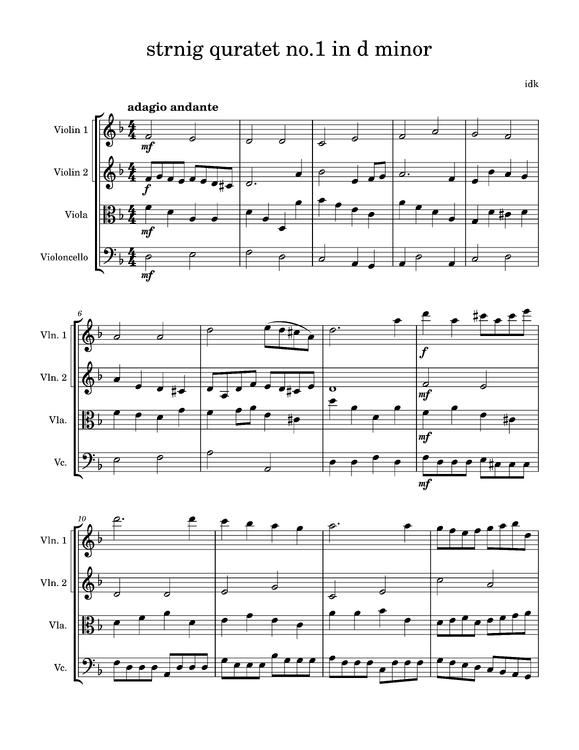
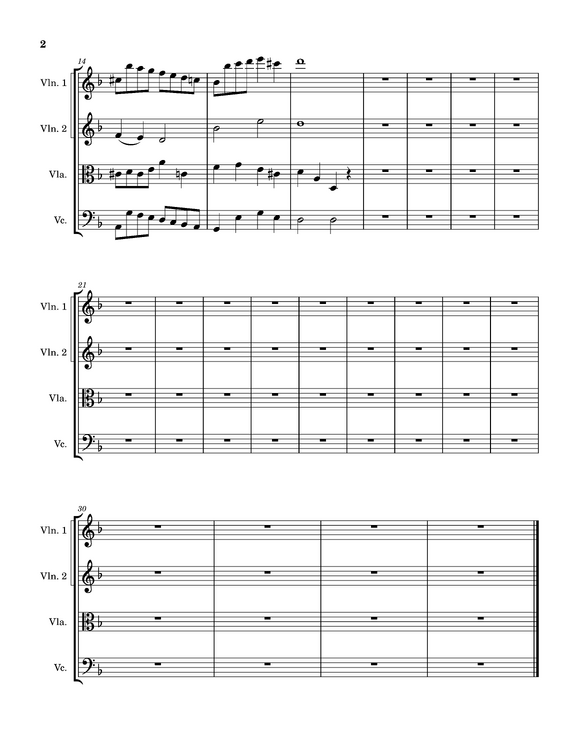
im trying to get 100 different people to contribute a variation on paganini caprice 24 if you want to make one then you can reply to this with a png of ur score thx
-
just what the title says also pls give rating out of 10
-
The piece in F major is well done. Although it has simple, sparse lines, it all sounds really good to me.
-
Fair point. I agree with this (without nostalgia, of course). It seems that because people are being exposed to so many musical languages today, there can be an underlying sentiment that "all music is equal". Or else the classical canon is treated as something sacred and inviolable, and its composers above all criticism. Either approach bypasses the hard and necessary work of actually understanding WHAT makes these pieces work, on a level deeper than that of surface rule-following (since rules evolve and change, but the principles behind music don't). Quoting Boulez here: "In order truly to harness the power of the classics, you have to dig deeper, reach down to what made them behave in a particular way, to understand and to analyze their approach. It is not enough to observe the results and to dispossess them (quotation, stylistic imitation, etc.); creativity does not have sufficiently powerful thematicism at its disposal, but becomes spent, though referencing and distorting, no longer able to forge material only for itself."
-
The reason for that is because it has a low barrier to entry. With synths and sound design, you can hold down a single note and get instant "atmosphere". You can be someone who comes from the EDM world and potentially score a major film. Creating the equivalent with an orchestra is much more difficult and much more work, but the results are always more musical. Directors these days don't really care much about what instruments you use, melody, etc. They just care that it "fits the vibe". A lot of people are mistakenly assuming the directors only want this synth stuff. On my most recent film, I used a mix of synths and orchestra, but I deliberately tried to write in the "old style" as much as possible. The director was never bothered by melody or the orchestra (he had no real requirements regarding instruments), his feedback only ever concerned "vibe" and whether something was too big or small sounding for a given scene.
-
Talk of "innovation" is a moot point when we are inundated with music that isn't even "good" to begin with. If something is new, but it sucks, then it doesn't matter how different it is. So the conversation is kind of cart before horse. People mistakenly assume, in a world right now of endless remakes, re-releases, etc. that the problem is a lack of "new ideas". The reality is that we, as a society, are not presently able to replicate what made the the old things great in the first place. And if we can't do that, then no "innovative" idea is going to be worth a damn.
Last week
-
Hi @TristanTheTristan! Perhaps I should have said "switching to a different plugin" instead of proposing the word "fix"! It might just be me, but doesn't that Pizz sound a bit... blurry, or muffled? It could just be my ears playing tricks on me (haha). I found myself thinking that something like "Berlin Free Orchestra" or "SSO Discover", whatever has a clearer sound, might have been a better choice. But it comes down to personal preference, so it might not be a big deal after all. In any case, thank you for sharing your work! I liked it! Best, Lithl.
-
Cath joined the community
-
Hi Samuel, These are lovely arrangements, thank you. I was wondering if you might be able to send through the score transcriptions for them? With thanks, Catherine
- 5 replies
-
- arrangement
- folk tune
- ireland
- music
-
Tagged with:
-