All Activity
- Today
- Yesterday
-
A four-part fugue exercise composed on a given subject, with no particular instrumentation in mind. Developing the subject contrapuntally wasn’t difficult, but after a while it became rather monotonous. The labels A1, A2, B1, etc. indicate the various fragments on which the episodes are built. (The slurs are only meant to highlight motifs for my own reference.)
-
- 1
-

-
@TristanTheTristan Thanks for the welcome! and thank you for taking the time of your day to check out my music! I really appreciate any feedback and looking forward to hear what you got say more! It's already been very interesting composing for multiple instruments my primary background is piano. I especially am blown away how much you can get away with modifying the motifs cause it feels like the instruments themselves can ground a motif pretty well.
-
Hi there, @MinGry, welcome to the Forum! This is a decent piece of music, for a start, although, I do realize there a lot of compositional errors too. Bars 1-2: One of my favourite parts. It kind of has a nice, catholic tone to it. I would say, this quiet opening really fits my style. Appreciate that, though stop writing tempo numberic markings, and start using muiscal terms more. (eg. Allegro; Fast, or Largo; Slow, etc.) Bars 2-4: This is where thngs start to get messy. (not done yet, gonna come back later)
-
I don't know. Due to its repetitive and diatonic nature it sounds like a copy of Phillip Glass (first two movements) and Carl Jenkins (third movement) to me. And the violin part is relatively ineffective, it's just a slightly exposed solo of concert master above the orchestra. It lacks certain ammount of longlasting interest. This is the type of music I'd listen to at home as a background but I'd not be really looking forward to hear such one at live concerts.
-

Persichetti Exercise 2 - 8 for Clarinet Quintet
chopin replied to PeterthePapercomPoser's topic in Chamber Music
This is a good motif, supported by interesting harmony! This would work well as a jazz piece. All you'd have to do is change up the harmony, and add some drums. But the rhythms and theme can remain the same!- 1 reply
-
- 1
-
- Last week
-
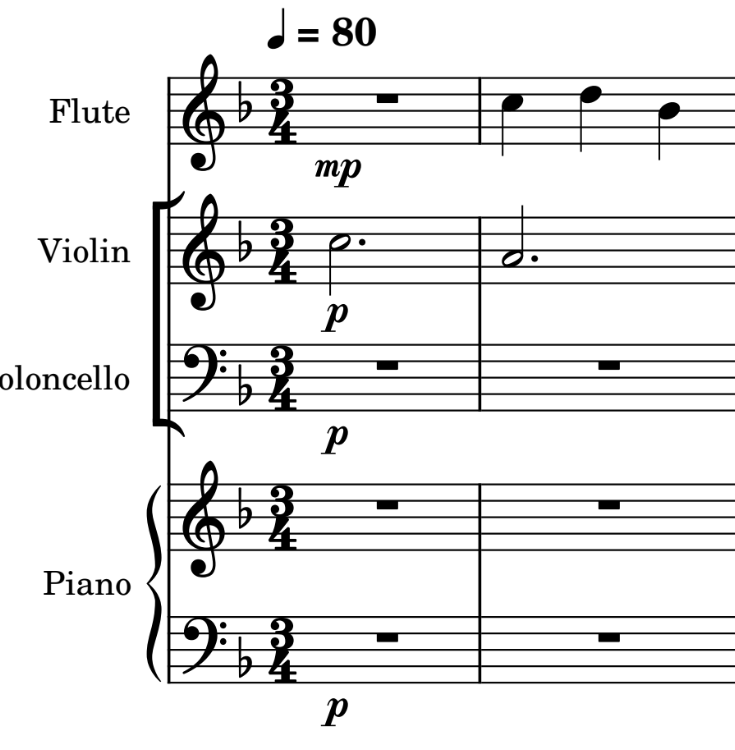
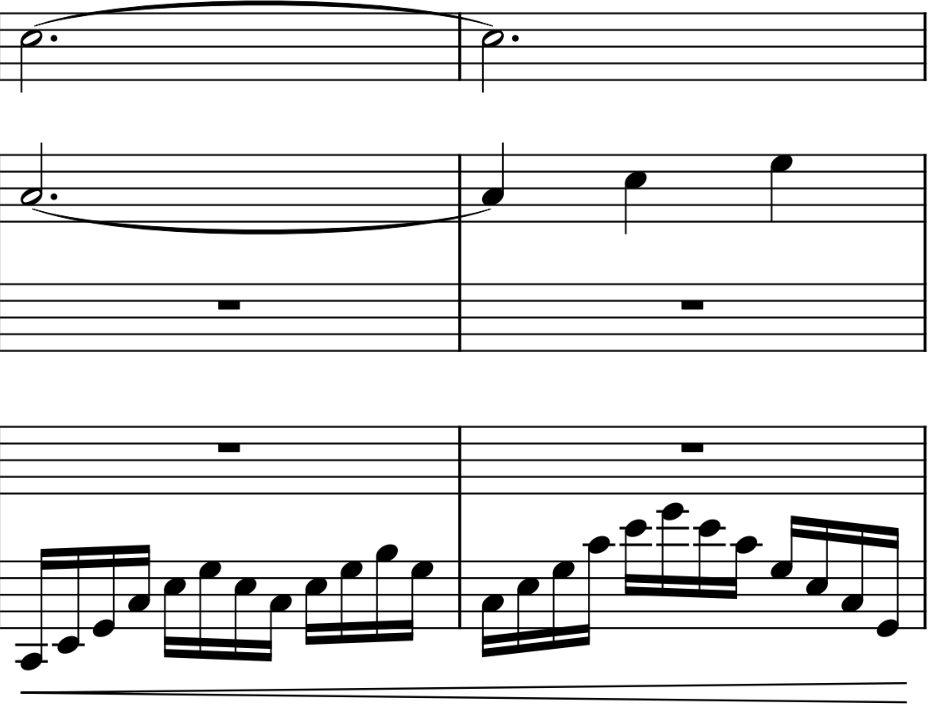
Hi Everyone!, Acceptance is the first multi instrument character piece I have written. It is part of a broader concept: a Cycle of Death, in which I explore the theme of mortality across three pieces: Denial, Acceptance, and Rest. Using the Dies Irae as a harmonic backbone. In this piece, each instrument has a distinct role: The piano represents the truth of death that must be accepted. The flute embodies the human conversation with oneself: longing, hoping, and ultimately accepting. The violin and cello symbolize the path toward acceptance, guiding the listener through the journey. It was very fun composing this! Especially love bars:29-36 and 53-60 Let me know what you guys think! Hope you enjoy it! YouTube link Acceptance.mp3
-
The 12/16 at the end? NEAR the end, I mean, m. 35
-
I hope you all enjoy this new work. All comments/feedback welcome. Thank you
-

As the sun descends - Large Orchestra + SATB Choir
Symphonic replied to Symphonic's topic in Orchestral and Large Ensemble
Dear Mark, The motivation/intent to for creating this piece was because composing keeps me going. There is a lot in my heart and mind which I would like to convey to other people. -
As the sun descends - Large Orchestra + SATB Choir
Symphonic replied to Symphonic's topic in Orchestral and Large Ensemble
Dear Mark, Thank you for your comprehensive and kind words. Yes, I do give some time for each segment to blossom. Though, I am always aware of trying to keep the attention of the audience and inject a sense of unpredictability - a change in direction. It is a fine balance. Yes, to my regret, there is quite a lot of distortion in this recording. That is my error. I very much enjoyed your analogy of looking at a long piece as a journey through a beautiful English garden. It has been three years since I returned home to England. Although I was born and raised in South-London where beautiful English gardens are not exactly readily found. -
 MinGry joined the community
 -
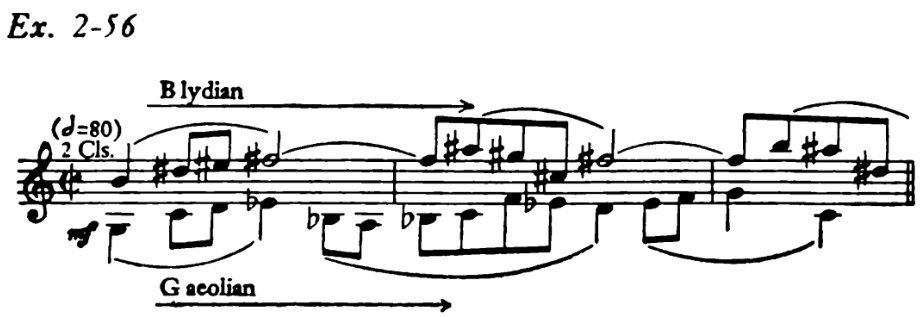
I come to you with yet another piece prompted by an exercise from Persichetti's "20th Century Harmony" - Chapter 2: Scale Materials. This time the prompt was "11. Extend the following polymodal and polytonal passage." I chose to change the instrumentation to Bass Clarinet and Sopranino Clarinet as I thought that increasing the distance between the voices would preserve their individuality. I also heard the bottom voice as being more in C dorian rather than in G aeolian. But for the end of the piece I defaulted to a kind of linear cadence rather than ending each voice on its individual tonic. Thanks for listening and I hope you enjoy and let me know what you think!
-
.thumb.png.8b5b433a341551e913a34392660bc95b.png)
Favorite Musical Book Quotes?
PeterthePapercomPoser replied to PeterthePapercomPoser's topic in Composers' Headquarters
I have another musical quote from Gary Lachman's "Beyond the Robot: The Life and Work of Colin Wilson". And if you've gotten this far, thanks for reading! -
Hello, this is my first time writing for choir. I am being commissioned by a local middle school to arrange Umbrella. I have just the bridge and a final chorus to add, but I wanted feedback. My background is percussion so I don't want to accidentally make anything to jumpy or impossible. Please be specific in critiques, I'd appreciate it! Thank you!
-
Piano. Fortepiano, musically. Or gravecembalo col piano e forte.
-
Just a little theme I wrote for my girlfriend! Thank you for listening!
-

Invention in Db for Piano
Frederic Gill replied to PeterthePapercomPoser's topic in Piano Music, Solo Keyboard
Comment: Rhythm: you have many unaccented dissonances (4th beat), before consonances at bars (1st beat). According to my books, the cadential effect of this breaks the flow. But as part of a repeated design, it creates a shift to the left in the rhythm. Another element that creates a shifting effect is the (10) suspensions on 2nd beat. Interesting that when you heard my v1 for the 1st time, you were caught by the Bb in me1, on 3rd beat, and questioning about the key being Db (major) or bb (minor). Because in your compo you’ve put more ‘accent’ on the 3rd and 4th beats and opted for a more minor & dissonant approach. This is highlighted in your final cadence. In contrast, my compo has a ‘dancing’ rythmic pattern (quarter notes on almost all 2nd beats). In me10, the last Cb you put (? for sake of symmetry with the ongoing sequence and the following one?) makes a 1st parallel aug4th with the next (accented) interval. I find that a plain C sounds better with the upper voice and the new key (f?).- 1 reply
-
- 1
-
-
Just came back to this piece... Appreciatable. I took an inspiration from one of the rhythms.
-
 Found this in a box, partially chewed by mice! 1989, age 20. I wrote a lot of very short choral pieces as a youngster, trying to get something published...if I find any more worth entering, I'll do so in this thread. Aaronic Benediction Free Sheet Music by Robert C. Fox for Various Instruments | Noteflight
 -
Well, I would start learning harmony. Soyar´s advice is excellent. By harmonizing simple, short known pieces, you will get the hang of it. At the same time, I recommend you to learn the theory, in order to understand why things work or do not work I also suggest that you should invest in a keyboard, and hook it up to a computer with a notation program (e.g.Musescore). This setup could be the easiest way for a practical study of harmony using different chords. You can store, compare and playback your work any time. Moreover, you can always see the score of your work. It is important to obtain a skill in notation and reading scores. At the same time, you can start writing (play) some VERY simple, short melodies. Then, continue with harmonizing your melody. Start with chords, and when you are satisfied, you can go for variations (for example make arpeggio´s of the chords, add a bassline etc. This is the way I started. In principle, you can do all this by yourself. There are on-line courses in composition, but mostly, I find them of limited value. Instead, I would recommend you to find a teacher.
-
 Fruit Punch joined the community
 -
Hi, I love the arrangement!!! Can I please ask if you can also send the PDF version of this arrangementof the separate part so I can try to play it!!! Thanks!!!
-
 This thread needs more activity
 -
 Yeah you did, as I don't have the time nor energy to make another year review anymore now lol!
 -
Add Your Own Composition-Related Maxim.
Henry Ng Tsz Kiu replied to luderart's topic in Composers' Headquarters
"Be Honest"