All Activity
- Past hour
-
Version 17 has arrived. I completely changed the logic for how panning constellations decide to orient themselves, using a highly complex and original idea that I came up with, and the result is very lucid and pleasing. I think this is the final stage of the program, actually, as I am finally quite happy with the sound. Below is a short sample, I will be adding more to this topic as I continue the rather slow and tedious process of reuploading all my music.
-
A Tribute to the Late Leonard Roseman
-
- Today
-
Exposition of Rondo-Sonata in Ragtime form, AABBACCDD. Melody/leading line only, and now I need CCDD theme! Development will start with a fugal exposition; hackneyed, I know, but I like such indulgences...that's going to be three minutes of the beginnings of music, and the CCDD themes should be about 1'30" giving me 4.5 to five minutes for the exposition, aiming at 9'00" like the other movements.
-
OK, HERE!!! I'll just allow others to go as I go, so here MIGHT be the first 80 seconds or so of the finale. We'll seeee, my prescioussss, how long it taaakes poor Smeagol; GOLLUM!!! First Theme Melodic Sketch-Piano Sonata 3 Free Sheet Music by Robert C. Fox for Piano/Keyboard | Noteflight
-
Hello, I'd like to share my new project - an organ mass for an actual use during a catholic mass. This Offertorium is the first completed part of this mass. I plan to compose this mass in the 19th century french romantic style inspired by small liturgical pieces by Boëllmann, Lefebure Wely and Guilmant. The remaining parts - Entree, Communion, Sortie and maybe an additional one will come soon. Thank you for listening (link to the video of me performing this little piece). Honest opinions are welcome :) Offertorium.pdf
-
-
-
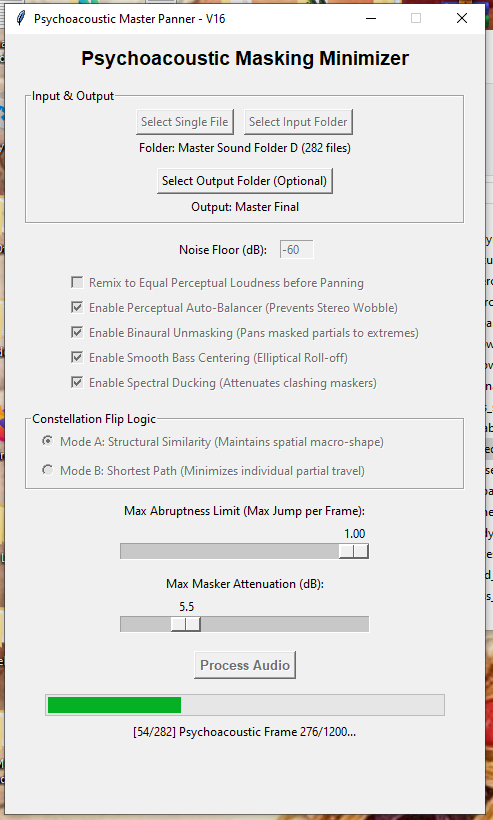
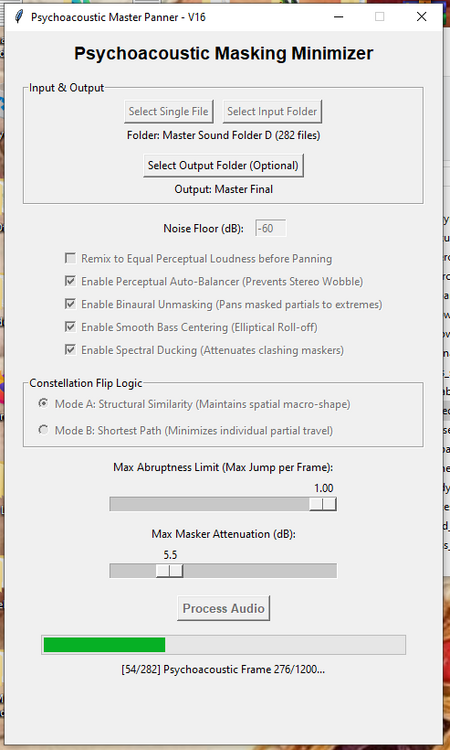
Here's a screenshot of the current version of the program, with which the music in the post directly above this has been remixed.
-
-
Now that I have more or less perfected the processing of adjusting panning, I have turned my attention to adjusting the loudnesses of sound partials. This second aspect of the program is already finished, I think. Here are some results.
-
A vast improvement. Formerly, below a certain frequency, partials were suddenly restricted to being panned hard center. Now there is a smooth transition rather than a hard cutoff, leading to a much smoother effect.
-
One of the last problems was that, while each stucture of panning was more or less optimal, the transitions between them were sometimes not. Sometimes, instruments seemed to jump about at random. I have therefore changed the logic behind this. Formerly, the program would flip optimally constructed "panning constellations" (partials with their orientations in stereo space) so that transitions would be maximally smooth. Instead now, they're connected to each other based on structural similarity, with the result that clusters of partials move around in a much more logical and coherent fashion.
-
-
Further improved the program by taking into account loudness masking and the fact that the panning of low frequencies cannot be distinguished (these are now panned dead center). Some results may be heard below.I like it, it seems to work! Some "rich" chords, but contrasting sections give the ear a break. The first theme briefly restated, end. Beautiful! And tasteful, not a wasted note. When I first glanced at the score, my inner ear didn't want to accept the A natural/E natural against Eb, Ab, but you make it work.I've written settings of poetry fragments that are less than thirty seconds, but I think you've got me there. 🤨 I just verified: I have a setting of a Hopkins Fragment that is about 20 seconds by the mm. That would be the shortest song I ever wrote that I would enter on the computer, as opposed to fragments fragmented by me, or false starts, etc.Hello everyone! This weekend I experimented with a really simple atonal technique and I turned the experiment into this piece for piano. The technique is "mirror writing". I applied it in the simplest way possible. The process was the following: 1. I decided on using four voices and mirror them around the middle C axis. 2. For each melody note, I added the mirrored bass below it (for example, a top note A is accompanied by the bass Eb, both a major sixth above/below middle C). 3. After that, I chose both internal notes (considering that those need to also be mirrored against each other). Except for two measures, the whole main theme was created through that technique. Afterwards I composed a tonal middle section and turned the piece into the form ABA'B'A''. This time I tried avoiding excessive exact repetition (with techniques such as changing octaves, creating different melodic contours and accompaniment, or mixing final restatement of main theme with the coda) in order to add some variety to the whole. That is because I tend to just copy and paste most of my sections and I want to get rid of that habit. In addition, the first measure copies the beginning of Schubert's Impromptu No.1 in C minor. As always, every feedback, comment or suggestion is more than welcome and hope you enjoy it! Thank you! PD: My main concerns are in m.39~40, where I change the ending of main theme making it maybe too dissonant, and the fact that the first time that I introduce the B section (m.13) I do not use the continuous tresillo accompaniment.A lot of overlapping perfects. I see you tried to imitate birds and animals. I see you have done it in a creative way, so I gave you a 10.I just realized that I have the option to dial the consonance levels all the way up. The remixes are coming out substantially better now. Below are three compositions processed by the program I designed.




.thumb.png.8b5b433a341551e913a34392660bc95b.png)