All Activity
- Past hour
-
A Grand and Ghastly Meal in Tartarus (Version II): The Glad Dirge of the Three:
- Today
-
Thanks for the comments, Alex! The piccolo will sound an octave higher than written, so technically it is still pitched above the flutes. I agree! I tried figuring out how to do this in Dorico but couldn't figure it out without it looking weird (hence my note). The "vertical" accents denote Marcato. My interpretation is that they are played stronger than your regular accent and are slightly shorter in duration (a half note maybe played as a dotted quarter perhaps)...each note with the Marcato marking needs to be hammered and short-ish. Err...I guess that is subjective and depends on the context of what else is going on in the score. sffz definitely is more "hammered" than sfz
-
With your idea for brass stings on the offbeats, consider holding off until later to do it. We're hearing the melody clearly for the first time, and doing some non-written flourishes would be better for after a clear statement of the theme/ later overall in the work. Present the melody clearly and let it develop to that point for extra changes and hold your cards until then imo.
-
Hi Danish, Really like your orchestration here. Interesting choice in Bar 85, where your piccolo is pitched below the flutes. I think in Bar 9, where you have two harp harmonics played together, you technically should have two harmonic circle symbols on top of each other above the staff. I wonder how you define the difference between vertical and horizontal accents? (The conductor I work with, advised me not to use the vertical ones, as he thought their meaning was ambiguous.) Also, how do sfz and sffz differ from an accent?
-
Hi Luis, You've achieved some lovely rich orchestral textures here. Think you did a great job with your orchestration! Are the originals considered to be from Schönberg’s early or late style?
-
Those are very different things. If I buy a hydraulic press and use it to flatten a stainless steel pipe, obviously I'm morally responsible for flattening the pipe. If that pipe belonged to someone else, I can hardly evade responsibility by saying, "Hey, it wasn't me! It was the hydraulic press!" On the other hand, it's equally obvious that I can't lay claim to flattening the pipe as a feat of strength. If I cry, "Behold my strength!" as I hold the flattened piece of steel aloft, I am quite rightly met with, "Uh... you didn't do that. The hydraulic press did."
-
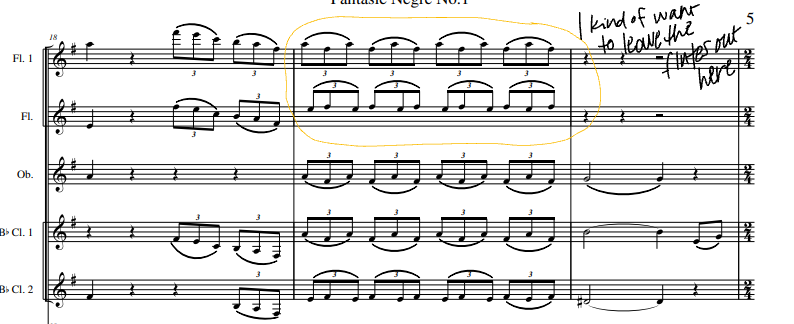
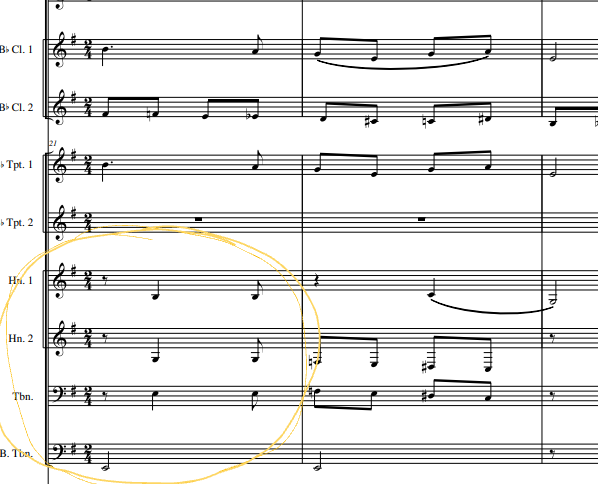
Honestly, feeling a lot better about this...It needs bowings, but I'm holding off until the last minute to do those b/c I don't play strings anymore lol Main things I'm looking over now Fullness Logical use of instruments throughout Logical flow throughout the arrangement pages 14-17 are looking a little empty I had an idea to give the horns some rhythmic "hits" in this section, but I wanted to get some feedback before taking that entire line out Thank you all so much, I have learned a lot from your feedback updated.pdf
-
We studied this piece in Orchestration, it was wonderful. Our textbook had different voicings/arrangements of chords w/ audio recordings so it was really helpful. I love this description...it's really a combination of instrument capability & range knowledge, compositional/arranging chops, and creativity. Imagining what you want the final to sound like and using your tool kit to make it happen.
-
Hello, I will do the overall judging of your piece. First, let me talk about the program notes and also your stunning picture out of curiosity though have you took this to yourself? Anyways, you give a very interesting concept so I’ll see how that ties in with the music and you’re very descriptive. I like to say at first that I enjoy the use of the artificial harmonics This gives a very alien in what I like to call crystalline atmosphere. Almost glassy in a weird good way. I also enjoy the dynamic use as well. As for the change structures, this is the only thing you really listening for so nothing is really a pallet cleanser however, though this is a five minute piece so there’s no need for one. Melodic material : 3.5 Harmony and texture: 8.3 Structure and development 3 Original creativity 7.56 Score presentation 9.79 Orchestration 8.9 Execution 9.04 Taste:7.9 This average is out to a 7.25
-
Nobodies reviews are more "official" than anyone else's and you're free to review whichever entries you want and in any manner you see fit (you can use the official competition reviewing template or review them any way you want or use your own template). The winners will be decided by popular voting polls.
-
- Yesterday
-
Presenting "A Grand Meal in Tartarus." The lyrics are mine and taken, once again, from my novel.
-
Hallo @HarryWood ! First of all, a warm welcome here at the YoungComposers Forum! Here are you among numerous music enthusiasts of a huge variety concerning their styles, compositional approaches and skills, so that I think, you’ll get the desired feedback. I was curious about what to expect about the style of your music, since you’ve called you a „new neo classical“ piano composer. The term „classical“ reminds me first to Beethoven or Mozart and „neo“ means for me to integrate more contemporary harmony and tonality. After listening to your pieces, they remind me more of Beethoven’s „Für Elise“, Richard Clayderman’s „Ballade Pour Adeline“ or „Comptine d'un autre ete – l'apres-midi“ from the French movie „Amelie“. Although all that pieces are very popular, that kind of genre is – as mentioned already by @Luis Hernández – somewhat too soft and non-exciting for me, too. Please don’t misunderstand that as a criticism on your person or your achievements in piano playing for about one year. The pieces sound good and have a calm mood, but putting some more ingredients in them would make them more unique: Whenever I think about what a good piece requires, the following things come to my mind: • First, a piece needs an idea how it could sound like, what mood it should have or which other pieces could be used as an inspiration (I think, that „ingredient“ you have already achieved with your pieces). • What a piece makes unique or captivating is a clever idea, creating a „unique selling point“, bringing some surprise to the listener. That is the „spice“ of the unexpected, for example a distinct harmony progression, an unexpected tonality or dissonances or a rhythmic surprise such as an unconventional meter (so I could imagine for your pieces a kind of Jazz harmony or somewhat more dissonant harmonies). • Another important thing is to think about the form of the piece. While this is a more theoretical topic, one sometimes has a good melodic idea (or even a number of), but the question is, how to put them together. So now the reflection comes, what the piece could be structurally, a simple A-B-A form, a rondo, in sonata form, a number of variations about the main theme? • A final question could be: In which context should the piece appear? I could imagine, that it is more satisfying to have an idea or „project“ of multiple pieces to be put together, for example, in a cycle such as „Six preludes“ or something like that. With such a framework in mind, you don’t run the risk of trying to create numerous unrelated pieces and perhaps putting them „unfinished“ away. The incentive „Now have I finished number four of six“ helps yourself to focus and you’ll see, nearly every piece is worth it to be retained. Looking around here at the forum would be a perfect place to get inspiration and don’t hesitate to „review“ other compositions too, even if they are from „more experienced“ composers. Every reply is welcome and receiving the „incentives“ (such as points, badges and finally ranks) does not primarily depend on the quality and quantity of the compositions you shared, but even more from the amount of feedback you’ve given. And, by the way, if you share your scores, too, the reviewers would be able to give more in-depth reply, for example also concerning the „art“ of score engraving. Friendly regards. Wieland
-
Haha, I was just curious whether you would notice that and even ask about! Yes, in fact the composer Thomas Handke is my brother. One could perhaps put the bars 11 and 12 together changing its time signature to 7/4 with a starting quarter rest. But I understand, that you would not like it, since the rhythmic recapitulation of the first bar would be changed with this leading rest. The “overly correct” version might be to write measure 10 twice using “volta brackets,” with version 1 remaining unchanged and version 2 changed to 5/4 with a closing quarter rest, so that the rest would appear at the end of the phrase as intended. However, there is no problem with the single bar in ¼ meter. The only thing which „bothered“ me was that the „whole bar rest“ – while being correctly - looks at the first glance like a „whole note rest“ which obviously does not fit in a bar of ¼. Thus, the simplest solution could be to change that rest to a quarter rest in mm. 11.
-
A beautiful and thoughtful prelude of which the counterpoint and harmonies linger in your ear long after you listen to it!
-
E.A.S. | Electronic Ambient Space ELECTRONIC AMBIENT SPACE.mp3
-
Not a specific note for your piece, but when it comes to orchestrating piano pieces, the gold standard is Ravel. I would highly recommend studying his orchestration of Mussorgsky’s Picture At An Exhibition, along with his orchestration of his pieces like Ma Mere l’Oyle and Le Tombeau de Couperin. I would also give a listen to Brahams Haydn Variations, in both the double piano and orchestral versions. One thing you’ll note about these works, is how they weren’t limited by the notes on the page. As an orchestrator you are not just transferring notes from one instrument to another. You are interpreting the music through your own sound.
-
Thanks Wieland Handke for your review of my piece and your impressions about each sententia often amounting to a detailed review of it. Indeed I also consider the sixth one to be the best realization of the “sententia” form as well as perhaps the best of this set. Regarding the link of the composer Thomas Handke that you mention, I wonder whether he is related to you as he has the same surname. I listened to his “Partita für Fagott solo, op. 33” and enjoyed it. It is also performed well by the performer. Thanks for the link! I have only composed one solo piece for fagott which is the bassoon in English, and consider it an instrument with a voice full of feeling. Regarding the 11th measure of Sententia No. 5 in ¼ and with only a rest, it was done for practicality since otherwise the repeat sign would have to be made in the middle of the bar (in case I changed it to 5/4), a practice which I have the impression is not desirable if not incorrect. Or I would have had to write out a new bar as a separate continuation of the repeat.
-
And here is the first video of the Episode #2 - introductory remarks and the music of the two productions (Jay Bacal's and mine) of the opening theme of John Barry's Out of Africa: Out of Africa - Learning by comparison, Episode #2 (music and introductory remarks) - YouTube
-
A dramatis personae for The Last Marriage:
-
-
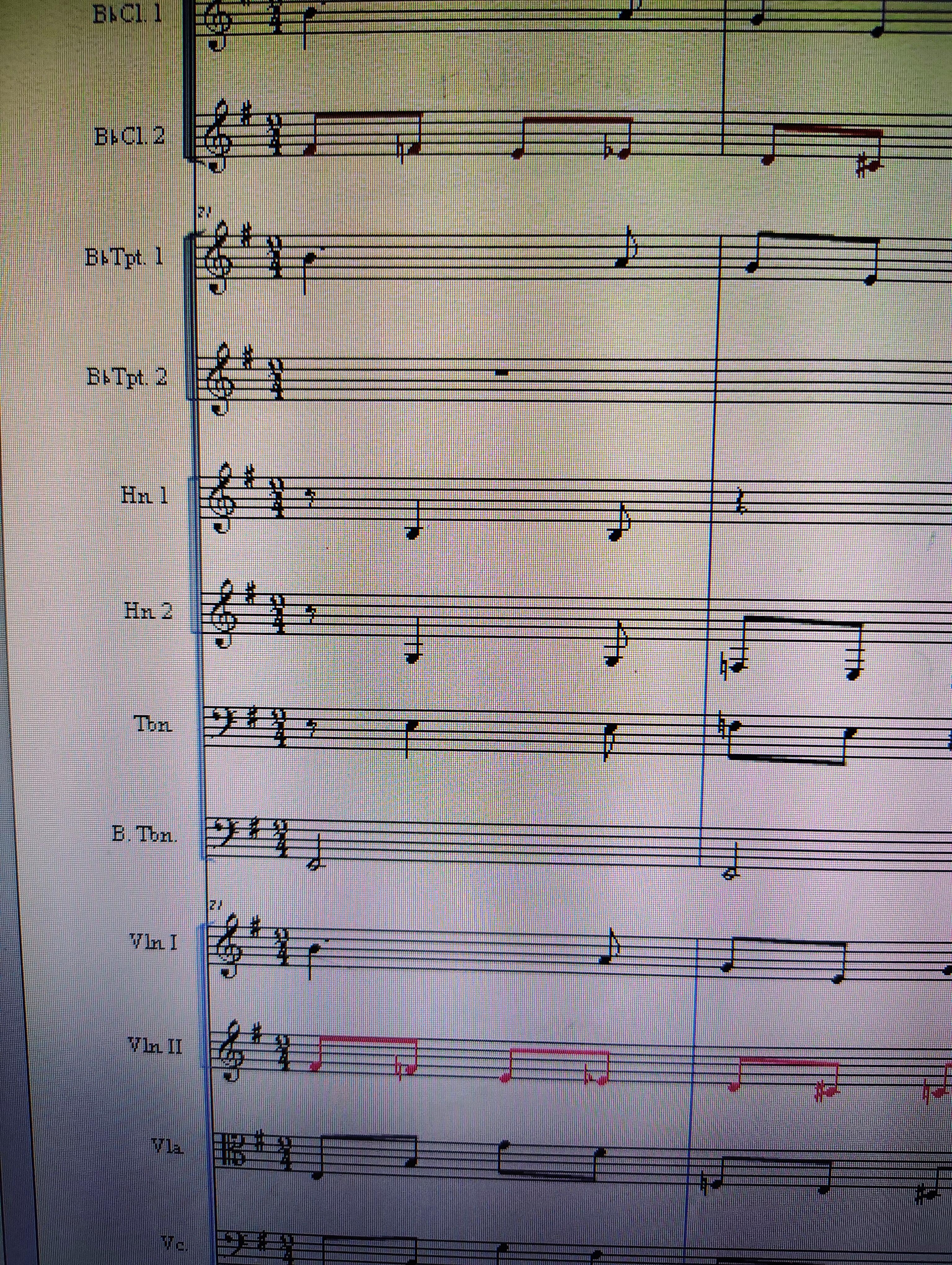
very true...ugh, I'll have to make more revisions lol update.pdf I was sitting down and playing through different sections of the original piano piece earlier, and I thought that using the bass instruments more rhythmically could be really fun...like doing "hits", with the French horn and trombone...just a thought
-
Keep in mind the harmonic series. In both examples you put, even if you sustain the harmony, be careful of the interval spacing. Small intervals in the bass voices have the potential to sound really muddy as the sound waves will fight for dominance. Same thing with the use of bass voices. Be careful of when Price writes them explicitly long in the score versus apart of a moving line. Depending on the pedal info, it may not be correct to include a prolonged voice. This time, I am cautioning against too much use of the same techniques; however, at this point, you should strive for making a rough draft versus detailing it all out. Get your ideas in full-score format and then go back and polish everything you need to before Wednesday.
- Last week
-
As the thread title says. So far, I have generated 7 suitable pieces using the AI Suno, which I have subscribed to because I am very pleased with the results. All the pieces I've generated so far use my lyrics. The music is inspired by my novel The Last Marriage. More will be posted in due time.






.thumb.png.8b5b433a341551e913a34392660bc95b.png)