All Activity
- Past hour
-
 Good for you! I'm too embarrassed to share my earlier works lol
 -
Here's a very short piano composition I composed for my daughter many years ago. Nothing extravagant .... simple theme and tone. Mark
- Today
-
 Thanks for the comment! I’m sure there could be plenty of changes to do, however, this work was one of my earlier attempts at writing for the orchestra. A time before I got any composition feedback from any mentors. I thankfully won a competition and spent a week working with composer Robert Bradshaw. During that time, he gave me tips on voicing, orchestration, and understanding tessitura. My rewrite was not to completely redo the work but polish it with the new information and techniques I learned. So, while I appreciate the feedback, I will not be rewriting certain spots in the work as I still want to keep it as is to show my growth overtime.
 -
 What can you do with 3 notes then?
 -
This is a very well constructed piece! I think it's a little too on the "safe" side. When I envision a piece about storms (be it Vivaldi's Summer, Beethoven's 6th, Alpine Symphony), I want to hear rapid scales (especially in the strings and woodwinds), wild tremolo in the strings & percussion, and more dissonant chords in the brass. Maybe I'm biased after listening to those pieces. I think the D major section (starting around 94) is too similar in terms of orchestration as the beginning. I think this should be more brighter sounding, maybe with some instruments playing an octave higher than written (for example violins/violas in 126). In general, a little variety would help differentiate this section.
-
 @Wieland Handke Apologies, I didn't think anyone would be interested in seeing the score. In any case, here it is.
 -
A very short thought, or a bubble. A fleeting moment. Built around a Csus2/F# to Cmaj9(add13). That's it. Just a moment. Just this evening. Love me some lydian and b9 and #7 sounds. Acoustic guitar, DADGAD capo 7. 🔹 Quarter-to.mp3
-
Symphony no 1 in A minor (I) March
danishali903 replied to Musicman_3254's topic in Orchestral and Large Ensemble
I agree with most of the comments above...that is a LOT of instruments! Even if you're trying to emulate Mahler's 6th Symphony (which clearly you are with the choice of key and title of the movement), Mahler shows restraint on how he orchestrates. The big loud moments when all the instruments play together is rare, and is used for an effect rather than just bombast. In the current state, this sounds more like a background score to a film, rather than a symphonic movement. @Sojar Voglar pretty much sums it up. There needs to be direction, a form, and something to keep people's attention. -
to be a Bossfight song. (preview)
MK_Piano replied to therealAJGS's topic in Incomplete Works; Writer's Block and Suggestions
@therealAJGS WOW! What an improvement! It is night and day. I have no comments on the music as again, I do not know much on what is meant to accompany, but it definitely conveys something dire or thrilling. As a point of enjoyment, I must say there feels like too much distortion in the file. Just about 30 seconds worth of a blurriness that is very overwhelming compared to the literal music. For me, it took my attention away... especially with headphones 😓 -
.thumb.png.8b5b433a341551e913a34392660bc95b.png)
My new String Symphony in D minor
PeterthePapercomPoser replied to Sonata_5's topic in Chamber Music
Hi @Sonata_5! Do you have an audio rendition of your symphony we could listen to? -
.thumb.png.1e2763f479362bbb522da50d31ef2e50.png)
When did you start composing?
therealAJGS replied to CaltechViolist's topic in Composers' Headquarters
It's them! they started "Random"! -
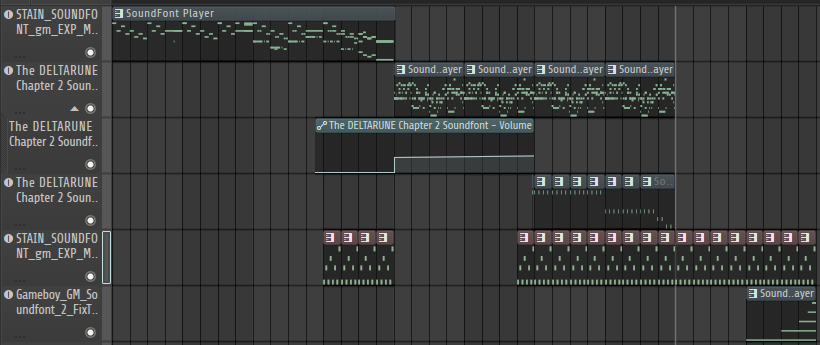
ok, I worked on it and gave it a MUCH needed improvement. this is what is it looks like right now. I honestly don't know what to do next, and I'm curious what you guys think, or if I should add any new instruments for either The next part or the part I have right now. to note, I also want it to be ~3 - 4 minutes long. This song actually came to me about 3 years ago, before I even knew what a "sharp" was, and before I started composing music. I Don't know how I still remember it. back then I thought of a lot of melodies in my head when I was bored and learned them on my Piano; now, I mostly play piano and if I play something I like, I continue it with my software, FL studio. I got really confused when I realized in the old one, after the intro it changed to C# and I thought the intro was D# so I changed the chorus to that, but apparently it was A# anyway. small mistake, big difference. anyway, here's how the progress is going. take a listen.
-
kinda ambient.
-
ok I guess I'll work on this song. reccomend any plugins or soundfonts?
-
Hi! I composed this string symphony a while ago and my orchestra director at my school wants to play this piece. Is there anything I can improve on? Feedback now would be very helpful as we are rehearsing in two days. Thank you!
-
Hi @MichaelJohn, I'm using Noire Pure!
- Yesterday
-
Three of my favourite composers! I didn't realise I was channeling Prokofiev!
-
Epic Triple 1- Cinematic | Original Composition 2- Turkish-Delight | Original Composition 3- Moon River Movie-Score | Rendition Epic Triple .1- Cinematic 2- Turkish-Delight 3- Moon River.mp3
-
 Charlies Angels Movie Theme-Cover + Star Trek Episode-Cover 1- charlies Angels Movie Theme-Cover 2-Star Trek Episode-Cover.mp3
-
- 1
-

-
 To add a bit of nuance to the idea I had floating around when I started: The start idea (Dbm-Eb#9) is quite dissonant and reminded me of the feeling you get when you are watching a show or reading a book and often something happens around late parts of the "middle" of the story where you sort of feel sore of something in the story. There is that unfortunate upset, the part you need to get over as the viewer, so that the ending makes sense and is satisfying in the way intended. That's what came to mind. From that it grew into a waltz and with my detuned E-string, a morsecodish pattern seemed fun. The way the piece evolves in my head is from this soreness, anxiety - what I imagine like one of those wounds you get for falling on asphalt or gravel, you know the ones. That soreness is distracted by this 11/8-ish thing, in a sort of bliss you get in a bad situation from small things. Everything's not alright and you know something is wrong, but your mind is preoccupied with this random thing for just a moment. The ending of the piece is abrupt, fragmented, it's like coming back to your senses, realizing the grimness of the situation. By complete chance "chapter 11", my original name idea (based on the 11/8 and the idea of this being a chapter in a story around the late-middle) means something adjacent to this - bankruptcy! Failure and reorganizing due to such. So the name has that pun in it (I mainly associate bankruptcy with businesses). To me improvisation and composition (and especially comprovised music which is partially what this falls into - a combination of the two) give a chance to tell about feelings, moments, memories, concepts, colours, smells etc. in a vastly abstract sense. Therefore all of this stuff is going through my mind while playing, and I think as that chapter of the book it works quite nicely :D. But feel free to disagree and give your own thoughts! -P
 -
Here is a quick semi-improvised piece I made! 🔷--...-- - waltz for chapter 11 of a movie (or business).mp3 It is based on 2 basic ideas really, a Eb6/9 (or Eb6b9) to Db6/9 movement (with the occasional Dm/F) and a morse code idea that evolves into what resembles a 11/8 pattern (--...--/2+2+3+2+2). The idea in the very start is a Dbm to Eb#9 (omit5, sometimes with a 6 too; basically a reduced Hendrix). The tuning is Drop-D with the E-string tuned up by around 20-25 cents. This is a technique I like to use to make things sound out of place - or to give them that slight microtonal colour. My question would be building on this. Like many of my guitar compositions this was originally an impro session, then I recorded my attempts to redo that impro session. TWO CENTRAL QUESTIONS. *How much detail is too much?* (in notation) -> As this composition is highly impro-based and there are a lot of small improvisatory moments (i.e. the percussive sounds which have a specific place in the form but not specific rhythms or techniques) and I'm wondering how much of them has to be notated. Also there are moments where I purposefully "throttle" the rhythm, like towards the end, where the rhythm fragments and by effect the pace slows down. What's the best way to both visually AND verbally (an)notate this *fragmentation*? I want to have both visual and verbal, reinforcing one another. *What instrumentation do you see fit for this?* -> I want to add other instruments - or effects too maybe - to this piece once I notate it. My mind first wonders towards R. Dyens' ideas for Libra Sonatine if I recall correctly: Originally for guitar, arranged for gtr, contrabass, fiddle and percussions. Ensemble Dre's rendition (spotify) . But I am wondering what to do. Often these first feel so... intimate for the guitar to me, but I still yearn for other instruments to join. This is a long standing block for me. (I also want to know what you guys think of my, self-claimed to be hilarious title) Love from Finland, Pyry
- 1 reply
-
- 1
-

-
- guitar
- solo guitar
- (and 3 more)
-
No.1 - Mountain Storms and Valley Peace 1: Now this is what i call "FULL-ON" , You cannot MAX-OUT the Orchestra more than this. 2: i First heard this Composition on your Main Website, it Instantly brought a smile and a laugh to my face, as i thought to myself : "OH YES" 3: Its Powerful, Professional, Inspiring, Complete.......It has all the Hallmarks Of a Hollywood Blockbuster.
-
A Ballade for the Dead | Rondo for Orchestra
interlect replied to MK_Piano's topic in Orchestral and Large Ensemble
No.2 - Ballade for the Dead 1: Oh My God....... This Composition actually has a " MELODY " I thought Melody's were Banned on this Forum. This Melody is DISTINCT , as opposed to OBSCURE, its instantly Recognized when it presents itself. So that is a Major Plus +++++ 2: This Score has a , Beginning-Middle-End that's also very Evident, as opposed to ........ " Where am i in this Composition ? " 3: Overall Feeling & Sound of this Performance is : Main-Stream-Commercial Movie-Score.