All Activity
- Past hour
-
Hi @gmm ! Wonderful and ethereal piece you've presented! It has a sense of floating and the rhythms are very well chosen, never giving an impression of mechanicality but of an inspired flow. I do agree with Luis that the violins would sound better with harmonics or perhaps sul ponticello, sul tasto or muted. Thanks for sharing and glad to see that you're delving into writing smaller ensemble works!
- Today
-
-
Alex, I corrected the post ... you can delete yours .......... Mark
-
Not nitpicks at all. I did think about the notation(s). Thank you for comments ... they are most welcome! Mark
-
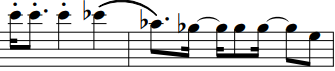
Hi Mark! Quite an interesting and chromatic solo oboe piece you've presented! I am wondering if you just arbitrarily decided to use only flats for this piece? It seems to me like, given it's highly chromatic nature, both flats and sharps would have been appropriate. Then there's also the Cb's you used in meas. 10 & 27 which to me should quite obviously be B naturals. In fact this whole phrase here: to me would have been better notated with a B natural, G#, F# and E since this would make the distances between all the tones more obvious (the distance between the Gb and E is a diminished 3rd which to me would just have been way nicer spelled as just a regular major 2nd). Likewise here: you could have spelled the E as well as an Fb perhaps? That would make the intervals between all the tones more obvious in this phrase. The Db in the 2nd measure could also have been a C# given the minor 3rd distance to E. Those are all just my personal enharmonic nitpicks for this piece. Overall, I enjoyed listening to this even though I usually don't enjoy solo instrument piece unless they're polyphonic. Thanks for sharing!
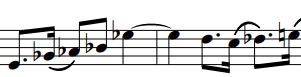
-
Rescinded.
-
Hi all, Here's short lament I composed for solo Oboe .... when some notes during my warm up tweaked my interest. As always comments always appreciated. Mark (Oboe is computer generated...although I have played it 😉) Oboe Lament6-30-26.mp3 Oboe Lament6-30-26.pdf
-
Lovely!
-
I'm sorry there hasn't been more comments on this very ambitious project. The orchestration is quite overwhelming. I wonder if more could have been accomplished with less. When I listened to the work mostly straight through .... I was looking/listening for a central prominent integrative theme(s) to guide me.... Did I miss something here? Mark
-
This is an ambitious and challenging work. It reminds me of two pieces I saw workshopped earlier this year, as part of the LSO's Panufnik Scheme (at least in terms of complexity of the scoring). Not sure I can offer anything useful, since your scoring is far more advanced than mine! I did spot one or two issues in the engraving that you're probably already aware of. These were: A misspelling on Page 2 ('deturned' instead of 'detuned' in the Viola instructions). Awkward beaming alignment in Bar 35 of the celesta part (one of the noteheads seems to be floating away from the beam, and is missing a stalk). Misaligned brackets in Bars 31 and 32 of the Doublebass part. Bar 74 and elsewhere: not sure why you write Celest' instead of Celesta? Looks a bit odd. Musically I really enjoyed it, and liked how you used the extended techniques. These were not there just for the sake of it; but to create a useful effect within the narrative of the music. I had to look up some of your directions (like gioiosamente), as I'd never seen them before! Sorry I can't be of more help, Alex
-
Hello everyone, Here is a little thing that I wanted simple, in the spirit of the beginning of the century, evoking a little a song, to stick with the bittersweet character of this poetry of Laforgue. Thank you for your opinions and comments, JC https://youtu.be/Ta7B6IZlmfo?si=xCh0K7gY20E74zYd
-
T. Kvistberg changed their profile photo
-
T. Kvistberg joined the community
-
Hmmm. I'm trying to figure out why other people's showcased music posts have mostly received replies and feedback within 1-3 days, while my piece has not seen a single reply after an entire week. I'm just taking a shot at the dark: the majority of people who visited this thread have been subconsciously made resistant to finish the piece from start to end, after listening to the first few moments of it; noting my "flighty" music behavior: going from one idea to the next, without endowing and developing much of any of them. This makes them "not want to" discuss the music, because it would be "hard" to; when the "central themes are not there". Would this sound about correct? 😁 ~~~~~~~~~~~~~~~~ edit - I said a whole lot more at first; and realize that I should keep it concise. This Tone Poem is meant to follow a style akin to "stream of consciousness": it's supposed to sound like ideas just come and go. On the other hand, there are central themes, and they do develop. Like Stravinsky's "Rite", one simply can't readily note them on first, second or third listen. But, they are there!
-
- Yesterday
-
Tumisang Tshose joined the community
-
Here is another ear-transcribed score from Halo 5: Guardians. (I have a handful of ear transcriptions I did, specifically for the Halo series of games... simply because Kazuma Jinnouchi, Neil Davidge, Martin O'Donnell, and Michael Salvatori are all just simply wonderful composers who I admire and respect greatly...) Audio referenced for transcription, here. blueteam.pdfBlueteam.mp3
-
Tristan25 changed their profile photo
-
I am on the other side of the pond, in the backwater that is the Isle of Man. Nothing much happens here, besides seagulls shitting on us from above. But I realize that can be a breath of fresh air in today's world order!
-
Thanks for listening! Yeah, I appreciate the point about monotony. For such a short piece (really just four phrases, played very slowly), I thought I could get by with just the one motif in the upper strings. I did consider inverting it for the fourth phrase, but it didn't seem to work as well that way. Also, thanks for the note about the Gorecki symphony; I wasn't familiar with it. I did have some of Shostakovich's political works in mind. Another idea I had banging around in my head was a parodistic minor-key version of "The Star-Spangled Banner" in the militaristic style of some of Shostakovich's symphonies, but that felt a little more blunt than what I wanted. Can't decide whether I like the rather sterile name "Semiquincentennial", though I can't really come up with anything better. I almost wanted to call it "America the Hideous and Beautiful", but that sounds kind of sophomorically pretentious.
- Last week
-
Sorry for the delayed reply. I gave it a listen. It has gotten better. The progression doesn't feel boring at all, and it maintains a consistent, calm atmosphere. At the same time, combined with the repetition of the melody, it actually started playing in my head on its own while I was doing other things. Also, regarding the awkwardness at 3:22 that I mentioned last time (which is around 3:15 in this version), in this new version, instead of feeling like a disconnect from the overall vibe of the piece, it now feels like an interesting twist in the progression. Best, Lithl.
-
@Markus Boyd Thank you for the detailed reply and the kind words, and your voice-leading examples.
-
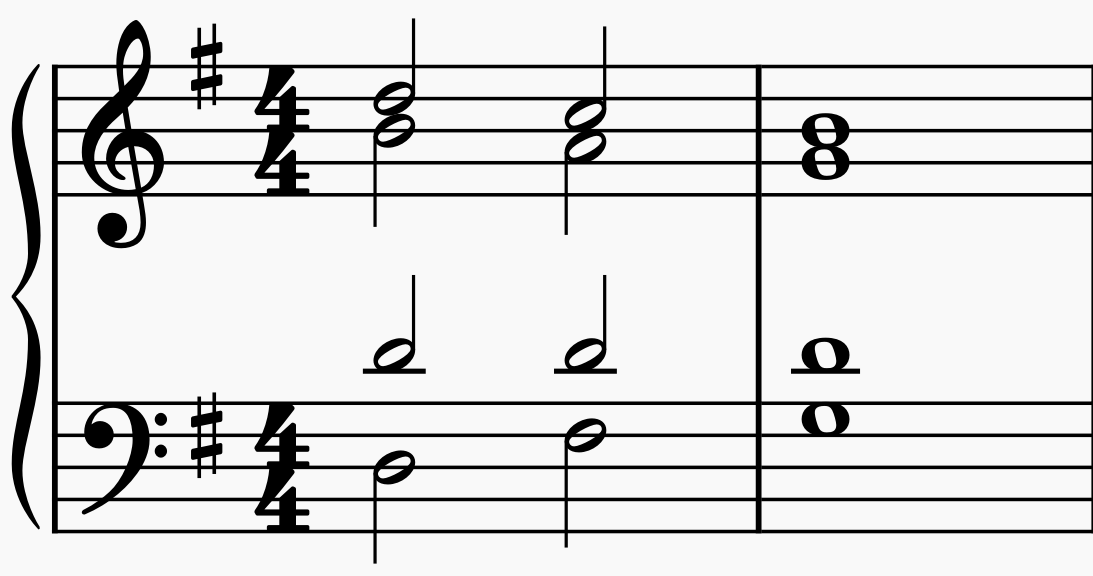
When you write for orchestra, you should consider the role each instrument should play in communicating your ideas. Unusually, much of your writing for the bassoon part is not aligned with the bass (taken by the cello's and violas). For instance from bar 29 the oboes, clarinets and bass are all doubled in such a way that is laden with consecutive octaves and 5ths. This is not good orchestration at all. Woodwind passage from bar 29 (bass clef at the bottom) As a basis, I would encourage you to use the bass parts as a guide for your bassoon writing and which should ideally contrast with the upper voices. Furthermore, the below central motif is uninspired/plain without some rhythmic interest. Perhaps consider adding syncopation between different parts to embed some form of dialogue. My feeling is that if you are not thinking yet in terms of that kind of dialogue, you are not ready for symphonic writing. Stick to chamber music - as I have done for much of my work - until you are comfortable with counterpoint and voice leading before going larger scale, is my suggestion!
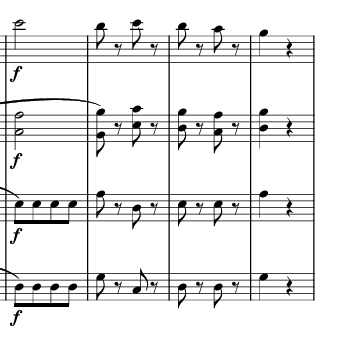
-
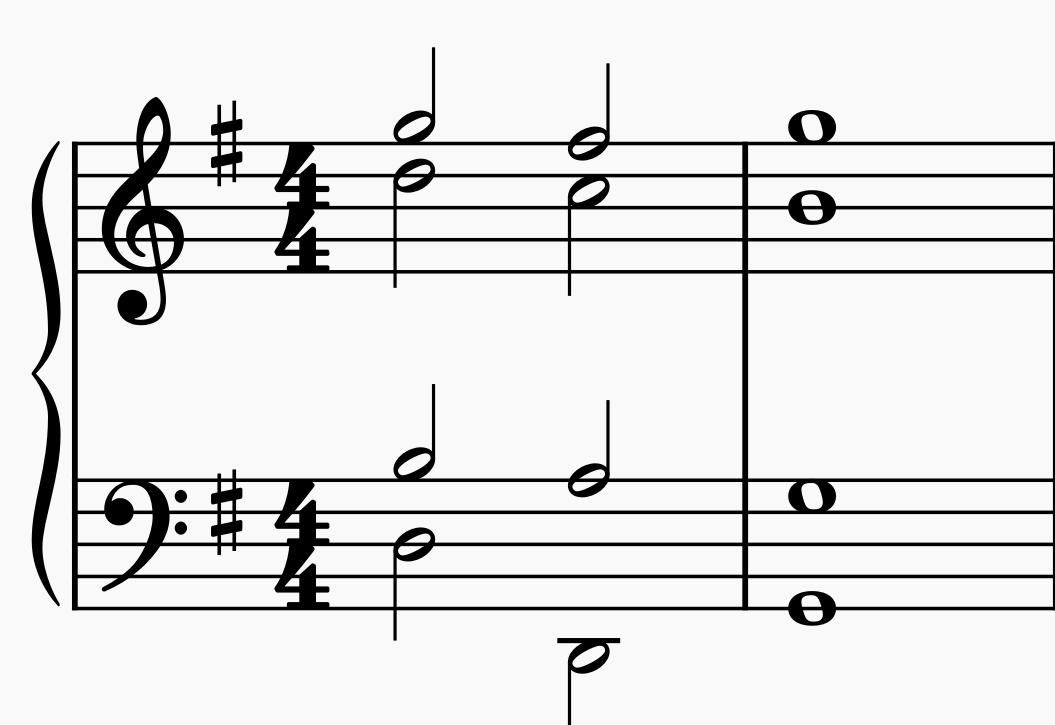
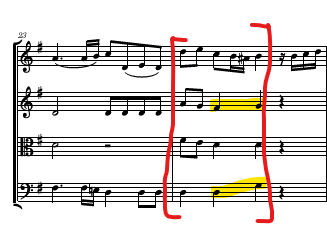
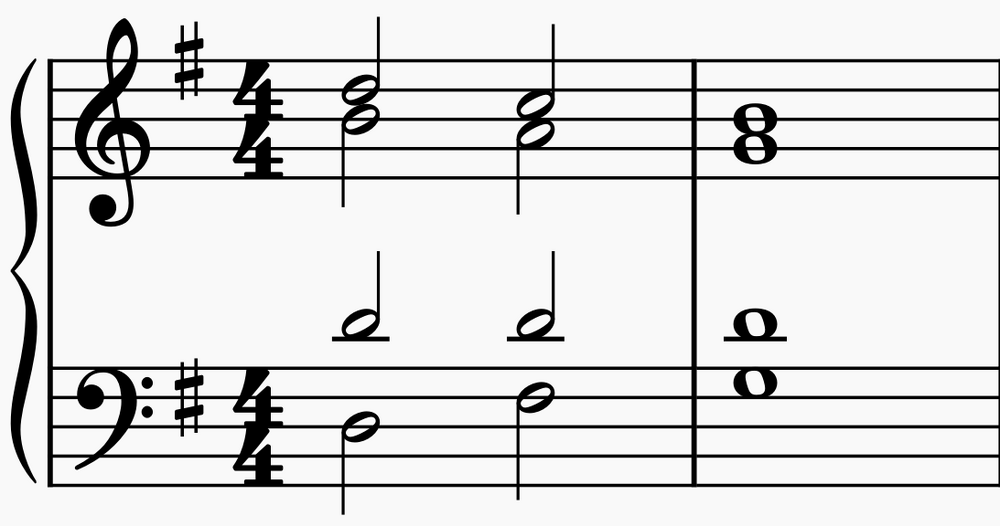
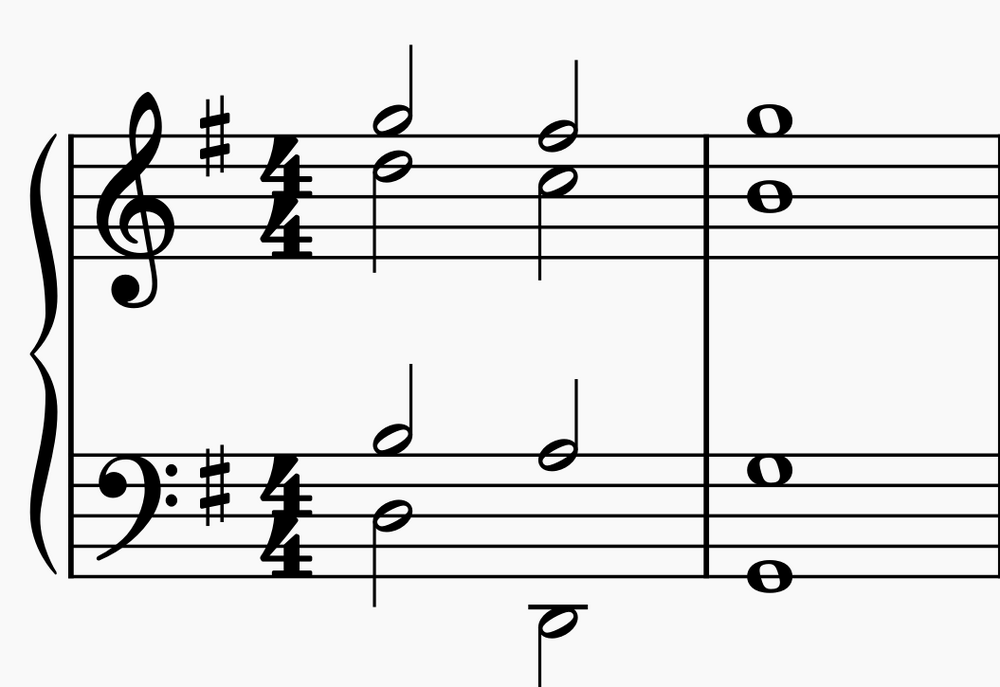
Unsure why this hasn't had much attention yet. There is a lot of music here to unpack after listening. You have some great ideas, particularly during those moments of counterpoint & dialogue between the parts. So, you have my respect! You say it is 'Haydnesque' but I beg to differ. The structure is particularly quirky. You have three movements but within each there are multiple distinct tempo changes with new ideas introduced and some of these new subsections are individually repeated. So the structure does not say "sonata form" to me. However there are some moments where classical oriented ideas dominate that definitely veer the Viennese school. Voice leading is generally good. But some areas could benefit from attention. Lets look at an example: Your choice of progression here is V-V7-I. Usually with a so-fa-mi descent at a cadence I would utilize a Ic-V7-I harmonisation. It isn't incorrect what you have done - it works - but the question I would put forward concerns the added value of choosing a V instead in this context, particularly if the prior measure also contains dominant harmony. In traditional voice leading many of the best solutions depend on optimum harmonic decisions. Against the so-far-mi descent, there is an opportunity for contrary motion in an outer part. Having the F#-G ascent in the bass offers a better contrast arguably than in the inner voice (presently in the alto). In addition, while perhaps defensible, the bass and alto in your realisation both ascend to a perfect consonance (the G). The alto would be better descending in thirds with the soprano (B-A-G) - effectively both in contrary motion with the bass - while the viola maintains oblique motion on the D throughout the progression. This way you also do not omit the 5th of V7 (A) that - while permissible - is preferred if there is a means to include it and does not undermine the underlying ascetics: Omitting the 5th of a chord generally occurs when ascetically optimum. For example, if the upper voice had a 1-7-1 pattern: Disclaimer: In no way am I implying you are "incorrect" in your decisions. I cannot speak on your behalf as composer; but just be aware that where other solutions exist, justifications may become necessary...
-
-
BlackkBeethoven replied to BlackkBeethoven's topic in Incomplete Works; Writer's Block and Suggestionshttps://drive.google.com/file/d/1SGU8fq9dRSEkF3T4KUgSZGHTdR4RvFs_/view?usp=sharing So is that my writing that's bad or my piece just being horrible?
-
This is a piece that I consider to be special. I have spent weeks working on it bit by bit, making one decision after another. It is Prelude No. 10 from Debussy’s Second Book, entitled ‘Canope’. A canope is the vessel in which the remains of mummies were stored in ancient Egypt; these were sealed with small sculptures of Anubis’s head. The piano piece is spectacular, with harmonies that defy all logic within the tonal world. I’m providing the score in concert pitch and in transposed pitch. Canope.mp3 Canope concert pitch.pdf Canope transposed pitch.pdf Link to the piano original version:
-
Ravelian joined the community
-
-
Hi Petr, I did some research, and the reason it wasn't embedded might be due to the link format. Right now, yours might be a link from the YouTube share button, but when I pasted the unsimplified link directly from the address bar, it worked! I didn't know that either, so this was a great learning opportunity for me. It might be worth editing your topic! And please continue with your own composing style. It is so unique and interesting.
.thumb.png.8b5b433a341551e913a34392660bc95b.png)