All Activity
- Past hour
-
.thumb.png.8b5b433a341551e913a34392660bc95b.png) Hello @Sojar Voglar and welcome back to the forum! This piece truly is "always something unique"! It's so mysterious and ebbing with variety although it is very well unified and coherent. I think I caught some of the mistakes in the performance when I followed along with the score - perhaps the flautist didn't quite play their part correctly in the slap-tongue section of the piece? Seems like their line was missing here and there. I love the venue of the Clarinet Quartet having played in one myself in high school. I also have a piece on here - 10 Variations on a Gypsy Theme for Clarinet Quartet. Check it out if you feel like it! But your instrumental combination is so much more creative! It's a great set of colors - Each instrument offers something distinctive to the ensemble. It's wonderful to listen to. You are a bassist, correct? That explains why you included a Contrabass in the piece. I thought maybe a bassoon would have been more appropriate among all the woodwinds. Congratulations and thanks for sharing!
Hello @Sojar Voglar and welcome back to the forum! This piece truly is "always something unique"! It's so mysterious and ebbing with variety although it is very well unified and coherent. I think I caught some of the mistakes in the performance when I followed along with the score - perhaps the flautist didn't quite play their part correctly in the slap-tongue section of the piece? Seems like their line was missing here and there. I love the venue of the Clarinet Quartet having played in one myself in high school. I also have a piece on here - 10 Variations on a Gypsy Theme for Clarinet Quartet. Check it out if you feel like it! But your instrumental combination is so much more creative! It's a great set of colors - Each instrument offers something distinctive to the ensemble. It's wonderful to listen to. You are a bassist, correct? That explains why you included a Contrabass in the piece. I thought maybe a bassoon would have been more appropriate among all the woodwinds. Congratulations and thanks for sharing! -
Mozart-style Sonata in F Major
PeterthePapercomPoser replied to Cafebabe's topic in Piano Music, Solo Keyboard
Hi @Cafebabe! This is a nice classical sonata! The thing that bothers me when listening to this at first is the really bad balance between the melodic right hand and the accompanying left hand. The left hand should be softer and the melody in the right brought out more to be in high relief. Before, the only way to make this happen is to use MS Basic Soundfonts and use velocity values for the right hand. But I don't know if you know about a recent trick I learned in writing piano music in Musescore Studio 4 using the Musesounds Piano. What I do now is I write the piece for two tracks of basically two separate pianos - one for each hand. I go to the layout options and have each piano displayed with only one clef in one staff rather than in a grand staff for both. Then I bracket them as if they're one grand staff but each retains its own individual identity. This way I can give each hand its own dedicated dynamics and volume, reverb and other settings giving me more control over what is the most prominent part of the composition at any given point. I also noticed that you don't have any dynamics in your piece at all. Maybe you didn't find it necessary, and it could be argued, it is more historically accurate if its meant to be played on a period instrument. Musically, I find the retransition back to F major at the end of the exposition a little abrupt and forced. Another thing is that I'd expect each theme in a sonata to have ample time to speak before going into transitional figures. This would usually be done by giving the themes a full period, double period or sentence form which you don't do and it makes the themes seem like they can't stand still and start to flit about try to run away from themselves before the listener has even had a chance to absorb them. Also, when the development section starts, it seems like it's just a chord progression without really any relation to the themes. It makes me question what, if anything, is being developed. Although I had a lot of critiques of this piece, I did find it an overall enjoyable easy listening experience. Thanks for sharing!- 1 reply
-
- 1
-

- Today
-
Composition in four hours without any breaks
PeterthePapercomPoser replied to Bjarke's topic in Orchestral and Large Ensemble
Hi @Bjarke! The piece starts in a soft and dark place giving it lots of room to grow. The trumpet melody at 0:43 is the first instance of a theme in the piece that could be developed. At 1:03 you reiterate the theme in the choir with variation. At 1:33 the thematic exposition is finished and you continue the piece with a sequence of ostinati over low brass accompaniment. At 1:52 you introduce a trumpet fanfare that is then continued in the strings with brass ostinati underneath. At 2:13 you introduce a rising choir and brass melody. At 2:38 you've modulated into a nice string melody. At 2:53 you start an intense passage for strings and brass. There is some relief from this intensity at 3:17 with the staccato brass and string hits. At 3:49 you have an intriguing string ostinato that in my opinion could have started softer to give it more room to crescendo towards the end of the piece. Now to give my more overall impression of the whole piece: I think the piece is exciting and full of energy but it suffers in terms of musical coherence and unity. The trumpet theme at 0:43 is not particularly notable - in terms of melodic construction, it starts off strong and heroic but soon suffers from lack of inner melodic coherence. What I mean is that melodies usually have some kind of self-similarity to give them a hook or a catchiness to the listener. You do actually reiterate the hook of your trumpet melody in your string melody at 2:38 with variation which is a nice way to add some unity to the piece, but none of the other material in the piece seems to be related to the theme which is a shame and why I would say that overall, your piece lacks unity. I would also say that it suffers from too much variety - it's a jumble of mostly unrelated ideas thrown together. And the overall sense of the piece (besides the introduction) is to be hard, fast and loud without very many places where you let up the intensity which isn't very musical. Like at 3:49 where I felt like you really could have drawn the listener in by bringing the dynamics of the whole orchestra way down so as to lead the piece with a big crescendo to the conclusion which would have been more effective imo. Perhaps the reason why the piece resulted to be the way it is is because of what you chose to focus on when you were writing it? It seems like "Composition in four hours without any breaks" was your goal rather than any kind of particular musical goal or inspiration. Music is boring when it's approached in such a way as to look at it only as a way to force oneself to work on something without any breaks. And why wouldn't you take any breaks? Is there any particular reason? That doesn't seem like a significant nor important goal in music. For me, composition usually goes in cycles: if I haven't composed something in a long time, I'll start out with something small to warm up, then I'll move on to progressively more substantial and involved musical projects. Whether I take a break or not is not even something I pay attention to nor aspire to avoid. Just saying: you might want to rethink what's important to you in music or what your musical values are because it seems to me like you're not focusing on the right thing. But everyone is different and you might not agree - if not, by all means continue writing the way you do and know how! Thanks for sharing.- 1 reply
-
- 1
-
-
Any feedback is largely apprciated. Thanks.
-
 AngelCityOutlaw changed their profile photo
 - Yesterday
-
I have a question about dictation. I’d like the melody that appears 25 seconds in (measure 17) to have a more “jumpy” rhythm. This is the audio of how I want it to sound. Basically some parts (like measure 19) are little quicker and come in a little earlier. Is there a way I can write this in the sheet music? Any help is appreciated.
-

Persichetti Exercise 7 - 51 for Piano
chopin replied to PeterthePapercomPoser's topic in Piano Music, Solo Keyboard
The polychords are starting to make the music sound much more adventurous, and perhaps more like Ravel. I feel like there's a lot more opportunity with this style of music. Great job, sounds awesome!- 1 reply
-
- 1
-
-
Persichetti Exercise 7 - 50 for Woodwind Sextet
chopin replied to PeterthePapercomPoser's topic in Chamber Music
I like it, sounds like music from an old film. Fun nuances around the instrumentation (the staccato and rhythms).- 1 reply
-
- 1
-
-
Here's another small invention. More quiet than the 1st one. It's an adagio! Mostly done in 2020, but updated in 2026.
-

2-part invention in counterpoint
Frederic Gill replied to Frederic Gill's topic in Piano Music, Solo Keyboard
Thanks. Yes the colours in the pdf help working and recognizing the motives. I've put it in b&W (below) 😉. After over 1600 small exercises in melody, harmony and counterpoint (all with 6 Goetschius books) + 25 invention, I don't know what 'level' I am at. I've never had feedback until now! -
 Obviously the censor nowadays is much stricter than before lol
 -
Thanks! @Luis Hernández
-
 I saw the viola in the bass clef thing; just a Noteflight glitch, it likes to change things! It was on a measure rest so didn't make a difference in the sound, but of course I corrected it!
 -
Also listen to this one the whole way through. How did this get passed the censors lol
-

2-part invention in counterpoint
Luis Hernández replied to Frederic Gill's topic in Piano Music, Solo Keyboard
Sounds good. The 13th bar is strange, but I see you've made a correction. I think there's some pretty good imitative treatment, characteristic of the Inventions. So many colours confuse me a bit. I suppose they highlight imitations or motifs, but as I'm colour blind, I can't tell. Best regards.- 4 replies
-
- 1
-
-
- invention
- counterpoint
- (and 1 more)
-
Nice text.
-
Persichetti Exercise 7 - 47 for Brass Sextet
Luis Hernández replied to PeterthePapercomPoser's topic in Chamber Music
That sounds great. I love this series you're doing on Persichetti's proposals. Organised, it would be a fantastic resource for anyone studying the book.- 1 reply
-
- 1
-
-
Thank you for showing me a path. I’m very inspired with your ideology “start with what you’ve,” I’ve an electric guitar and a macbook. I’ve done my research and I have found that I can use the garageband to record my guitar and do my experiments with it. Now, I’m researching how I can take full advantage of garageband. I’ve watched a lot of YouTube tutorials on it. And yes this is a good idea to start with children's songs or folk music. God Bless You 🙂 Thank you for guiding me
-
 A lot of voice leading things that are weird. Very postmodern sounding to. I somewhat appreciate the dissonance. OK, I like the change to pace. I appreciate the different folk aspects of this piece. And I definitely like that electric guitar cadenza. A mixing issue with the winds burying the main theme. We are back at measure 59 with the folk melody There may be some difficulty at 83 and before that with the double tongue in the brass. I also like how some of the other instruments double the guitar with the runs. Why is the viola in the bass clef. I like the rhythmic interpretation and variation around 111. I enjoy the guitar solo and also the irregular variation with the rhythm although that the playback may not support this make sure you write some slurring around. At 179 a previous theme returns. Along with the folk melody running after that. Some of the guitar material had returned. And I like the end. Good job and I appreciate the amazing structure and the cool material that you have given throughout the first Movement
 -
Reach the Highest Rank "Transcendent" on 31st January, 2026, after joining the forum for 3 years and 9 months.
-
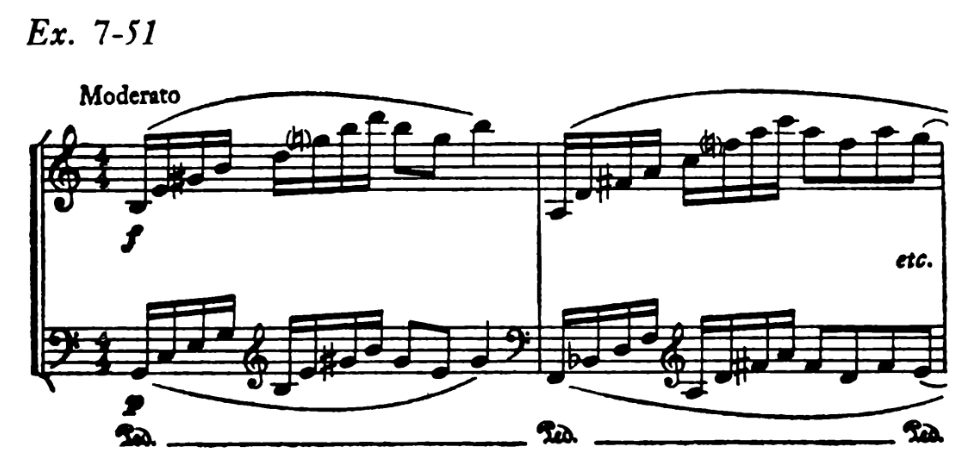
The prompt for this polychordal Persichetti produced piano piece was "6. Extend the passage of broken polychords (three units) for piano." Thanks for listening and I'd appreciate any of your comments!
-
Favorite Musical Book Quotes?
PeterthePapercomPoser replied to PeterthePapercomPoser's topic in Composers' Headquarters
I come to you with yet another quote from Gary Lachman's "Beyond the Robot: The Life and Work of Colin Wilson". There is a pertinent insight about creative artists at the end of the quote in this chapter which has to do with peak experiences. Go forth and dominate the world with your creative "originative intellectual work"! -
Greetings, Space Cowboy! "Neo-Tokyo," describes the, Hayabusa Feather, coming home after gathering, Asteroid. As the space vessel operates, large asteroids clash in the background. I think there are at least 7 fugues represented in the piece. Some from, "Seraphim," some from Symphony No.2, two more on general texture, 1 final in the background, constant. Feel free to make 'stamps,' or short samples, to use for your work. If you wait until the fugue ends, make a sample, you have a 1 minute sample. 30 seconds of that could be used for anime, AI, or entertaining yourself. Complexity Magnitude, is the most complex fugue I could come up with, and it ended up surprisingly simple. Easily underestimated, easily understood, I wrote a tutorial: Atonal Fugue Writing Tutorial Other than that, feel free to alliterate from your favorite media - and keep the good times rolling. Splendid night, Space Cowboy! Complexity Magnitude_Harper.mid
- Last week
-
I want the melody around 25 seconds in to the piece to have a more “jumpy” rhythm, that sounds like the audio recording below. Not sure what exactly is happening tempo wise. Any help is appreciated.

.thumb.jpg.a1bd070fa88caa1c83527ffe77c97a41.jpg)