All Activity
- Past hour
-
Over the last month, I have challenged myself to compose every day, and the following 10 pieces are the result. It's been quite a challenge and I need a bit of rest after this, but I'm proud of the amount of work I was able to put into composition this month. YouTube link Score I hope you find some joy in them!
- Today
-
I made multiple little tweaks and improvements today (at least I think they're improvements?) Frank Bridge - The Dew Fairy #31.mp3 Frank Bridge - The Dew Fairy #31.pdf
-
Thanks Kyle, I'm so glad you enjoy the piece, as I don't think it's very well known. The tuplets are crazy; but I was just reflecting what was in the original score. Bridge writes them as reduced size notes, rather like Chopin's flourishes; but this was the only way I could think to translate them into midi. One thing I'd like to fix is the tenuto accents in the harp part, as they're too strong at the moment. Will have to see if I can tweak the properties. Anyway, many thanks for listening and commenting. Alex
-
Thanks! I actually hadn't heard of him until a fortnight ago, when You Tube recommended this piece to me. Perhaps it's time for a Bridge revival?
-
Vadim joined the community
-
I wrote this yesterday in time I should have allocated to study for University, but alas this had to be born. The name is because it reminds me a little bit of Ravel, though perhaps it is closer to his student Vaughan Williams. The main themes are presented at the beginning and then each subsequently orchestrated on their own. There are some interludes for the brass and the final two darker sections are connected only motivically to the rest, though there is a deep harmonic relationship between those last two. It is not intended for real performance, I think the sound is clear enough and the work short enough to not need a score to follow (my excuse to not clean it up haha). https://youtu.be/zKFozjlhlJI?si=1WDGgZvzNyXdK_cu
-
I must confess I'm not a fan of Bridge. I know he got more intriguing as he aged, which I find attractive. I really like this arrangement!
-
@D.V.Vanin, my friend... May I ask you, how do you go about "writing" your music? Do you notate it? Do you improvise a motif then improvise the rest after you've settled on that motif? I'm hearing so much repetition, far too many Parallel 5ths, and what you have here is quite formless... As in; there are no distinct sections that I can follow the music through to the end. Music that will appeal to people, whether musically inclined or not, has structure, attention to detail, enjoyable harmonic ideas, and a motif that's recognizable as a "home" sound that the music returns to. To help simplify, I could use the basic pop music structure without going into Music Theory terminology... Most pop songs are written; (Verse) - (Verse) - (*Chorus*(The motif)) - (Verse) - (Verse) - (Chorus) - (*Bridge*(Something new and interesting)) - (Chorus(Make it back to the "home" motif)) - (Outro (Usually a variation of the chorus)). I can't distinctly make out anything even similar to this with the audio you've provided. It has something of a medieval / neo-classical hybrid kind of theme, with no structure, and no recognizable / memorable sound, making the music all around very flat, dull, and unnoteworthy. I mean no malice when saying this. My intent is to help you see what you are doing that may be hindering your musical output, and where to focus in order to make your work that much better. I'd urge you to read a book I've recently acquired that may help you with this, called "The Science of Music" by Allen Van Wert. (Amazon link to purchase the paperback copy, if you'd like.) It's quite capable of explaining many of the basic concepts of music theory in a digestible way for beginners, those with learning disabilities, and those with trouble understanding the concepts. It includes exercises as well within the book itself. It's not all intensive, and enitrely comprehensive to everything you need to know, but it can help provide you with a good start... I encourage you to never leave this interest of yours behind, and simply begin to make attempts to grasp the important concepts of what makes great musical output, so that we all may enjoy what you come up with, armed with the proper knowledge. :) -Unc
-
I've just seen this come across my feed, tonight. Sorry I didn't see it sooner, @D.V.Vanin. After skimming through your works posted here, I'd like to make a suggestion... Before writing a melody, or making an attempt at one even, why not try to establish a key & a mode that you'd like to use for it first? Then establish a chord progression, and then create a melodic line to drive it forward... What you have written here feels more randomized, atonal, and unorthodox, if I'm being brutally honest. I'd enjoy to hear what you come up with, having made those procedural changes. Keep trying and keep practicing! -Unc
-
Not a harpist, so I couldn't speak to the playability of this piece, however, just judging off of the difficulty in the reading of this alone, I would wager to say that it would be either extremely difficult to perform, and would likely be reserved for only the best of the best harpists 😅 as far as your question regarding string harmonies, I feel that it was done very well. it blends well, and it very much so fits the description that your title suggests. Very ethereal, whimsical, magical etc... I was also gonna comment on the fact that you had a pppp for piccolo while they were playing in the high register, which would be physically impossible, but as I thought that it was likely just for the playback, your description of it affirmed that suspicion lol so I'll leave that one be. Though, I do wonder if this could be more legible if written in a different time signature? 🤔 Right this second, I haven't taken the liberty to subdivide what you have here, to suggest a specific time signature, however, I say this because the 11-lets & 15-lets, without having some sort of a split-beam, at least to me, become difficult to follow, and appear unsightly, but that's simply my own opinion on the appearance and readability of the score itself. The work itself is phenomenal! I'm simply unsure of how it would be best written to allow for the clearest interpretation while reading. Thanks for sharing, and apologies on my lack of suggestions for alternatives :/ at the time I've decided to login, my brain is just not at its peak performance, as I've just made it back home from a repair job and it's currently 12:32am my time 😅
-
Hello everyone, I'm back, this is my new piece in Japanese style, hope you like it. the video: https://www.bilibili.com/video/BV1c3EQ6aE9k/?vd_source=95e0ca6d098d75738c935e50eaa3ac41 Op.8 Nr.2.mp3
-
I can play that song fairly well on Electric, fretless bass, but can't handle those constant high G Sharps vocally, without a microphone, at least! 🤣
-
The Doobie Brothers - Listen To The Music (Live in Isolation)
-
Hi to all. I've now completed my orchestration of all three movements of "The Hour Glass" (originally for piano solo). This second movement was the hardest of all to orchestrate: so any tips on how to make it better would be very welcome! I found it especially difficult to create suitable harmonies for a string bed to go underneath the intricate arpeggios in the harp. Not sure I've done it very well. Also, some of the chromaticism in the harp part may be unplayable, because of the pedals? Haven't got around to adding slurs and phrasing yet, and as usual, my dynamics are designed for midi only. (N.B. Updated versions will be posted lower down the thread.) Frank Bridge - The Dew Fairy #28.mp3 Frank Bridge - The Dew Fairy #28.pdf
-
Hello, glad to be here. I love listening to music. However, since I couldn't attend a music university or take lessons and didn't try to learn by myself, I couldn't learn music notation. Now, I feel how important it is to learn notation. Therefore, I want to ask how I can learn music notation. I want to learn it on my own while occasionally asking for help on this forum. First, I want to start with free resources, but my search returned too many websites and YouTube channels, leaving me totally confused about which one to choose. If you have some time, I would be so happy to receive your advice about how I can start to learn it and how to go to the next step. By the way, I would like to say that you all compose such good music. My hat is always off to you. Thank you. Best, Lithl.
- Yesterday
-
In this sonata, the right hand is usually Jackie, and the left hand is usually me...I think it is a good piano sonata. It is not profound, but heartfelt.
-
Hello, friends. About three years ago, I penned this song cycle for a friend from El Salvador, based on poems by the beloved Salvadoran poet, Alfredo Espino. These hold a special place in my heart because they're the last music I've ever written, though they were sadly never performed. The songs and directions are completely in Spanish. Here they've been rendered by Cantamus (unfortunately sung in a Castilian accent and not the Latin American accent spoken in El Salvador) and the piano accompaniment has been [poorly] played by me. They're not the best recordings and some of the lyrics didn't render properly, but hopefully they deliver the music effectively. The cycle is chiasmic in structure (i.e., the first and last movements and the second and fourth movements mirror each other) and it tells the story of a day in El Salvador. I. Madrugada: This means early morning. The lyrics and music represent the waking of the Salvadoran countryside: farmers starting their day, roosters crowing, birds chirping. It begins mysteriously but soon "warms up," preparing us for the rest of the song cycle. II. Plombagina: The title is about a tiny flower found along the riverbanks in El Salvador; here it represents the playfulness of the river and the hopefulness of midmorning. This one is unmistakably waltzlike and lyrical. III. Tardecitas: "Little afternoons" is a piece about watching the rainfall in the heat of the day. It's lazy and less ambitious than the others in the cycle, representing the languor of a dreary, rainy day. IV. Estrella in el río: We return once more to a song about the river, this time in a more contemplative frame of mind. "Star in the river" is shimmering and reflective, capturing the tranquility of twilight as the stars begin to pinprick the sky and cast their reflections into the river below. V. Nocturno: While "Madrugada" expresses the joys of a new morning, "Nocturno" explores the angst found at the close of the day. It's by far the most restless of the cycle, employing a sort of perverted tango rhythm in mockery of the soothing sway of a nocturne. In it, you'll find themes of grief and fear and anxiety, embedded in harmonies very reminiscent of Spain/Latin America. Even if you don't understand Spanish, I hope these songs move you and perhaps inspire you. As ever, I'm happy to receive any feedback you may have. Best, Jordan Canciones de El Salvador.pdf I. Madrugada.mp3 II. Plombagina.mp3 III. Tardecitas.mp3 IV. Estrella en el río.mp3 V. Nocturno.mp3
-
HudsonD joined the community
-
Hey, these seem very nice! I will check them out. Already "liked" them, I can just tell from glancing at a few of them...Yes, I'm worried about my best friend Jackie, wheezing/breathing problems, but she is probably ok; needs her Albuterol/Ventolin inhaler. I'll probably get some beer to help calm my nerves and listen; after all, my own music sounds better to me after a couple beers!😆(I sure don't want to hear my sonata again unless I know she's OK, it's about her! I had to listen so many times to edit, anyway, seeing that I can't even play piano.)
-
Endless recitative? Like in Mozart's last opera "The Clemency of Titus?" 🤣Very naughty to pick on Mozart's more hurried and inferior, for him, works...
-
Complaint of the poor young man; I really like your manuscript calligraphy! I know I listened to this, I could always listen again.
-
Keats? I would NEVER set his little epitaph "This Living Hand;" very creepy, seeing as he died very young from Tuberculosis...or Gerard Manley Hopkins' "Terrible Sonnets:" they are quite terrible indeed, even though he is my favorite poet. (Hopkins suffered from awful digestive symptoms, very much like Beethoven. I think I shall refrain from discussing THAT right now.)
-
THIS is still at the top of the page? I think it is a decent setting. Maybe I should write more English Poetry settings. I could certainly set German, do some Lieder...not fluent in the Sprache, just working on basic conversational German, so I would have to analyze a German poem first before I could set it.
-
Anyway, I dashed off this muck in two hours!🤣I guess it's not horrible for two hours. I am a pretty fast composer, but I need more than two hours!
-
-
Piece isn't great, at the time I thought it was for the fellow's dead grandmother, not sure the dying grandmother story was true now, though...☹️However, Kyrylo WAS a very intelligent, nice young man of 22. He could even make out Middle English and thought it was really cool, General Prologue of Chaucer's Canterbury Tales, helped me with the few, three dozen or so Russian words I know! He didn't even ask for that much money, but I can't, and wouldn't have, given it to him. I can't come up with $900 ready cash! I just have my retirement account, and I sure as hell don't want to cash that out early and pay all those taxes! Loved my guitar Symphony-Concerto, and was shocked when I told him how long it takes to write something like that, 4-6 months...🫢Malenkey Malchik was quite impressed...
-
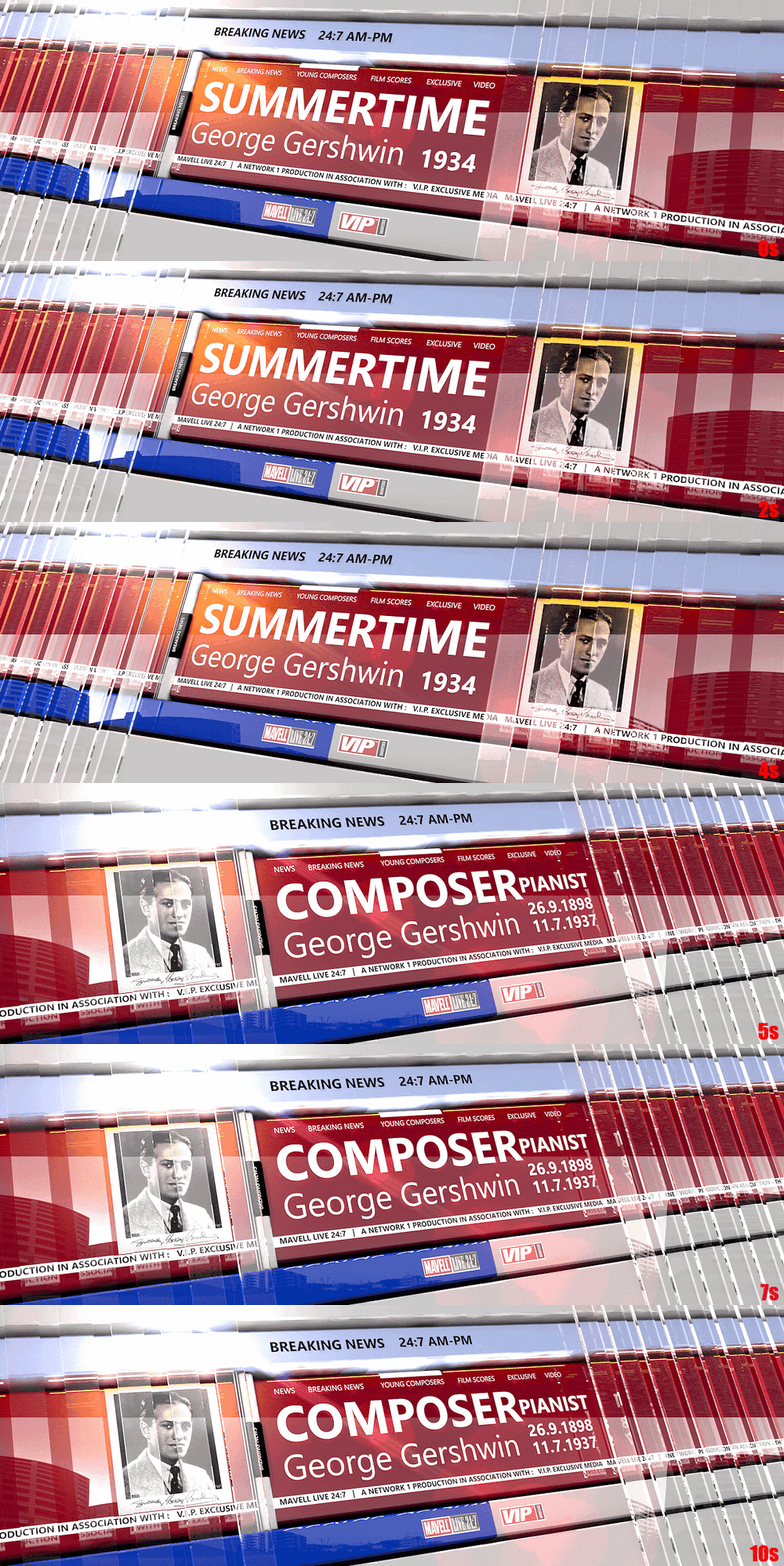
🌞 𝑺𝒖𝒎𝒎𝒆𝒓 𝑺𝒖𝒏𝒔𝒆𝒕 𝑾𝒂𝒍𝒕𝒛 - 𝒃𝒚 𝑴𝒂𝒗𝒆𝒍𝒍© | + SUMMERTIME 1934 by George Gershwin - Rendition Summer Sunset Waltz - by Mavell.mp3 Summer Sunset Waltz - by Mavell.pdf Summer Sunset Waltz - by Mavell.mid SUMMERTIME 1934 by George Gershwin - Rendition.mp3 SUMMERTIME 1934 by George Gershwin - Rendition.mid SUMMERTIME 1934 by George Gershwin - Rendition.pdf