All Activity
- Past hour
-
Thank you for sharing this wonderful Prelude-and-Fugue piece. Since I also compose preludes and fugues, I am very excited and interested in reviewing such a pair. And indeed, I really enjoyed it and have now a few thoughts or comments which are not to be considered as „criticism“, but rather intended as an advice or idea how this beautiful piece could be improved further and finally made „great“: When listening to the prelude for the first time, I clearly recognized the Baroque style of a French overture with its double dots and 32nd runs, but there were something stylistic that differed from a typical Baroque and counterpuntual piece. Now, after listening multiple times and with the help of the other comments, I figured out that this is due to the repetition of measures 1-14 in bars 15-27, which means that up to this point there is no real modulation away from the tonic G minor. There is nothing wrong with it, but I would agree with the suggestions of @muchen_ and @Willibald to possibly change something concerning the modulation and recurrection of the material, also with respect that usually the prelude is not longer than its fugue. The fugue subject is very memorable and expressive, I especially love the „wedge-like“ ending in mm. 68, which, in my opinion, implies that the theme should not end with the first eighth note in bar 68, but should extend over the entire four bars. In the comes in bar 72, you have already quoted the “wedge,” even though this bar is a variation of the original, while in the third entry in bar 76, the “wedge” is completely lost, which I regret. In measures 80-85, 87-95, and 96-103, you have created three (or even four) sections with sequences based on different contrapuntal material—for example, quotations or parts of the theme—which would be perfect as interludes or episodes between further development (or exposition) sections of the fugue theme. And that is exactly what I would like to see: at least two further developments of the excellent fugue subject. I also could imagine a coda with a pedal point and perhaps a recurrection of the 32nd notes texture from the prelude as ending climax! With this in mind – to shorten the prelude and to extend or „complete“ the fugue – your piece could become a marvellous pair – Prelude and Fugue in G minor!
- Today
-
Daybliss.mid Daybliss.mid
-
Heyo! This came to me immediately when I saw the Marian Grotto when I was back at my Catholic college. Could you please let me know especially if the piano part could use any work, or if you think there’s a musically fitting way to reduce the range of the song? Also, is it ever too simple/boring/slow? The first video is of the whole arrangement, and the second has strings backing the melody so you can hear what it’s meant to sound like especially in the low range. Ave Maria Full https://youtu.be/Ei65cgc0m68 Ave Maria w/ Strings https://youtu.be/Z0t9bLS4dJA
-
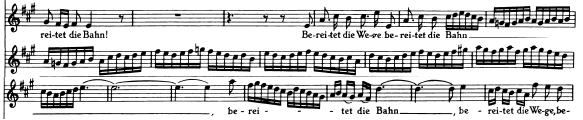
I forgot to add this last time, but I thought of this (infamous) aria when the breathing problem was mentioned. In addition, for historical reasons, this cantata is usually transposed up a semitone as opposed to down. Just look at the tessitura of this melisma! Bach must've really hated the poor soprano who had to sing this...
-
 Happy New Year to all! For my first post of 2026, here's my orchestration of Medelssohn's Barcarolle from Songs Without Words. It's more or less done; though I may add more dynamics to match the original piano work, and need to add more slurs. Current dynamics are intended for midi playback: so I will be adjusting those for real life performance. Haven't decided where to mark a2 and solo in the winds: so any tips on that would be really helpful.
-
- 1
-

-
 Still need you guys’ and gals’ opinion! Henry
 -
A short Sonata in D Major for Cembalo
Henry Ng Tsz Kiu replied to Willibald's topic in Piano Music, Solo Keyboard
Hi @Willibald! I just check out the 4th movement and it’s a lively nice rondo, I like your B minor episode inviting some contrast. Thx for your update! Henry -
Prelude & Fugue in G Minor
Henry Ng Tsz Kiu replied to Cafebabe's topic in Piano Music, Solo Keyboard
Hi @Cafebabe, I like the recurring March like turn figure in your prelude, it reminds of the D major fugue in WTC I. For the fugue, nice Dido and Aeneas like subject. If you are writing in Baroque style, usually the 3rd entry of the subject (in b.73) will be in tonic G minor instead of dominant D minor. I agree with @Willibald that there can be more appearances of the fugue subject, and to me especially there should be more appearances of the subject in the tonic G minor! Good counterpoint throughout though. Thx for sharing! Henry -
Sonata for Piano and Alto Saxophone
Henry Ng Tsz Kiu replied to mercurypickles's topic in Chamber Music
Hi @mercurypickles! For the first movement even without reading your description (I haven’t) it sounds so Brahmsian with the 2 against 3 and the Brahmsian Scherzo section, as well as the thick and more contrapuntal texture. It can well be a Clarinet Sonata if the saxophone is played with a Clarinet! (I’m thinking of Brahms’s 2 late Clarinet sonatas.) I really like the Scherzo sections with its energy. For the 2nd movement again both Schumannesque and Brahmsian, and b.28 even reminds me of Chopin’s Polonaise Fantasy where he has a similar figuration. The 3rd movement is exciting and I love the complex rhythm as you say the most. For me both fugues are more rhythmic than contrapuntal because there’s at a least a voice playing the ostinato instead of individual voices, but that doesn’t undermine it given how complex the rhythm is! Thx for sharing! Henry- 1 reply
-
- 1
-
-
Hi @Kvothe! The waltz is fine and I think you can add a contrasting section to it, probably in a major key or something. Also the false relation in b.12 sounds a bit harsh in this context to me. Thx for sharing! Henry
-
Thanks for sharing this prelude and fugue, both of them a joy to listen to. The beginning of the prelude is especially very charming. However, the passage in m. 12 and 13 (and similar ones) with those notes of different length tied to semidemiquavers in both hands running in parallel seems difficult to play, especially to get the timing right, but I am a rather bad pianist. After the cadence in m. 14/15, the verbatim repetition in m. 15-27 is not that unusual, but would have been easier to notate with a repeat sign. The following passage brings finally the modulation everyone is waiting for (you could try and modulate already in the first part of the prelude; it increases momentum as the prelude then has to find a way back) 😉 , and with it some harsh harmonies which you handle tastefully. At the end, for a short moment it sounds like the opening phrase would come back in d minor, but in a clever move, we are disappointed; the return of g minor is, however, a bit too surprising for my taste; a e.g. "motivo di cadenza" or a similar adapted cadence could be used to flesh this more out. The fugue has a good and versatile subject and I just identified three full instances of the subject (m. 65, m. 69, m. 73) and two partial ones (m. 77, m. 93); it would have been nice to have fewer instances of the sequences and more instances of the subject. But of course this is a well composed fugue, so this is more a matter of one's preferences.
-

Poll concerning AI sub-forum
PCC replied to PeterthePapercomPoser's topic in Announcements and Technical Problems
Good if we can cite sources meanwhile, as an amateur accompanist, I must allow audio deviations from the score such as improvisations and cadenzas though, illogical deviations should be regarded as suspicious -
.thumb.png.8b5b433a341551e913a34392660bc95b.png) Google says that some Alto Flutes have a B foot joint allowing them to reach that low concert F# but it's not standard. Edit: Perhaps a Bass Flute could be used if the G major one were sought after. Or you could transpose it up an octave.
Google says that some Alto Flutes have a B foot joint allowing them to reach that low concert F# but it's not standard. Edit: Perhaps a Bass Flute could be used if the G major one were sought after. Or you could transpose it up an octave. -
Just Google "mp3 converter" and pick the appropriate site that will convert your file type to an mp3. Just don't click "allow" if it asks you because many of those websites are spammy.
-
 I realize I'm quite late to the party on this piece, but I wrote up a running log of my thoughts as I listened to this. Henry, this is the best piece I've come across on this forum. First of all, kudos to you for taking on a piece like Mahler's Eighth for formal inspiration - I've attempted such a thing myself and have nothing to show for it. The first movement's unification of pentatonic and chromatic harmony is quite unusual in sound, it strikes me as being somewhat similar to Dvorak's "Wagnerian" period - around the time of his third string quartet's composition. Anyway, there are many striking aspects to this movement; one thing I can't help but notice is your use of recurring textures. Even when motivic material itself may not recur necessarily, the settings that those motives were heard in are recast and developed in increasingly colourful ways so the whole thing hangs together anyway. The pizzicato passage at about 8:00 is one such example. That said, I would be curious to see the result of potentially stripping back just some of the figuration around the end of the first movement - I wonder if it might help clarify the polyphony in the final triple fugue. It is very beautiful as written though! Okay, second mvoement: This introduction is suitably mysterious, and at the Agitato the music takes on a nicely turbulent affect. The counterpoint here is quite rich, and I almost wonder if perhaps a little more time could've been taken before the lines came into full effect. I wonder, have you listened to the 0th and 2nd string quartets by Arnold Schoenberg? You may find some interesting common ground with him. As you noted, the passage beginning at 23:38 is extremely special, I can hear the intensity of the feeling behind it quite clearly. You communicate your thoughts very well in this piece - it is perfectly followable from beginning to end and never wastes a moment. One final thought, have you considered orchestrating this? I think some of my little things about the density of the texture could be greatly improved with a little more breathing room in the ensemble. Not to mention it would bring out many of the fabulous colours of the piece in even more vivid detail. In short, thank you, Henry, for sharing this with us. This is a wonderful work that deserves to be performed. I would like to also thank you for all of the feedback you have offered on my music over the last few years - you've been a real voice of encouragement. (P.S. I see you also cited David Goza as an important influence in your initial post, his videos have been massively helpful to me as well!)
 -
Hi @Crescent Roulade! Just a personal preference but I will put it in Db major for a calmer atmosphere. One thing to consider is that, if you really want to use flute as the solo instrument, the G major one contains notes lower than the middle C and won't be playable by the flute (not even an alto flute with the F#3). Henry
- Yesterday
-
I’m struggling to upload files, since it won’t accept video files or the converted audio I made using my iPhone. If you have any suggestions, I would appreciate them
-
Yeah, definitely include a key/legend of the extended techniques you use in the piece as is common for pieces that use extended techniques. I personally have never tried to play microtones nor multiphonics on Clarinet so I would definitely need an explanation on how to achieve the necessary sounds.
-
That's covered by the "Musicologist" badge. Google: "Musicology is the scholarly study of music, exploring its history, cultural contexts, theory, and social impact, encompassing all musical traditions from classical to popular music, beyond just performance. It uses various methods, including analysis, history, and anthropology, to understand how music functions in life, its development over time, and its relationship with psychology, sociology, and other fields. Traditionally divided into historical, systematic, and ethnomusicology, modern musicology is broad and interdisciplinary, focusing on meaning, practices, and the "web of culture" surrounding music."
-

Poll concerning AI sub-forum
Kvothe replied to PeterthePapercomPoser's topic in Announcements and Technical Problems
@TristanTheTristan I can help you -
 I don't know how to download and input these files here.
 -
Award to someone who has written multiple long essays on a piece of music by someone else.
-
How would this be related to music? Seems like an award for anybody who might write an essay about any topic. But there are already existing awards for "Musicologist" or "Ardent Reviewer" or "Theory Buff" or "Musical Debator" or "Programmatic Composer" or "Musical Advisor" and those awards have specific musical cases in which they apply.
-
Poll concerning AI sub-forum
Kvothe replied to PeterthePapercomPoser's topic in Announcements and Technical Problems
Correct! Let us say YC hosted a formal competition, entries have to meet the core requirements before proceeding further. If They fail to meet that, they won't proceed. Formal competitions usually require a score with a audio file. Last time I check, Suno does not cut it. It would be rejected. As I have said multiple times, no one in the industry uses Suno. -
 Hello! I was working on a movement and I wanted to go for a lake-theme so I was wondering whether C or G Major sounded better for this. I also provided scores for each major key.