Leaderboard
-
Henry Ng Tsz Kiu
Moderators4Points3,143Posts -
Omicronrg9
Moderators3Points595Posts -
jawoodruff
Old Members3Points4,233Posts -
Luis Hernández
Members2Points3,401Posts



Popular Content
Showing content with the highest reputation on 12/30/2022 in Posts
-
1 pointHello everyone, here is 2 little duos i composed the last few days for piano and clarinette for christmas. It is supposed to reflect the early romantic-style and was composed in honour of my favourite composer: Mendelssohn. Indeed, the lenght, form and general spirit is heavily inspired of the famous lieder ohne worte. Writing in Mendelssohn style was a good and fun exercise. Any remark/review is welcomed. 🙂1 point
-
1 point
-
1 pointAfter a long hiatus, I started writing a little piano sonata as a gift for a dear friend. The piece is partly modeled after some sonatas Haydn wrote in his early years, presumable for his students. I wanted to write something that I can play myself with my rather limited skills, so it's not too complicated. Still, the attached MP3s are computer-generated. Also, I have yet to add the dynamics I use to the score. All three movements have a rising triad as characteristic motive, the slow second movement in a more drawn-out fort than the other ones. The Adagio features a strong walking bass line which is rather atypical for the overall style, but gives the movement a strong momentum. The Menuetto is rather simple to increase the contrast with the Trio that features suspensions etc., and should provide a joyous end.1 point
-
1 pointSeasons greetings everyone! Here's a very simple piece I improvised on electric piano. One person I played it to, said the melody sounds too hopeful to be a lament. Maybe he's right; though for me it feels quite melancholy and poignant. N.B. Two modified versions of the piece are posted lower down the thread.1 point
-
1 pointQuality music here. I love how it sounds. Near 1:15 some woodwinds (if I'm not mistaken) add some underlying rhythmic material that despite not being repeated ever again, fits with the rest of the piece. In fact, this is my favourite chunk... Though the ending is EPIC. Kind regards, Daniel–Ømicrón.1 point
-
1 pointNice improvisation Alex, though I'm not a fan of the timbre, it's too metallic in some parts. Also I more or less agree with @Henry Ng Tsz Kiuand your friend. I don't find it hopeful though. It's in the very rich scale of grey between those. But at the end of the day, it's your perception of the piece what counts for its title in this case. Kind regards and happy holidays too, Daniel–Ømicrón.1 point
-
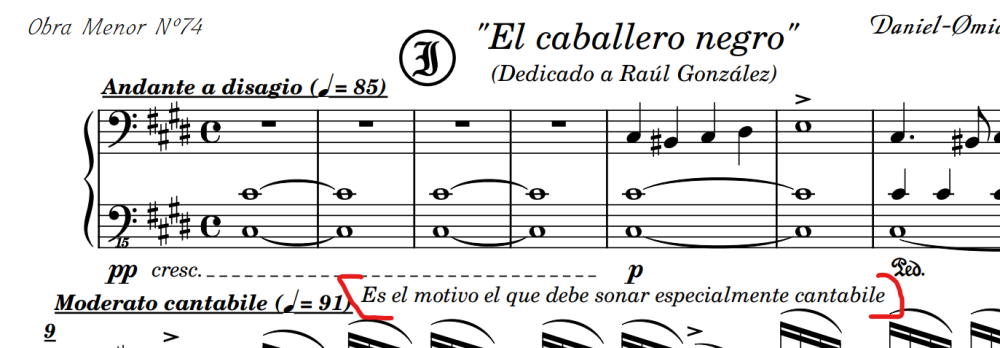
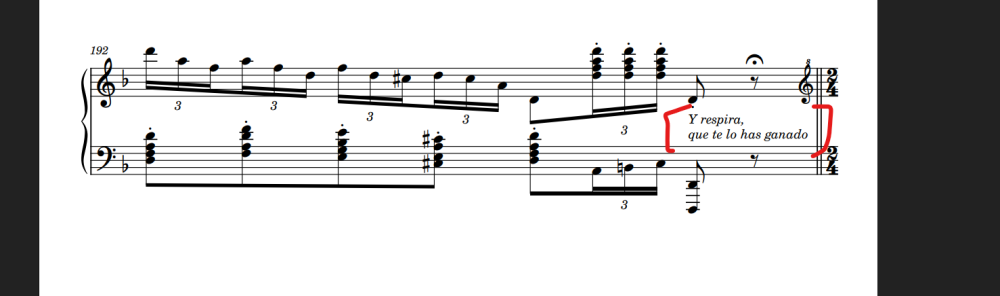
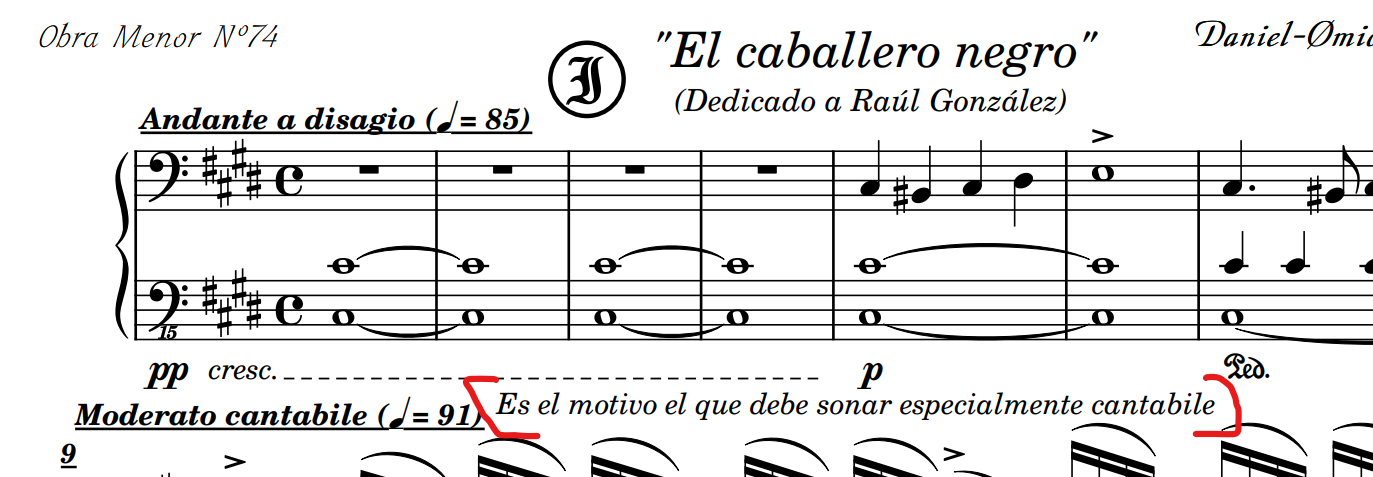
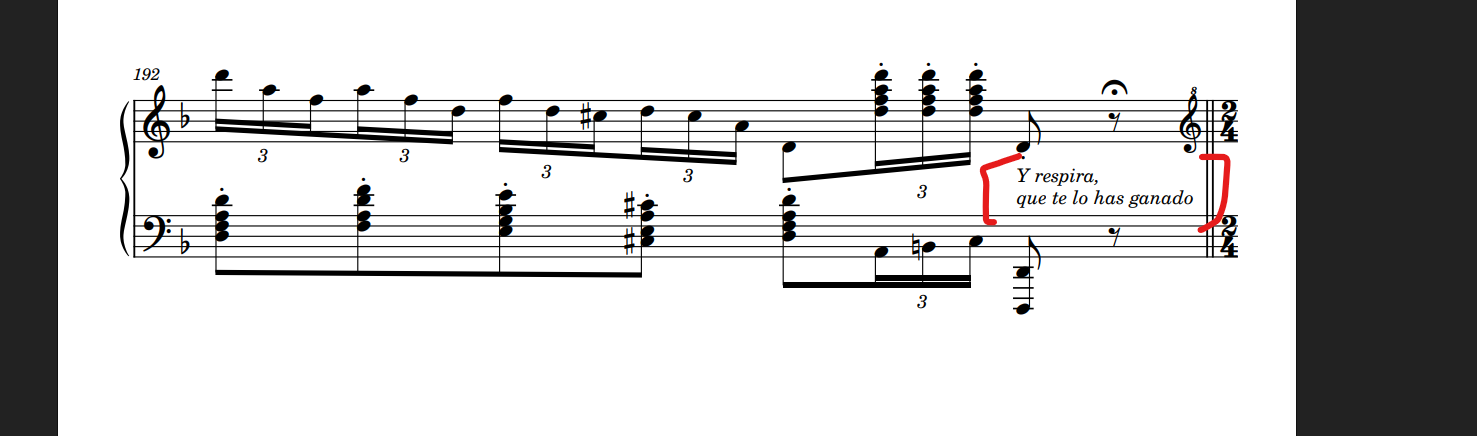
1 pointI made it using Stable Diffusion v2.1 & some Paint.NET to correct things here and there (though not all, I had no time to). I wouldn't mind writing it in Italian despite it being less known, but I think it's alright to do it in your native language even if it's not English. I have seen German and Spanish, and I myself use Spanish: That's an example, hope it suffices. As you see I apply it as any other indication, but I tend to write everything in italian unless it's a longer sentence like the one above. In my "big" piano works like that one and the prior one I also tend to write some text after a certain movement or the whole piece (and in the latter case, some paragraphs), but that's probably out of the question. For example too, in my sonata Nº2 I textually compliment the performer after finishing the 2nd movement. Ngl probably nobody will go through that if there's not a big bag of money behind. Hope that was clarifying enough and not too dense. Again I have shared your piece in my twitter and it seems it got two likes which is like 3 more than my average. Finally: • You can use the image I made freely if you want to. • I've just seen that you submitted another piece in this post. I'll definitely have a look whenever my free time gets less scarcer. Kind regards ^^!
 1 point
 -
1 pointAh, it's been awhile since I've heard your cues. Still as awesome as you were a few years back when I last heard your work. Thanks for sharing!1 point
-
Miniature I.pdf Miniature I.mp31 point
-
1 pointFor starters, I want to apologize if this is in the wrong subforum. I'm debating on starting a masterclass that will cover a few topics: Modern Counterpoint Technique: Motivic interplay, Dissonant Counterpoint Modern Musical Forms and Microforms Modern Development I might add a few more topics in here. These are pretty vague, umbrella topics. What I'd like to know is if anyone would find merit in learning these topics within a forum masterclass? My idea would be to start with the contrapuntal techniques. I'd provide a short theme snippet of say 5 or 6 notes. Students would be able to take these 6 note themes and extrapolate motivic units that they would then utilize within a contrapuntal texture. Analysis would occur within the forum and the student would learn the various techniques available to develop further contrapuntal material from this material. Anyone interested?1 point
-
1 point
-
Not a bad miniature. I love seeing people move out of the box and try something new. That said, this style -as you can probably attest- isn't easy to compose in. The removal of a tonal anchor removes formulaic structuring of musical material. We are accustomed to hearing music in terms of t-d relationships, harmony that assumes a purely functional role, and melodic contours that fit interchangeably within the aforementioned musical roles. In writing music like this, there's a few things that I've discovered in my own musical pursuits: 1. It's important to give the listener something to latch onto. Your opening 3 measures lay out 3 distinct motivic units coupled together into a short melodic snippet. This snippet is memorable and definitely something one can look for within your textures. When I compose in this style, I've learned to take these snippets and develop them within the texture. This also allows you to venture further into more eclectic arenas by being able to incorporate diverse styles -almost similar to how composers treated the Theme and Variations form. 2. Some techniques are cliche. I hate using the term cliche when it comes to this aesthetic of music. However, I found that rhythm is one of the easiest facets of music to play around with. You can literally make anything sound amazing with the right rhythmic undertones. Oftentimes, many who write this style of music will over rely on rhythm to compensate for other musical deficiencies. As I mentioned above, you have to keep the listener engaged -and when the other musical facets are difficult to maintain... rhythm is an easy go to. That said, I like the rhythmic punctuation in mm. 23 - 34. I also like that it seemed to play with the descendingmaterial from mm. 10-11. However, it didn't seem to congeal with the remainder of the miniature. It certainly isn't a driving force behind it. Perhaps you can transition into this material or overshadow it in the Lento section? 3. Color, Color, Color! Moving away from tonality removes mostly predetermined colorations to the material. We know that the further away from a tonal center, the more tense the music will get. Adding chromaticism also increases the tension in often colorful ways. In this type of music, 'texture' and 'form' become the tools that you'll want to use to bring life and color to your work. It shouldn't just be dissonant for dissonance's sake (though, believe me, I do write works that have that sole purpose). What I mean is that dissonance is just like any other tool. It's something there to add coloration to your material. The bass line beginning at measure 7 is what brings this point up. The motion here seems to move from an ethereal to plodding manner -that doesn't seem to accentuate the right hand. I'd look at perhaps playing with the right hand material in the left hand. Offsetting rhythms, perhaps gentle punctuations of the offbeat chord, or even just suspended contrapuntal material here would bring out that retrograded material in the right hand. Goal is here to add color to your material that fits the material. I hope these points help. I'd love to see you do more of these and try to push your envelope further in this aesthetic. Nice foray!1 point
-
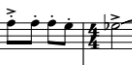
Hey glad to see you join here from reddit! This miniature shows great motivic unity, and I love the experimental nature of this. I like how you repeat this cell throughout the piece: You also recapitulate certain phrases like the one at the very beginning which gets repeated a half step higher at bar 17. This is a very abstact style of composing music - very much like a concept art kind of piece where the composer is guided by conceptual motivic ideas rather than by sound. How did you write this? Do you work in a DAW, notation program, on paper, or in front of a piano? Thanks for sharing!
 1 point
 -
1 pointDear @ComposedBySam, My opinion is the same as @Luis Hernández that it is a ternary movement! Nice three part structure and voice exchange in b.49! When the music modultates into b.69, it gives me the feeling of @Omicronrg9, cool and chic! However I don't think the appoggiatura in b.72 can be played without a mess of pedal sound. Nice change of texture in the next section For the recording itself is it played by yourself? It's always great to have real sound here, let alone the one played by composer himself! But I think the right hand is somewhat low in volume, making the melody less clear. In 0:58 it seems it should be octaves in the right hand, rather than only one note in the melody. Overall a beautiful movement! Many lovely moments and sounds! Henry1 point
-
1 pointI'm always on @Left Unexplained's case for writing such short sketches! Short and sweet is sometimes warranted, but a beautiful piece like this deserves to get a little more "run time". I would love to see you expand on this. But I absolutely love the counterpoint in the first half of the piece. I know you said offline that this was meant to be a contrapuntal study (should be in the description of this piece so we have more context!), so I was hoping you would have expanded more on that, especially during the second half. Regarding the audio in 2nd half, it gets a bit too loud for my ears, and I had to lower my volume halfway through the piece. The theme is really great though, and I found myself humming the theme in my head.1 point
-
1 pointA remarkable work - grand, powerful and with some great twists to the harmony. What strikes me foremost are: it builds up to a climax that portrays vastness, power and solidity; and it flows coherently beginning to end. Good balance too, your awareness of how the brass at ff will drown almost everything else out. That's how it is with orchestras and full tuttis. It would have been nice to see a score just to see what you were doing here and there but...a good listen all the same. Cheers.1 point
-
1 pointQuite good first part (I only got a bit tired of the Alberti bass...) I like even more the adagio, very elegant and beautiful. The ritardo 7-1 (C#-D) is very unstable.1 point
-
1 pointDear @Willibald, First movement: This is a good galant style sonata movement like those of Scarlatti! Nice use of ornaments. I think changing some of the quavers can be more non-legato though to reflect the style. Secons movement: Good use of the three part in b.17-21! Just find a little bit weird in b.12 when F# is resolved in R.H. but reappears in L.H.. Third movement: A lovely dance movement! I think b.9-10 quite weird to have a D minor cadence even it's temporarily in C major, and then directly returns to G major. Nice use of bassline at the beginning of the Trio! It's also nice to end with a minuet to a light styled sonata. Overall I enjoy this galant style Sonata! Great job! Henry1 point
-
1 pointOh it's weird but lovely to be complimented in other members' post!1 point
-
1. Use of composition software, sound samples etc. This has become something like a necessity for composers at present. It would be great to learn more than we know and to cover things beyond the basics (while covering/reviewing the basics also). 2. Composing in sonata form and the other large forms with practical examples or exercises. 3. Theory, harmony, counterpoint as general topics and different aspects of them. 4. Orchestration, and discussing (the orchestration of) various classics from the orchestral repertoire.1 point
-
Topics on contemporary techniques: New scales, new modes, mixing modes, modes of limited transposition Composing with interval sets Working with rhythm: polyrhythm, addition, odd meter, no meter, non retrogradable rhythm Extended triad techniques: non functional triads, parallelism, planing, stasis New Forms: Fibonacci series, mosaic form, cagean structures Indetrminacy: chance music, graphic notation etc...1 point




.thumb.png.8b5b433a341551e913a34392660bc95b.png)