
Leaderboard

.thumb.png.8b5b433a341551e913a34392660bc95b.png)

Popular Content
Showing content with the highest reputation on 01/07/2026 in all areas
-
1 point
-
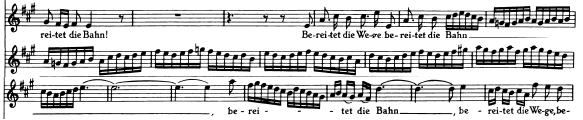
I forgot to add this last time, but I thought of this (infamous) aria when the breathing problem was mentioned. In addition, for historical reasons, this cantata is usually transposed up a semitone as opposed to down. Just look at the tessitura of this melisma! Bach must've really hated the poor soprano who had to sing this...
 1 point
 -
Happy New Year to all! For my first post of 2026, here's my orchestration of Medelssohn's Barcarolle from Songs Without Words. It's more or less done; though I may add more dynamics to match the original piano work, and need to add more slurs. Current dynamics are intended for midi playback: so I will be adjusting those for real life performance. Haven't decided where to mark a2 and solo in the winds: so any tips on that would be really helpful.1 point
-
Hi @Willibald! I just check out the 4th movement and it’s a lively nice rondo, I like your B minor episode inviting some contrast. Thx for your update! Henry1 point
-
Hi everyone! This is my sonata for piano and alto saxophone, which I composed over this summer as a birthday gift for my mom (born on Halloween!) Below you'll find my own formal analysis of the work to help parse a piece that even I find a little bit dense. The analysis will focus on the most complex movement, the third, so if a more thorough explanation of the first two movements is wanted I'll edit this post to include theme here. Please bear in mind that there are passages in this piece which are meant to be played completely freely from a rhythmic standpoint, and MIDI simply can't simulate that. Thank you for listening and providing your thoughts on this piece, it's something I spent a lot of time and energy on. Analysis: My Sonata for Piano and Saxophone in Eb major is cast in three movements. The last two are played without a break. The first movement is in a free form based on tempo transformation. (It’s essentially the form of the third movement of Brahms’ second symphony). The second movement, Romanza, is a simple, ternary form in Bb with an F minor middle section. It’s very beautiful but harmonically slightly troubled, somewhat unstable. The movement plays without a break into the third. The third movement is in a freely reworked version of sonata form. There is a slow, dramatic introduction for the piano alone which moves through various keys from F# minor to Eb major. Then follows “Cavatina I” a ternary form subsection. The A section of this is a pastoral tune in Ab minor over a pedal Ab. This then gives way to the B section, a modally ambiguous march. Then the A section returns. This gives way to “Fuga I” which is a fugue in Gb major over a Db pedal point (lasting almost the entire three and a half minute long fugue). This fugue is more dramatic than rhetorical, climaxing with an episode in Gb minor which is subverted into “Cavatina II”. This is the same music as Cavatina I, but formally inverted (the A section becomes the B section and vice versa). The march is heard in a more ornamental form for the piano alone. Then the pastoral tune, this time in Gb major over a pedal fifth in the bass of the piano. The march returns and leads directly into “Fuga II” This fugue uses as its subject a transformed version of the subject of Fuga I, itself a transformation and combination of the first movement’s “seed motive” (Eb - C - G - Bb - F - Eb) and the pastoral tune. This fugue is highly metrically complex, representing a transition and conflict between the considerable amount of 6/8 music, and the common time of the section that follows. The final passage of the finale is a chorale. The chorale introduces new melodic material (actually built from intervalic material from the introduction, which is a transformation of the first movement seed motive), but the harmony under it was carefully constructed: the entire finale is an elaboration on the harmonic progression (F# minor - D# diminished - Ab minor - Eb minor - Gb major - Bb minor - Eb major) heard in the introduction of the movement. The chorale is just another restatement of that harmonic progression, reaffirming the journey back to Eb major for the third time in the movement. The chorale-coda also gradually introduces a new rhythmic cell which crystallizes over the course of the passage, resulting in the final Eb major chords of the movement being sounded in the following rhythm: eighth note - dotted quarter - half note - dotted quarter - eighth note (- half note). This is a rhythmic palindrome, mirroring the harmonic palindrome which comprises the structure of the sonata as a whole.1 point
-
Hi @mercurypickles! For the first movement even without reading your description (I haven’t) it sounds so Brahmsian with the 2 against 3 and the Brahmsian Scherzo section, as well as the thick and more contrapuntal texture. It can well be a Clarinet Sonata if the saxophone is played with a Clarinet! (I’m thinking of Brahms’s 2 late Clarinet sonatas.) I really like the Scherzo sections with its energy. For the 2nd movement again both Schumannesque and Brahmsian, and b.28 even reminds me of Chopin’s Polonaise Fantasy where he has a similar figuration. The 3rd movement is exciting and I love the complex rhythm as you say the most. For me both fugues are more rhythmic than contrapuntal because there’s at a least a voice playing the ostinato instead of individual voices, but that doesn’t undermine it given how complex the rhythm is! Thx for sharing! Henry1 point
-
Google says that some Alto Flutes have a B foot joint allowing them to reach that low concert F# but it's not standard. Edit: Perhaps a Bass Flute could be used if the G major one were sought after. Or you could transpose it up an octave.1 point
-
This is the final draft of my best work up to date in my life, String Sextet in G flat major. Posts of seperate movements have been posted before and I'm not gonna repeat it here. If you're interested in the music details, pls check the following YCs: 1st Mov: 2nd mov: Here is the score and YT link of the work: String Sextet in G flat major.pdf Here is the structure of the work: (*denotes parts I love). The two movement structure is inspired by Mahler's 8th Symphony, so the second movement is proportionally much longer than 1st movement: 0:00 Opening credit and structure 0:11 1st Mov, 1st Part: Tao Primo (*3:35-3:47 nice bridge, **4:40-5:26 nice chromatics) 5:34 1st Mov, 2nd Part: Minore, a fugato, some little challenges (**9:40-10:10 nice retransition) 10:10 1st Mov, 3rd Part: Tao Return, a triple fugue and ending (falsely) (*11:45, **12:46 till the end) 14:48 2nd Mov, Lamentoso: Denial of Tao and realization of the realistic World full of tragedies. (*16:54, *19:11, ***19:44 sounds like my version of Bee's op.131 finale!, ***23:38-25:15 most emotional passage for me) 26:33 2nd Mov, Fugue a6: Objectification of emotions and reason. The most difficult passage for me to write technically but easiest emotionally. (**28:10-28:42 includes a 6 part stretto of 1st subject and a nice C minor modultation quoting my own Clarinet Quintet, ****30:07-31:27 a 6 part stretto of 2nd subject and one of my fav. section in the entire work with the very beautiful C minor passage, ***32:58-34:31 nice turn to pentatonics and nice disappointment) 35:03 2nd Mov, The Return. Start picking up the real self and soul and connect oneself with Tao, finding self equals to finding Tao. “I Six Books explain me and I explain Six Books (Lu Jiuyuan)”(*35:03-35:36 try to regain energy, **37:05,37:37,38:11,38:43 Nice color, **39:12 nice folk melody, ***39:15-40:15 Nice pizz.! And a very nice snap pizz! **** 40:46-41:46This passage leaves me in wonder. I don't know how do I compose this, **42:17-43:23 Nice appetizer fugato, ****43:24-44:53 Grand Climax!, ***44:54-45:41 Nice heterophonic passage which ignites my creative power for this movement, *****45:42 till end Pefect ending) This work was first inspired by Chinese Philosopher Tang Chun I's Realm of Heavenly Morality in his monumental book, The Existence of Life and the World of Spirituality, in April 2022. I wanna felt and descibed it hence I finished the whole 1st mov. I thought it's enough, until I met with my dedicatee Johnson, my respected philosophy professor Dr. Tao and my friend Merina in April 2023, and I knew it's not enough since without pain Tao isn't possible at all. After some painful incidents in 2024, I am finally able to finish the whole piece in March 2025. For me this work is about Tao, Tao lost and Tao regained. Since this would be the final post on the Sextet, please let me acknowledge people I would like to thank along my way of composing. This work is dedicated to and in memoriam Mr. Johnson Ho https://youtube.com/@beingintheworld?si=9Ch3hnk1UtluHTRF who sadly passed away in July 2024, and it's a regret the work couldn't be finished when he's alive. I would like to thank him for his great inspiration especially his postive way to deal with his illness. I would like to thank Dr. Tao, without his teaching esp. the one on the book Buddha-nature and Prajñā (?) did I realise the importance of pain and human suffering to morality and humanity, and probably won't have enough philosophical basis for this work. I would like to thank Mr. Vince Meyer @Thatguy v2.0, who acts as my musical Virgil, providing so many inspiration particularly in this piece's fugue and different motivic usage, and also make this great recording. Also, thank him for his encouragement when I kept saying I could never finish this piece. I would like to thank Dr. David Goza http://www.youtube.com/@David_Goza ,without his videos on YT I would never able to improve my own writing. I would like to thank Merina, Yvonne, Arjuna @expert21 and Peter @PeterthePapercomPoser for staying with me in my difficult times. I would like to thank Mike @chopin for his idea to go back to medieval texture in the Return. I would like to thank Luis @Luis Hernández which helps me solve the harmonic progression btw tritiones. I would also like to thank my ex-boss's mistreatment, as she teaches me a great lesson and the pain helps me reflect a lot which shows here. Also, thanks to everyone who has listen to this piece before and comments, as they help me a lot. Thank you Young Composers Forum and @chopin for giving me a chance to grow musically. Thank you for everyone who has commented on the work's parts before, I especially love the comments by @Fugax Contrapunctus @Giacomo925. Last but most importantly, I would like to thank my mum and family. Without their love I would probably fall much deeper and won't be able to finish this piece at all. Thank you!! P.S. One interesting fact on the piece is that it stays longer in F sharp minor then G flat Major….. Henry1 point
-
I realize I'm quite late to the party on this piece, but I wrote up a running log of my thoughts as I listened to this. Henry, this is the best piece I've come across on this forum. First of all, kudos to you for taking on a piece like Mahler's Eighth for formal inspiration - I've attempted such a thing myself and have nothing to show for it. The first movement's unification of pentatonic and chromatic harmony is quite unusual in sound, it strikes me as being somewhat similar to Dvorak's "Wagnerian" period - around the time of his third string quartet's composition. Anyway, there are many striking aspects to this movement; one thing I can't help but notice is your use of recurring textures. Even when motivic material itself may not recur necessarily, the settings that those motives were heard in are recast and developed in increasingly colourful ways so the whole thing hangs together anyway. The pizzicato passage at about 8:00 is one such example. That said, I would be curious to see the result of potentially stripping back just some of the figuration around the end of the first movement - I wonder if it might help clarify the polyphony in the final triple fugue. It is very beautiful as written though! Okay, second mvoement: This introduction is suitably mysterious, and at the Agitato the music takes on a nicely turbulent affect. The counterpoint here is quite rich, and I almost wonder if perhaps a little more time could've been taken before the lines came into full effect. I wonder, have you listened to the 0th and 2nd string quartets by Arnold Schoenberg? You may find some interesting common ground with him. As you noted, the passage beginning at 23:38 is extremely special, I can hear the intensity of the feeling behind it quite clearly. You communicate your thoughts very well in this piece - it is perfectly followable from beginning to end and never wastes a moment. One final thought, have you considered orchestrating this? I think some of my little things about the density of the texture could be greatly improved with a little more breathing room in the ensemble. Not to mention it would bring out many of the fabulous colours of the piece in even more vivid detail. In short, thank you, Henry, for sharing this with us. This is a wonderful work that deserves to be performed. I would like to also thank you for all of the feedback you have offered on my music over the last few years - you've been a real voice of encouragement. (P.S. I see you also cited David Goza as an important influence in your initial post, his videos have been massively helpful to me as well!)1 point
-
Hi @Crescent Roulade! Just a personal preference but I will put it in Db major for a calmer atmosphere. One thing to consider is that, if you really want to use flute as the solo instrument, the G major one contains notes lower than the middle C and won't be playable by the flute (not even an alto flute with the F#3). Henry1 point
-
That's covered by the "Musicologist" badge. Google: "Musicology is the scholarly study of music, exploring its history, cultural contexts, theory, and social impact, encompassing all musical traditions from classical to popular music, beyond just performance. It uses various methods, including analysis, history, and anthropology, to understand how music functions in life, its development over time, and its relationship with psychology, sociology, and other fields. Traditionally divided into historical, systematic, and ethnomusicology, modern musicology is broad and interdisciplinary, focusing on meaning, practices, and the "web of culture" surrounding music."1 point
-
@TristanTheTristan I can help you1 point
-
Thanks, @Henry Ng Tsz Kiu, for your kind words. I took up your suggestion and tried to compose a fitting end for this set. So without further ado: a draft for a fast-paced 2/4-Presto with the basic structure |: A :| b1 b2 b3 |: A : |: c1 : | c2 |: A :| The audio file needs some polishing. Any comments welcome.1 point
-
Good if we can cite sources meanwhile, as an amateur accompanist, I must allow audio deviations from the score such as improvisations and cadenzas though, illogical deviations should be regarded as suspicious0 points
.thumb.jpg.a1bd070fa88caa1c83527ffe77c97a41.jpg)


