Leaderboard
-
Luis Hernández
Members2Points3,401Posts -
Fugax Contrapunctus
Members1Points221Posts -
WowBroThatWasReallyEdgy
Members1Points52Posts -
johannhowitzer
Old Members1Points1,741Posts


Popular Content
Showing content with the highest reputation on 03/08/2026 in all areas
-
Since this is in essence a revised version of my earlier Enharmonic Perpetual Canon No. 3, whose single contrapuntal flaw replicated across all voices required a modification of an octave leap which ultimately ended up necessitating a transposition of the whole canon a perfect fourth higher, I decided to change the title of the entire series thus far to "Pantonal Perpetual Canons", as the previous title didn't quite serve as an accurate descriptor of the technicalities within the compositional process that gave rise to these pieces. Due to the necessary integral transposition of this work, however, the coda's newly resulting ending key (F-sharp/G-flat major), the only key along with its relative D-sharp/E-flat minor that displays an equal number of accidentals when enharmonized, far too many inconsistencies relating to the enharmonization of melodic intervals can be found in this version. Normally I would have managed to transcribe the melodic theme across all its internal transpositions in a way capable of satisfying apparent melodic continuity throughout the notation process, but due to the ambivalent quality of this key when it comes to enharmonization, not even the coda could be perfectly transcribed without far too many double accidentals. As such, as much as it irks me to see it like this, I have had no choice but to leave the currently notated version of this canon as is. The choral lyrics of this canon (once again, in Latin) translate as follows: "Change is inevitable in all things. Everything flows in the balance of those who are tempestive." As for the coda, its own lyrics further drive the meaning of these aphorisms to greater clarity and realization. YouTube video link:1 point
-
1 point
-
https://flat.io/score/69ac2e0ec3fb848b0b1ba22e-rainbow-motif?sharingKey=c41a8a0ae1afde60e4d714077a6c63bf9c03d1373a7f7d3f7897743a5aa00cb69e393452925b590a859c557105db3d587e5a8dd6ced3488277ad205afa53e256 https://www.youtube.com/watch?v=E0Ux3ULOuAU Writing a triumphant 8-bar intro in the style of Rainbow Road themes. Tried to vary up the melody and bass rhythms so it doesn't come off as Legally Distinct Rainbow Road. I really like how the descending notes in measure 4 shift to a bit of minor, underlining the return to tonic in measure 5. And the left hand jumps worked out better than I expected. Dunno how much I am a fan of that last flourish on the trumpet, but... on we go!1 point
-
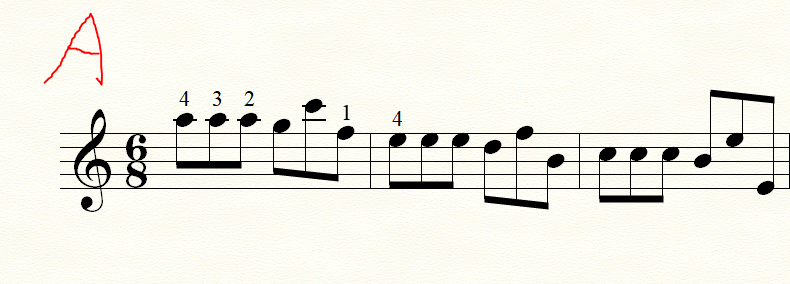
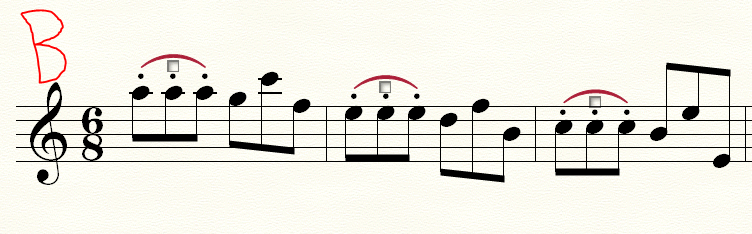
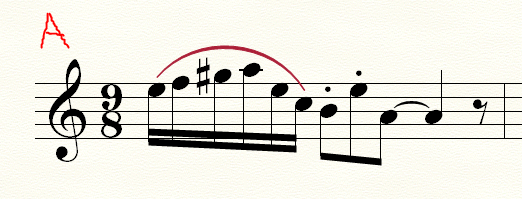
1 pointHi luderart, I am approaching your music as a performer. If I were sitting at the piano and you handed me this, these are the questions and suggestions I would have: 1) The first thing that stands out to me is the metronome marking. You indicate the quarter note receives the beat at 140 beats per minute. Yet, your starting time signature is 6/8. You need to indicate what the dotted quarter note receives. 2) The writing is pianistic; I can play this and it fits in my hands well. However, adding fingerings, articulations, and music shapes would prove your technical intentions. Example A demonstrates a finger alternation technique. Chopin's Grand Waltz Brillante, Op. 18, is a good example of this technique. Example B tells me to use the same finger on the repeated notes. 3) Measure 14 is slightly confusing because of the way it's presented to me. The time signature is now 9/8 and I have a dotted quarter note on beat 6, not 7. You also have a staccato marking on the dotted quarter note. Did you want it to be short? Example A depicts the music as you've written it, but with a display in accordance with the meter of 9/8. Example B depicts the note on beat 6 as short. I hope my approach finds some consideration with you, Patrick
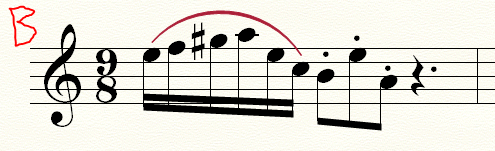 1 point
 -
Hello, I think it's a huge undertaking. In particular, it's very well structured and the themes develop and evolve smoothly and beautifully. To me, it sounds like late classical or early romantic music. The solo violin part isn't particularly complicated (virtuoso). There are some things that strike me as rather strange. For example, the tessitura where the timpani appears is excessively high, although it seems to sound where it should (so I gather it is a question of notation). Sometimes the horn acts as a “bass” in a very (too much, I think) deep tessitura... when you have other instruments available. The indication Qleg (quasi legato?) appears in many places where it makes no sense (with separate notes and staccato). There is a tendency (logical at certain stages of one's training in orchestration) to use strings predominantly. In moments with orchestral weight, I think the bass (double bass) needs to be doubled, as it is what the ear hears least. On the other hand, when parts are played where sections are separated (wind or strings), the counterpoints can be heard very well. Good work.1 point