
Leaderboard
-
TristanTheTristan
Members3Points457Posts -
Wieland Handke
Members2Points151Posts -
chopin
Administrator2Points2,741Posts -
PeterthePapercomPoser
Admin1Points2,864Posts


.thumb.png.8b5b433a341551e913a34392660bc95b.png)
Popular Content
Showing content with the highest reputation on 03/22/2026 in all areas
-
1 pointIt's that time again! Time for another Young Composer's Musical Composition Competition and thanks to @TristanTheTristan who has instigated this poll! There are a few things we'd like the members to help us determine (and to help gauge the level of interest in another competition): 1) What should the competition be about? To write background music for one of @chopin 's Retry Bro's YouTube videos. Explanation: @chopin has a new YouTube channel! It's called Retry Bros. and consists of him playing Super Mario Maker levels and coming up with entertaining narration from Mario, Luigi, Princess Peach, Bowser, and other assorted characters. There's also a musical element. So far, Mike has come up with some clever lyrics and used AI to make realistic sounding songs that go along with the video. Now, where you would come in is that you'd be writing background music for one of @chopin 's new videos! To write some kind of autobiographical piece with a paragraph describing how the music portrays the autobiographical material. This one is @UncleRed99 's suggestion. The idea is to "write a piece that simply tells a story about your life, and something meaningful within it. Utilize complex elements to express emotion, tension, or any other desired emotional or mentally relatable expression. Provide a brief summary describing the root of the story being told." @Thatguy v2.0's proposal is for everyone to write a piece about their home landscape. This theme could be called "Landscapes - Soundscapes." @Henry Ng Tsz Kiu bestowed his theme proposal to me so I decided to include another theme in the options: "Sound Mimesis - Acoustic Anatomy". The idea is to use the instruments at your disposal to mimic sounds in your natural environment (although the sounds don't technically have to be created by nature - they could definitely be artificial sounds, but should be mimicked by acoustic instruments). My own idea is for the members to write M&M&M's - Mock-ups, Mash-ups and Medleys. The idea is for the members to take 2 or more preexisting themes from different genres of music and to make mash-ups and Medleys with them. 2) What kind of ensemble should the competitors be free to choose to write for? Solo piano/keyboard or solo polyphonic instrument (such as guitar or harp) One monophonic instrument accompanied by one polyphonic instrument Choice of mixed trio/quartet/quintet of individual instruments Chamber orchestra (string orchestra) Full orchestra 3) How many months should the competition span? (1 month, 2 months or 3 months) The duration of each piece should once again be between 3 - 7 minutes. Reviewing the entries will once again be spearheaded by the members/competitors at large. You are free to use the Official Competition Reviewing Template or you can review the entries in any way you see fit or create a template of your own making! There will be tiered "Ardent Reviewer" badges given out for this event: Featherweight Reviewer - for reviewing 33% of the entries submitted to the event Welterweight Reviewer - for reviewing 66% of the entries submitted to the event Heavyweight Reviewer - for reviewing 100% of the entries submitted to the event We are instituting a policy of not allowing any AI generated works in the competition. Because of this you will be required to detail how you created your piece and submit a PDF score or midi file for the perusal of the staff and members at large.1 point
-
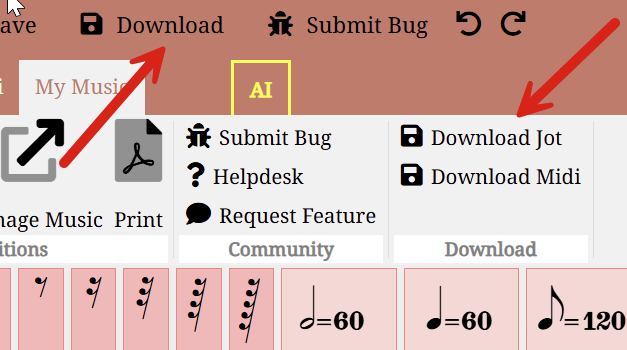
This part may be a bit confusing for first time users. I have 2 ways to export midi. As a jot file, and as a midi file. The jot file is actually the file you want to save and load back into Music Jotter. The midi file is the performance file, which is intended to be used in DAWS or other software. I strip it of all the formatting meta data so keep the files lightweight. Download the .jot file, load it back into Music Jotter, and see if that fixes your issue.
 1 point
 -
1 pointIt saves on every keystroke while you compose, it's like Google Docs; you can just download your midi file. But if basic composition isn't working for you, it could be a browser bug, so if this is the case, I would need more information about your browser. I've tested Music Jotter with Firefox and Chrome, and it should also work with Safari. Here's another trick...as long as your composition plays back, you know it has been saved, because saving your midi file happens before the playback compiles (behind the scenes).1 point
-
1 pointThanks everyone for your comments, I sincerely appreciate every one of them! As is ever the concern of a composer I'm very happy to know that the right mood/atmosphere came across to other people :) There seems to have been some discussion about the key and key signatures: I was never really a fan of music with all sorts of accidentals and black keys until I came across Scriabin, whose delight for the likes of F♯ major/D♯ minor, B major/G♯ minor, G♭ major/E♭ minor, and D♭ major/B♭ minor seems to have slightly rubbed off on me. Idk though, I felt like F♯ major gave off sweet lyrical romance (e.g. Poème op. 32/1 or Étude op. 42/4) vibes so I went with writing in that for this work. The key signature switch to G♭ major/E♭ minor was actually only a logistical sight-reading one, if I remember correctly. In the middle section there's some vacillation between a major key and its relative minor, which would have been fine for bars 9-12. However, I move a fourth lower in the following four bars, i.e. tonicising the dominant, which means that if I kept the original key signature I'd get C♯ major and its relative minor A♯ minor. Eek. Sharp overload. I am not quite sadistic enough to put that onto the performer, let alone F♭ major (though that has now given me an idea...). I figured that writing out the middle section in flats meant that I could resort to using natural signs rather than extra sharps in bars 13-16, but yo, @Luis Hernández and @Wieland Handke, you may have a point with it also engendering a somewhat darker mood, as I had intended. This is an excellent point, now that I'm poring through the score again. I think there are some spots (e.g. b. 12) where I quite like the arpeggiated quality, but I have also decided to add a few markings for spots where I think it is justifiable to have the other hand take a note or two. Was this what you were thinking of? Version with redistributions.pdf1 point
-
1 pointI like these ideas. Or at least some of them as that I could definitely do and feel motivated. I do have others just in case if something I wasn’t prepared got voted on and it’s probably still do things. Frankly, I prefer to do string orchestra works for things like these. But I’m open too many things.1 point
-
1 point
-
1 pointHallo @TristanTheTristan , Haha, F-flat major, a key with a double flat in its key signature … But thanks for the link; interestingly, it included some examples where composers actually used F-flat major, at least in certain passages or movements of their works. So you brought me to an idea: Since I have not yet composed my E-major fugue, there might be a spot where I could use F-flat major in a passage with a mood that calls for flats rather than sharps (I associate the mood of flats with „darker“ and „somber“, but also „warmer“ and „mellow“.) But to take it a step further, I should not use F-flat major, but F-flat lydian, so that I could make a key signature change in the score to seven flats in order to stay within the common range of usable accidentals. And the mood of F-flat lydian must be completely confusing: As „dark“ as possible due to the seven flats and „luminous“ at the same time, from the Lydian mode.1 point
-
1 pointI would argue sharps are more brilliant, flats are more ambient, and c major... is just nursery rhymes basically.1 point
-
1 point
-
1 pointI very enjoyed this dreamy prelude with its nocturne-like charm. What I was especially excited for is the tonality, e.g the use of both F-sharp major and G-flat major. (I mention this because my last recently posted composition is in G-flat major/F-sharp major, too, while not a prelude but a fugue …). I guess you’ve chosen that key change to emphasize the different nuances of mood in the piece, the sharps for the brighter passages and the flats for the melancholic ones. The texture is well balanced and I like that you decided to present the score with revealing the five-part movement. As you yourself noted, there are some large chords which are playable with arpeggiating only. When I’m looking at the score at the first glance, there are – beside the large chords – some intervals that seem to be uncomfortable to be played. However, many of them are playable when taking a note in the other hand. I would appreciate, if such situations would be written out or marked in the score (even if it would look somewhat cluttered) for an easier sight-reading experience.1 point
-
1 pointNice stuff. F Sharp?! Why? So many sharps! Anyways, taking a guess, the next thing you compose is in F Flat Major.1 point
-
1 pointIt’s a composition that sounds very harmonious and sweet. I haven’t taken the time to analyze it, but that middle section caught my attention (the key signature change).1 point
-
0 points